
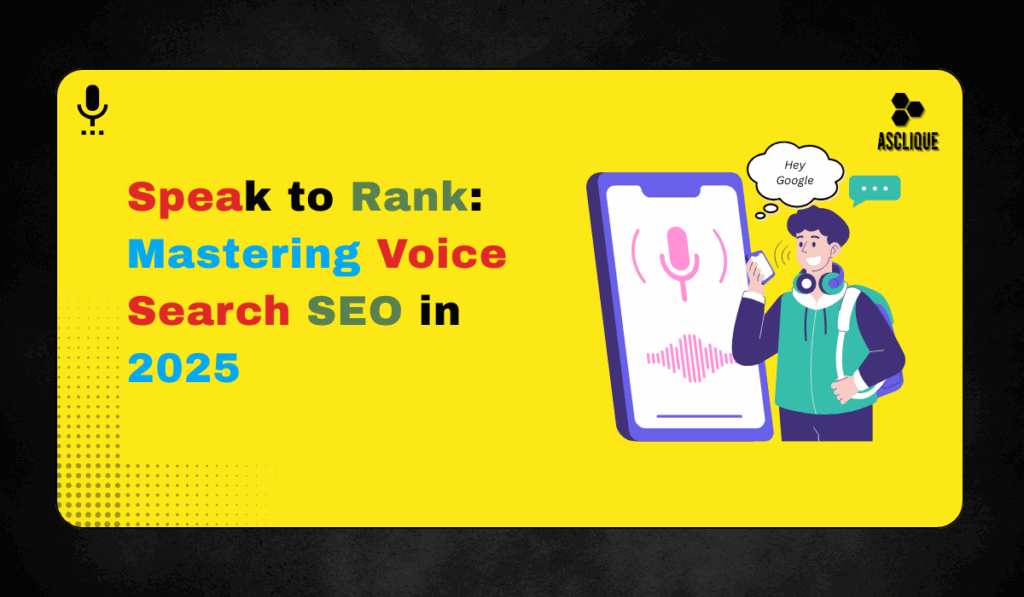
Voice Search SEO services are no longer just an option—they’re a necessity in today’s fast-evolving digital landscape. As smart assistants like Google Assistant, Alexa, and Siri become an integral part of everyday life, businesses must adapt to stay visible and competitive in 2025 and beyond.
If you’ve ever said, “Hey Google, what’s the best pizza place near me?”—you’ve already experienced the power of voice search. But as a website owner or digital marketer, the real question is: Is your content truly optimized to answer these voice-driven queries?
In this blog, we’ll walk you through everything you need to know about Voice Search SEO services, including how to optimize your website step by step for “Hey Google” queries in 2025.
What Is Voice Search SEO?
Voice Search SEO is the process of optimizing your content to appear in voice-based queries performed using virtual assistants like Google Assistant, Siri, Alexa, or Cortana. These queries are often in the form of questions and are more conversational compared to traditional search.
Instead of typing “best digital camera 2025”, users now say “Hey Google, what’s the best digital camera to buy in 2025?”
Optimizing for these voice search queries is about understanding user intent, writing question-based content, optimizing page speed, and ensuring your content is accurate and accessible.
Why Voice Search in 2025 Matters
Voice search has gone from being a novelty to a daily routine for millions of individuals. As of 2025, here’s why it’s more critical than ever for businesses:
- More than 60% of mobile phone users have tried voice search once, and that number is expanding each year.
- Almost 30% of all online search inquiries are becoming voice-based, which represents a seismic change in how individuals discover information.
- Smart speaker use within homes, such as Google Home and Amazon Alex,a is growing at double-digit percentages every year, becoming an integral part of daily life.
People no longer need to stop what they’re doing to type a query. Instead, they simply say, “Hey Google,” while cooking, driving, walking, or multitasking. This hands-free convenience means voice search is often the first choice for quick answers.
If your website or business isn’t optimized to respond to these spoken queries, you’re missing out on a fast-growing segment of search traffic—potential customers who are ready to act.
How Voice Search Is Different from Text Search
Understanding the difference between text and voice queries is key:
| Text Search | Voice Search |
| Short & keyword-based | Long & conversational |
| “Best pizza NYC” | “Hey Google, where can I get the best pizza near me?” |
| Often typed on desktops | Mostly spoken on mobile or smart speakers |
| Lacks emotion/intent | Has stronger user intent |
As you can see, voice search queries are longer, question-based, and location-driven.
Important Elements of Voice Search SEO Services
When you outsource to a Voice Search SEO service in 2025, you’re doing more than optimizing your rankings—you’re matching your online presence with the way people actually talk and search in 2025. A good service should prioritize the following key elements:
Conversational Keyword Research
Old school keywords aren’t enough for voice search. Humans speak to devices the same way they speak to fellow humans. A voice SEO provider must pay attention to long-tail, conversational language phrases that mimic actual human conversations. For instance, instead of going after “best plumber Mumbai,” your strategy must cover phrases such as “Who is the best plumber close to me in Mumbai?”
Structured Data Implementation
Google’s intelligent assistants heavily depend on structured data for realizing the content of a page. Using schema markup (such as FAQ schema, local business schema, and product schema) allows search engines to comprehend the intention of your content and get the opportunity to appear in voice results or featured snippets.
Local SEO Optimization
Voice searches tend to be location-based, like “Hey Google, search a salon near me” or “Where do I get flowers in Delhi?” That’s why local SEO is an important element of voice SEO services. This involves claiming and optimizing your Google Business Profile, maintaining consistent NAP (Name, Address, Phone), and optimizing for “near me” keywords throughout your site.
Content Rewriting for Featured Snippets
The majority of voice answers are taken from position zero—the featured snippet box. A decent service ought to enable you to reform your content into bite-sized, straightforward answers with the aid of bullet points, tables, and succinct headings. The aim is to make your content the most convenient and straightforward answer to typical voice questions.
Website Speed & Mobile Optimization
The majority of voice queries originate from smartphones or smart speakers. If your site is not mobile-friendly and designed for speed, users (and Google) will abandon ship. Voice SEO services guarantee that your site loads in less than 2 seconds, is responsive-designed, and provides a seamless mobile experience.
FAQs and Q&A-Based Content
Because voice searches tend to be in question format—such as “What is the most effective way to lose weight quickly?”—your content must deliver plain-speaking answers. Placing FAQ elements on every important page enables you to organically answer these voice-style questions. It’s one of the best methods to increase your chances of being chosen as a voice response.
How to Optimize for “Hey Google” Queries
If you wish your website to appear when a person utters, “Hey Google…”, follow these step-by-step instructions to make it so. These are actionable tips you can implement to make your content voice-search ready:
Step 1: Use Conversational Keywords
Consider the way people speak rather than the way they write. Voice search is more natural and conversational.
Example:
Whereas you would normally use the keyword “best Indian food,” use a phrase such as:
“What is the best Indian restaurant near me?”
Your content should sound like something someone would say out loud.
Step 2: Aim for Featured Snippets
Google often reads voice responses from the featured snippet—the top section of search results.
- To increase your chances:
- Add short, clear answers at the beginning of your content.
- Use bullet points, numbered lists, and tables when possible.
- Make it easy for Google to pick your answer.
Step 3: Add FAQ Sections
As voice search is based on questions, it makes a big difference to have an FAQ section on each important page.
- Use plain and straightforward questions such as:
- “How does this service work?”
- “Is this product available in my area?”
These replicate the way folks ask questions with Google Assistant or smart speakers.
Step 4: Enhance Page Speed
Nobody’s a fan of a slow website, least of all Google. Use resources such as:
- Google PageSpeed Insights
- GTmetrix
Ensure that your site loads within 2 seconds, particularly on mobile phones.
Step 5: Optimize Your Site for Mobile
The majority of voice searches occur on mobile phones. Your site needs to:
- Have a smooth performance on any screen size
- It is simple to use on mobile phones
Employ responsive design so that your site is excellent on phones and tablets.
Step 6: Implement Structured Data Markup
Structured data assists Google in better comprehension of your site. Use Schema.org markup to label significant elements of your content, such as:
- Business name and type
- Services
- Reviews
- Location
- FAQs
This will boost your likelihood of appearing in voice and rich search results.
Step 7: Claim and Optimize Your Google Business Profile
This is important for local voice searches such as “Hey Google, where’s the nearest salon?”
Ensure your Google Business Profile contains:
- The right business name
- Latest phone number
- The right address and opening hours
- Photos and reviews
When this information is correct, Google will be more likely to suggest your business.
Local SEO and Voice Search Go Hand in Hand
Google says that “Near me” searches have increased more than 500% in recent years. That is to say, people typically utter:
“Hey Google, locate a hair salon near me.”
So, local SEO becomes an essential aspect of voice search strategy.
To optimize:
- Employ city names and neighborhood keywords.
- Include location-based schema.
- Keep your Google Business Profile updated.
- Encourage customers to leave reviews with keywords in them.
Tools and Technologies to Help with Voice SEO
There are several helpful tools that can guide your voice search optimization strategy. These tools assist in keyword research, page speed improvement, structured data creation, and overall performance tracking.
Answer The Public – Generates real-world voice-like queries.
Semrush / Ahrefs – Discover long-tail and question-based keywords.
Google Search Console – Track how your pages rank in search.
Schema Markup Generator – Assist with the inclusion of structured data.
Google’s PageSpeed Insights – Optimize for speed.
Voice SEO Metrics You Should Track
Tracking the success of voice search can be challenging because platforms don’t provide direct voice data. Still, you can measure progress through tracking featured snippet rank, increasing “near me” and question-based keyword traffic, mobile visits, and local search visibility. These indicators indicate whether your site becomes voice-search friendly.
- More featured snippet visibility
- Local pack rankings improved
- Increase in “near me” keyword traffic
- Mobile traffic increases
- Question-based query impressions
- Improved dwell time and bounce rate
Although Google Analytics does not yet segment voice traffic, monitoring indirect metrics and user behavior can reflect success.
Industries Benefiting Most from Voice SEO
Though voice search optimization can be helpful to nearly any business, some businesses are more suited for voice queries naturally. Those tend to be businesses in which individuals require speedy, location-based, or service-based responses. Voice search typically serves users who seek quick answers or proximate options.
Restaurants & Cafes: “Hey Google, where can I find Chinese food close to me?”
Local Services (electricians, plumbers, doctors): “Hey Google, call a plumber close to me.”
Retail and eCommerce: “Hey Google, get me the best wireless earbuds deals.”
Travel & Hospitality: “Hey Google, reserve a hotel in Goa for this weekend.”
Real Estate: “Hey Google, list me houses for sale in Mumbai below 50 lakhs.”
If your business depends on quick or local decision-making, voice SEO is crucial.
Final Tips and Takeaways
By 2025, voice search will be mandatory, not optional. Consumers are demanding fast, verbal responses, and companies that pivot early will reign.
- Voice SEO Must-Haves Recap:
- Utilize long-tail conversational phrases.
- Create content that answers directly.
- Optimize your site to load fast and be mobile-friendly.
- Optimize for local search.
- Add FAQ and structured data.
- Monitor featured snippets and mobile traffic increases.
Conclusion
Voice search is no longer the future—it’s happening now. Whether you run a blog, an eCommerce site, or a local business, optimizing for “Hey Google” queries is essential to staying ahead in 2025.
If your current SEO strategy still revolves only around traditional text-based searches, it’s time for a shift. By leveraging the right Voice Search SEO services, you can tap into an entirely new way users interact with search engines—through natural conversation.
With a strong voice search optimization strategy in place, your business will not only keep up but stand out, ready to respond when your next customer says, “Hey Google…”
FAQ’s
Is voice search really that important for my business?
Yes! More people are asking Google out loud than ever before. If you’re not showing up, your competitors are.
How is voice SEO different from regular SEO?
Voice SEO focuses on how people talk, not just type. It’s more about questions and natural conversation.
What’s the easiest way to start optimizing for voice search?
Add an FAQ section with actual questions your customers have. It’s easy and effective.
Do I have to redesign my entire website for voice SEO?
Not at all. You simply need to modify the main pages, such as your homepage, service pages, and blog posts.
When can I expect results from voice SEO?
You can see the differences in 1–3 months, particularly if you are optimizing for local or “near me” searches.