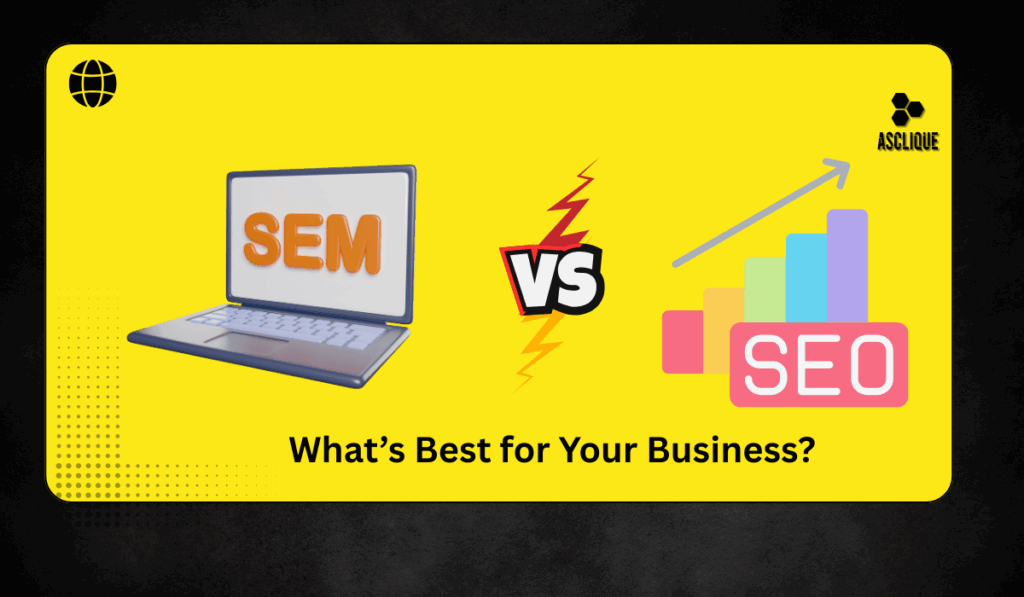
SEO vs SEM are two of the most powerful strategies in digital marketing, and in the digital era, online visibility can either make or break a business. Whether you’re a startup founder, small business owner, or marketing professional, understanding how to position your brand in search engines is essential. That’s where SEO (Search Engine Optimization) and SEM (Search Engine Marketing) come into play. While they may sound similar, SEO and SEM serve different purposes and require different strategies.
In this comprehensive guide, we’ll break down the definitions, distinctions, pros and cons, and best use cases for SEO vs SEM to guide you toward making the right choice for your business in 2025.
What Is SEO (Search Engine Optimization)?
Search Engine Optimization (SEO) is the process of improving your website’s content, architecture, and functionality to enable it to rank higher in free (organic) search engine listings. When effectively applied, SEO helps your web pages appear at the top of search results when potential customers search for specific keywords on platforms like Google, Bing, or Yahoo. For businesses targeting a specific geographic area, Local SEO plays a crucial role by optimizing your site to rank for location-based searches, helping you attract nearby customers and stand out in local search results, Google Maps, and mobile queries.
SEO involves a series of factors that are interconnected:
- Keyword Research: Learning what words and phrases your target audience is typing to search for products, services, or information relating to your business.
- On-Page SEO: Optimizing individual pages by modifying title tags, meta descriptions, header tags (H1, H2, etc.), keyword placement, internal linking, and image alt text to boost relevance and crawlability.
- Technical SEO: Ensuring that your site’s technical foundation is search engine crawler-friendly—this involves optimizing page speed, mobile usability, secure protocol (HTTPS), and structured data (schema markup).
- Off-Page SEO: Establishing your site’s authority and trust by gaining backlinks from good sites, increasing social signals, and having a solid online reputation.
SEO is an ongoing strategy that not only directs consistent, high-quality traffic to your site but also boosts user experience and builds credibility in the long term. Unlike paid campaigns that wither away once the money runs out, effective SEO continues to build visibility and drive leads many years later than when it was done.
What Is SEM (Search Engine Marketing)?
Search Engine Marketing (SEM) is paid internet promotion that allows businesses to appear in top positions on search engine results pages (SERPs). Interchangeably applied with Pay-Per-Click (PPC) ads, SEM aims to create instant traffic by displaying focused adverts when users input search terms.
Some of the most popular SEM sites include:
- Google Ads
- Microsoft Advertising (Bing Ads)
- Shopping Ads and Product Listings
- Display Ads via search networks
With SEM, advertisers bid on keywords, and when users search for those terms, ads appear at the top or bottom of the results page. You’re only charged when someone clicks your ad—hence the name Pay-Per-Click.
Unlike SEO, which builds up slowly with organic traffic, SEM can deliver instant visibility and quantifiable results, and it is hence best suited for product launches, time-limited promotions, or extremely competitive industries. It contains advanced targeting capabilities like location, device, and day of the week, allowing for very targeted campaigns.
But SEM traffic stops when the budget is exhausted, so it should be paired with a long-term SEO plan for sustainable growth.
Key Differences Between SEO and SEM
| Factor | SEO | SEM |
| Cost | Organic traffic is free, but SEO requires time and resources | Paid per click or impression |
| Time to See Results | Long-term; can take months | Immediate visibility |
| Placement | Below are ads in search results | Top of search results (ad section) |
| Targeting Options | Limited targeting | Precise targeting by location, device, time, etc. |
| Performance Tracking | Organic analytics (Google Search Console) | Detailed ad metrics (Google Ads dashboard) |
| Trust Factor | Users trust organic results more | Users may skip ads if they prefer organic results |
Advantages of SEO
Long-Term Value
After your website receives good rankings on search pages, it can continue to generate consistent organic traffic without the need for repeated advertising expenditure. Contrary to ads that stop generating leads when the budget is depleted, SEO generates results in the future. An optimized page can remain visible and relevant for months or even years, and thus SEO is a potent long-term business growth tool.
Greater Credibility
Users tend to trust organic search results over paid advertising. Having your site naturally rank on the first page of Google communicates to users that your site and content are authoritative and trustworthy. Such trust helps customers make decisions, particularly in competitive markets. The higher your site ranks for applicable searches, the more users trust your brand as reputable and legitimate.
Long-lasting ROI
SEO is one of the best return on investment in digital marketing. While it will take time and effort to build, the long-term yield is much higher than the investment cost. As your rankings improve and traffic increases, the cost of lead or sale decreases. You do not have to pay ongoing for every visitor, unlike pay-per-click marketing. Over time, this creates a scalable and cost-effective marketing channel.
Improved User Experience
Much of SEO involves having your website’s design, speed, mobile responsiveness, and overall experience be fantastic. Not only do these enhance how search engines can understand your site, but they also improve the user experience to be more refined and enjoyable. High-speed, easy-to-use, and great content websites will keep users around longer and have lower bounce rates—both of which benefit search rankings.
Brand Awareness
Positioning on a set of keywords, especially long-tail and information-based ones, exposes your brand. Even if users don’t click your link right away, repeated visibility in the results reinforces your brand in their memory. Over time, this yields greater brand recall, in-direct searches for your company name, and greater trust among potential customers. SEO not only directs traffic but also establishes your brand as a go-to authority in your category.
Disadvantages of SEO
Time-Consuming
SEO results aren’t instantaneous; in most cases, it takes 3 to 6 months or more to see real improvements. Building authority, acquiring backlinks, and content optimization all take time. This slow pace can be challenging to those businesses requiring quick results or short-term marketing goals.
Ongoing Algorithm Changes
Search engines like Google update their algorithms constantly to provide the user with improved and more relevant search results. Such updates sometimes inevitably lead to your website’s ranking changing, even if otherwise your content and SEO strategies had been functioning well. Staying current with these updates calls for steadfast alertness, adaptability, and sometimes a complete redesign of your SEO methods.
Needs Expertise
SEO is a complex practice that involves technical optimization, content strategy, keyword research, link building, and user experience. Achieving success with SEO typically requires thorough knowledge of how search engines work. Without professional advice or ample knowledge, it’s easy to make mistakes that hinder performance rather than improving it. It’s sometimes necessary to outsource skilled SEO specialists or SEO firms but often too costly for small companies.
Advantages of SEM
Immediacy of Visibility
One of the best advantages of SEM is the immediacy of results. You can get a campaign live and rank top of Google search within hours. This is great for new businesses, product launches, or offers that have finite time scales. Unlike SEO, which can take months, SEM is instant traffic and visibility to your marketplace.
Targeted Ads
SEM allows extremely targeted advertising on many different criteria such as location, interests, search history, device, language, time of day, and even previous interaction with your site. This kind of precision ensures your ads are being shown to the most relevant users, which translates to better conversion opportunities. You can even create custom audiences and retarget previous users who have visited your site.
Flexible Budgeting
Regardless of whether your budget is tight or loose, SEM sites like Google Ads allow you to place budget limits that suit your business best. Users can start as little as $10 a day to start and move up based on performance. Scalability makes SEM accessible to startups and scalable to large corporations. Also, you only pay when someone clicks your ad, which means that every dollar is for results.
Transparent Data Insights
In SEM, you see real-time data and performance metrics like impressions, clicks, click-through rate (CTR), conversions, cost per click (CPC), and return on investment (ROI). These data insights allow you to understand what works and what does not and make wise decisions and optimize your campaigns for better results. The reporting level is far higher compared to most other marketing media.
Testing Capabilities
SEM platforms provide A/B testing, allowing you to test different headlines, ad copy, keywords, bidding strategies, and landing pages. Experiment with what works best and optimize accordingly. Testing helps refine conversion rates and run your campaigns more cost-efficiently in the long run. It’s a strategic means of discovering the likes and behavior of your audience.
Disadvantages of SEM
Recurring Costs
With SEM, your visibility is exactly equal to your wallet. The instant you switch off ads, your search visibility disappears overnight. In the case of SEO, traffic can still keep coming years after the first effort has been made; with SEM, you have to keep it going by spending money continually. This makes it not as budget-friendly in the long term, especially for small companies with limited marketing budgets.
Ad Blindness
Most consumers have developed so-called “ad blindness”—they scroll right over upper ad sections of search results automatically. Even with an above-the-fold position, your ads may be skipped simply because users prefer organic results. This behavior can decrease your click-through rate (CTR), which has the implication that you pay for impressions without getting as much attention as you expect.
More Competition = Higher Cost
In competitive markets, bidding on high-demand keywords is very expensive. The Cost Per Click (CPC) charges skyrocket, especially in markets like insurance, law, or software. When multiple companies are competing over the same target market, you’ll pay higher costs to even be noticed. The intense competition here makes it difficult for small brands to compete effectively without spending their fortune.
When Should You Use SEO?
SEO is perfect for:
- Long-term brand establishment
- Creating evergreen content
- Establishing authority in your niche
- Businesses with small budgets for ads
- Pages with a focus on organic discovery
For instance, if you have an online store or a fitness blog that would like to rank for “organic protein powder” or “home workout routines,” SEO can produce steady, long-lasting traffic.
When to Use SEM?
SEM is suitable for:
- Revealing new offerings or services
- Scheduling time-sensitive promotions
- Local service-based businesses (e.g., dentists, plumbers)
- To test keyword performance
- To get immediate traffic
As an example, a new SaaS offering might have SEM ads running for “AI content generator” to get quick traction and leads and establish SEO authority while doing so.
Can SEO and SEM Co-Exist?
Yes! And indeed, a good marketing strategy should blend both SEO and SEM. SEO establishes long-term growth, and SEM is the rocket fuel. Below are the reasons why and how they go together:
- Employ SEM to experiment with high-converting keywords and then produce SEO-optimized content for them.
- Employ retargeting ads to individuals who visited your website from organic search.
- Employ SEM analytics data to tweak SEO tactics.
- Establish brand awareness quickly with SEM, then further reinforce it with SEO credibility.
How to Make the Decision: SEO or SEM?
Use this checklist to guide your decision:
| Consideration | Choose SEO If… | Choose SEM If… |
| Budget | You want sustainable, long-term results with low recurring costs | You have a flexible ad budget |
| Timeframe | You’re okay waiting months for traffic | You need leads immediately |
| Goals | You want to build brand trust & authority | You want quick exposure and conversions |
| Competition | You can compete in content quality | Your niche is too competitive for SEO |
| Team/Resources | You have access to content creators and SEO tools | You have a PPC expert or agency |
Future Trends: SEO and SEM 2025
As we progress further with AI-powered search engines and voice search, here’s what you can look forward to:
SEO Trends:
- More focus on E-E-A-T (Experience, Expertise, Authority, Trust)
- Content clusters and topic authority
- Human-edited AI-created SEO content
SEM Trends:
- Increased automation of bidding and ad placement
- Smarter audience segmentation through AI
- Search ads that use video are gaining traction
Shaking both strategies into your marketing mix will be the secret to future-proofing your brand.
Final Thoughts
In the age-old fight between SEO vs SEM, there is no clear victor—it all boils down to the specific needs, goals, budget, and timeframe of your company. If you require a long-term, lasting solution that builds credibility and generates steady organic traffic, SEO is your best option. However, if your priority is immediate visibility, quick experimentation, and laser-targeted campaigns, SEM is the way to go.
Ideally, the optimal approach is to leverage both. Using the long-term potential of SEO and the short-term power of SEM, you can produce maximum reach, conversions, and return on investment. Instead of pitting them against each other as competing approaches, look at SEO as the engine that powers your growth and SEM as the fuel that accelerates it. A tactical blend of both in the right proportions can create a highly effective and lasting digital presence for any business.
FAQ’s
What is cheaper in the long term: SEO or SEM?
When SEO vs SEM is compared, SEO is more cost-effective in the long run. Although SEM provides traffic immediately, it involves an ongoing ad budget. SEO takes months to come up with results, but still generates traffic without incurring ongoing expenses after your site is well-ranked.
Is SEM or SEO more appropriate for a new business?
They both are required but, for the instantaneous visibility and lead generation required for a new company, SEM is generally more suitable. In the SEO vs SEM debate, SEO takes more time to construct but offers long-term growth. New companies should use SEM initially to get traction and invest in SEO long-term.
Do I need to implement both SEO and SEM at the same time?
Of course! Indeed, using them both together is one of the best practices in internet marketing. When it comes to SEO vs SEM, remember that they are best used together—SEM provides you with immediate traffic and insights, while SEO builds long-term authority and trust.
How do I decide between SEO vs SEM for my business?
Look at your budget, schedule, and objectives. If you require instant benefits, SEM is for you. If you’re playing the long game and want to build a solid brand, SEO is better. Many companies employ both for the advantage of both.
Why is SEO more credible than SEM?
In the question of SEO vs SEM, SEO is the winner when it comes to trust because users prefer to trust organic results over pay-per-click advertisements. Appearing on page one organically signals credibility and authority, which are factors that influence positive user decisions.