
The rise of AI writing tools like ChatGPT, Claude, and Gemini has made content creation easier than ever—but it’s also raised serious questions about authenticity. Whether you’re an educator checking student work, a content creator protecting SEO rankings, or a business maintaining brand integrity, choosing the right AI detector is critical.
This guide examines seven leading AI detection tools, comparing their accuracy, features, and real-world performance to help you make an informed decision.
How AI Detection Technology Works
AI detectors analyze writing patterns that distinguish human text from machine-generated content. They examine several key factors:
Perplexity measures how predictable text is. AI-generated content tends to follow predictable patterns, while human writing shows more variety and unexpected word choices.
Burstiness tracks sentence length variation. Humans naturally write some long, complex sentences followed by shorter ones. AI typically produces more uniform sentence structures.
Linguistic Features include vocabulary diversity, syntactic patterns, and stylistic consistency. Advanced detectors analyze 100+ features simultaneously.
The most sophisticated tools use dual-model architectures combining traditional machine learning (analyzing statistical features) with deep learning transformers (understanding semantic meaning). This hybrid approach captures both surface patterns and deeper contextual nuances.
However, detection isn’t foolproof. AI models are trained on datasets of human and AI-generated text, meaning they can only identify patterns they’ve seen before. As AI writing improves, detection becomes more challenging—creating an ongoing arms race between generators and detectors.
Why AI Detection Matters
The implications of undetected AI content extend across multiple sectors:
In Education: Academic integrity depends on authentic student work. Undetected AI undermines learning outcomes, devalues degrees, and creates unfair advantages. Students who rely on AI without disclosure miss critical skill development.
For Publishers and SEO: Google and other search engines can penalize AI-generated content that lacks originality or value. Low-quality AI content harms rankings, reduces organic traffic, and damages brand credibility. Publishers need detection to maintain editorial standards.
In Business: Companies face legal and ethical risks from undisclosed AI content in proposals, reports, and client deliverables. Authentic content builds trust; discovered AI usage can destroy business relationships and reputation.
For Content Creators: Freelancers and agencies must verify work authenticity to maintain client relationships and competitive advantages. Detection protects against plagiarism accusations and ensures deliverable quality.
The stakes are real: students have been wrongly accused based on faulty detection, while others have graduated using undetected AI. Publishers have lost rankings due to AI content penalties. The right detection tool helps navigate these risks responsibly.
1. Detecting-AI: Best Overall AI Detector

Detecting-AI stands out by combining multiple detection engines into one platform, cross-referencing results from GPTZero, Originality.ai, and ZeroGPT. This multi-engine approach dramatically reduces false positives while maintaining 99%+ accuracy.
Key Features:
- 99% accuracy rate with <1% false positive rate
- 50+ languages including English, Spanish, German, Arabic, French, Portuguese
- Sentence-level highlighting showing exactly where AI was detected
- Advanced Paraphraser Shield detecting rewritten and humanized AI content
- Plagiarism detection integrated into the platform
- Fact-checking capabilities for content verification
- OCR technology analyzing text from images and scanned documents
- Content quality metrics for comprehensive analysis
- LMS integration compatible with major learning management systems
- Browser extension for seamless workflow integration
Why It’s Best Overall:
The multi-engine approach is Detecting-AI’s secret weapon. By combining results from multiple detectors, it catches what individual tools miss while filtering out false positives. The dual-model architecture uses XGBoost feature analysis alongside RoBERTa transformer models, analyzing 100+ linguistic features for unmatched reliability. However, this comprehensive feature set may be overwhelming for users who only need quick, basic detection—in those cases, simpler free tools like QuillBot might be more practical.
Best For: Anyone seeking the most complete AI detection solution with maximum accuracy and minimal false positives—particularly educators handling high-stakes assessments, content publishers protecting SEO rankings, and businesses requiring comprehensive content verification.
Pricing: Free tier available for testing; paid plans start at competitive rates for unlimited access with full feature suite.
2. Winston AI: Best for Academic Institutions
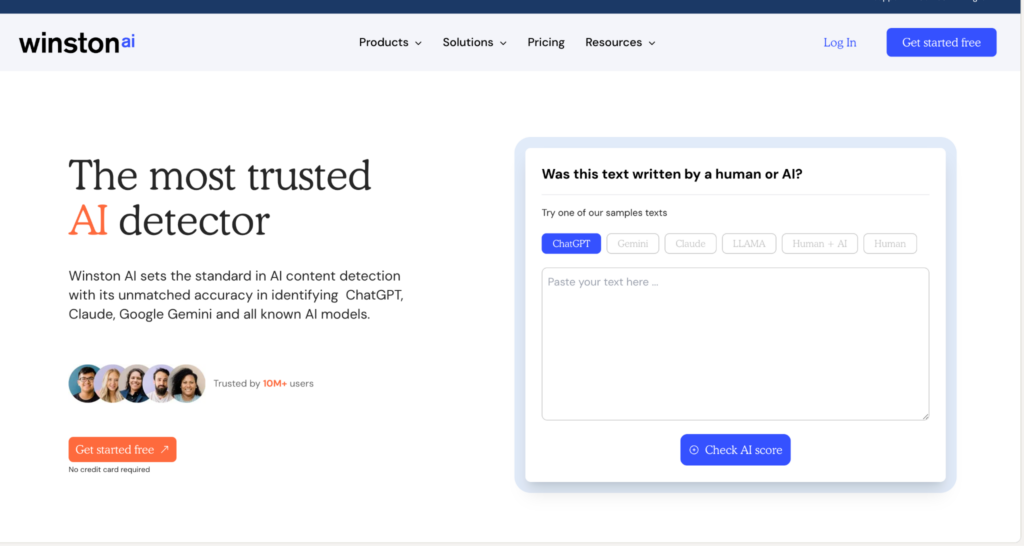
Winston AI claims 99.98% accuracy and targets academic institutions with detailed reporting and audit trails. The platform includes plagiarism detection, OCR for handwritten text, and support for 11 languages.
Key Features:
- AI prediction maps with color-coded visualization
- Batch document processing for multiple submissions
- OCR for printed and handwritten documents
- LMS integration for institutional workflows
- Paraphraser detection for modified content
Real-World Performance:
While Winston AI advertises exceptional accuracy, independent testing shows 42-70% accuracy depending on content type. This gap highlights why verification matters.
Best For: Universities requiring detailed documentation and institutional integration.
Pricing: Starting from ~$12-18/month; institutional licensing available.
3. GPTZero: Best for Educators

GPTZero is a widely used AI detector specifically designed for education, with a generous free tier and classroom-friendly interface. Testing shows approximately 78% accuracy—reliable for educational contexts.
Key Features:
- Chrome extension (Origin) for browser-based detection
- Writing report with detailed probability breakdown
- Canvas LMS integration for seamless workflows
- Batch file processing for multiple assignments
- Writing video feature visualizing creation process
Best For: Teachers wanting accessible, education-focused tools with generous free access.
Pricing: Free plan available; Premium starts at $14.99/month.
4. Walter Writes AI: Best for Content Teams Verifying AI-Assisted Drafts
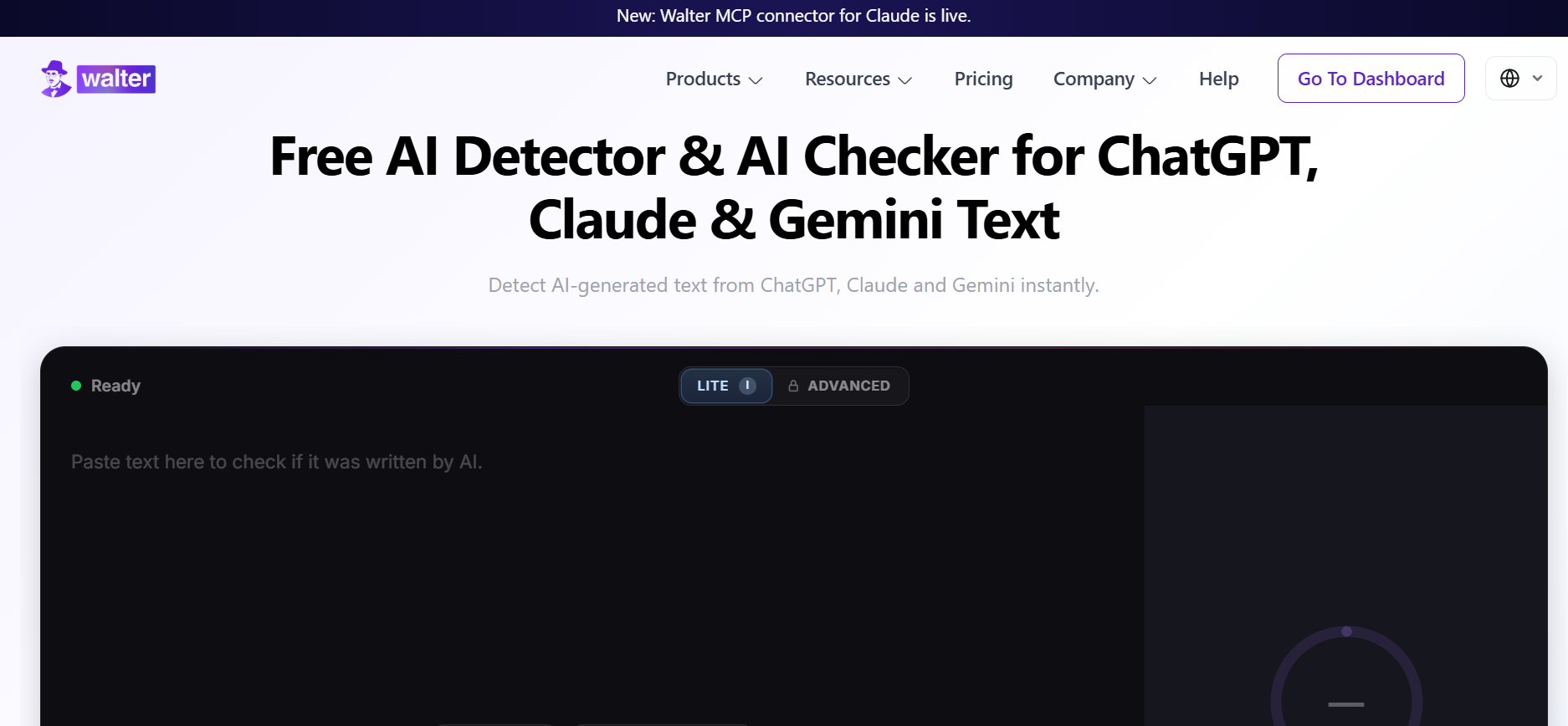
Walter Writes AI Checker is different from other AI detection tools because of its practical approach to detecting AI content. Unlike many academic-focused AI detection tools, which are used solely as standalone detectors, Walter Writes is a combination of an AI detector and humanizer (rewrite/verify) in one workflow.
Therefore, users can reword their flagged content and re-run results within one platform rather than having to switch between two. This makes it perfect for content teams, marketing teams, and SEO professionals who draft large amounts of AI-assisted drafts and need a reliable final check before they publish.
Key Features:
- Clear AI detection scoring for any submitted content
- Built-in humanizer so users can check, rewrite, and verify in one workflow
- Supports 80+ languages with automatic language detection
- Privacy-first handling — content is never stored or used for model training
- Free tier available with no credit card required
Best For: Content teams, marketers, and SEO professionals who produce AI-assisted content at volume and need a reliable detection check before publishing.
Pricing: Free tier available. Paid plans from ~$8–10/month.
5. Proofademic: Best for Academic AI Detection
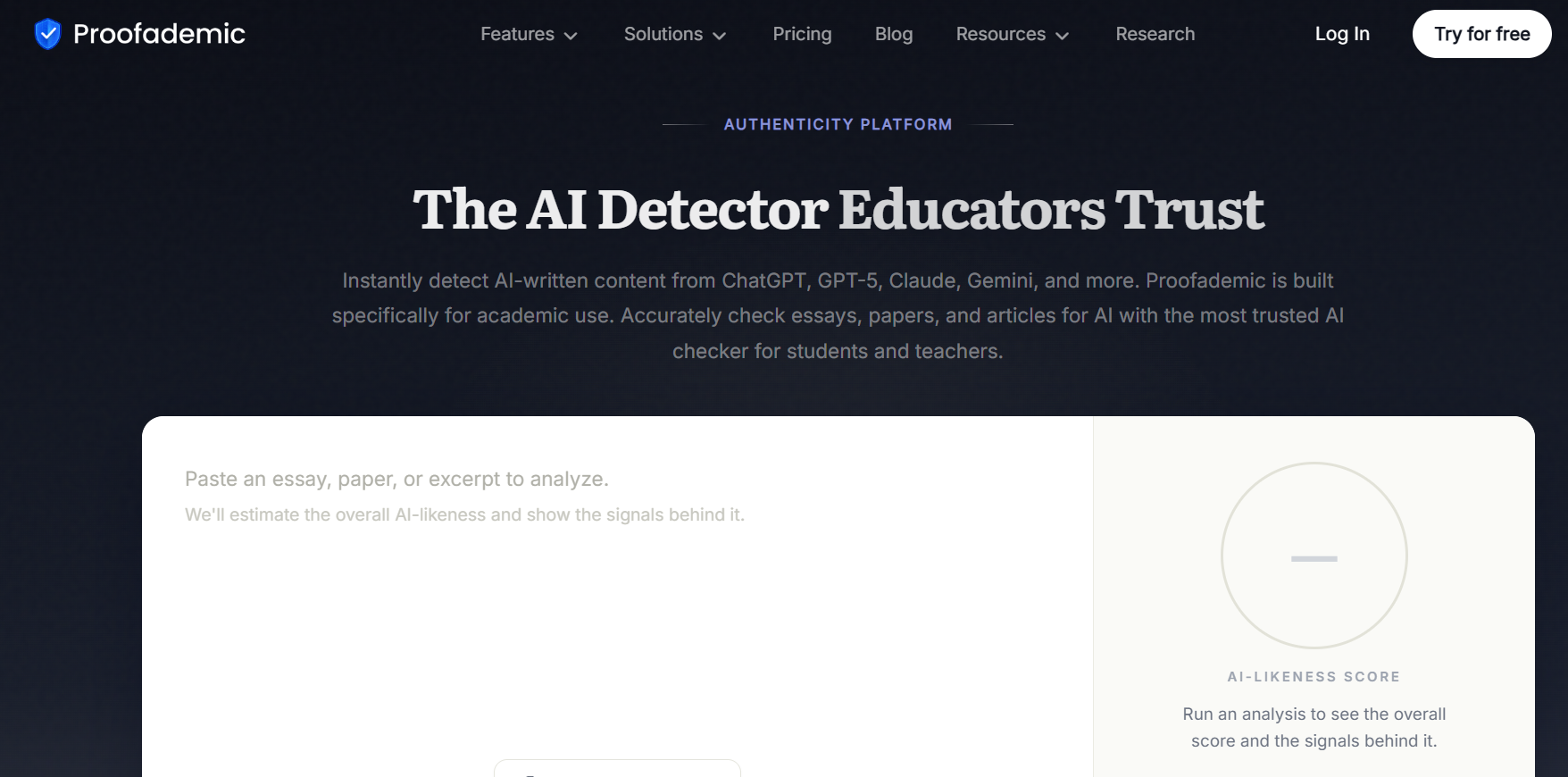
Proofademic AI is a custom-built AI Detection System, developed for academic writing environments such as schools, universities, colleges, research institutions, and academic publishers. Unlike general-purpose detectors, Proofademic was created to be used on formal academic writing styles, which include essays, research papers, dissertations, and lab reports. Due to this, it also provides far more accurate results within educational settings, where false positives can result in serious consequences.
Proofademic’s transparency at the sentence level allows users to see each sentence individually, along with a per-sentence confidence score using a color-coded heatmap (green = likely human-written; red = likely AI-generated). Additionally, this allows users to defend their results when reviewed by an institution or during a student appeal. The Paraphrase Shield feature allows users to detect content that has been rewritten or passed through tools designed to “humanize” content, helping to address one of the largest weaknesses of standard AI detectors.
Key Features:
- Sentence-level detection with per-sentence confidence scores and color-coded heatmap
- Paraphrase Shield for detecting humanized or paraphrased AI content
- Consistent results — running the same text twice returns the same output
- Plagiarism indicators included alongside AI detection scoring
- Batch scanning for educators reviewing entire class sets simultaneously
- Supports documents up to 25,000 words per scan via paste, .docx, or PDF
- 22 languages supported with ESL false-positive reduction
- Privacy-first — submissions never stored or used for model training
Best For: Educators, students, academic integrity offices, journal editors, and institutional reviewers who need defensible, sentence-level AI detection results for formal academic submissions.
Pricing: Free plan available with no credit card required. Paid plans from $8/month.
6. Originality.AI: Best for Content Publishers
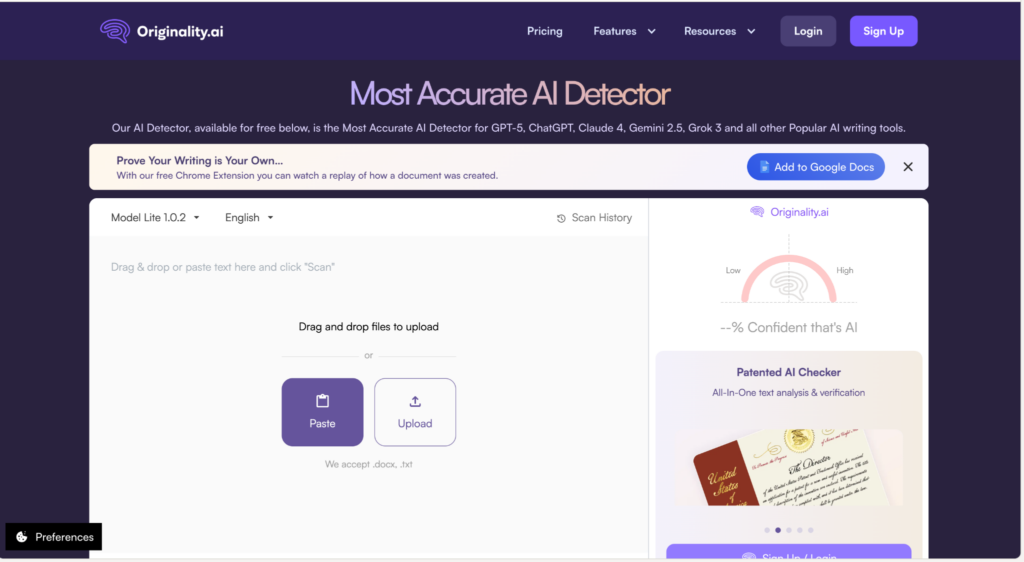
Originality.AI targets digital publishers with combined AI detection, plagiarism checking, and fact-verification. Testing shows 76-79% accuracy with 1-2% false positives.
Key Features:
- Content quality and readability scoring
- Fact-checking capabilities for accuracy verification
- Team collaboration tools for content teams
- API access for workflow integration
Best For: Content marketers and SEO professionals protecting organic rankings from AI content penalties.
Pricing: Pay-as-you-go at $0.01 per 100 words, or $14.95/month for 20,000 words.
7. Copyleaks: Best for Multilingual Detection
Copyleaks supports 100+ languages, making it ideal for global organizations. The platform combines AI detection with plagiarism checking and enterprise-grade governance tools.
Key Features:
- 100+ language support for global content
- Code governance and detection capabilities
- IP and copyright protection tools
- LMS and API integration options
Best For: International organizations and enterprises needing multilingual detection with comprehensive governance.
Pricing: Starting at $9.99/month; enterprise plans available.
8. Turnitin: Best for Established Institutions
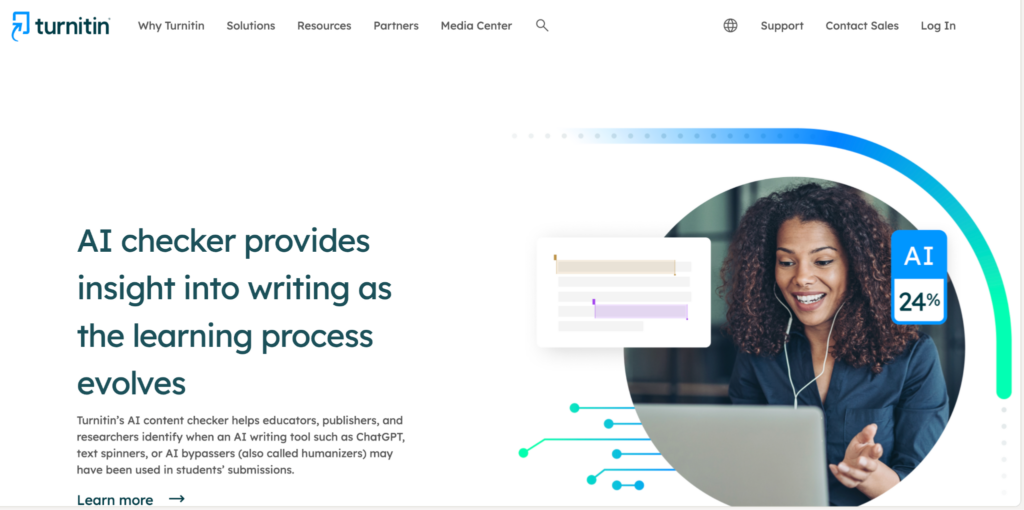
Turnitin dominates higher education with decades of institutional presence. Its AI detection feature (Turnitin Clarity, named to TIME’s Best Inventions of 2025) integrates with existing plagiarism detection.
Important Considerations:
Recent reports highlight accuracy concerns and higher false positive rates, especially for non-native English speakers. The platform only displays AI scores above 20% to reduce false positives.
Best For: Institutions with existing Turnitin contracts prioritizing workflow continuity.
Pricing: Institutional licensing only.
9. QuillBot AI Detector: Best Free Option

QuillBot offers completely free AI detection with no registration required. Testing shows 78% accuracy—impressive for a free tool.
Key Features:
- Completely free with no registration needed
- Distinguishes between AI-generated, AI-refined, and human text
- PDF report downloads for documentation
- Mobile app available (iOS/Android)
Unique Advantage:
QuillBot specifically identifies AI-refined content (text improved with grammar checkers), reducing false positives for non-native speakers who use writing assistance tools ethically.
Best For: Students, freelancers, and anyone needing reliable free detection.
Pricing: Free.
Comparison Table: At-a-Glance Features
Tool | Accuracy | Languages | Plagiarism | AI Rewrite Detection | Free Tier | Starting Price |
|---|---|---|---|---|---|---|
Detecting-AI | 99%+ | 50+ | ✅ | ✅ Advanced | ✅ | Competitive |
Winston AI | 42–70% tested | 11 | ✅ | ✅ | ❌ | ~$12–18/mo |
GPTZero | ~78% | English | ❌ | ⚠️ Limited | ✅ | $14.99/mo |
Walter Writes AI | ~78–85% | 80+ | ❌ | ✅ Built-in | ✅ | ~$8–10/mo |
Proofademic | 99.8% claimed | 22 | ✅ Indicators | ✅ Shield | ✅ | From $8/mo |
Originality.AI | 76–79% | English | ✅ | ⚠️ Limited | ❌ | $14.95/mo |
Copyleaks | ~80% | 100+ | ✅ | ⚠️ Limited | ❌ | $9.99/mo |
Turnitin | Variable | English | ✅ | ⚠️ Limited | ❌ | Institutional |
QuillBot | ~78% | 4 | ❌ | ✅ | ✅ | Free |
Pricing Comparison and Value Analysis
Understanding the cost structure helps you choose based on budget and usage needs:
Free Options:
- QuillBot: Completely free, unlimited use, no registration—best for individual users and students
- GPTZero: Free tier with 10,000 characters per scan—generous for educators
- Detecting-AI: Free tier available with limited scans—good for testing before committing
Budget-Friendly Paid:
- Copyleaks: $9.99/month for 100 credits (25,000 words)—lowest entry price
- Originality.AI: Pay-as-you-go at $0.01 per 100 words—only pay for what you use
Mid-Tier Professional:
- Detecting-AI: Competitive pricing with comprehensive features—best value for features
- Winston AI: ~$12-18/month—good for academic institutions
- GPTZero Premium: $14.99/month—solid for individual educators
- Originality.AI: $14.95/month for 20,000 words—good for regular content checking
Enterprise Level:
- Turnitin: Custom institutional pricing—established education market leader
- Copyleaks Enterprise: Custom pricing with volume discounts
- Winston AI: Institutional licenses with batch processing
Value Consideration: While free tools offer basic detection, paid tools provide lower false positives, better accuracy, and critical features like plagiarism detection and LMS integration. For professional use, the 1-2% false positive rate of premium tools (vs 5-10% for free options) justifies the investment by avoiding wrongful accusations.
Common Myths About AI Detection Debunked
Myth 1: “99% Accuracy Means It’s Always Right”
Reality: Accuracy metrics are tested on controlled datasets. Real-world performance varies by content type, writing style, and AI model used. A 99% accuracy claim might mean 99% correct on the test set, not your specific document. Always use detection as guidance, not proof.
Myth 2: “AI Detectors Can Catch All AI-Generated Content”
Reality: New AI models and humanization tools constantly evolve. Detectors can only identify patterns they’ve been trained on. Paraphrased content, heavily edited AI text, or outputs from cutting-edge unreleased models may slip through. Multi-engine approaches (like Detecting-AI) help but aren’t foolproof.
Myth 3: “If It’s Flagged as AI, It Must Be AI”
Reality: False positives happen, especially with non-native English speakers whose formal writing can resemble AI patterns. Formulaic writing, technical content, and certain academic styles naturally trigger detectors. Context and investigation matter more than raw scores.
Myth 4: “Free Detectors Are Just as Good as Paid Ones”
Reality: Free tools often have higher false positive rates (5-10% vs 1-2% for premium tools), limited language support, and no advanced features like paraphraser detection. For casual checking, free works fine. For high-stakes decisions (grading, hiring, publishing), premium tools reduce risk.
Myth 5: “Using Multiple AI Detectors Guarantees Accuracy”
Reality: Running text through several detectors provides more data points, but if all use similar detection methods, they may share the same blind spots. Multi-engine platforms (like Detecting-AI) that aggregate different detection approaches offer better reliability than manually checking multiple single-engine tools.
Myth 6: “AI Detection Violates Privacy”
Reality: Reputable detectors (those that are GDPR compliant and SOC 2 certified) don’t store your text or use it for training. Always verify a detector’s privacy policy. Tools like Detecting-AI explicitly state text is never saved or shared.
Myth 7: “Short Texts Can Be Accurately Detected”
Reality: Most detectors need 250-350+ words for reliable results. Short texts lack sufficient patterns for confident analysis. A two-sentence email flagged as AI might just be coincidentally simple language.
Understanding these realities helps set appropriate expectations and guides responsible use of AI detection technology.
How to Choose the Right AI Detector
Consider Your Primary Need:
- For Maximum Accuracy: Choose Detecting-AI with its multi-engine verification and <1% false positive rate.
- For Education: Choose GPTZero (free, classroom-friendly) or Turnitin (institutional integration).
- For Publishing/SEO: Choose Originality.AI with content quality metrics and fact-checking.
- For Global Teams: Choose Copyleaks with 100+ language support.
- For Budget Users: Choose QuillBot (completely free) or Detecting-AI (generous free tier).
Critical Success Factors:
- Language Requirements: International content needs Copyleaks (100+ languages) or Detecting-AI (50+ languages)
- False Positive Tolerance: Academic contexts require low false positives—Detecting-AI (<1%) or Originality.AI (1-2%)
- Integration Needs: Existing institutional systems favor Turnitin or Winston AI
- Budget Reality: Free options (QuillBot, GPTZero) deliver 78% accuracy—acceptable for many uses
- Volume Requirements: High-volume checking benefits from batch processing (available in most paid tools)
Best Practices for Effective AI Detection
Do:
- Cross-reference results using multiple detectors or multi-engine platforms
- Review sentence-level analysis for context—look at which specific sections are flagged
- Consider the writer’s background—non-native speakers and ESL learners may be falsely flagged
- Use 250+ words for accurate detection—shorter texts produce unreliable results
- Combine with human judgment—tools inform decisions, they don’t make them
- Document your process—keep detection reports and reasoning for transparency
- Communicate policies clearly—students and employees should understand how detection is used
Don’t:
- Rely on scores alone as definitive proof of AI use
- Ignore context—consider writing history, subject knowledge, and circumstances
- Punish without investigation—false positives happen; conversation matters
- Expect 100% accuracy—all detectors have limitations and blind spots
- Use detection as “gotcha” enforcement—focus on education and improvement
- Ignore appeals—provide fair review processes for contested results
Step-by-Step Detection Process:
- Run initial scan with your chosen detector
- Review sentence-level results to identify specific flagged sections
- Check for false positive indicators (formal language, technical terms, ESL patterns)
- Cross-verify suspicious sections with a second detector or multi-engine tool
- Investigate context (assignment requirements, student history, subject matter)
- Document findings with specific examples and reasoning
- Engage in conversation before making final determinations
- Provide educational guidance regardless of outcome
Understanding the Limitations
AI detection faces inherent challenges that affect all tools:
Evolving AI Models: New AI tools produce increasingly human-like text. Detectors must constantly update their training data and algorithms. Today’s 99% accurate detector might drop to 85% when GPT-5 or Claude 4 launches.
Gaming the System: Paraphrasing tools, AI humanizers, and strategic editing can reduce detection accuracy. Students and writers know about these workarounds. Advanced tools like Detecting-AI’s Paraphraser Shield help but don’t eliminate the problem.
Cultural Bias: Non-native speakers using grammar tools for language refinement often get falsely flagged. Their corrected writing can resemble AI patterns. This creates equity issues—privileged native speakers face less scrutiny.
Mixed Content: Real-world documents often combine human brainstorming, AI-assisted research, and human editing. Sentence-level analysis helps identify these hybrid approaches, but determining acceptable AI use requires policy, not just technology.
Dataset Limitations: Detectors are only as good as their training data. Content types underrepresented in training (creative writing, poetry, technical documentation) may produce unreliable results.
Research shows AI detectors average 40-80% accuracy depending on conditions, with adversarial techniques reducing effectiveness further. This underscores why multi-engine approaches and human oversight remain essential for responsible use.
The Future of AI Detection
As AI writing tools advance, detection technology must evolve. Promising developments include:
Behavioral Analysis: Rather than analyzing only final text, future tools will examine writing processes—tracking editing patterns, typing speed variations, and revision behaviors that distinguish human from AI creation.
Real-Time Integration: Detection moving from post-submission checking to real-time writing assistance, flagging AI content as it’s created and helping writers understand acceptable vs. problematic AI use.
Improved Multilingual Capabilities: Better accuracy across languages and dialects, reducing bias against non-native speakers through more diverse training datasets and culturally-aware algorithms.
Watermarking Technology: AI companies are developing invisible watermarks embedded in generated text, making detection more reliable. However, paraphrasing can remove watermarks, limiting effectiveness.
Context-Aware Detection: Future tools will consider assignment type, subject matter, and educational level when assessing likelihood of AI use, reducing false positives from appropriate use cases.
Leading platforms like Detecting-AI, GPTZero, and others continuously update models to detect newer AI iterations including ChatGPT-4, Claude 3, Gemini Advanced, and emerging technologies. The arms race between generation and detection continues.
The Verdict
For comprehensive AI detection that minimizes false positives while maximizing accuracy, Detecting-AI delivers the best overall value. Its multi-engine approach, combined with plagiarism detection, fact-checking, OCR, content quality metrics, and advanced Paraphraser Shield, makes it the most complete solution available. The <1% false positive rate is critical for high-stakes educational and professional contexts where wrongful accusations carry serious consequences.
Winston AI suits institutions needing detailed audit trails, GPTZero excels for classroom use with its educational focus, Originality.AI serves publishers protecting SEO rankings, Copyleaks handles global multilingual needs across 100+ languages, Turnitin maintains established institutional workflows, and QuillBot provides solid free detection for budget-conscious users.
The key is matching your specific needs—accuracy requirements, language support, budget constraints, and integration demands—with the right tool. Remember: AI detectors guide decisions; they don’t make them. Combine sophisticated detection technology with human expertise, clear policies, and fair processes to navigate the AI content landscape effectively.
As AI writing tools evolve, staying informed about detection capabilities and limitations ensures you maintain authenticity, academic integrity, and content quality in an AI-enhanced world. The goal isn’t to eliminate AI use entirely but to ensure transparency, appropriate application, and continued development of genuine human skills.