
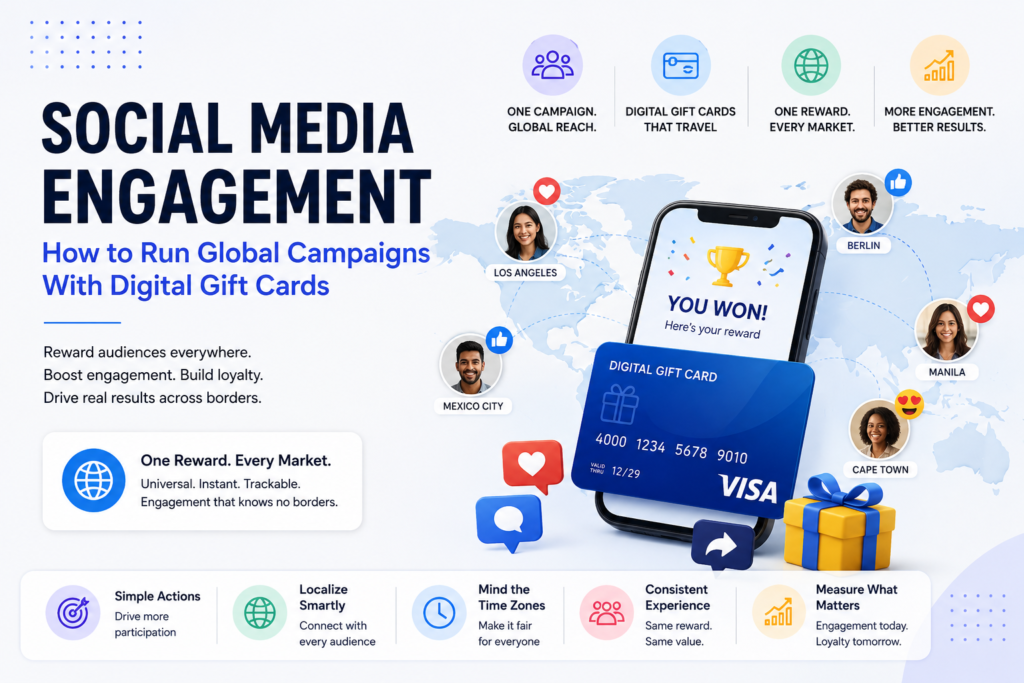
Reaching people in different countries is the easy part now. Almost anyone can publish a post that lands in front of an audience in Manila, Madrid, and Mexico City on the same afternoon. The hard part is getting those people to stop, comment, enter, share, and come back. Engagement is what separates a campaign that travels from one that just gets seen and forgotten. This is where rewards, and specifically digital gift cards, change how we think about global activations.
Why Reach Is Cheap and Engagement Is Expensive
The audience is already there. As of April 2026, there were 5.79 billion social media user identities worldwide, close to 70 percent of everyone on the planet. That number used to feel like the goal. Now it is just the starting line.
The problem we keep running into is that reach does not equal participation. We can put a campaign in front of a million people across twenty countries and still get a few hundred comments. People scroll past anything that asks for effort without offering something back. A like costs them nothing, so they give it freely. A share, a tag, a user-generated post, or a contest entry costs them attention and social capital, so they need a reason.
Strong content carries some of that weight. Posts that are genuinely useful or entertaining earn participation on their own, which is why content quality is the foundation of any campaign. But content alone rarely pushes someone from passive viewer to active participant across a whole region. A clear incentive does. When we attach a reward to the action we want, the math changes for the person on the other side of the screen.
The Reward That Actually Travels
Here is the wall most global campaigns hit. We design a great incentive, then realize it does not work in half the markets we are trying to reach. A coupon for a US store is useless to a follower in Brazil. Branded swag means shipping costs, customs delays, and weeks of waiting. Cash transfers run into banking rules that differ in every country.
Global campaigns require rewards that work consistently across all regions without operational barriers or delay. For campaigns that cross borders, a digital reward like an international Visa gift card removes issues that usually break these activations. The participant in Berlin and the participant in Bangkok receive the same value with a simple, consistent experience everywhere. That consistency enables one unified campaign instead of building separate prize structures for each region.
Gift cards backed by a major payment network avoid most of that. A card-based reward is understood and usable almost everywhere we are likely to run a campaign, so the universality is the whole point. We are not asking a winner in Lagos to figure out a reward built for someone in London.
Digital also means trackable. We know when a reward was sent, opened, and redeemed, which matters when we are reporting on a campaign that touched several markets at once.
Designing a Campaign That Works Across Markets
A reward fixes the incentive problem. It does not fix a campaign that ignores how different audiences behave. Platform habits vary widely by region. Pew Research Center’s data on social media use shows how differently platforms are adopted across demographics and countries, and that gap is even wider once we look beyond a single market. WhatsApp dominates in much of Latin America and South Asia, while the platform mix in North America looks nothing alike.
So we plan the mechanics around the action, then localize the delivery. A few principles hold up no matter where the audience sits:
- Make the entry action simple. Tag a friend, share a story, or answer one question. The more steps we add, the more we lose people in markets where mobile data is expensive or connections are slow.
- Localize the language, not just the translation. A literal translation often misses the tone. The hook that works in one country can fall flat in another.
- Mind the time zones. A 24-hour global contest favors whoever is awake when it launches. Stagger announcements or run regional windows so no audience starts at a disadvantage.
- Keep the reward identical. When the prize is the same everywhere, the campaign feels fair, and the messaging stays clean across every account.
Consistency behind the scenes is what holds this together. Running activations on top of a steady social media strategy rather than as one-off stunts is what turns a single spike in engagement into an audience that sticks around after the contest ends.
Where These Campaigns Go Wrong
The most common mistake is treating the reward as the entire idea. A gift card pulls people in, but if the content around it is thin, we attract prize hunters who unfollow the moment the campaign closes. The reward should amplify content people actually want to share, not paper over a post no one would engage with on its own.
The second mistake is asking for too much. Long entry forms, multiple required actions, and follow-plus-tag-plus-share combinations all bleed participants. Every extra requirement filters out casual followers who might have become loyal ones.
The third is running the same creative everywhere and assuming it lands. The reward itself travels fine – Visa alone operates in more than 200 countries and territories – but a creative that ignores local platforms, languages, and posting times will still fall flat. A campaign built around regional habits will always outperform a copy-paste rollout, even with an identical prize on offer.
Measuring What Actually Matters
Reach and impressions look good in a deck, but they tell us almost nothing about whether a campaign worked. For engagement-driven activations, we track participation rate, the share of viewers who took the action, alongside comments, shares, and saves. We also watch what happens after: do the new followers stay, and do they engage with the next post that has no reward attached?
A campaign that spikes during the giveaway and flatlines the day after did not build engagement. It commanded attention. The goal is to use the reward as a reason for someone to interact for the first time, then earn the second and third interactions with content alone.
Digital gift cards give global campaigns a reward that every market understands and can use, without the shipping, currency, and banking headaches that sink most cross-border activations. Pair that with simple mechanics, localized delivery, and content worth engaging with, and a campaign stops being a one-time spike and starts building an audience that participates long after the prize is gone.
FAQs
Why are digital gift cards effective for social media engagement campaigns?
Digital gift cards create a direct incentive for participation. Users are more likely to comment, share, tag friends, or create content when there is a practical reward attached. Unlike physical products, digital rewards are instant, easy to distribute, and accessible across multiple countries.
What makes digital gift cards better than physical giveaways for global campaigns?
Physical giveaways often involve shipping delays, customs fees, lost packages, and regional restrictions. Digital gift cards eliminate these issues by allowing participants to receive and use rewards online immediately, regardless of location.
Can international digital gift cards work in multiple countries?
Yes. International Visa gift cards and other globally supported digital payment rewards can often be used across many countries and regions. This allows brands to run one unified campaign instead of creating separate prize systems for each market.
Which social media platforms work best for global engagement campaigns?
The best platform depends on the audience and region. Instagram, TikTok, Facebook, LinkedIn, WhatsApp, and X all have different levels of popularity depending on the country and demographic. Successful campaigns adapt their platform strategy based on local user behavior.
How can brands prevent giveaway campaigns from attracting only prize hunters?
The reward should support strong content rather than replace it. Brands that combine useful, entertaining, or emotionally engaging content with a giveaway are more likely to retain followers after the campaign ends. Keeping the entry process aligned with the brand’s core message also helps attract more relevant participants.
What metrics should be tracked during a social media engagement campaign?
Important metrics include participation rate, comments, shares, saves, user-generated content submissions, follower retention, click-through rates, and post-campaign engagement. Reach and impressions alone do not accurately measure campaign success.
How do you localize a global social media campaign effectively?
Localization involves more than translation. Brands should adapt messaging tone, posting schedules, visuals, and platform choices to match local audience behavior and cultural expectations. Regional timing and language nuances can significantly impact engagement rates.