
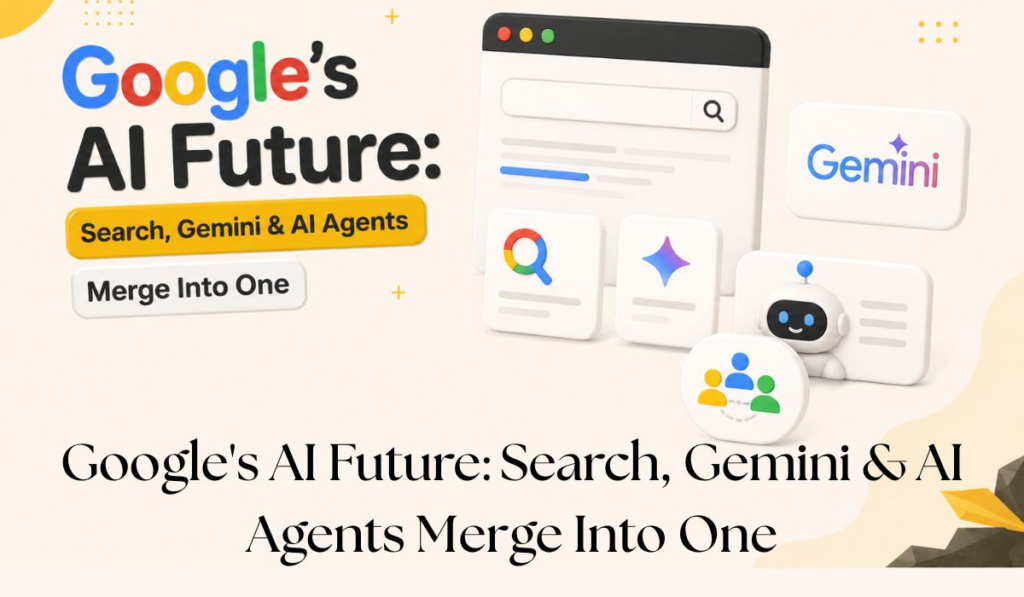
Imagine a world where you don’t need to click around searching for information, then open another app to book a flight, then check a third platform to compare prices. That’s exactly what Google CEO Sundar Pichai is planning—and it’s coming sooner than you think.
In a recent interview with The Verge, Pichai pulled back the curtain on Google’s vision for the future. And spoiler alert: it’s a major shift in how we’ll interact with technology.
The Great Convergence Is Coming
Forget everything you know about Google Search, Google Gemini (the AI assistant), and separate tools. They’re not staying separate for long.
When asked whether Google’s AI search box, app-building tools, and AI agent products should become one product, Pichai didn’t hesitate: “It will.”
This isn’t just exciting news—it’s transformative. Instead of juggling multiple products, you’ll get one unified AI experience that handles searching, creating content, building things, and completing tasks all in one place.
Think of it like this: Your AI becomes your personal assistant, working intelligently in the background to help you plan trips, build projects, and tackle complex tasks without you having to switch between apps.
What Are AI Agents Anyway?
You might be wondering: “What exactly is an AI agent?”
AI agents are the next evolution of artificial intelligence. Unlike traditional chatbots that just answer questions, agents can actually do things. They can:
- Book your vacation
- Plan your schedule
- Complete research tasks
- Manage workflows
- Handle complex projects
Pichai is pretty clear about how important this is: “I look at agents, and that is the next evolution of the web. I think it will evolve the web pretty profoundly.”
Google is already building agentic capabilities across Search, Gemini, Spark, and Antigravity. The goal? Make them work seamlessly together.
Why This Matters for Publishers (And Everyone Else)
Now, here’s where things get interesting—and slightly concerning.
Publishers are worried. Really worried. Condé Nast’s CEO recently said his company was planning as if search traffic would fall to zero. That’s the “Google Zero” nightmare scenario: What if Google’s AI answers questions directly without sending anyone to your website?
Pichai’s Response? Google is “very committed to both meeting user expectations and also connecting them to what’s out on the web.”
Fair enough. But there’s a catch: Google admits that some clicks are already going away.
Pichai acknowledged that as AI improves, “low-quality clicks get filtered out.” He also mentioned that “bounce clicks are going down”—meaning fewer people are clicking to websites and immediately leaving.
This is the real challenge for content creators and publishers: They need to adapt or risk being left behind.
The Web Is Changing Faster Than Ever
The information ecosystem isn’t what it used to be. Users aren’t just going to Google anymore. They’re on social media, using multiple search engines, getting recommendations from AI—the landscape is completely different.
Pichai acknowledges this shift: “The information ecosystem is so much broader beyond Google, by far.”
This means:
✓ For publishers: You can’t rely on search traffic alone anymore
✓ For users: You have more options than ever
✓ For Google: The old search paradigm is evolving into something much bigger
Google’s Secret Weapon: Speed and Reorganization
Why is Google moving so fast on this? Because they reorganized.
Pichai revealed that Search was “split across many leaders,” which slowed things down. So Google put Elizabeth Reid in charge of Search, with Nick Fox leading the broader area. Josh Woodward also helped lead Labs and Gemini work.
The message is clear: Google needs to move faster, and they restructured to make that happen.
This reorganization signals that AI isn’t a side project at Google anymore—it’s the main event.
What About Subscriptions?
Here’s one way Google is trying to keep publishers happy: subscriptions.
If you subscribe to a publication, Google will show it as a “preferred source” for you in Search. Google is adapting to the fact that more publishers are turning to subscription models because they can’t rely on search traffic like they used to.
It’s a helpful feature, but it also highlights a bigger truth: Publishers had to pivot to subscriptions because traditional search traffic became unreliable.
The Bottom Line: Change Is Here
Sundar Pichai’s vision for the future isn’t theoretical—it’s already in motion. Google is laying the groundwork for an AI-powered internet where:
- AI agents do the heavy lifting instead of you clicking through multiple websites
- Search, Gemini, and tools become one seamless experience
- The traditional web click becomes less important as AI handles more tasks
- Publishers need to adapt to a world where search traffic might be smaller but more valuable
For users, this could be amazing: faster, easier, smarter ways to get things done.
For publishers and creators, it’s a wake-up call: The old playbook doesn’t work anymore. High-quality, valuable content will still matter—but the path to that content is changing fundamentally.
Google says it’s committed to sending traffic to the web. But the reality? The nature of that traffic is transforming. And if you’re not prepared for agents and AI-powered search, you might get left behind.