Every growing business starts somewhere. In the early days, speed matters more than perfection. Designers grab icons from one free icon library, developers download SVGs from another, and marketers occasionally use stock illustrations or graphics they find online. It helps projects move forward quickly, and when budgets are tight, free resources are often the obvious choice.
The problem doesn’t appear immediately. It shows up months or even years later when your website has grown, your team has expanded, and your brand is expected to look polished across every customer touchpoint.
Building a consistent visual identity is an important part of learning how to build a brand online, helping customers recognize and trust your business wherever they interact with it. Suddenly, those free resources become one of the biggest sources of visual technical debt.
At Asclique, we’ve worked with businesses that have invested heavily in SEO, paid advertising, and website development, only to discover that inconsistent design assets were quietly affecting their user experience and brand perception.
What Is Visual Technical Debt?
When people hear the term technical debt, they usually think about messy code or outdated software. However, technical debt can also exist in your design system.
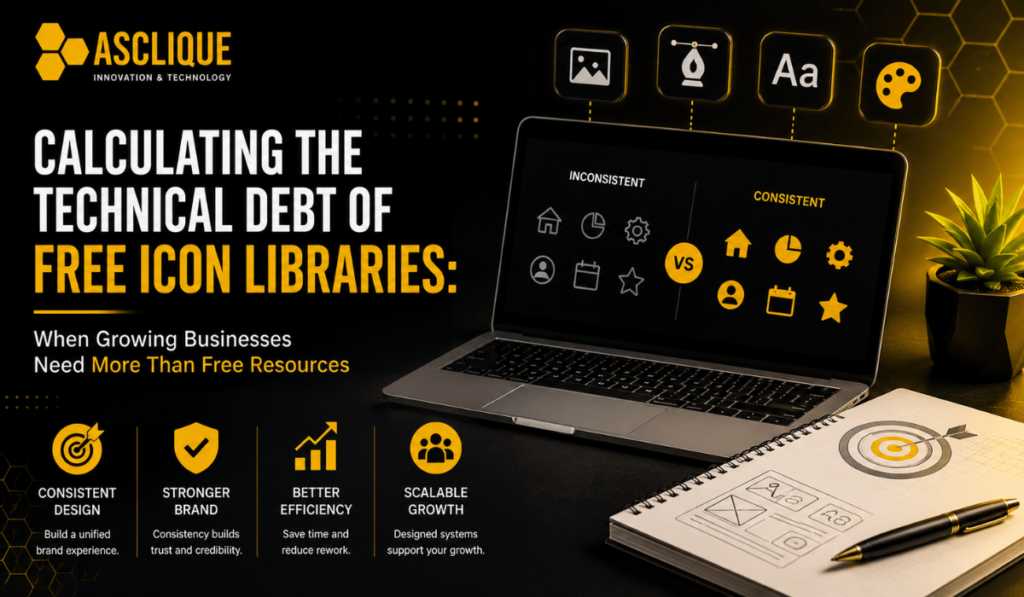
Visual technical debt occurs when different icon libraries, image styles, fonts, colors, and illustrations are mixed together over time without a consistent strategy. One page might use thin outline icons while another uses bold filled graphics. Marketing materials may follow one style, while the website follows another. Individually these differences seem insignificant, but together they create an inconsistent experience that visitors notice almost immediately.
Unlike coding issues that remain hidden behind the scenes, visual inconsistencies are visible to every customer who visits your website.
Why Design Consistency Matters
Modern users form opinions about a website within seconds. Before reading your content or contacting your business, they subconsciously evaluate whether your website feels trustworthy and professionally built.
A consistent visual language creates confidence.Consistent icons and design elements also support responsive website design, ensuring your website delivers a seamless experience across desktops, tablets, and mobile devices.
When icons, graphics, colors, and layouts all work together, the experience feels intentional. On the other hand, mixing assets from multiple sources can make even a technically excellent website feel unfinished.
This becomes even more important when you’re investing in SEO services, Google Ads, social media marketing, or content marketing. Driving visitors to your website is only part of the equation—your design needs to convert them once they arrive. Driving traffic to your website is only half the battle. Converting those visitors depends heavily on how professional and credible your brand appears.
The Hidden Cost of Free Icon Libraries
There’s nothing wrong with using free icon libraries. They are incredibly useful for startups, prototypes, internal tools, and minimum viable products. They allow businesses to launch quickly without adding unnecessary costs.
The challenge comes when businesses continue relying on multiple free libraries as they grow. Eventually, developers spend more time searching for matching icons than building new features. Designers manually edit SVG files to maintain consistency. Marketing teams recreate graphics because the original assets no longer match current branding.
These small tasks seem harmless individually, but together they consume dozens of hours every month. The cost of that lost productivity often exceeds the price of investing in a professional design platform.
Why Growing Businesses Need a Centralized Design System
One of the biggest differences between small businesses and mature organizations is process. Successful companies rarely rely on random design assets downloaded from different websites. Instead, they create centralized systems that everyone follows.
A shared design library gives designers, developers, marketers, and content creators access to the same visual assets. Every icon follows the same style. Every illustration matches the brand. Every new landing page looks like it belongs to the same company.
This consistency speeds up collaboration while reducing the maintenance burden across future projects. New team members also adapt much faster because there is a clear standard for every visual element.
Visual Consistency Extends Beyond Your Website
Many businesses assume icon libraries only matter to developers, but that’s no longer true.
Marketing teams rely on the same assets for blog graphics, landing pages, social media campaigns, email newsletters, presentations, downloadable guides, and sales materials. Maintaining a consistent visual style across your content marketing efforts strengthens brand recognition and creates a more professional experience for your audience.
Even something as simple as adding a well-placed emoji in a social media post can improve engagement, but it should complement your overall visual identity instead of competing with it.
When every department works from the same design system, your brand looks professional regardless of where customers interact with it. This consistency is also an important part of learning how to build a brand online, because customers are more likely to recognize and trust a business that maintains the same identity across different channels.
Open Source vs Premium Design Libraries
Free icon libraries continue to play an important role in modern web development. Popular collections like Heroicons and Feather Icons are lightweight, easy to implement, and ideal for smaller projects. For startups trying to validate an idea, they offer tremendous value.
A standardized asset library can also make responsive website design easier to manage by ensuring icons and visual elements remain consistent across desktop, tablet, and mobile experiences.
However, as products become more sophisticated, businesses often discover that free libraries lack the specialized icons required for complex features. Teams begin mixing multiple collections simply to fill those gaps, introducing inconsistencies that grow with every release.
Premium design platforms address this problem by offering thousands of matching assets within carefully maintained style systems. Instead of searching multiple websites for similar icons, teams can find everything they need within a single ecosystem, keeping both the website and marketing materials visually aligned.
The monthly subscription becomes less about purchasing icons and more about saving time while protecting brand consistency.
When Is It Time to Upgrade?
Every business reaches a point where free resources begin creating more work than they save.
If multiple designers are contributing to your website, if developers regularly spend time replacing graphics, or if your marketing team creates content every week, investing in a centralized asset library usually becomes a smart business decision.
Likewise, businesses preparing for major growth, launching new products, or redesigning their website should consider standardizing their visual assets before inconsistencies become more difficult to fix.
The same principle applies to content marketing. Reusing approved visual assets across blog graphics, downloadable resources, social posts, and campaigns helps teams produce content faster while maintaining a recognizable brand identity.
Building a Sustainable Design Workflow
Reducing visual technical debt isn’t just about choosing better icons. It requires establishing clear workflows that everyone follows.
Successful businesses maintain a central asset library, define approved icon styles, organize reusable graphics, document brand colors, and periodically review their websites for inconsistencies. These simple processes prevent small design decisions from becoming expensive problems later.
Like any form of technical debt, visual debt is far easier to prevent than to remove.
Final Thoughts
Free icon libraries are excellent tools, especially for businesses in their early stages. They help teams move quickly, reduce costs, and launch products faster.
However, as your business grows, maintaining a consistent visual identity becomes increasingly important. What once saved money can gradually create maintenance challenges, branding inconsistencies, and unnecessary development costs.
At Asclique, we help businesses build scalable digital experiences through professional web design, SEO, branding, and digital marketing. By creating consistent visual systems alongside strong technical foundations, businesses can improve user experience, strengthen their brand, and reduce long-term maintenance costs.
FAQ’s
What is visual technical debt?
Visual technical debt is the accumulation of inconsistent design elements such as icons, illustrations, fonts, and graphics that make a website harder to maintain and less visually cohesive over time.
Are free icon libraries suitable for business websites?
Yes. They are ideal for startups, MVPs, and smaller projects. As businesses grow, however, premium design systems often provide better consistency, scalability, and efficiency.
Can inconsistent icons affect conversions?
While icons alone don’t determine conversions, inconsistent design can reduce user trust and make a website appear less professional, which may impact engagement and conversion rates.
Should marketing and development teams use the same design assets?
Absolutely. Using a shared visual system helps maintain brand consistency across websites, presentations, email campaigns, social media, and advertising materials.
Does visual consistency improve SEO?
Visual consistency doesn’t directly affect rankings, but it contributes to a better user experience, which can improve engagement metrics that support your overall digital marketing performance.
How often should businesses review their design assets?
A visual audit every six to twelve months is recommended, especially before a website redesign or major branding update.
How can Asclique help?
Asclique helps businesses build consistent digital experiences through website design, SEO, branding, UI/UX improvements, and digital marketing strategies that support long-term growth.