
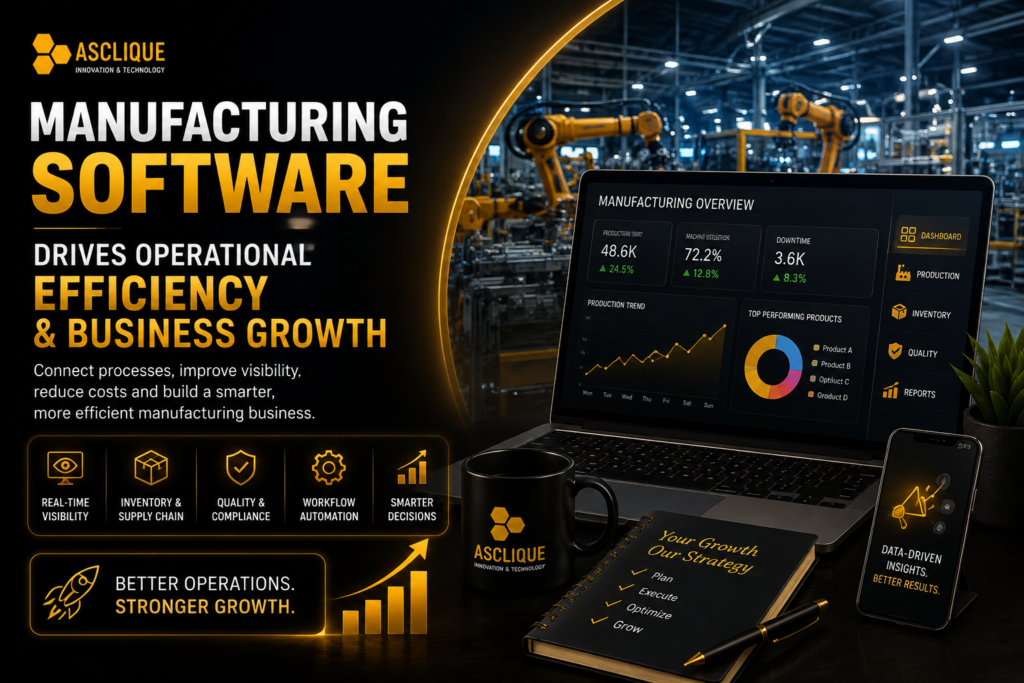
Manufacturers today face pressure from almost every direction. They need to increase output, control costs, reduce waste, manage workforce shortages and respond quickly to changing customer demand.
At the same time, supply chains are becoming more complex, material costs remain unpredictable and customers increasingly expect faster service and greater transparency.
For many manufacturers, improving efficiency is no longer simply about producing more in less time. It is about creating a connected operation where information moves efficiently between production, inventory, procurement, finance and management.
This is where digital technology can make a significant difference.
Modern manufacturing systems can help businesses improve visibility, automate repetitive processes and make better use of operational data. When combined with a broader digital strategy, these improvements can support both operational performance and long-term business growth.
The Real Cost of Operational Inefficiency
Operational inefficiency does not always appear as one obvious problem. Instead, it often develops through smaller issues across different departments.
Unexpected downtime can delay production. Excess inventory can tie up working capital. Poor communication between departments can lead to incorrect orders or scheduling problems. Manual reporting can delay important decisions.
Individually, these issues may seem manageable. Together, they can significantly affect profitability and customer satisfaction.
The challenge becomes even greater when manufacturers rely on disconnected systems.
Production information may exist in one platform, financial data in another and inventory information in spreadsheets or manual records. Employees then spend valuable time collecting and reconciling information instead of using it to make decisions.
A stronger technology-driven approach can help manufacturers connect these processes and create a more coordinated operating environment.
Rather than simply adding new technology, manufacturers need systems that solve specific operational problems and communicate effectively with existing business processes.
Connecting Manufacturing Operations Through Technology
One of the biggest advantages of digital transformation in manufacturing is improved connectivity.
Modern manufacturing software can help businesses connect important operational functions and provide teams with better visibility into what is happening across the organisation.
Instead of waiting for weekly or monthly reports, managers may be able to access more current information about production, inventory, purchasing, workforce activity and financial performance.
This can make it easier to identify problems before they become more expensive.
For example, if production output begins falling below expectations, managers can investigate the issue sooner. If inventory levels are approaching critical levels, procurement teams can respond before production is interrupted.
The objective is not simply to collect more data. It is to make useful information available to the people who need it.
How Technology Improves Day-to-Day Manufacturing Operations
Digital systems can improve manufacturing operations in several ways, but their greatest value often comes from providing better information and reducing unnecessary manual work.
When different departments work from consistent information, businesses can reduce duplicate data entry and communication gaps.
Production teams can understand upcoming requirements. Procurement teams can monitor material needs. Finance teams can gain better visibility into costs, while management can evaluate overall performance.
This connected approach also supports data-driven decision-making.
Instead of relying primarily on assumptions or outdated reports, manufacturers can use operational information to understand what is working, identify potential problems and determine where improvements are needed.
Key Manufacturing Software Capabilities That Improve Efficiency
Manufacturing businesses have different operational requirements, so there is no single technology solution that works for every organisation.
However, several capabilities can have a significant impact on operational efficiency.
Real-Time Operational Visibility
Access to current operational information gives managers a clearer picture of business performance.
Production volumes, inventory levels, order status, equipment performance and other important metrics can provide early indications of potential problems.
Better visibility can also improve accountability because departments have access to consistent information rather than maintaining separate versions of the same data.
Inventory and Supply Chain Management
Inventory management requires manufacturers to maintain a careful balance.
Holding excessive stock can increase storage costs and tie up working capital. Holding too little can create shortages that interrupt production and delay customer orders.
Digital inventory and planning tools can help businesses assess stock requirements based on demand forecasts, supplier lead times and production schedules.
Better information can also help procurement teams identify potential supply chain risks earlier.
Quality and Compliance Management
Quality control is essential for maintaining customer trust and meeting industry requirements.
Digital systems can help manufacturers maintain quality records, document inspections and organise compliance information.
This can reduce the administrative work involved in preparing documentation for audits while making important records easier to access when needed.
Workflow Automation
Many manufacturing businesses still rely on employees to complete repetitive administrative tasks manually.
Approvals, purchase orders, reporting, scheduling and data entry can consume significant amounts of time.
Automating suitable workflows can reduce manual effort while improving consistency.
Employees can then spend more time solving operational problems, improving processes and supporting customers instead of completing repetitive administrative work.
Turning Manufacturing Data Into Business Intelligence
Collecting operational data is only useful when businesses know how to interpret it.
Manufacturers can generate enormous amounts of information across production, inventory, sales, finance, equipment and customer interactions.
Analytics can help transform this information into practical insights.
Using the right analytics tools can help businesses identify patterns that might otherwise remain hidden.
For example, manufacturers may discover that certain products consistently create higher production costs, particular periods experience greater downtime or specific customer segments generate stronger margins.
These insights can influence everything from production scheduling and procurement to pricing and investment decisions.
How Operational Efficiency Supports Business Growth
Efficiency is often associated with reducing costs, but its impact can extend much further.
When manufacturers reduce waste, improve coordination and increase production capacity, they may be able to process more orders without increasing overheads at the same rate.
This creates greater flexibility when demand increases.
Better information can also support stronger strategic decisions. Management can evaluate capacity, identify areas requiring investment and allocate resources more effectively.
Operational improvements can also affect the customer experience.
Reliable production schedules, consistent product quality and faster responses can help manufacturers build stronger relationships with customers.
Over time, these improvements can contribute to better margins, increased customer retention and more sustainable growth.
Operational Growth Should Be Supported by Digital Growth
Improving manufacturing capacity is only one part of business growth.
Manufacturers also need customers to discover their products, services and capabilities.
This is particularly important for B2B manufacturers where purchasing decisions increasingly begin with online research.
Potential buyers may search for specific manufacturing capabilities, materials, certifications, production processes or suppliers before contacting a company.
A strong Search Engine Optimization strategy can help manufacturers improve their visibility for these searches and connect operational growth with customer acquisition.
The way people discover businesses online is also changing.
Traditional search engines are increasingly being supplemented by AI-powered search experiences and answer engines. Manufacturers therefore need to consider how their expertise and services are represented across both traditional and emerging discovery platforms.
Strategies such as AI SEO can help businesses adapt their digital presence as search behaviour continues to evolve.
This creates an important connection between operational technology and marketing technology.
Manufacturing software can help a company produce and deliver more efficiently, while digital marketing can help ensure there is sufficient demand to support that increased capacity.
Choosing the Right Manufacturing Technology
The right technology depends on the manufacturer’s size, operational complexity, existing systems and business objectives.
Before investing in another platform, businesses should identify where inefficiencies currently exist.
Where does manual work consume the most time?
Which processes regularly create delays?
Where is information being duplicated?
Which departments struggle to access reliable information?
Answering these questions can help manufacturers identify which technology investments should receive priority.
Integration should also be considered early.
A platform that communicates effectively with finance, procurement, inventory, workforce management and other important systems can provide greater value than another isolated tool. Cloud-based solutions like NetSuite manufacturing are increasingly popular among mid-market manufacturers because they unify production, inventory, and financial management in a single platform, eliminating the data silos that slow down decision-making.
Scalability matters as well.
Technology should be capable of supporting changing production requirements, additional employees, new locations and greater transaction volumes as the business expands.
Finally, businesses should consider usability.
Even sophisticated software will provide limited value if employees find it difficult to understand or use consistently.
Building a More Connected Manufacturing Business
Technology alone does not create operational efficiency.
The real value comes from using technology to improve how people, processes and information work together.
Manufacturers that successfully connect production, inventory, procurement, finance and management can gain a clearer understanding of their operations and respond more quickly when conditions change.
The same principle applies to business growth.
Operational systems provide manufacturers with the infrastructure to produce efficiently, while analytics and digital marketing help businesses understand opportunities and reach potential customers.
For manufacturers facing rising costs, tighter margins and increasingly complex operations, building a connected digital ecosystem can provide a stronger foundation for sustainable growth.
The objective should not be to adopt technology simply because it is available. It should be to invest in systems that solve real business problems, improve decision-making and help the organisation operate more effectively as it grows.
FAQ’s
What is manufacturing software?
Manufacturing software is a digital solution designed to help manufacturers manage and connect processes such as production planning, inventory, procurement, scheduling, quality control and reporting. Depending on the platform, it may also integrate with finance, workforce management and other business systems.
How does manufacturing software improve operational efficiency?
Manufacturing software can improve efficiency by providing better visibility into operations, reducing manual data entry, automating repetitive workflows and connecting information across departments. This can help teams identify delays, inventory issues and production bottlenecks earlier.
What are the main benefits of manufacturing software?
Key benefits can include improved production visibility, better inventory management, streamlined workflows, more accurate reporting, improved quality control and faster decision-making. The specific benefits depend on the software and how effectively it is implemented.
Can manufacturing software help reduce costs?
Yes. Manufacturing software can help identify waste, reduce unnecessary manual work, improve inventory planning and minimise operational delays. These improvements can contribute to lower operating costs, although results depend on the manufacturer’s processes and implementation.
How can digital technology help manufacturing businesses grow?
Digital technology can help manufacturers increase capacity, improve customer service and make better decisions using operational data. Combined with analytics, SEO and other digital strategies, technology can support both operational efficiency and customer acquisition.
What should manufacturers consider when choosing software?
Manufacturers should consider their operational requirements, existing technology, integration capabilities, scalability, ease of use and implementation costs. The best solution should address specific business problems rather than simply provide the largest number of features.