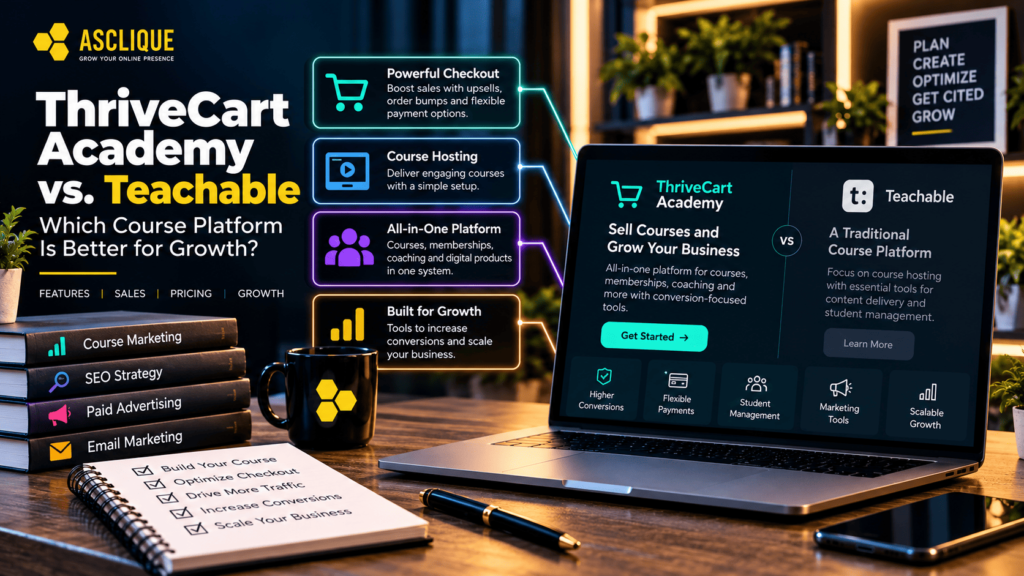
Yes, ThriveCart can be a better option for creators who are focused on selling, not only hosting courses. It helps creators sell courses, digital downloads, memberships, coaching, and digital and physical products without relying on multiple separate tools.
Selling online courses is no longer just about uploading videos. If you’re a course creator, marketer, or digital business owner, you now need a platform that supports course delivery, payment processing, student management, and sales optimization in a single, simple system.
For businesses focused on digital growth, this is especially important. Your course platform becomes part of a much larger customer journey that can include SEO, content marketing, paid advertising, email campaigns, landing pages, and conversion optimization.
The best choice depends on your online business model. Some creators need a learning management system (LMS) with advanced assessment tools. Others need stronger sales tools, native video hosting, a community platform, flexible payment options, and a checkout system that helps increase average order value.
For creators comparing course hosting and checkout optimization, ThriveCart Academy, as a Teachable alternative, provides useful context on how ThriveCart compares with a traditional course platform.
What Should Creators Look for in a Teachable Alternative?
A strong Teachable alternative should match how the course business earns money and how customers move from discovering the brand to purchasing a product.
Look for these core features first:
- Course hosting for lessons, modules, files, and student access
- Sales funnels that connect offers, checkout pages, and follow-up steps
- Payment plans for higher-ticket online courses
- Student data that helps track progress and engagement
- Marketing performance tools that support email marketing and conversion optimization
- Community features if student motivation depends on peer support
A basic plan or starter plan may work for a small audience. But if you’re an established creator or digital business, you often need paid plans that offer more advanced features, stronger automation, and lower platform transaction fees.
Platform selection should also fit into your broader digital marketing strategy. Generating traffic is only one part of growth. Businesses also need landing pages, checkout experiences, content, and follow-up systems that convert that traffic into revenue.
Why Does Checkout Matter for Selling Online Courses?
Checkout matters because the sales page is only one part of the buying path. If the checkout system is slow, confusing, or limited, more people can leave before they pay.
This is where conversion optimization becomes particularly important. SEO, paid advertising, social media, and content marketing can bring potential customers to an offer, but the checkout experience determines whether many of those visitors actually complete the purchase.
ThriveCart is built around checkout optimization. Its built-in sales tools can support one-click upsells, order bumps, coupons, affiliate tracking, and flexible payment options.
That matters for creators who want to sell courses and improve average order value. A simple example is a course creator selling a $497 program with an upsell for templates, coaching, or a private learning center. The right checkout flow can make that offer easier to buy while increasing the potential value of each customer.
Many traditional platforms focus first on course content and course delivery. ThriveCart focuses on sales optimization first, then connects that to hosting courses through ThriveCart Academy.
How Does ThriveCart Support Course Creators?
ThriveCart supports course creators by combining course delivery and sales tools into a single platform. That means you can manage offers, checkout pages, access rules, and student management without stitching together multiple tools.
ThriveCart Academy features gamification within courses. It also provides additional course-business support if you’re seeking an all-in-one solution. It reduces the need for multiple separate tools used for checkout, funnels, products, and course hosting.
For agencies, marketers, and businesses managing several digital channels, reducing unnecessary tools can also make analytics and campaign management easier. A simpler technology stack can help teams understand where customers originate, which campaigns generate sales, and where users drop out of the buying journey.
This is useful if you want your own courses with your own website style without building an entire business from scratch on disconnected software.
How Does Marketing Fit Into the Course Platform Decision?
Choosing the right platform is only part of building a successful course business. Creators still need a reliable way to attract qualified visitors.
Organic search can help course businesses reach people actively researching solutions, while paid advertising can accelerate visibility for specific offers. Email marketing can then nurture prospects who are not ready to purchase immediately.
For this reason, the platform should work alongside your existing marketing strategy rather than becoming an isolated system.
For example, an SEO-driven article might attract a potential customer through Google or an AI search optimization platform. That visitor could then enter an email sequence, visit a sales page, and ultimately reach a ThriveCart checkout.
Understanding this complete journey helps businesses identify which channels actually contribute to revenue instead of looking only at traffic.
When Should You Switch Platforms?
You should switch platforms when the current setup slows growth.
Here are clear signs it may be time to move:
You need better checkout control. Your offer needs bumps, one-click upsells, coupons, or stronger payment plans.
You rely on multiple separate tools. Your checkout, course hosting, email marketing, and sales funnels feel disconnected.
You want more ownership. You want clearer control over payment processing, student data, and your own website experience.
You sell more than courses. You also sell digital downloads, coaching, memberships, and digital and physical products.
Your business scales beyond a starter setup. A free plan, hobby plan, or basic plan is no longer enough.
Before switching, businesses should also review their analytics and conversion data. A platform migration will not automatically solve problems caused by weak traffic, unclear positioning, poor landing pages, or an ineffective marketing strategy.
How Can Course Creators Increase Visibility After Choosing a Platform?
Once the technical platform is in place, growth depends heavily on visibility and conversion.
Course creators can build topic-focused content around the questions their target audience searches for, optimize important landing and sales pages, strengthen internal linking, and make their expertise clear to both traditional search engines and AI-powered discovery platforms.
Paid campaigns can support launches or high-value offers, while email marketing can continue nurturing visitors after their first interaction.
The goal is not simply to generate more traffic. It is to build a measurable system connecting discovery, engagement, checkout, purchase, and retention.
For growing digital businesses, this combination of marketing and conversion infrastructure is usually more valuable than choosing a platform based on the longest feature list.
Parting Thoughts
Choosing a course platform is really a business model decision. The right platform should help you build, sell, deliver, and improve your offers.
ThriveCart connects course delivery with sales funnels, checkout optimization, flexible payment options, and built-in sales tools. If you want to grow a course business with fewer moving parts, this can make the platform easier to manage as the business scales. Best of all, ThriveCart’s one-time payment option can offer long-term cost savings compared with platforms that depend primarily on recurring subscriptions.
However, the platform itself is only part of the growth equation. Course creators still need a strategy for attracting qualified visitors and converting them into customers.
Asclique helps businesses connect SEO, content, paid marketing, website optimization, and conversion-focused digital strategies so traffic has a clearer path toward measurable business results.
FAQs
What is the best Teachable alternative for selling online courses?
The best Teachable alternative depends on the creator’s goal. ThriveCart Academy can be a good fit if your priorities include conversions, checkout flexibility, course delivery, and building a scalable sales system.
Can creators sell digital downloads and courses from the same platform?
Yes. Many platforms support digital products, but ThriveCart is built for selling digital downloads, interactive video courses, coaching, memberships, and digital and physical products through optimized checkout flows.
Why do transaction fees matter?
Transaction fees reduce profit on every sale. Platform transaction fees can become expensive when sales volume grows. Therefore, you should compare pricing, payment processing costs, and plan limits before choosing a course platform.
Is the course platform enough to grow an online course business?
No. A course platform handles important parts of delivery and sales, but sustainable growth usually requires traffic acquisition, SEO, content marketing, paid advertising, email marketing, analytics, and conversion optimization.
Should SEO matter when choosing a course platform?
Yes, particularly if organic search is an important acquisition channel. Course creators should consider how their main website, landing pages, educational content, and course platform work together so potential customers can discover the business and move smoothly toward conversion.