
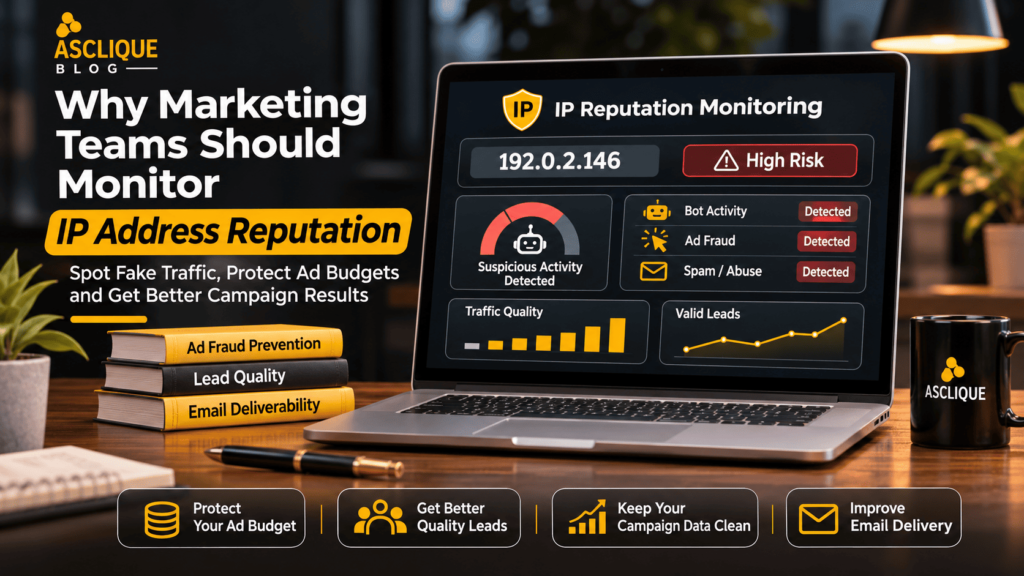
There are many reasons to monitor the source of this traffic, i.e., the IP address. One of the more compelling reasons is that not all traffic is real. Many of the clicks are from bots or fake users.
They click on ads but don’t take any action afterward, which means the marketing team paid for a useless click (most ads cost money per click). Some people can use this maliciously to drive fake clicks, make marketers lose a lot of money, and make their campaigns fail.
However, by monitoring IP addresses, particularly IP address reputation, marketers can block fake traffic and ensure their campaign results are not skewed.
In this article, we will discuss more reasons why marketing teams should monitor visitors’ IP reputation and the benefits it brings.
Quick Answer
IP reputation checks help teams spot fake traffic, protect ad budgets, and improve lead quality. They can also help prevent email delivery problems.
Use IP reputation as one risk indicator alongside website behavior, lead validation, and campaign performance before deciding whether traffic should be blocked.
Key Facts
- IP reputation is a trust value associated with IP addresses based on their activity.
- Checking IP activity can help teams find patterns linked to bots and spam.
- A poor IP score does not always mean a visitor is fake.
- Teams should look at other signs before blocking anyone.
Asclique Workflow
Our recommended approach is to identify suspicious traffic, validate the findings, assess potential business impact, apply appropriate controls, and monitor campaign performance afterward.
Start by reviewing unusual increases in website visits, advertising clicks, and form submissions. Compare these patterns with IP reputation signals, visitor behavior, and lead information before determining whether activity is potentially fraudulent.
Document the affected campaigns, traffic sources, relevant IP addresses, supporting evidence, actions taken, and results. This creates a repeatable process that helps marketing teams distinguish genuine traffic-quality improvements from normal campaign fluctuations.
What Is IP Address Reputation?
IP addresses, as you know, are numerical identifiers used to locate specific devices or servers on the Internet. IP reputation is a trust value associated with IP addresses based on their activity. This value shows whether an IP address is safe or risky to interact with.
Usually, an IP address’s reputation is poor if it is associated with:
- Spam
- Fraud
- Bot activity
- Hacks and cybercrime
Marketing teams can use IP reputation values to identify fake traffic and block it.
But marketers should also monitor their own IP reputation, as it can affect their campaigns as well.
How Poor IP Reputation Affects Marketing
A poor IP reputation can cause many problems for online campaigns. Here are some common examples.
It Can Lead to Ad Fraud
Ad fraud is when fake clicks or views make an ad appear more popular than it is to siphon money from digital ad networks and advertisers.
Bots and paid farmers can visit websites to click ads without any follow-up. This means businesses may pay for clicks that bring no sales.
While marketers can’t stop bot traffic from clicking ads on other platforms, they can monitor visitors’ IP reputation on their own website and block traffic that appears to be bot-generated or untrusted.
It Can Fill Your System With Fake Leads
Another problem that can affect marketing campaigns is incorrect results. Not every lead is a real person; sometimes bots and fake users will fill out forms using made-up details.
These leads are dead ends. However, during reporting and analysis, they inflate the number of leads generated and paint a false narrative. This wastes time for both marketing and sales teams.
An IP reputation check for all visitors can prevent this. By blocking IPs with low reputation, many bots and fake users can be filtered out.
It Can Affect Email Delivery
Email marketing relies on trust. If a sending IP has a poor reputation, email providers may send its messages to spam.
This means fewer people may see your emails. Marketing teams should check their sending IPs and watch for signs of spam or abuse.
| Are Fake Leads Affecting Your Marketing Results? Asclique helps businesses evaluate campaign performance, improve traffic quality, and build marketing strategies focused on measurable results. |
Why Should Marketing Teams Monitor IP Reputation?
Checking IP reputation can help teams get better results from their campaigns. It can also help them avoid common online risks.
Protect Your Ad Budget
Every click can cost money. If bots click your ads, your budget may run out without bringing in real customers.
IP checks can help teams find unusual traffic and look into its source. This makes it easier to spot possible ad fraud.
Get Better Quality Leads
Good leads give sales teams a chance to find new customers. Fake leads only waste their time.
By checking IP activity, marketers can spot patterns linked to bots and spam. They can then review these leads before adding them to their sales system.
Keep Your Campaign Data Clean
Marketing teams use reports to see how well their campaigns are doing. But fake clicks and visits can make these reports less useful.
For example, a campaign may seem popular because it gets many clicks. Yet, those clicks may come from bots rather than real users.
Checking IP activity can help teams find these patterns. This gives them a clearer view of their campaign results.
Tools That Help Check IP Reputation
Marketing teams do not need to check every IP address by hand. Online tools can make this task much easier.
An IP fraud score checker helps users review an IP address and check its fraud risk. Marketing teams can use it to look into traffic from website visitors, leads, or other online sources.
An IP Blacklist checker can show whether an IP address appears on known blacklists. This helps teams find addresses that may have a history of spam or abuse.
These tools can help teams spot possible risks. Still, a poor IP score does not always mean a visitor is fake. People may use shared networks, VPNs, or public Wi-Fi. So, teams should look at other signs before blocking anyone.
Best Practices for Monitoring IP Reputation
A few simple steps can help marketing teams make better use of IP checks.
- Check unusual traffic: Look into sudden spikes in clicks, visits, or form entries.
- Watch email IPs: Check the reputation of the IPs used to send marketing emails.
- Look for repeat activity: Watch for many visits or form entries from the same IP in a short time.
- Use other checks: Review IP data along with email details and user activity.
- Check blacklists: Make sure your business IPs do not appear on known blacklists.
- Review before blocking: Do not block every visitor with a poor IP score. Check their activity first.
| Want Better Results From Your Marketing Campaigns? Our team can help you review campaign performance, identify opportunities for improvement, and focus your marketing efforts on qualified traffic and conversions. |
Weak vs. Better
| Weak Approach | Better Approach |
|---|---|
| Block every IP address with a poor reputation score. | Review IP reputation alongside visitor behavior and other evidence before blocking. |
| Measure campaign success using clicks and form submissions alone. | Track qualified leads, conversion quality, and meaningful business outcomes. |
| Assume all traffic from VPNs or shared networks is fraudulent. | Consider legitimate network usage and investigate suspicious activity individually. |
| Check IP reputation only after a major campaign problem. | Include reputation checks in regular traffic-quality and email-deliverability reviews. |
| Rely on a single reputation checker. | Compare reputation information with analytics, lead details, and relevant security signals. |
Common Mistakes
- Blocking visitors based on one IP reputation score without checking other signals.
- Treating shared networks or VPN traffic as proof of fraud.
- Assuming a blacklist entry confirms that every visit is malicious.
- Failing to distinguish the reputation of a sending email IP from website visitor traffic.
- Counting suspicious form submissions as qualified leads without verification.
- Assuming that every advertising click without a conversion is fraudulent.
The most important mistake is treating IP reputation as definitive proof of fraudulent activity. Reputation scores provide useful signals, but they should be evaluated alongside visitor behavior, campaign data, and other available evidence.
What Is Not Proven
An IP reputation score alone cannot prove that a visitor is fraudulent, identify every bot, or establish that a campaign click was invalid. Review multiple signals before taking action.
Likewise, blocking suspicious IP addresses does not guarantee lower advertising costs, improved conversion rates, or complete protection against fraudulent traffic. Sophisticated bots may use rotating IP addresses or legitimate-looking networks, while genuine customers may share addresses with users who previously engaged in suspicious activity.
Marketing teams should treat reputation scores as diagnostic information and evaluate whether any resulting changes produce measurable improvements in lead quality and campaign performance.
Measure Success
To understand whether IP reputation monitoring improves marketing performance, establish a baseline before implementing new checks or traffic restrictions.
Review advertising clicks, website sessions, form submissions, suspicious traffic patterns, qualified leads, and conversion rates. For email campaigns, monitor delivery failures, spam complaints, and available sending reputation information.
Compare results over consistent reporting periods and document any changes to campaigns, tracking configurations, traffic filters, or website security settings.
Separate the number of suspicious visitors identified from confirmed fraudulent activity. A reduction in website traffic does not automatically represent an improvement if legitimate visitors were also affected.
Where possible, evaluate lead quality and downstream sales outcomes to determine whether the monitoring process is supporting better business decisions.
Implementation Checklist
- Review unusual spikes in website traffic and form submissions.
- Check the reputation of sending email IP addresses.
- Compare IP signals with on-site behavior and lead details.
- Verify suspected fraud before blocking traffic.
- Document changes and review campaign performance afterward.
- Review advertising platform reports for unusual click activity.
- Check whether suspicious leads contain repeated or invalid information.
- Maintain records of traffic restrictions and their impact on legitimate visitors.
- Include relevant IP reputation findings in regular campaign reviews.
FAQs
What is IP address reputation, and why is it important for marketing teams?
IP address reputation refers to the level of trust associated with an IP address based on its previous activity, security history, and potential involvement in suspicious behavior. Reputation monitoring services may evaluate factors such as spam activity, bot traffic, fraud reports, and known security threats.
For marketing teams, IP reputation helps identify potentially suspicious website visitors, investigate unusual campaign activity, and maintain better-quality lead data.
It is particularly useful for businesses running paid advertising campaigns, collecting leads through online forms, or sending marketing emails.
However, IP reputation should be treated as one risk indicator rather than definitive proof of fraudulent activity. Combining reputation checks with behavioral analysis and other security measures provides a more reliable assessment.
How does poor IP reputation affect email marketing campaigns?
Poor sending IP reputation can negatively affect email deliverability. Email providers evaluate several signals when deciding whether to deliver messages to inboxes, filter them into spam folders, or reject them.
These signals can include sending IP reputation, domain reputation, authentication records, spam complaints, and recipient engagement.
If a business sends large volumes of unsolicited emails or experiences repeated spam complaints, its sending reputation may deteriorate. As a result, legitimate marketing emails may struggle to reach subscribers.
Marketing teams should regularly monitor sending reputation, maintain clean subscriber lists, configure SPF, DKIM, and DMARC correctly, and avoid sudden increases in sending volume.
Businesses using shared email infrastructure should also understand that sending IP reputation may be influenced by other senders using the same infrastructure.
Can monitoring IP reputation help prevent advertising fraud?
Monitoring IP reputation can help marketing teams identify suspicious traffic patterns associated with advertising fraud, but it cannot prevent every fraudulent click.
For example, repeated visits from IP addresses associated with automated activity, unusual geographic patterns, or large numbers of clicks without meaningful engagement may justify further investigation.
By combining IP reputation checks with advertising platform reports, website analytics, and behavioral signals, marketers can identify traffic that requires closer examination.
However, sophisticated fraud operations may use residential networks, rotating IP addresses, or devices that appear legitimate.
Therefore, businesses should avoid relying exclusively on IP blocking. A stronger approach includes reviewing campaign placement quality, monitoring conversion patterns, using advertising platform fraud controls, and investigating suspicious activity before taking action.
How can IP reputation monitoring improve lead quality?
IP reputation monitoring helps marketing teams identify potentially fraudulent form submissions and suspicious lead-generation activity.
For example, a website may receive dozens of form submissions within minutes from the same network. If those submissions also contain invalid email addresses, repeated information, or unusual behavior, they may indicate automated activity.
Reviewing IP reputation alongside these signals helps teams decide which submissions require verification before entering the sales pipeline.
This can reduce time spent investigating fake inquiries and improve the accuracy of lead-generation reports.
However, multiple legitimate users may share an IP address, especially when using corporate networks, public Wi-Fi, or mobile internet connections.
For this reason, marketers should combine IP reputation monitoring with email verification, form protection, behavioral analysis, and CRM qualification rather than automatically rejecting leads based on IP scores alone.
What tools can marketing teams use to check IP address reputation?
Marketing teams can use IP reputation checkers, blacklist monitoring services, website security platforms, and analytics tools to investigate potentially suspicious traffic.
An IP fraud score checker can provide information about an address’s potential fraud risk based on available reputation signals.
An IP blacklist checker can identify whether an address appears on supported lists associated with spam, abuse, or other suspicious activity.
Website security platforms may provide additional capabilities, including bot detection, traffic filtering, rate limiting, and automated threat monitoring.
Marketing teams should evaluate each tool’s data sources, update frequency, detection methods, and limitations before relying on its results.
It is also important to understand that different tools may assign different risk scores to the same IP address. A single unfavorable result should prompt investigation rather than automatic blocking.
How often should marketing teams monitor IP address reputation?
The appropriate monitoring frequency depends on campaign volume, website traffic, email activity, and the business’s exposure to fraudulent submissions.
Businesses running high-budget advertising campaigns or receiving large numbers of daily leads may benefit from continuous automated monitoring and regular reviews of suspicious activity.
Smaller marketing teams can begin with weekly checks and investigate unusual traffic spikes whenever they occur.
Sending IP reputation should also be reviewed when email bounce rates, spam complaints, or delivery failures increase unexpectedly.
A practical monitoring schedule includes checking campaign anomalies regularly, reviewing suspicious leads before sales qualification, and evaluating reputation trends during monthly performance reporting.
The objective is to identify meaningful changes early without creating unnecessary work or blocking legitimate customers.
Can a legitimate website visitor have a poor IP reputation?
Yes. A legitimate visitor can use an IP address with a poor reputation without participating in fraudulent activity.
Many internet users share IP addresses through corporate networks, mobile carriers, public Wi-Fi connections, and internet service providers.
Some visitors also use VPNs or privacy services that route traffic through shared addresses.
If another user previously engaged in suspicious activity through the same IP address, reputation databases may associate that address with elevated risk.
Additionally, reputation information can become outdated or contain incorrect classifications.
Automatically blocking every visitor with a low reputation score can prevent legitimate customers from accessing a website or submitting inquiries.
Marketing teams should consider additional signals, including browsing behavior, form activity, request frequency, and other available evidence, before deciding whether traffic should be restricted.
What are the best practices for managing IP reputation in digital marketing?
Effective IP reputation management requires a combination of monitoring, security controls, and accurate campaign measurement.
Marketing teams should begin by identifying the activities that matter most, such as paid advertising clicks, lead form submissions, email delivery, and website conversions.
They should then monitor unusual traffic patterns, investigate suspicious IP addresses, and compare reputation information with actual visitor behavior.
For email marketing, businesses should maintain proper authentication, monitor sending reputation, and follow permission-based email practices.
For lead generation, teams should implement appropriate form protection, validate contact information, and review suspicious submissions before counting them as qualified leads.
Businesses should also maintain clear procedures for investigating and responding to potential fraud.
Most importantly, IP reputation should support better marketing decisions rather than become the only factor determining whether a visitor or lead is legitimate.
Recommendation
Use IP reputation as one risk signal within a broader traffic-quality review. Compare it with behavior, lead validation, and campaign results before restricting access or changing reporting.
Begin with the campaigns and lead-generation channels that matter most to your business. Establish a baseline, investigate suspicious activity, document the evidence, and monitor whether your actions improve lead quality and marketing performance.
A consistent monitoring process is more valuable than blocking large numbers of IP addresses without understanding their impact on legitimate customers.
Conclusion
Marketing is not just about getting more clicks and views. It is also about reaching real people who may become customers.
IP reputation checks help teams spot fake traffic, protect ad budgets, and improve lead quality. They can also help prevent email delivery problems.
By checking IP activity as part of their regular work, marketing teams can make better choices and get more value from their campaigns.
Need Help?
Asclique supports businesses with SEO, digital marketing strategies, content marketing, and performance measurement. Share your website, marketing goals, and current challenges to discuss how we can help improve your results.
| Need Help Improving Your Digital Marketing Performance? Asclique can help you build a more effective digital marketing strategy, improve campaign measurement, and focus on attracting qualified leads. | Contact Asclique |