
Quick Answer
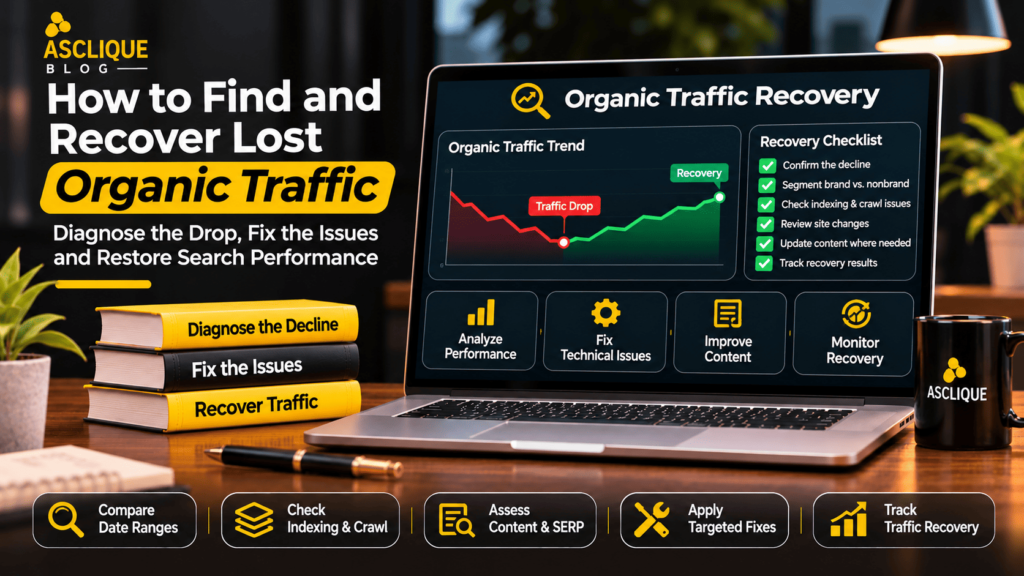
Diagnose search declines with date comparisons, query segmentation, technical checks and evidence-based recovery plans.
Begin with a reliable baseline, prioritize the highest-value pages, document the action and confirm the outcome after implementation.
Key Facts
- Search Console and analytics can differ for legitimate reasons.
- A traffic drop does not automatically mean a penalty.
- Check demand and SERP click behavior before rewriting content.
Asclique Workflow
Our recommended sequence is: discover the issue, validate it against independent evidence, estimate business impact, implement a controlled fix and monitor the result. This avoids spending weeks on technical changes that have no credible path to improved user experience or business performance.
Use a shared issue log with columns for affected URLs, evidence, priority, owner, dependency, deployment date and post-launch result. Capture screenshots or exports when necessary so future reviews can distinguish genuine improvements from measurement changes.
Professional search engine optimization services can help businesses investigate organic traffic declines, identify technical and content-related issues, and develop recovery strategies based on measurable evidence. A structured approach connects SEO improvements with search visibility, qualified traffic, and business performance.
Confirm the decline in reliable data
Identify the first sustained decline and compare the same period with relevant historical baselines. The practical objective is to make this decision auditable: record the affected URL group, the source of the evidence, the person responsible, and the specific observation that would show the work is complete. Do not assume that a tool warning, a ranking change, or a competitor example proves the cause. Confirm the issue on real pages and distinguish measured facts from working hypotheses.
For example, take a representative sample of pages and document their current state before editing. Apply the same check after implementation, noting exceptions rather than hiding them in an average. This gives the team a reproducible method for confirm the decline in reliable data and makes it easier to explain why the chosen work deserves time and budget.
For example, select one commercially important page group, review its current search performance and technical behavior, and write down what a successful change would look like. Keep an untouched comparison group where possible. If evidence is incomplete, label the hypothesis as unconfirmed and investigate before making a sitewide change.
Separate brand and nonbrand trends
Segment loss by landing page, query, device, country and brand versus nonbrand. The practical objective is to make this decision auditable: record the affected URL group, the source of the evidence, the person responsible, and the specific observation that would show the work is complete. Do not assume that a tool warning, a ranking change, or a competitor example proves the cause. Confirm the issue on real pages and distinguish measured facts from working hypotheses.
For example, take a representative sample of pages and document their current state before editing. Apply the same check after implementation, noting exceptions rather than hiding them in an average. This gives the team a reproducible method for separate brand and nonbrand trends and makes it easier to explain why the chosen work deserves time and budget.
For example, select one commercially important page group, review its current search performance and technical behavior, and write down what a successful change would look like. Keep an untouched comparison group where possible. If evidence is incomplete, label the hypothesis as unconfirmed and investigate before making a sitewide change.
| Need help with organic traffic recovery? Asclique can help turn findings into an actionable SEO plan. Request a review of your priorities and measurement approach. |
Locate affected pages and queries
Check whether demand fell, rankings changed or click-through rate shifted. The practical objective is to make this decision auditable: record the affected URL group, the source of the evidence, the person responsible, and the specific observation that would show the work is complete. Do not assume that a tool warning, a ranking change, or a competitor example proves the cause. Confirm the issue on real pages and distinguish measured facts from working hypotheses.
For example, take a representative sample of pages and document their current state before editing. Apply the same check after implementation, noting exceptions rather than hiding them in an average. This gives the team a reproducible method for locate affected pages and queries and makes it easier to explain why the chosen work deserves time and budget.
For example, select one commercially important page group, review its current search performance and technical behavior, and write down what a successful change would look like. Keep an untouched comparison group where possible. If evidence is incomplete, label the hypothesis as unconfirmed and investigate before making a sitewide change.
Check indexing and crawl changes
Review recent releases, redirects, robots rules, canonicals and server errors. The practical objective is to make this decision auditable: record the affected URL group, the source of the evidence, the person responsible, and the specific observation that would show the work is complete. Do not assume that a tool warning, a ranking change, or a competitor example proves the cause. Confirm the issue on real pages and distinguish measured facts from working hypotheses.
For example, take a representative sample of pages and document their current state before editing. Apply the same check after implementation, noting exceptions rather than hiding them in an average. This gives the team a reproducible method for check indexing and crawl changes and makes it easier to explain why the chosen work deserves time and budget.
For example, select one commercially important page group, review its current search performance and technical behavior, and write down what a successful change would look like. Keep an untouched comparison group where possible. If evidence is incomplete, label the hypothesis as unconfirmed and investigate before making a sitewide change.
A comprehensive technical SEO audit can help identify indexing errors, crawlability problems, broken redirects, and other technical issues that may contribute to declining organic traffic. Reviewing these findings alongside historical performance data helps businesses determine which problems require immediate attention.
Review site releases and migrations
Check tracking changes before concluding that organic visitors disappeared. The practical objective is to make this decision auditable: record the affected URL group, the source of the evidence, the person responsible, and the specific observation that would show the work is complete. Do not assume that a tool warning, a ranking change, or a competitor example proves the cause. Confirm the issue on real pages and distinguish measured facts from working hypotheses.
For example, take a representative sample of pages and document their current state before editing. Apply the same check after implementation, noting exceptions rather than hiding them in an average. This gives the team a reproducible method for review site releases and migrations and makes it easier to explain why the chosen work deserves time and budget.
For example, select one commercially important page group, review its current search performance and technical behavior, and write down what a successful change would look like. Keep an untouched comparison group where possible. If evidence is incomplete, label the hypothesis as unconfirmed and investigate before making a sitewide change.
Changes to SEO site architecture can affect how search engines discover, crawl, and understand important website pages. When investigating traffic losses after a redesign or migration, review changes to URL structures, navigation, internal linking, and page accessibility.
| Need help with organic traffic recovery? Asclique can help turn findings into an actionable SEO plan. Request a review of your priorities and measurement approach. |
Assess content and SERP changes
Refresh pages only where intent, evidence or usefulness has genuinely deteriorated. The practical objective is to make this decision auditable: record the affected URL group, the source of the evidence, the person responsible, and the specific observation that would show the work is complete. Do not assume that a tool warning, a ranking change, or a competitor example proves the cause. Confirm the issue on real pages and distinguish measured facts from working hypotheses.
For example, take a representative sample of pages and document their current state before editing. Apply the same check after implementation, noting exceptions rather than hiding them in an average. This gives the team a reproducible method for assess content and serp changes and makes it easier to explain why the chosen work deserves time and budget.
For example, select one commercially important page group, review its current search performance and technical behavior, and write down what a successful change would look like. Keep an untouched comparison group where possible. If evidence is incomplete, label the hypothesis as unconfirmed and investigate before making a sitewide change.
Following page speed optimization best practices can help businesses identify performance issues affecting mobile usability and user experience. Although faster loading does not guarantee traffic recovery, resolving significant performance problems can improve website accessibility and reduce unnecessary friction.
Choose targeted fixes
Separate quick technical restoration from longer content and competitive work. The practical objective is to make this decision auditable: record the affected URL group, the source of the evidence, the person responsible, and the specific observation that would show the work is complete. Do not assume that a tool warning, a ranking change, or a competitor example proves the cause. Confirm the issue on real pages and distinguish measured facts from working hypotheses.
For example, take a representative sample of pages and document their current state before editing. Apply the same check after implementation, noting exceptions rather than hiding them in an average. This gives the team a reproducible method for choose targeted fixes and makes it easier to explain why the chosen work deserves time and budget.
For example, select one commercially important page group, review its current search performance and technical behavior, and write down what a successful change would look like. Keep an untouched comparison group where possible. If evidence is incomplete, label the hypothesis as unconfirmed and investigate before making a sitewide change.
Professional content marketing services can help businesses evaluate underperforming pages, identify content gaps, and improve existing information to better match search intent. Content updates should focus on relevance, accuracy, and usefulness rather than rewriting pages simply because traffic has declined.
Track recovery without false promises
Monitor recovery by affected cohorts, with a change log and realistic observation window. The practical objective is to make this decision auditable: record the affected URL group, the source of the evidence, the person responsible, and the specific observation that would show the work is complete. Do not assume that a tool warning, a ranking change, or a competitor example proves the cause. Confirm the issue on real pages and distinguish measured facts from working hypotheses.
For example, take a representative sample of pages and document their current state before editing. Apply the same check after implementation, noting exceptions rather than hiding them in an average. This gives the team a reproducible method for track recovery without false promises and makes it easier to explain why the chosen work deserves time and budget.
For example, select one commercially important page group, review its current search performance and technical behavior, and write down what a successful change would look like. Keep an untouched comparison group where possible. If evidence is incomplete, label the hypothesis as unconfirmed and investigate before making a sitewide change.
Weak vs. Better
| Weak approach | Better approach |
|---|---|
| Treat every URL as equal | Segment pages by traffic potential, user intent and business value |
| Act on a single tool warning | Validate with first-party data and a manual URL sample |
| Promise a fixed uplift | Use scenarios, assumptions and clear confidence limits |
| Mark the task done at deployment | Check live behavior and outcomes after release |
Common Mistakes
- Blaming every decline on an algorithm update
- Comparing unequal date ranges
- Deleting pages before diagnosing intent
- Making many simultaneous changes
The common thread is overconfidence. Before changing many pages, verify the problem, confirm its scope and preserve a rollback path. A technically valid change may still be commercially unhelpful if it targets the wrong audience or removes useful content.
Not Proven
No responsible practitioner can guarantee a ranking, a specific volume of AI citations or a fixed revenue gain from organic traffic recovery. Search interfaces change, measurement is incomplete and competitors respond. Treat estimated uplift as a scenario, not an invoiceable outcome. Likewise, third-party SEO scores are diagnostic signals rather than Google ranking formulas.
Measure Success
Create a before-and-after scorecard with Search Console clicks, impressions, click-through rate and relevant query groups; analytics landing-page sessions and meaningful events; and CRM-qualified leads or revenue where available. Record the exact comparison dates, filters and attribution assumptions.
Evaluate leading indicators such as resolved indexation issues or improved internal discovery separately from lagging indicators such as sales. Annotate releases, seasonality and tracking changes. Where possible, compare affected templates against a similar unaffected group instead of attributing every sitewide movement to one change.
Checklist
- Document the business objective and the current baseline.
- Identify the affected page types, owners and dependencies.
- Validate important findings with at least two relevant evidence sources.
- Estimate priority using potential impact, confidence, effort and risk.
- Test the change on representative URLs before a broad rollout.
- Verify live implementation and capture a deployment record.
- Review results at agreed intervals and update the backlog.
FAQs
What data should be collected before starting?
Begin with a dated URL inventory, Search Console exports, GA4 landing-page reports and a record of recent website changes. For How to Find and Recover Lost Organic Traffic, also capture the relevant business outcome, the page templates involved and any known data gaps. Save raw exports so later comparisons do not depend on screenshots or changing dashboard filters.
How should a team prioritize the first improvements?
Rank the work by affected business value, evidence strength, number of impacted URLs and implementation effort. In this topic, a verified problem affecting important landing pages should normally take precedence over a low-confidence warning on a page that serves no meaningful search demand. Assign an owner and a measurable acceptance test to each selected action.
Which mistakes can invalidate the findings?
The most damaging mistake is treating correlation as proof. A decline after a redesign does not automatically mean the redesign caused it; similarly, a ranking gain after an edit does not isolate the effect of that edit. Check dates, seasonality, tracking, search demand and concurrent releases before making a confident claim about how to find and recover lost organic traffic.
What should be checked after implementation?
Check the live production version, not only the CMS preview. Verify HTTP status, canonical and robots signals when relevant, inspect rendered content, test internal links and confirm that analytics events fire correctly. Record sample URLs and results. Follow-up checks should cover both immediate implementation accuracy and subsequent search or business outcomes.
How should results be explained to stakeholders?
Explain the baseline, the intervention, the expected mechanism and what the observed data actually supports. Separate leading indicators such as crawl health and impressions from outcomes such as qualified leads and sales. Where evidence is incomplete, give a confidence range and identify the next validation step instead of promising a specific traffic or revenue gain.
Can the process work for a small business?
Yes. A smaller business can use a spreadsheet, Search Console, GA4 and a short monthly review rather than buying an enterprise platform. Focus on the few service or product pages that drive meaningful enquiries. The same principles apply: verify the problem, document the change and evaluate whether customer outcomes improved.
What changes when the site is very large?
At scale, template-level issues, crawl sampling, automation and ownership become more important. A single incorrect canonical rule can affect thousands of URLs, while a single successful template fix can resolve many pages. Use page groups, automated regression checks and representative manual review rather than assuming a full crawl alone proves quality.
How can AI search affect the analysis?
AI answer interfaces may change how often searchers click through to websites, but most analytics setups cannot observe every answer impression or citation. Track identifiable AI referrals as a separate channel where possible and label manual answer samples as observations. Do not add assumed AI citations to organic clicks or present an AI visibility estimate as verified revenue.
Recommendation
Approach organic traffic recovery as a sequence of measurable decisions. Start with the pages and user journeys that matter most, make changes in controlled batches, and keep evidence of what changed. A focused plan with verified outcomes is more valuable than an extensive audit that nobody implements.
Integrating answer engine optimization services into a broader organic traffic recovery strategy can help businesses structure content around relevant customer questions and improve information accessibility. As search experiences evolve, businesses should evaluate traditional organic performance alongside identifiable traffic from AI-powered search platforms.
Need Help?
Asclique supports SEO planning, technical reviews and performance measurement. Share your website, goals and current constraints to discuss an appropriate scope.
| Need help with organic traffic recovery? Asclique can help turn findings into an actionable SEO plan. Request a review of your priorities and measurement approach. | Contact Asclique |