
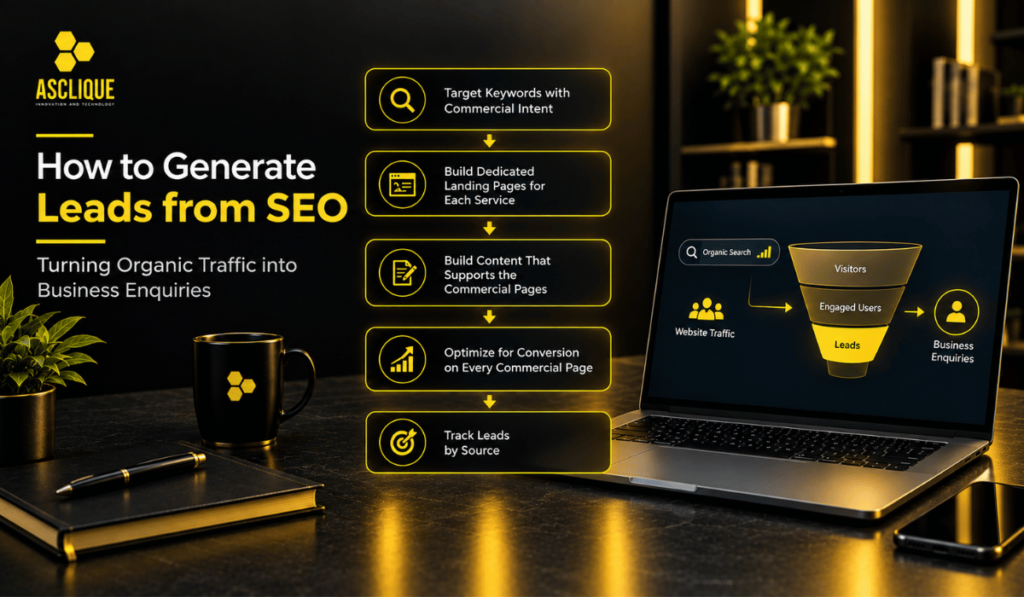
Ranking in Google is the first step. Converting that traffic into qualified leads is where most SEO programs fall short.
This guide covers how to build an SEO program oriented toward lead generation—not just traffic—and what changes at each stage of the process when the goal is inquiries and revenue rather than ranking positions.
Why Traffic Alone Is Not Enough
A site can generate tens of thousands of monthly organic visits and still produce almost no leads. This happens when:
- The site ranks for informational keywords with no commercial intent
- The landing pages are not designed to convert visitors into inquiries
- There is no clear next step for visitors who are ready to engage
- The audience being targeted is not the buyer—it is a researcher or a student or a competitor
Generating SEO leads starts with building an organic search strategy around commercial intent, not just search volume.
Step 1: Target Keywords with Commercial Intent
The keywords that generate leads are different from the keywords that generate traffic. High-traffic informational keywords (“what is content marketing”) attract researchers. Commercial keywords (“content marketing agency for SaaS”) attract buyers.
Commercial intent keyword patterns:
- Service + location (“SEO agency [city],” “plumber near me”)
- Comparison queries (“Ahrefs vs Semrush,” “best email marketing software”)
- Vendor selection queries (“digital marketing agency for ecommerce,” “white label SEO for agencies”)
- Problem-specific queries where the solution is a product or service (“how to fix Google penalty,” “website not ranking on Google”)
- Pricing queries (“SEO services cost,” “how much does PPC management cost”)
These queries are often lower in search volume than broad informational terms, but they convert at significantly higher rates. A page that generates 200 visits from “SEO agency for law firms” will produce more leads than a page generating 2,000 visits from “what is SEO?”
Step 2: Build Dedicated Landing Pages for Each Service
A common mistake: driving commercial keyword traffic to a generic homepage or a “Services” overview page. Each service should have its own dedicated landing page designed for both ranking and conversion.
A lead-generating service page includes:
A clear, specific headline. Not “Our Services” but “SEO for Law Firms — Organic Growth for Legal Practices.”
A direct explanation of what you do and who it is for. No jargon, no vague positioning. Specific is more convincing than general.
Trust signals. Client logos, case study summaries, testimonials with specific results, certifications, and number of clients served or years in operation.
Clear social proof. A review quote with the reviewer’s full name and company converts better than an anonymous “Happy client.”
A primary CTA above the fold. The most important call to action—”Get a free audit,” “Book a consultation,” “Contact us”—should be visible without scrolling.
Secondary CTA options. Not everyone is ready to book immediately. A secondary offer (download a guide, see pricing, read case studies) captures mid-funnel visitors who need more information before engaging.
FAQs that address objections. Common concerns about price, timeline, process, and guarantees addressed directly on the page reduce friction before the first inquiry.
Step 3: Build Content That Supports the Commercial Pages
Content marketing generates organic traffic, but its role in lead generation is often misunderstood. Blog content rarely converts directly into leads—its value is reaching buyers at an earlier stage of their research and guiding them toward the commercial pages.
Content that supports lead generation:
Problem-aware content. Articles that help potential buyers understand a problem they have and the solutions available (“Signs your SEO strategy is not working,” “Why your Google Business Profile is not showing up”).
Comparison and evaluation content. Content for buyers comparing options (“Agency vs in-house SEO: which is right for your business,” “What to look for in an SEO agency”).
Case studies and results content. Detailed breakdowns of client results build credibility and attract buyers searching for evidence that the service works.
FAQ and objection-handling content. Articles that address common questions about price, process, and timelines inform buyers and reduce friction in the sales process.
Each content piece should link naturally to the relevant service page—a post about “how to choose an SEO agency” should link to your SEO services page with clear anchor text and a contextual CTA.
Step 4: Optimize for Conversion on Every Commercial Page
Getting organic traffic to a landing page is only half the work. Conversion rate optimization (CRO) on commercial pages directly affects lead volume without requiring more traffic.
Key conversion elements:
Contact form above the fold. On a service or contact page, the form should be visible immediately. Multi-page or multi-step forms reduce friction compared to long single-page forms.
Phone number prominently displayed. Many buyers prefer to call rather than fill out a form, particularly for high-value services. A visible phone number captures these leads.
Page load speed. Slow pages on mobile produce higher bounce rates. Check Core Web Vitals for commercial pages.
Mobile optimization. More than half of B2B searches happen on mobile. A mobile-unfriendly service page loses a significant portion of its potential leads.
Trust signals near the CTA. Place testimonials, client logos, or certifications adjacent to the form or CTA button.
Step 5: Track Leads by Source
You cannot optimize what you cannot measure. Set up lead attribution before optimizing for it.
GA4 conversion tracking: Define form completions as conversion events. Track these by traffic source to see which organic pages and keywords are generating leads.
UTM parameters for campaigns: All paid ads and email campaigns driving to service pages should use UTMs so organic traffic is clearly separated.
CRM integration: If possible, pass the lead source through to the CRM so the full journey (from organic search to closed deal) is trackable. HubSpot, Salesforce, and Pipedrive all support this.
Call tracking: Use a call tracking number on the website distinct from your main number. Services like CallRail or ResponseTap show which pages and sources generate calls.
What a Lead-Generating SEO Program Looks Like
Month 1–2: Audit existing service pages for conversion elements. Improve above-fold CTAs, add trust signals, and fix mobile issues.
Month 2–4: Launch or update commercial landing pages for each target service, optimized for high-intent keywords.
Month 3–6: Publish supporting blog content linking to commercial pages. Build internal links from high-traffic informational pages to commercial pages.
Month 4–8: Acquire backlinks to commercial pages through digital PR, guest posting, and outreach. Link building to service pages directly improves rankings for commercial keywords.
Month 6–12: Review lead attribution data. Double down on content topics and page types that are producing the highest conversion rates.
Frequently Asked Questions
How long does SEO take to generate leads?
With a focused commercial keyword strategy and optimized landing pages, most businesses start seeing organic leads within 4–6 months of a properly executed SEO program. Highly competitive markets may take 8–12 months for meaningful lead volume.
Can I generate leads from SEO without a large content strategy?
Yes. If your service pages are well-optimized for commercial keywords and your domain has sufficient authority to rank, you can generate leads without running a large content marketing program. Content accelerates results but is not the only path.
Should I focus on local or national SEO for lead generation?
This depends on your business model. Service businesses with defined geographic service areas should prioritize local SEO. Agencies, SaaS companies, and businesses that can serve clients nationally should target national commercial keywords.
What conversion rate should I expect from SEO traffic?
Commercial page conversion rates for B2B service businesses typically range from 2–8%. Informational blog content converts at 0.1–1%. Track your specific page-level conversion rates and benchmark against your own historical performance.
How do I know which SEO keywords are actually generating leads?
Use GA4 with conversion tracking set up for form completions. In GA4, go to Reports > Acquisition > Traffic Acquisition and filter by organic search. Use Landing Page reports to see which pages produce conversions. Google Search Console shows which queries drive traffic to those pages.
Asclique builds SEO programs focused on commercial outcomes—not just rankings. Our SEO services include commercial keyword strategy, landing page optimization, and content designed to support lead generation. Contact us to discuss what a lead-focused SEO program looks like for your business.