
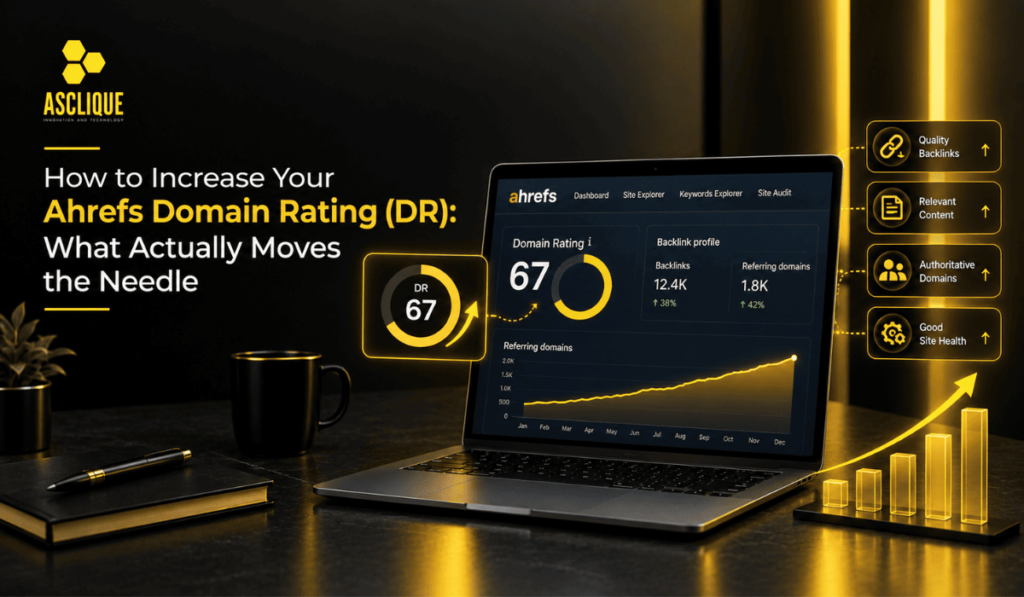
Domain Rating (DR) is Ahrefs’ proprietary metric that scores a website’s backlink profile strength on a scale from 0 to 100. It is logarithmic, meaning the difference between DR 70 and DR 80 is significantly larger than the difference between DR 10 and DR 20.
Higher DR correlates with the ability to rank competitively for harder keywords. But increasing DR is not about chasing the number—it is the outcome of building a genuinely strong backlink profile. This guide explains how DR is calculated and what actions actually move it.
How Ahrefs Domain Rating Is Calculated
DR is based on the quantity and quality of unique referring domains pointing to your website, weighted by the DR of those domains. The formula, as Ahrefs describes it:
- Each linking domain passes some of its DR to the domains it links to
- The more outgoing links a domain has, the less DR each recipient receives
- DR is normalized logarithmically—gains are harder at higher score ranges
What this means in practice: one high-DR link is often more valuable than dozens of low-DR links. And a high-DR site that links to thousands of other sites passes less DR to each than one that links to fewer.
DR does not measure content quality, traffic, or relevance—only link profile strength. A spammy site could technically have a high DR if it has accumulated many links.
What Actually Increases Domain Rating
1. Earn Links from High-DR Referring Domains
The most direct path to increasing DR is acquiring links from high-authority websites. The higher the DR of the linking site, and the fewer external links it has on the page linking to you, the more DR equity is passed.
Effective strategies for earning high-DR links:
Digital PR: Pitch original data, research, or expert commentary to journalists and editorial publications. High-authority news sites, industry publications, and research platforms regularly link out. A single link from a DR 80+ news publication can meaningfully move DR for most small- to mid-sized sites.
Guest posting on authoritative sites: Contributing bylined articles to industry publications with genuine editorial standards produces links that build DR. Quality matters—links from publications with real editorial vetting are more valuable than links from low-bar guest post farms.
Linkable asset creation: Original research reports, industry surveys, unique tools or calculators, and comprehensive guides attract links organically. If you publish something genuinely useful that other sites want to reference, links follow.
Resource page outreach: Identify resource pages or curated lists in your industry that link to similar content. Reach out and suggest your content for inclusion. This works best with genuinely high-quality resources.
Broken link building: Find broken outbound links on high-authority sites in your niche, create a page that matches what the broken link pointed to, and notify the site owner. Conversion rates are modest, but the acquired links are high quality.
2. Increase the Number of Unique Referring Domains
DR responds more to unique domains than to multiple links from the same domain. Ten links from ten different DR 60 sites will increase DR more than ten links from the same DR 60 site.
Diversify link-building efforts across target publications rather than concentrating on repeat links from the same sources.
3. Avoid Losing Existing Referring Domains
DR can decrease when existing backlinks are lost—through site migrations, content deletion, or linking sites going offline.
Monitor backlinks monthly with Ahrefs’ Alerts or the “Lost Backlinks” filter to catch losses early. When a high-value linking page is deleted or moved, try to get the link reinstated or redirect it to a live page.
4. Do Not Block Ahrefs Bot
Ahrefs discovers and evaluates your backlinks by crawling the web. If Ahrefs Bot is blocked by your robots.txt or server settings, it may undercount your link profile. Verify that Ahrefs Bot (user agent: AhrefsBot) is not blocked on your site.
What Does NOT Increase Domain Rating
Buying links from link networks: Purchased links from private blog networks (PBNs) or low-quality link directories may temporarily show in Ahrefs’ index but are often devalued over time as Ahrefs identifies link patterns. They also risk Google penalties.
Adding more internal links: Internal links do not affect DR. They influence page-level metrics (URL Rating) but not the domain-level backlink profile.
Creating more content by itself: Publishing more content does not directly increase DR unless that content attracts new inbound links from external domains.
Social media links: Social links are almost universally nofollow and not indexed by Ahrefs as DR-contributing backlinks.
Submitting to low-quality directories: Directories with DR 20 or below contribute minimal DR. A large number of directory submissions does not meaningfully improve DR for established sites.
Realistic DR Growth Expectations
DR growth is slow for most sites and accelerates with scale. Some context:
- A new site (DR 0–20) can grow significantly with 10–20 quality referring domains
- A mid-authority site (DR 30–50) needs consistent high-quality link acquisition to show movement—typically months of active link building
- A high-authority site (DR 60+) may need dozens of high-DR links to move the needle because the logarithmic scale makes each point harder to earn
Sites that see DR growth of 5–10 points per quarter are doing aggressive, consistent link building from quality sources. Sites that grow 1–3 points per quarter are actively building links but at a moderate pace.
Do not compare your DR to a competitor’s and expect to close a 20-point gap in three months. DR at the higher ranges reflects years of link acquisition.
Using DR as a Strategic Tool
DR is most useful as a benchmark for comparison, not as an absolute goal. Track:
- Your DR versus your top competitors’ DR
- New referring domains per month as a leading indicator of future DR growth
- Lost referring domains to catch backlink erosion
A site with DR 45 competing in a space where competitors average DR 55 has a structural authority disadvantage. That gap informs how much link-building investment is needed to compete and which keywords are within reach at the current authority level.
Frequently Asked Questions
How long does it take for DR to update in Ahrefs?
Ahrefs updates DR as it crawls the web and discovers new or lost backlinks. There is no fixed schedule, but significant changes typically reflect within 2–4 weeks of new links being indexed. DR recalculations also happen periodically.
Why did my DR go down even though I gained new backlinks?
DR is relative and recalculated based on the entire web’s link graph. If high-DR sites that previously linked to you lost links themselves (reducing their DR), or if you lost referring domains at a faster rate than you gained them, DR can decline. DR can also be affected by Ahrefs’ periodic index updates.
Is DR more important than DA (Domain Authority by Moz)?
Both are third-party metrics—neither is used by Google. DR (Ahrefs) and DA (Moz) measure similar things with different methodologies. SEO professionals tend to use whichever tool they rely on for backlink analysis. Neither DR nor DA directly determines Google rankings; they are proxies for backlink profile strength.
What DR should I target to rank competitively?
The DR needed to rank depends on the keyword and competition level. Use Ahrefs’ SERP overview for your target keywords to see the DR range of currently ranking pages. If the top 10 sites average DR 70 and you are at DR 30, authority-building is a prerequisite to competing.
Does disavowing toxic links increase DR?
Disavowing low-quality backlinks removes them from consideration in Google’s evaluation of your link profile. However, Ahrefs still counts disavowed links in its DR calculation—the disavow file is a Google-specific signal that Ahrefs does not read. Disavowing primarily helps with manual actions or algorithmic filters, not with increasing Ahrefs DR.
Asclique’s link building services focus on quality referring domain acquisition from editorially relevant sources. If you want to systematically increase your site’s authority and improve competitive rankings, contact us to discuss a link-building strategy.