
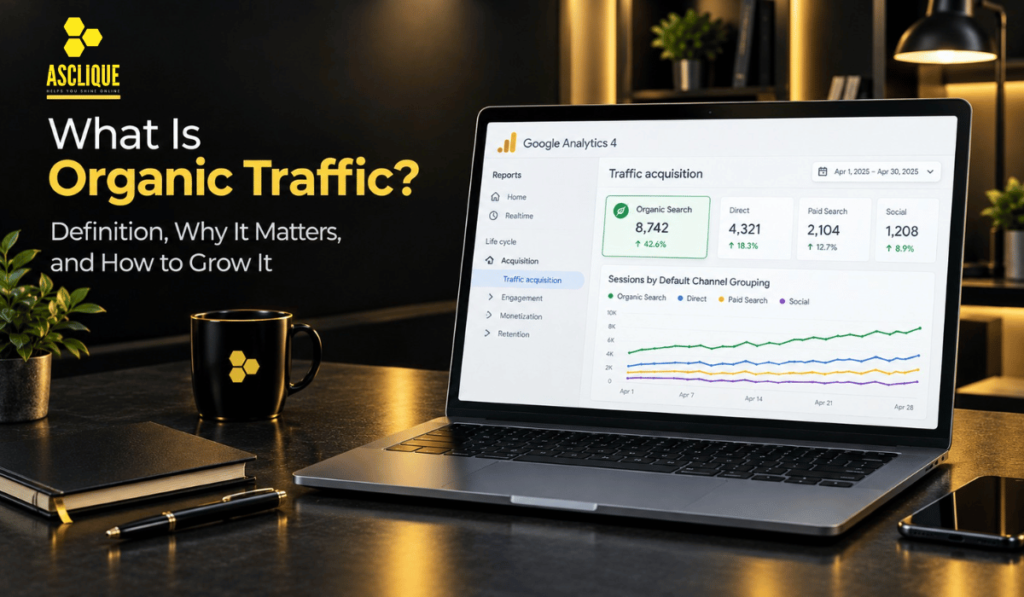
Organic traffic is the visitors who arrive at your website by clicking on unpaid (non-sponsored) search results. When someone types a query into Google or Bing, finds your page in the search results without it being marked as an ad, and clicks through—that is organic traffic.
It is one of the most valuable traffic sources for businesses because it is driven by intent (the visitor actively searched for something), it does not cost per click, and it compounds over time as more content ranks.
What Counts as Organic Traffic?
In Google Analytics 4, organic traffic is classified under the “Organic Search” channel in acquisition reports. It includes:
- Clicks from Google’s standard search results (the blue links)
- Clicks from Bing, Yahoo, DuckDuckGo, and other search engines
- Clicks from image search results
- Some traffic from Google Shopping (free listings)
It does not include:
- Google Ads clicks (these appear as “Paid Search” in GA4)
- Traffic from social media (appears as “Social”)
- Traffic from email campaigns (appears as “Email”)
- Direct traffic (typed URL or bookmarks)
- Referral traffic (links from other websites that are not search engines)
Why Organic Traffic Is Valuable
It does not cost per click. Unlike Google Ads or social media ads, you do not pay each time someone clicks your organic result. Once a page ranks, traffic from that ranking is essentially free—you pay for the SEO investment, but not for each individual visitor.
It is intent-based. Someone who found your site by searching “accountant for freelancers” is looking for exactly what you might offer. That intent makes organic traffic more likely to convert than audience-based advertising targeting.
It compounds. A well-ranked page can send traffic for months or years. Compare this to paid ads, which stop the moment you stop paying. The return on a content investment grows over time.
It builds brand authority. Appearing in search results for terms relevant to your business builds brand recognition with your target audience—even for users who do not click.
Organic Traffic vs. Paid Traffic
| Metric | Organic Traffic | Paid Traffic |
|---|---|---|
| Cost per click | None (after SEO investment) | Paid each click |
| Speed | Takes months to build | Immediate |
| Duration | Ongoing once ranking is established | Stops when spending stops |
| Click-through rate | Generally higher trust | Lower trust (labeled as Ad) |
| Scalability | Limited by search volume | Scalable with budget |
| Competitive | Rankings must be earned. | Positions can be bought. |
Both organic and paid traffic have a place in most digital marketing strategies. Paid search fills the gap while organic builds. Organic provides the compounding, lower-cost traffic base.
How Organic Traffic Works: The Basics of SEO
Organic traffic comes from SEO—search engine optimization. The factors Google uses to rank pages determine which sites receive organic traffic for a given search.
The primary ranking factors:
Content relevance and quality: Does the page thoroughly address the search query? Google assesses how well the content matches what users searching that query actually want.
Domain and page authority: Sites with more high-quality backlinks have more authority in Google’s index, which helps their pages rank for competitive queries.
Technical health: Pages that load quickly, are mobile-friendly, and have clean crawlability signals rank more effectively than technically problematic sites.
User experience signals: Click-through rate from search results, time-on-page, and other engagement signals influence how Google assesses whether a page is satisfying searcher intent.
How to Measure Organic Traffic
Google Analytics 4: In GA4, go to Reports → Acquisition → Traffic Acquisition. Filter or segment by “Session source / medium” containing “organic.” This shows sessions, users, conversions, and engagement metrics from organic search.
Google Search Console: GSC provides data specifically on organic search performance—impressions (how many times your pages appeared in search results), clicks (how many times those appearances resulted in clicks), average position, and click-through rate. It also shows which specific queries drive traffic to your site.
The two tools together give a complete view: GSC shows what Google sees (queries, impressions, positions); GA4 shows what happens when visitors arrive (pages visited, conversions, sessions).
How to Grow Organic Traffic
Create Content That Targets Relevant Queries
Organic traffic starts with keyword research—identifying what your target audience is searching for and creating content that matches those queries. Content that is:
- Specifically aligned to search intent (the right format, the right depth)
- More thorough and accurate than what currently ranks
- Authored by someone with relevant expertise
- Updated when information changes
Build Domain Authority
More authoritative domains rank for more competitive queries. Domain authority comes primarily from backlinks—other sites linking to yours editorially. Building authority through digital PR, guest posting, and creating linkable resources expands the range of keywords your site can rank for.
Fix Technical SEO Issues
Pages that are not indexed, that load too slowly, or that have duplicate content issues do not rank effectively even with good content. A technical SEO audit identifies and prioritizes issues that block organic performance.
Optimize Existing Pages for Higher Positions
Pages ranking in positions 5–20 are often close to significantly more traffic. Improving the content depth, updating statistics, adding internal links from high-authority pages, and building a few links directly to those pages can move them into the top-3 positions where click-through rates are dramatically higher.
Improve Click-Through Rate from Search Results
A page can rank in position 3 and receive minimal traffic if the title tag and meta description are not compelling. Optimizing titles and descriptions for the search queries that trigger impressions (visible in GSC) can increase organic traffic without improving the ranking position.
How Long Does It Take to See Organic Traffic?
New websites with no existing authority may take 6–12 months to generate meaningful organic traffic. Established sites with some existing authority can see results from new content in 3–6 months. The compounding nature of SEO means growth accelerates as authority builds—months 12–24 typically see faster growth than months 1–6.
Realistic expectations:
- Month 1–3: Technical fixes, indexation, initial rankings for long-tail keywords
- Month 3–6: Traffic from informational content, some commercial keyword movement
- Month 6–12: Compounding organic growth, more competitive keyword rankings improving
- Month 12+: Established authority driving consistent organic leads and traffic
Frequently Asked Questions
What is a good amount of organic traffic?
Organic traffic benchmarks vary wildly by industry, business size, and how established the site is. More useful than a universal benchmark: is your organic traffic trending upward over time, and is it producing qualified leads or sales? A site with 1,000 monthly organic visitors that converts at 5% and produces 50 qualified leads is more valuable than a site with 50,000 visitors and a 0.05% conversion rate.
Is organic traffic better than paid traffic?
Each has strengths. Organic traffic has no cost per click and compounds over time. Paid traffic is immediate and controllable. The best digital marketing programs use paid to fill short-term gaps while organic builds. For businesses with limited budgets, SEO often produces a better long-term ROI than sustained paid advertising.
Why does my organic traffic fluctuate?
Normal seasonal variation, algorithm updates, ranking changes on specific keywords, and shifts in search demand all cause organic traffic to fluctuate. Month-over-month comparisons within the same season (or year-over-year) are more meaningful than week-to-week comparisons.
Can I get organic traffic without a blog?
Yes. Service pages, product pages, location pages, and FAQ pages all attract organic traffic if they rank for relevant queries. A blog accelerates organic traffic growth by producing more rankable content, but it is not the only way to build organic visibility.
How do I see which keywords are driving my organic traffic?
In Google Search Console, go to “Performance → Search Results.” This shows all the queries your site generates impressions and clicks for, with average position and CTR. In GA4, use the “Organic” channel filters combined with landing page reports to see which pages receive the most organic sessions.
Asclique builds organic traffic programs through SEO and content marketing. If you want to grow your site’s organic traffic with a strategy that produces qualified leads, contact us.