
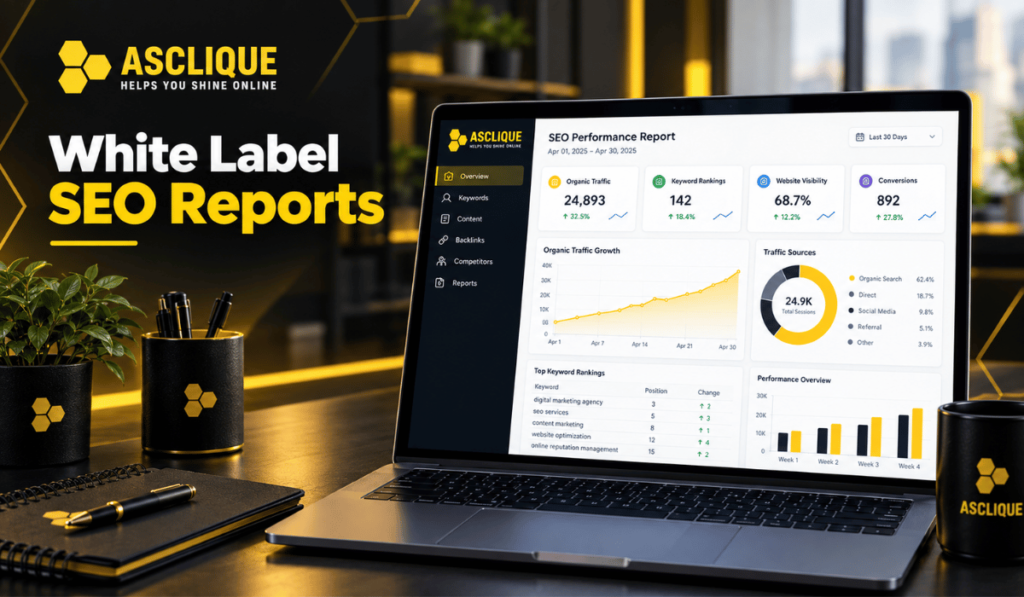
Every agency reselling SEO services faces the same pressure: clients expect professional reporting that reflects the quality of work being delivered. A white label SEO report solves this by presenting performance data under your own branding, with no trace of the underlying tool.
Done well, white label reporting strengthens client trust, reduces churn, and gives your agency the professional appearance of a much larger operation. Done poorly, it creates confusion, prompts unnecessary client concerns, and makes you look like you outsourced the analysis along with the SEO.
This guide covers what white label SEO reports actually are, what to include in them, which format holds up best in practice, the tools worth evaluating, and the mistakes that undermine client confidence.
What Is a White Label SEO Report?
A white label SEO report is a client-facing performance document branded with your agency’s logo, colors, and contact details, with no reference to the third-party platform that generated it. The client receives what appears to be a proprietary agency report. The underlying software remains invisible.
The defining characteristic is ownership of presentation. The data comes from tools like Google Search Console, Google Analytics 4, or a dedicated SEO platform. The report itself looks like it was built by your team.
White label reports differ from generic SEO reports in one key respect: they strip out any tool branding, watermarks, or platform references before delivery. Agencies typically use white label SEO reporting software that connects to data sources automatically and outputs branded PDFs or live dashboards without manual reformatting.
What to Include in a White Label SEO Report
Report structure should reflect what the client actually needs to know, not what’s easiest to pull from your reporting tool. The sections below represent the components of a well-structured monthly agency report.
Executive Summary
Lead with a brief, plain-language summary of the month’s performance. Three to five bullet points covering the most significant movements: keyword rankings gained or lost, traffic changes, conversions, and any notable external factors like algorithm updates.
Clients make decisions based on executive summaries. If a client reads nothing else, they should still understand whether SEO is working and what happened this month.
Business KPIs and Conversion Data
Organic traffic by itself does not tell a client whether SEO is generating business value. Connect performance to business outcomes:
- Phone calls and form submissions attributed to organic search
- Revenue or leads from organic landing pages (via GA4 or CRM integration)
- Conversion rate by landing page
- Goal completions month-over-month
For clients who do not have conversion tracking properly set up, note this explicitly and recommend implementation. Reporting only on rankings and traffic without tying them to outcomes is one of the most common reasons clients question the value of SEO investment.
Organic Traffic and Keyword Rankings
Include core visibility metrics but frame them in context:
- Total organic sessions (GA4), with month-over-month and year-over-year comparisons
- Top organic landing pages by sessions and conversions
- Keyword rank movements: top 10, top 3, and new rankings entering positions 1–30
- Impressions and clicks from Google Search Console
- Average CTR by page, flagging underperforming pages with high impressions
Avoid raw keyword count totals. A client ranking for 847 keywords means nothing unless the right keywords are moving in the right direction.
AI Visibility and Search Generative Experience
AI Overviews and AI-generated search results are now part of mainstream search behavior. Agencies serving clients who depend on visibility should track:
- Whether the client’s content appears in AI Overview citations
- Share of voice in AI-generated results for target queries
- Changes in GSC impressions for queries where AI Overviews have appeared
This is no longer an optional section. Search behavior has shifted enough that reporting only on traditional ranking positions misses a meaningful part of the visibility picture.
Local and Map Pack Performance (Where Applicable)
For clients with local SEO objectives:
- Google Business Profile impressions and actions (calls, directions, website clicks)
- Map pack ranking positions for core local keywords
- Review count and average rating changes
- Local citation consistency status
Technical SEO and Work Delivered
Clients should understand what your team actually did, not just what happened. Include:
- Technical issues resolved during the reporting period (crawl errors, page speed improvements, structured data implemented)
- Content published or optimized
- Links acquired, with source domains
- Any changes made in response to algorithm updates
This section justifies the retainer. Without it, clients perceive SEO as a passive service with no visible activity.
Annotated Timeline
A simple timeline overlaying key events, including:
- Major Google algorithm updates
- Content published or updated
- Technical changes made
- Significant ranking movements
This gives clients context for traffic fluctuations. A drop in sessions following a Google core update reads very differently from an unexplained decline.
PDF vs. Live Dashboard: Which Format Should You Use?
Neither format is strictly superior. Each serves a different purpose, and the most effective approach combines both.
| Format | Strengths | Limitations |
|---|---|---|
| PDF Report | Narrative context, strategic commentary, easy to share and archive | Becomes outdated immediately after generation |
| Live Dashboard | Real-time data, client self-service, reduces inbound questions | Clients may misinterpret fluctuations without context |
| Hybrid (PDF + Dashboard) | Best of both: dashboard for transparency, PDF for interpretation | Requires setup in both outputs |
The hybrid model has become standard practice at well-run agencies. The live dashboard answers “what is happening right now,” while the monthly PDF explains “what it means and what we’re doing about it.”
A short video walkthrough, typically 90 seconds to two minutes, accompanying the PDF significantly increases client engagement. Clients who understand their reports are less likely to cancel.
What to Remove from Your Reports
Many agencies inadvertently fill reports with metrics that confuse or concern clients without providing actionable information.
Remove or deprioritize:
- Domain Authority or Domain Rating scores as headline metrics. These are third-party estimates, not Google signals. If you include them, explain what they measure and why they can fluctuate.
- Total backlink count. Raw numbers without context (new links, lost links, referring domain quality) are not useful to most clients.
- Bounce rate in isolation. Without session duration and conversion data alongside it, bounce rate is frequently misread.
- Third-party tool screenshots with visible platform branding. Clients see the platform, not your agency.
- Keyword density metrics. These are irrelevant to modern SEO outcomes and suggest an outdated approach.
Leading with technical SEO metrics rather than business outcomes is the most common structural mistake. An executive at a client company wants to know if they are getting more leads from search. The crawler error count belongs in the appendix.
Best White Label SEO Reporting Tools
The tools below are commonly used by agencies for white label SEO reporting. Pricing reflects publicly listed rates and may change.
| Tool | Starting Price | Best For |
|---|---|---|
| AgencyAnalytics | From ~$20/month | Agencies managing multiple clients; strong multi-platform dashboard |
| Morningscore | From ~$69/month | Agencies wanting automated PDF + live link delivery |
| SE Ranking | From ~$119/month | Full SEO suite with built-in white label reporting and custom domain |
| DashThis | From ~$159/month | Custom dashboards; white label from Professional tier |
| Semrush | From ~$270/month | Large agencies needing deep data with branded reporting |
Key features to verify before committing to any platform:
- Custom logo, colors, and contact details in all report outputs
- Ability to use your own domain or subdomain for client-facing dashboards
- Automated scheduled delivery (PDF email or dashboard link)
- Integration with Google Search Console and GA4
- Option to hide the tool’s own branding completely
Most platforms offer trial periods. Running a test report for one client before migrating your full client base is worth the time.
How to Brand and Customize White Label Reports Effectively
Branding extends beyond dropping your logo on a PDF template. Clients who receive a report that looks like a generic template will notice. A few practices that improve perceived quality:
Use your color palette throughout. Most reporting tools allow custom color themes. Apply your agency’s primary and secondary colors to charts, headers, and callouts.
Replace default cover pages. Many tools provide generic covers. Replace them with a cover that includes your client’s company name, the reporting period, and your agency contact information.
Write the executive summary manually. Automate data collection and chart generation, but write the executive summary narrative each month. A few sentences of strategic commentary signal active management, not passive reporting.
Set up a branded subdomain for live dashboards. A dashboard accessible at reports.youragencyname.com carries significantly more authority than a link to a third-party platform URL.
Standardize delivery timing. Send reports on the same day each month, with a short personal note. Consistency builds confidence in the reporting process itself.
Frequently Asked Questions
What is a white label SEO report?
A white label SEO report is an SEO performance document branded with an agency’s own logo, colors, and contact information, with no reference to the third-party tool that generated the data. It allows agencies to present reports as their own proprietary output.
What should be included in an SEO report for clients?
A client SEO report should include an executive summary, business KPIs and conversion data, organic traffic trends, keyword ranking movements, AI visibility metrics, local performance data (if applicable), technical work completed, and an annotated timeline of key events and algorithm updates.
How often should I send white label SEO reports to clients?
Monthly reporting is standard for most SEO retainers. Some agencies add quarterly business reviews for longer-term strategic discussion, and a live dashboard for clients who want ongoing access between reports.
How long does it take to create a white label SEO report?
Using reporting software to automate data collection and chart generation, most agencies produce a client report in 20 to 45 minutes, primarily spent on writing the executive summary and reviewing the data for anomalies. Manual report creation without automation typically takes 8 to 12 hours per client.
Can clients tell whether a report was generated by a tool?
Not if the tool is properly configured and all platform branding is removed. High-quality white label reports with custom branding, a manually written executive summary, and a branded delivery domain appear entirely agency-produced.
What metrics should I stop including in SEO reports?
Remove or significantly deprioritize: raw domain authority scores, total backlink counts without context, keyword density metrics, bounce rate without supporting data, and any screenshots that show third-party tool branding.
Do I need a separate tool for white label reporting, or can I use Semrush or Ahrefs?
Semrush includes white label reporting features at higher pricing tiers. Ahrefs does not currently offer white label PDF reports natively. Dedicated reporting platforms like AgencyAnalytics or DashThis offer more customization and multi-platform integration at lower costs than full-suite tools.
Building Client Retention Through Better Reporting
White label SEO reporting is not just a branding exercise. Reports are often the primary touchpoint between your agency and a client each month. The quality of that document shapes how clients perceive the value of SEO, whether they renew, and whether they refer other businesses.
Agencies that report on business outcomes rather than technical metrics, explain changes rather than just listing them, and deliver consistently and on schedule retain clients significantly longer than those who treat reporting as an administrative task.
If your current reports are template-driven, metric-heavy, and light on strategic commentary, that is worth addressing before your next client renewal conversation.
Asclique provides white label SEO services for agencies looking to scale client delivery without expanding in-house teams. If you are evaluating white label SEO partners rather than reporting tools, our guide to white label SEO partners covers the fulfillment side in detail.
For agencies building out a broader digital offering alongside SEO, our link building services and answer engine optimization services are available under white label arrangements.