
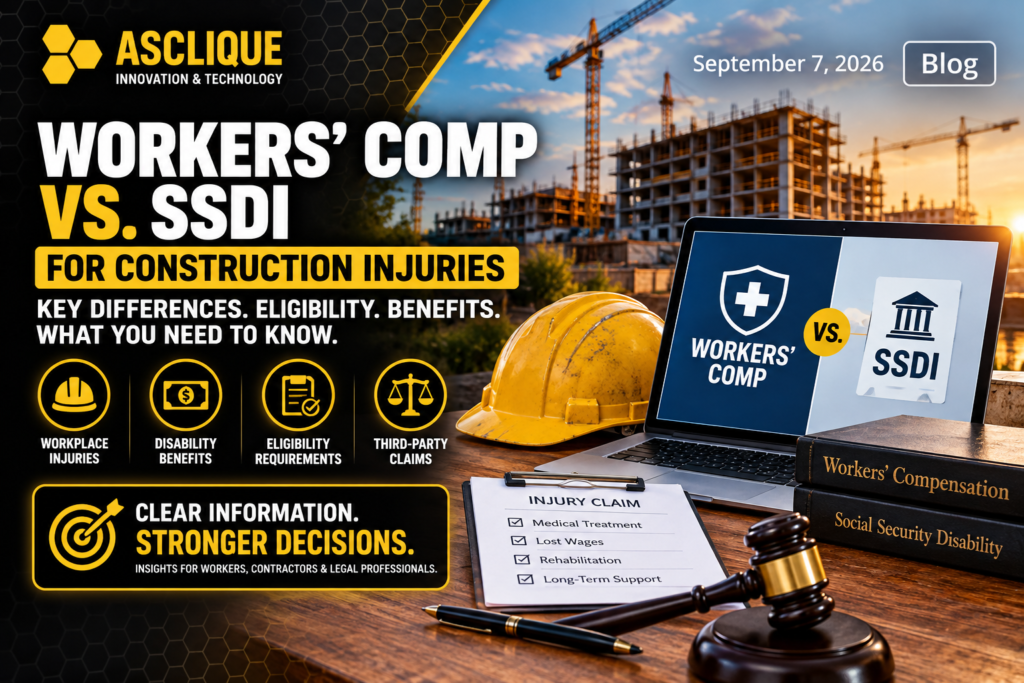
Construction remains one of the most physically demanding industries in the United States. In 2024, the construction industry recorded 1,034 fatal workplace injuries, the highest number among private industries, according to the U.S. Bureau of Labor Statistics.
But fatal accidents represent only part of the risk. Falls, machinery accidents, repetitive strain, falling objects, vehicle incidents, and other workplace hazards can leave construction workers unable to work for weeks, months, or permanently.
When a serious construction injury occurs, two benefit programs may become particularly important: workers’ compensation and Social Security Disability Insurance (SSDI).
Although both can provide financial assistance, they are not interchangeable. Workers’ compensation generally addresses job-related injuries and illnesses, while SSDI is a federal disability program for people who meet Social Security’s work-history and disability requirements.
Understanding workers’ comp vs. SSDI can therefore be important for injured workers, construction employers, contractors, and even law firms serving clients in this industry.
Workers’ Comp vs. SSDI: What Is the Main Difference?
The biggest difference is the reason someone qualifies for benefits.
Workers’ compensation is generally tied to an injury or illness connected to employment. A construction worker injured after falling from scaffolding, for example, may have a workers’ compensation claim because the accident happened in connection with the job.
SSDI takes a different approach.
The Social Security Administration generally requires a person to have a medical condition that prevents substantial gainful activity and prevents them from performing previous work or adjusting to other work. The condition must also have lasted, or be expected to last, at least 12 consecutive months or result in death.
That distinction becomes particularly important for construction workers.
Someone may be physically unable to return to roofing, concrete work, framing, electrical work, or another physically demanding occupation but potentially remain capable of performing less strenuous work.
That situation could affect an SSDI application differently from a workers’ compensation claim.
Workers’ Compensation Focuses on Workplace Injuries
Workers’ compensation programs are governed primarily by state law, which means eligibility requirements and benefits can vary considerably.
Generally, workers’ compensation may provide benefits associated with:
- Medical treatment
- Temporary disability
- Lost wages
- Permanent impairment or disability
- Rehabilitation
- Certain death benefits for surviving dependents
Workers typically do not need to prove that their employer intentionally caused the accident to seek workers’ compensation benefits. Instead, the central issue is generally whether the injury or illness falls within the state’s workers’ compensation system.
For construction businesses, this makes workplace safety, documentation, insurance coverage, and proper accident-reporting procedures particularly important.
Construction companies also operate in an increasingly competitive environment. Beyond managing employees and projects, contractors need to establish trust with customers and clearly communicate their expertise online. Asclique’s guide to digital marketing for contractors explains how contractors can use their websites, local search visibility, reviews, and content to build a stronger digital presence.
SSDI Uses a Much Broader Disability Standard
SSDI isn’t limited to workplace injuries.
A qualifying disability could result from a workplace accident, illness, medical condition, or another cause. What matters is whether the applicant meets Social Security’s requirements.
The Social Security Administration generally considers whether someone can perform substantial gainful activity because of their medical condition, whether they can perform their previous work or adjust to other work, and whether the disability satisfies the required duration.
For construction workers, this distinction matters because their previous jobs may require substantial lifting, climbing, bending, standing, or repetitive movement.
Consider a worker who develops a serious spinal injury.
They may no longer be physically capable of returning to construction. However, an SSDI determination may also consider whether that person can adjust to other types of substantial gainful work based on factors such as their medical limitations, age, education, and work experience.
The Timelines Can Be Very Different
Workers’ compensation and SSDI can also operate on different timelines.
Workers’ compensation is intended to address work-related injuries, including situations where an employee may only be temporarily unable to perform their job. The precise waiting periods and payment rules depend on state law.
SSDI is designed for long-term disability.
Social Security generally requires the qualifying disability to have lasted or be expected to last for at least 12 months or result in death. SSDI also generally has a five-month waiting period, although specific rules and exceptions can affect when entitlement begins.
This means an injured construction worker could potentially receive workers’ compensation before SSDI benefits become payable.
Can You Receive Workers’ Comp and SSDI at the Same Time?
Potentially, yes.
Qualifying for one program doesn’t automatically prevent a worker from qualifying for the other.
However, receiving both doesn’t necessarily mean simply adding the two benefit amounts together.
Under federal rules, workers’ compensation and SSDI can interact through what is commonly known as the workers’ compensation offset.
If the combined applicable benefits exceed the federal limit, Social Security benefits may be reduced.
For anyone researching the specific differences between workers’ comp vs. SSDI, it is important to consider both federal SSDI rules and the workers’ compensation laws of the state where the claim arises.
Understanding the 80% Workers’ Compensation Offset
The Social Security Administration generally compares applicable SSDI and workers’ compensation/public disability benefits against 80% of the worker’s average current earnings before the disability.
When applicable combined benefits exceed the relevant limit, Social Security benefits can be reduced.
For example, suppose an eligible worker’s average current earnings were $5,000 per month before becoming disabled.
Eighty percent would be:
$5,000 × 80% = $4,000
If applicable workers’ compensation and SSDI benefits together exceed the relevant $4,000 threshold, an offset may apply.
The actual calculation is more complicated because Social Security has specific rules for calculating average current earnings and determining which payments are included.
Workers should therefore avoid assuming that qualifying for $2,000 in workers’ compensation and $2,500 in SSDI automatically means receiving $4,500 each month.
Why Construction Injuries Can Make the Interaction Particularly Important
Construction accidents can produce injuries that substantially affect someone’s ability to continue physical work.
Examples can include:
- Spinal cord and back injuries
- Traumatic brain injuries
- Serious fractures
- Crush injuries
- Amputations
- Severe burns
- Joint and ligament damage
- Occupational illnesses
- Permanent mobility limitations
A serious fall, for example, could leave someone unable to return to construction for an extended period.
That creates the possibility that workers’ compensation addresses the employment-related injury while SSDI becomes relevant if the worker’s medical limitations satisfy Social Security’s separate disability standard.
Understanding how the programs interact becomes especially important when the disability becomes long term.
State Workers’ Compensation Laws Still Matter
SSDI is a federal program, but workers’ compensation systems are largely state-specific.
States can differ in areas such as:
- Wage-replacement calculations
- Temporary disability limits
- Permanent disability ratings
- Medical benefits
- Filing deadlines
- Employer coverage requirements
- Settlement procedures
- Treatment of workers’ compensation offsets
Consequently, an injured worker shouldn’t assume that another person’s workers’ compensation experience in a different state will apply to their case.
This state-by-state complexity is also one reason legal businesses need highly targeted online content.
Someone with a workplace injury is much more likely to search for a lawyer using a combination of their problem and location than simply search for a generic legal website.
For law firms trying to reach those audiences, Asclique’s guide to SEO for lawyers in the USA explains how practice-specific content, local SEO, website structure, and targeted keywords can improve visibility.
Third-Party Construction Accident Claims Are Different
Workers’ compensation can limit an employee’s ability to bring a traditional negligence lawsuit against their employer, subject to the applicable state’s laws and exceptions.
Construction sites, however, often involve many businesses and individuals.
A project could include:
- General contractors
- Subcontractors
- Property owners
- Equipment manufacturers
- Equipment rental businesses
- Engineers
- Architects
- Material suppliers
- Other vendors
If someone other than the injured worker’s employer contributed to an accident, there may potentially be a separate third-party claim.
For example, an accident could involve defective machinery supplied by a manufacturer or dangerous conditions controlled by another contractor.
Whether a third-party claim exists depends heavily on the facts and applicable law.
It is therefore useful to think of workers’ compensation, SSDI, and third-party liability as separate systems rather than different names for the same type of compensation.
Why Digital Visibility Matters for Construction and Legal Businesses
There is another side to the construction-injury landscape that businesses cannot ignore: how people find information after an accident.
An injured worker may immediately search Google for questions such as:
- Can I get workers’ comp and SSDI?
- What happens if I can’t return to construction?
- Construction accident lawyer near me
- How long does workers’ compensation last?
- Does workers’ comp reduce SSDI?
For attorneys and professional-service businesses, these searches represent highly specific user intent.
A strong SEO strategy can help businesses build pages around the questions their potential clients are actually asking rather than relying exclusively on broad service descriptions.
For legal businesses in particular, informative content can help explain complicated subjects before a prospective client makes contact.
Asclique’s guide to PPC for law firms also explains how paid search can complement organic visibility by reaching people actively searching for legal assistance.
Educational Content Can Build Authority in Complex Industries
Legal and construction topics can be difficult to communicate because readers often arrive with a specific problem but little understanding of the terminology surrounding it.
Content therefore needs to answer the question first instead of burying the reader in industry language.
For example, an article targeting “workers’ comp vs. SSDI” should clearly establish:
Workers’ compensation: Primarily connected to job-related injuries or illnesses and governed largely by state law.
SSDI: A federal program for qualifying long-term disabilities based on Social Security’s disability and work-history requirements.
Once that distinction is clear, the content can explain offsets, timelines, state rules, third-party claims, and other complications.
This question-first approach is increasingly useful as search behavior expands beyond traditional Google results into featured answers, voice search, and AI-assisted discovery. Asclique’s Answer Engine Optimization services focus on structuring information around the specific questions users ask.
Businesses that publish educational material can also use a broader content marketing strategy to turn complicated industry knowledge into useful articles, FAQs, guides, and other resources.
Workers’ Comp vs. SSDI: The Bottom Line
Workers’ compensation and SSDI can both provide important support following a serious construction injury, but they address different situations.
Workers’ compensation generally focuses on injuries or illnesses connected to employment and is governed primarily at the state level.
SSDI focuses on qualifying long-term disabilities under federal Social Security rules and requires sufficient work history.
Some injured construction workers may qualify for both programs. When that happens, federal offset provisions can affect the total benefits received.
A construction accident may also involve potential third-party liability depending on who caused or contributed to the injury.
For injured workers, understanding these distinctions can help prevent unrealistic assumptions about available benefits. For construction companies and legal professionals, clearly communicating complicated subjects like these is equally important when educating employees, clients, and online audiences.
Third-Party Claims Add a Separate Layer Entirely
Workers’ compensation is generally an injured employee’s primary remedy when they suffer a work-related injury or illness. In many cases, it also protects employers from direct negligence lawsuits. Construction sites, however, often involve multiple parties, including general contractors, subcontractors, equipment suppliers, property owners, and other vendors.
Depending on the circumstances and applicable state law, one or more of these third parties may have separate liability for a worker’s injuries.
A San Bernardino construction accident lawyer handling these cases may evaluate whether a third party’s negligence, defective equipment, or an unsafe site condition maintained by someone other than the employer creates an additional claim beyond workers’ comp and SSDI. Third-party claims are legally distinct from these benefit programs and can involve different rules regarding liability, damages, and potential offsets.
FAQ’s
What is the difference between workers’ comp and SSDI?
Workers’ compensation generally provides benefits for qualifying work-related injuries and illnesses under state law. SSDI is a federal Social Security program for people who meet its work-history requirements and have a qualifying long-term disability that prevents substantial gainful activity.
Can a construction worker receive workers’ comp and SSDI at the same time?
Yes, a construction worker may potentially qualify for both. However, workers’ compensation payments can affect the amount of SSDI received because federal offset rules may apply.
Does workers’ compensation reduce SSDI benefits?
It can. The Social Security Administration may reduce SSDI when applicable SSDI, workers’ compensation, and certain other public disability benefits exceed the relevant federal limit, generally based on 80% of the worker’s average current earnings.
Does a construction injury automatically qualify someone for SSDI?
No. A serious workplace injury alone does not guarantee SSDI eligibility. The worker must independently satisfy Social Security’s disability requirements, including the duration requirement and limitations on performing substantial gainful work.
How long must a disability last to qualify for SSDI?
Social Security generally requires the medical condition to have lasted or be expected to last for at least 12 consecutive months or to result in death.
Can an injured construction worker sue someone besides their employer?
Potentially. Construction projects frequently involve contractors, subcontractors, property owners, manufacturers, and other parties. If a third party contributed to an accident, a separate liability claim may be possible depending on the facts and state law.
Why do workers’ compensation rules differ by state?
Workers’ compensation is primarily governed at the state level. Eligibility requirements, benefit calculations, disability classifications, deadlines, settlements, and other rules can therefore vary depending on where the claim is filed.
This article provides general informational content and should not be considered legal advice. Workers’ compensation and disability rules can vary based on jurisdiction and individual circumstances.