
Today’s hectic digital world has today’s consumers searching for on-time, topical, and individualised engagement with brands. But amidst hundreds of marketing messages arriving in inboxes daily, though, how do your firm’s voices ring out? The secret is in one of the strongest yet least leveraged digital marketing tools — the drip campaign.
A smartly built drip campaign will strengthen your relationships, guide prospects through the process of buying, and leave your audience coming back to you months prior to the initial touch. As a startup B2B company or an online store seller, drip marketing is no longer a nice-to-have but a have-to-have.
Let’s get started and learn what a drip campaign is, why it is important, and how you can create a successful plan to convert leads to long-term customers.
What Is a Drip Campaign?
A drip campaign is a series of written emails or messages that are automatically sent to prospects or customers at scheduled intervals following a particular action or date.
Even the term “drip” itself evokes “dripping” pertinent information in little drops from time to time—seeding, so to speak, slowly in the garden, instead of drowning individuals in heaps of material all at once.
Example:
- When a subscriber signs up for your newsletter, he/she may be offered an instant welcome letter, a second letter in three days with your goodies, and a buy offer after seven days.
- A cart abandoner would be sent a reminder email in a couple of hours and a discount offer a day later.
All these mailings are in a strategic flow that guides the user from awareness to action.
Why Drip Campaigns Are Indispensable for Marketers
They Automatically Feed Leads
Not all leads are ready to buy. Not by any stretch of the imagination; most research shows that the vast majority of leads need multiple touches before they’re ready to buy. With drip campaigns, you can automate lead building with high-quality, informative, and entertaining content over time.
By sending messages about where the lead is in your process, you build trust and remain top of mind — without burning out on manual follow-ups.
They Make Engagement and Retention Easy
The correct message, sent at the correct time, makes engagement easier. Instead of sending out a bulk email to everyone, drip campaigns segment individuals and send them messages specific to them.
Example:
- New subscribers can receive an education message on the company history.
- Repeat customers can be shown with loyalty promotions or recommendations of products.
- Inactive subscribers can be shown a funnel encouraging them to return.
This is the degree of personalisation that triggers bigger open rates, more clicks, and stronger brand loyalty—all recipes for long-term retention.
They Save Time and Increase Efficiency
One of the largest benefits of drip campaigns is that they are automated. Once your sequences are established, they run automatically in the background — 24/7.
This means your marketing team can focus on strategy, creativity, and analysis instead of repetitive tasks. You’re essentially creating a “set it and scale it” system that keeps generating results long after it’s launched.
They Strengthen Customer Relationships
Today’s consumers crave content from brands, not fluffy marketing. Drip campaigns enable you to check in periodically, sharing value in the interim — say, information, guidance, and tools — before asking them to spend.
Regular value-driven messaging turns occasional buyers into long-term heroes. It’s about the reality that you’re interested in their journey, not their wallet.
They Increase Conversions
When done well, drip campaigns can boost conversions upside down. By sending the proper content at each stage of the buyer’s journey — awareness, consideration, decision — you nudge the prospects toward a purchase.
Example:
- Educational emails create awareness.
- Comparison guides navigate consideration.
- Time-sensitive offers prompt action.
Statistics show that firms using drip campaigns enjoy 20% more sales leads and over 100% more click-throughs than those firms that do not utilise automation.
Types of Drip Campaigns Every Marketer Must Know
Not every goal needs the same type of drip campaign. The ones to include in your strategy are the following:
Welcome Drip Campaigns
Make an initial impression. Welcome campaign presents your brand to new subscribers, establishes expectations, and gives them value right away.
Sample sequence:
- Email 1 – Brand introduction + welcome message.
- Email 2 – Most popular content, blogs, or guides to share.
- Email 3 – Discount or get them in your tribe.
A friendly and welcoming welcome series earns instant credibility, and individuals are curious to find out what is coming next.
Lead Nurturing Campaigns
Lead nurturing drips are designed to educate prospects and fix their pain points. Your goal is to make them understand your solution is the optimal solution.
Example:
- Publish case studies, testimonials, and market reports.
- Offer free content as eBooks or webinars.
- Roll out your product or service incrementally.
These campaigns take leads through the funnel — from interest to conversion.
Abandoned Cart Campaigns
Abandoned cart drips are liquid gold when you are an e-commerce business. Customers will leave their purchases behind but will be nudged to return.
Example flow:
- Email 1 – Cart reminder of products in cart.
- Email 2 – Promote product benefits or reviews.
- Email 3 – Limited-time offer or discount.
This simple automation can regain 30–40% of abandoned carts.
Re-engagement Campaigns
Inactive subscribers or customers are re-energised by a clever re-engagement drip. They’re encouraged to reignite new interest and bring back repeat shoppers to your business.
Example:
- Remind them what they’re missing.
- Invite them to special incentives or offers.
- Collect feedback on why they disengaged.
An activation sequence can bring back inactive leads and enhance your ROI from your existing lists.
Post-Purchase Campaigns
The process doesn’t end with a sale. Post-purchase drip campaigns build long-term relationships and drive repeat business.
Example:
- Thank them for the purchase.
- Give tips on use or instructions.
- Ask for reviews or referrals.
These campaigns build loyalty and turn shoppers into brand champions.
How to Create an Effective Drip Campaign Strategy
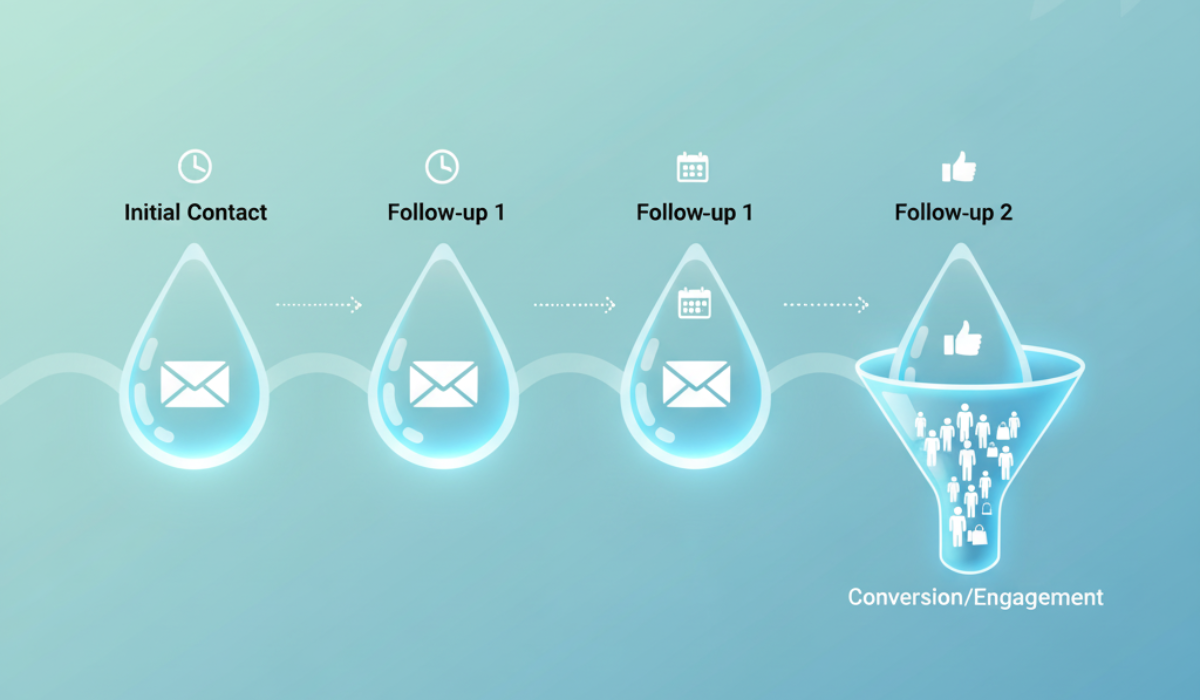
It’s not a case of sending a bunch of emails to develop a drip campaign. It’s creating a beautifully designed course that mirrors your customers’ journey. Here’s how to do it:
Define Your Goal
Start with the question:
What do I do with this drip campaign?
Possible goals are:
- Generating leads
- Notifying new subscribers
- Reactivating lost sales
- Retaining existing customers
Each goal must have some style, tone, and sequence length.
Segment Your Audience
Segmentation is personalisation’s worst-kept secret. Segment your audience on:
- Demographics (age, geography, etc.)
- Behaviour (website visits, purchases, downloads)
- Interests (products or topics they interact with)
The more targeted your segments, the more applicable your messages will be — and applicability is where results are achieved.
Write Engaging Content
Each email in your drip must provide value. Vary content types:
- Educational: blog posts, guides, or videos
- Emotional: stories, testimonials, or case studies
- Promotional: new product, offer, or sale
Be friendly and sincere. The goal is to build rapport, not push a sale.
Maximize Timing and Frequency
Timing is paramount. Too many emails are spam; too few emails are a forget-fest.
A place to begin:
- 3–5 emails per campaign.
- 2–4 days between communications.
Then repeat based on engagement metrics.
Automate and Test
Utilize marketing automation software such as HubSpot, Mailchimp, ActiveCampaign, or Klaviyo to automate and maximize your drips.
But don’t set and forget — test everything:
- Subject lines
- CTAs (Call-to-Action)
- Send times
- Email length
A/B testing determines what best works for your people.
Track, Measure, and Improve
Then, measure success with the right metrics:
- Open rate
- Click-through rate
- Conversion rate
- Unsubscribe rate
Learn from the numbers, observe weak points, and make future campaigns improved. Continuous improvement makes a good drip campaign great.
Real-World Example of Drip Campaign Success
Let us consider Airbnb as an example. When the leads are interested but have not booked yet, Airbnb uses an auto-drip campaign to send:
- A reminder of what they browsed.
- Suggestions of similar properties.
- Social proof — other guests’ ratings and photos.
- A nudge: “Still planning your trip to Paris?”
It is a balance of opening up sufficiently to users without irritating them — and pushing hard for bookings.
Mistakes to Avoid
Even the best plans are spoiled by these errors creeping in:
- Bombarding individuals with an excessive amount of emails in rapid succession.
- Not prioritising mobile optimisation — they read most emails on their phone.
- Sending generic subject lines that have little effect.
- Don’t segment — every lead is equal.
Avoid these, and drip campaigns will produce steady, scalable results.
The Future of Drip Campaigns
With predictive analytics and AI improvement growing, the future of drip marketing is more focused and smart than ever.
Think about campaigns that:
- Respond automatically to user activity in real time.
- Use AI to forecast when a customer is likely to make a purchase.
- Converge on channels — social media, SMS, email, and chat.
These next-generation technologies will keep pushing drip marketing further to build long-term relationships.
Conclusion
Drip campaigns are not a marketing trend—they’re an essential tactic for any business that wants to grow, connect, and convert over and over again.
Through autopilot lead generation, putting the right message in front of people at the right time, and offering value over and over, you can warm up cold prospects into warm leads — and warm leads into fanatics.
Whether you’re introducing a new product, bringing on new customers, or reactivating lapsed clients, drip campaigns remain top of mind, on schedule, and effective with little or no human intervention.
During a period of transience, a drip campaign puts your business in focus, consistently, and ahead of individuals constantly.
FAQ’s
What is the main purpose of a drip campaign?
A drip campaign’s main purpose is to automate communication with leads and customers. It delivers relevant messages at the right time, helping businesses nurture relationships, guide prospects through the sales funnel, and increase conversions without constant manual effort.
How do drip campaigns help in lead nurturing?
Drip campaigns gradually educate leads through personalised emails or messages. By sending helpful content and offers over time, they build trust and keep prospects engaged until they’re ready to buy, improving overall conversion rates and customer relationships.
What types of businesses can use drip campaigns?
Any business can benefit from drip campaigns—whether it’s e-commerce, B2B, education, or service-based industries. They’re effective for welcoming new users, nurturing leads, re-engaging inactive customers, and boosting sales through automated, personalised communication sequences.
How long should a drip campaign be?
A drip campaign typically includes 3–7 emails spread over one to three weeks. However, the length depends on your goal—shorter for sales, longer for education or onboarding. The key is to maintain consistent, relevant communication without overwhelming your audience.
What tools are best for creating drip campaigns?
Popular tools for creating drip campaigns include Mailchimp, HubSpot, ActiveCampaign, ConvertKit, and Klaviyo. These platforms allow marketers to automate email sequences, segment audiences, track engagement, and optimize performance with data-driven insights and A/B testing features.
How do I measure the success of a drip campaign?
Success can be measured through metrics like open rate, click-through rate, conversions, and unsubscribe rate. Regularly analyzing these indicators helps you understand audience behaviour, refine your messages, and improve campaign performance for better engagement and ROI.
What mistakes should I avoid in drip campaigns?
Avoid sending too many emails, using generic messages, or neglecting mobile-friendly designs. Always personalize content, test subject lines, and track analytics. Over-automation or poor timing can make users lose interest, so maintain a natural and engaging communication flow.