
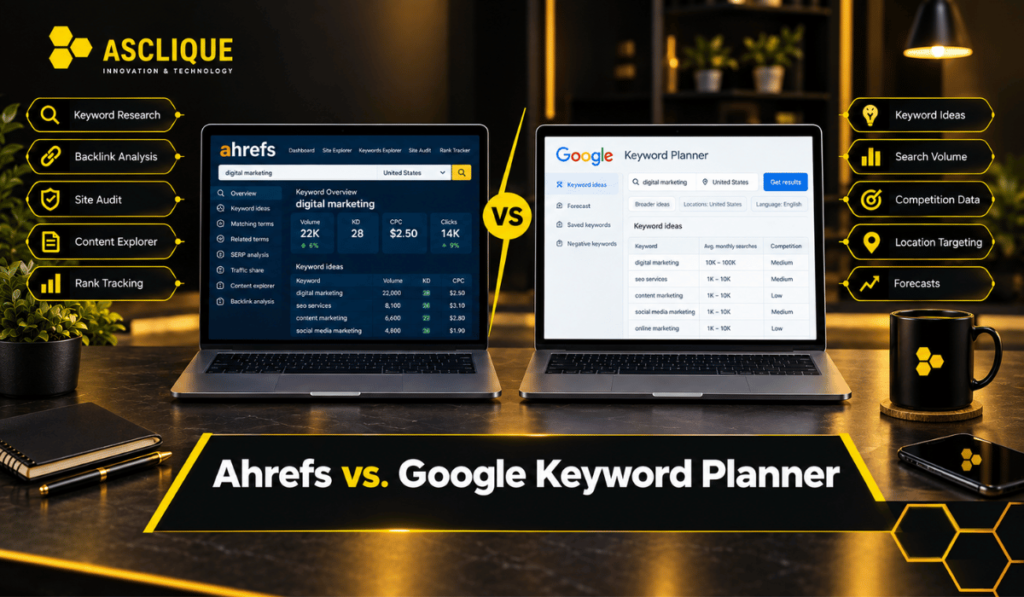
Ahrefs and Google Keyword Planner are two of the most widely used keyword research tools, but they serve fundamentally different purposes. Google Keyword Planner was built for advertisers running Google Ads campaigns. Ahrefs was built for SEO professionals analyzing organic search.
Understanding what each tool actually does—and where each falls short—helps you choose the right one for your specific situation or understand why using both makes sense.
What Is Google Keyword Planner?
Google Keyword Planner is a free tool within Google Ads designed to help advertisers plan paid search campaigns. It allows users to discover keyword ideas, see search volume estimates, and understand competition levels and cost-per-click (CPC) data.
Because Keyword Planner uses data directly from Google’s advertising platform, its search volume data comes from actual Google searches. However, it is designed for ad campaign planning, not SEO strategy.
Strengths:
- Free with a Google Ads account
- Search volume data comes directly from Google
- Shows CPC (cost per click)—useful for understanding the commercial value of keywords
- Includes historical monthly trend data
- No external index—data reflects real Google Ads performance
Limitations:
- Search volumes are shown as ranges (1K–10K, 10K–100K) rather than exact figures, making precise prioritization difficult
- Volumes are shown at even higher-level ranges if you do not have an active spending Google Ads account
- No keyword difficulty score for SEO—it shows “competition” only in the context of paid ads
- No backlink data, site auditing, or rank tracking
- Cannot show you which competitors rank for a keyword organically
- Not built for content strategy or organic SEO planning
What Is Ahrefs Keywords Explorer?
Ahrefs Keywords Explorer is a paid keyword research tool built specifically for SEO. It pulls data from Ahrefs’ own search index rather than Google directly and provides keyword difficulty scores, click estimates, SERP analysis, and competitive data for organic search.
Strengths:
- Keyword Difficulty (KD) score based on the backlink profiles of pages currently ranking
- Click rate estimates (what percentage of searchers actually click vs. get answers from AI Overviews or featured snippets)
- SERP analysis—see who currently ranks for a keyword and why
- Parent topic identification—groups related keywords by their primary intent
- Traffic potential—estimates total traffic a page could get ranking #1, not just clicks on one keyword
- Available across 200+ countries and multiple search engines (Google, Bing, Amazon, YouTube)
- Integrated with backlink data, content gap analysis, and rank tracking
Limitations:
- Paid subscription required (starting around $129/month for the Lite plan)
- Search volume data is estimated, not taken directly from Google — accuracy varies
- Requires learning the interface and understanding what each metric means
Key Differences: Ahrefs vs. Google Keyword Planner
| Ahrefs Keywords Explorer | Google Keyword Planner | |
|---|---|---|
| Cost | From ~$129/month | Free with Google account |
| Data source | Ahrefs’ own index | Google Ads platform |
| Search volume accuracy | Estimated; generally reliable | Direct from Google, but shown as ranges |
| Keyword difficulty | Yes (SEO-specific KD score) | Ad competition only — not SEO-relevant |
| Click rate data | Yes. | No |
| SERP analysis | Yes—see who ranks and why | No |
| Backlink data | Full integration | None |
| CPC data | Yes (pulled from Ads data) | Yes. |
| Content gap analysis | Yes. | No |
| Rank tracking | Yes. | No |
| Best for | SEO strategy, content planning, competitive analysis | Google Ads campaign planning |
When to Use Google Keyword Planner
Keyword Planner is the right choice when:
- You are planning a Google Ads campaign and need CPC and competition data for paid keywords
- You want direct Google data to validate search volume for a specific keyword
- You need a free keyword research tool and have basic requirements
- You are comparing organic and paid intent for the same keywords
It is not a reliable substitute for a dedicated SEO tool if you are planning content strategy, competitive analysis, or link building prioritization.
When to Use Ahrefs for Keyword Research
Ahrefs is the right choice when:
- You are planning blog content, service pages, or landing pages for organic search
- You need to understand keyword difficulty and ranking feasibility
- You want to identify what competitors rank for that you do not
- You need click data to understand whether ranking #1 for a keyword will actually drive meaningful traffic
- You are building a topic cluster strategy that requires grouping related keywords by intent
Can You Use Both Together?
Yes, and many SEO professionals do. A common workflow:
- Use Ahrefs to identify keyword opportunities, assess difficulty, analyze competitor rankings, and build topic clusters
- Cross-reference high-priority keywords in Google Keyword Planner to validate actual search volumes and understand CPC for commercial keywords
- Use CPC data from Keyword Planner as a proxy for commercial intent—high CPC keywords have more business value
This combination gets you Ahrefs’ SEO-specific analysis alongside Google’s first-party volume data.
Frequently Asked Questions
Is Google Keyword Planner accurate for SEO?
Keyword Planner provides direct Google data, but it shows volume ranges rather than exact figures (unless you have an active Ads campaign). It also does not show keyword difficulty from an SEO perspective. It is useful for directional understanding but not sufficient for detailed SEO planning.
Is Ahrefs better than Google Keyword Planner for content strategy?
Yes, significantly. Ahrefs was built for SEO and provides keyword difficulty, click rates, SERP analysis, and competitor data that Keyword Planner does not offer. For content strategy and competitive SEO, Ahrefs is the stronger tool.
Does Google Keyword Planner show exact search volumes?
For accounts with active ad spend, Keyword Planner shows more granular volume data. For accounts without ad spend, volumes are displayed as broad ranges (1K–10K, 10K–100K), which limits detailed prioritization.
Is there a free alternative that combines both?
Google Search Console provides free, accurate data on how your existing pages perform in Google Search. For researching new keywords, free tools like Ubersuggest or the free tier of Semrush offer limited data. A paid tool like Ahrefs or SE Ranking is needed for comprehensive SEO keyword research.
For agencies doing comprehensive keyword research, content planning, and competitive analysis, Ahrefs provides significantly more SEO-specific capability than Google Keyword Planner alone. Asclique uses both tools as part of our SEO services to build keyword strategies grounded in both direct search data and organic ranking analysis.