
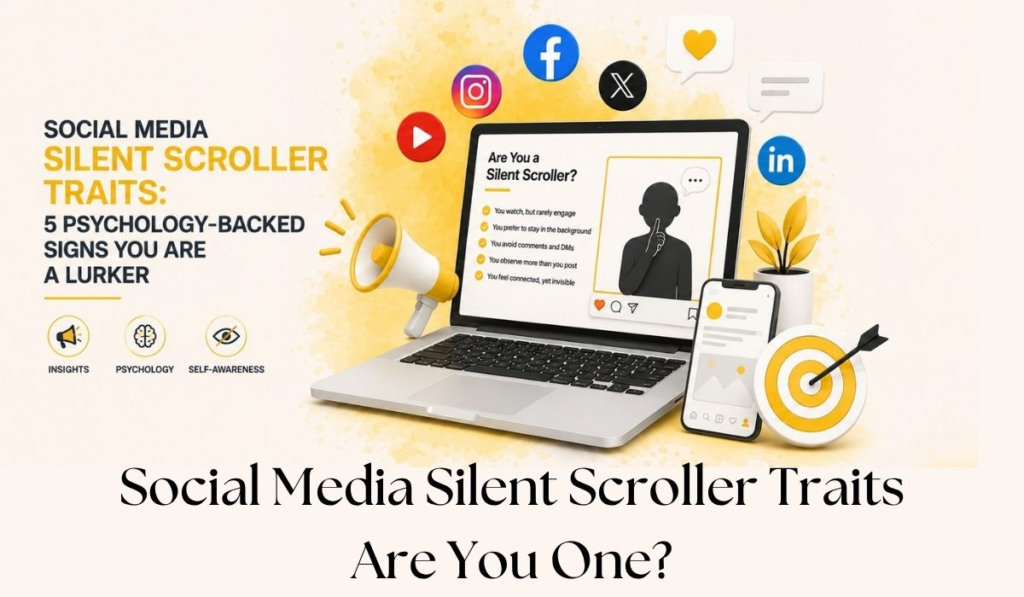
Do you spend hours scrolling through Instagram, Facebook, or Twitter — but almost never post anything?
You are not alone. And honestly? You might be smarter than the rest of us.
People who browse social media without posting are called social media lurkers or silent observers. Research shows that up to 90% of all social media users are scrollers they consume content every single day but rarely or never create any.
This behavior has a name. Researchers call it “lurking” and it is far more fascinating than it sounds.
So why do some people scroll without ever posting? What does it say about their personality? And is the lurker lifestyle actually better for your mental health?
Psychology has some surprising answers. Let’s break down the 5 key social media silent scroller traits — backed by real research and what they reveal about the people who quietly watch from the sidelines.
Who Are Social Media Lurkers?
Before we dive into the traits, let’s understand what a lurker actually is.
A social media lurker (also called a silent observer or passive user) is someone who:
- Regularly logs onto social media platforms
- Reads posts, watches videos, and follows conversations
- Almost never posts original content
- Rarely comments, likes, or shares anything publicly
They see everything — but say nothing.
In online communities, researchers use the 90-9-1 rule to describe user behavior:
- 90% of users are silent scrollers — they only read and watch
- 9% occasionally engage by liking or commenting
- 1% actively create and post original content
So if you never post, you are in the largest group of social media users on the planet.
Now here is the interesting part psychology research shows that these silent scrollers and lurkers share specific personality traits. And most of these traits are genuinely positive.
5 Social Media Silent Scroller Traits (Backed by Psychology)
Trait 1 — They Are Deeply Observant and Analytical
The biggest and most consistent trait among silent observers is their ability to watch, process, and analyze without needing to react out loud.
While active users are busy crafting the perfect caption or chasing likes, lurkers are doing something completely different they are paying full attention.
Research from the University of Texas found that people who primarily observe on social media score significantly higher on measures of analytical thinking. They notice patterns in online behavior, understand how social dynamics shift, and pick up on things most people scroll right past.
Think about it this way:
When you are always talking, you are never really listening. Silent scrollers are always listening.
This gives lurkers a huge advantage. They understand their social circle better than most. They know who is going through a hard time, who is exaggerating their life online, and which stories are genuine versus carefully staged for attention.
Over time, silent observers develop what researchers describe as a more comprehensive social awareness a deep, accurate picture of their networks built entirely through observation rather than participation.
What this means for you: If you rarely post but always seem to “just know” what is going on with people, this is why. Your observational habits are a genuine strength.
Trait 2 — They Take Privacy Seriously and Have Strong Personal Boundaries
One of the clearest social media lurker traits is a strong, instinctive respect for personal privacy.
Lurkers understand something that many active posters learn the hard way:
Once something is online, it is essentially permanent.
A study published in Computers in Human Behavior found that privacy concerns are the single biggest reason people choose not to post on social media. But for silent scrollers, this goes much deeper than just protecting personal information.
These individuals have often watched others face real consequences from oversharing a job lost over a tweet, a relationship damaged by a Facebook post, a private moment turned into public gossip. They see these situations play out regularly and make a conscious choice to protect themselves.
This boundary-setting also extends to their emotional life. Lurkers are less likely to get caught up in the toxic habit of measuring their self-worth through likes and follower counts. Their self-image is not tied to public validation, which makes their sense of identity far more stable and grounded.
Real talk: In a digital age where oversharing is the norm, having strong privacy boundaries is not a weakness — it is a form of self-protection that more people should practice.
Trait 3 — They Show Lower Levels of Narcissism
This one might feel uncomfortable, but the research is very clear.
Multiple psychological studies have found a direct correlation between frequent social media posting and narcissistic personality traits. Active posters especially those who post daily selfies, life updates, and opinion pieces tend to score higher on narcissism scales.
Flip that around, and the picture becomes clear: people who rarely post score significantly lower on narcissism measures.
Why? Because lurkers simply do not need the validation that comes from posting. They are not crafting an idealized version of themselves for public consumption. They are not refreshing their feed every five minutes to count their likes. They are not building a personal “brand” or seeking an audience.
They are just existing without performing.
In psychology, this is connected to the concept of intrinsic vs. extrinsic motivation. Active posters are often motivated by external rewards (likes, comments, follower growth). Silent scrollers tend to be driven more by internal values their own opinions, feelings, and goals matter more to them than public approval.
This does not mean active posters are bad people. But it does suggest that lurkers tend to have a more grounded, less approval-dependent relationship with themselves.
Trait 4 — They Demonstrate Higher Emotional Intelligence
Here is the trait that surprises most people.
Silent observers often show characteristics closely associated with high emotional intelligence (EQ).
Emotional intelligence includes the ability to:
- Understand your own emotions clearly
- Read and empathize with other people’s feelings
- Pause before reacting in emotionally charged situations
- See situations from multiple perspectives
Lurkers do all of this naturally, and constantly.
A study from Northwestern University found that people who observe but do not participate in online discussions develop a far more nuanced understanding of different viewpoints. Because they are not pressured to immediately pick a side or defend a public opinion, they can sit with complexity and ambiguity far better than active posters.
They watch heated arguments unfold from start to finish. They see how quickly emotions escalate. They notice who apologizes, who doubles down, and what the real cost of a careless comment can be. All of this builds a sophisticated, emotionally intelligent lens for understanding human behavior.
Silent scrollers are also less reactive. While others fire off hot takes in the heat of the moment, lurkers pause, observe the full situation, and form thoughtful conclusions or simply choose not to engage at all.
In a world that rewards the loudest voices, this quiet emotional intelligence is an underrated superpower.
Trait 5 — They Experience Less Social Media Anxiety and Stress
Perhaps the most significant and most practical benefit of being a silent scroller is this:
They are simply less stressed.
Active social media users often experience what psychologists call “social media performance anxiety.” This is the ongoing mental burden of asking yourself:
- Did my post get enough likes?
- Why did that person unfollow me?
- Should I have said that differently?
- Am I being judged right now?
This cycle of posting, waiting, evaluating, and second-guessing is genuinely exhausting. Research consistently links frequent posting behavior with higher levels of anxiety, depression, and social comparison.
Lurkers bypass this entire cycle.
Research found that people who do not post regularly report:
- Lower levels of FOMO (fear of missing out)
- Less social comparison they do not measure themselves against others’ highlight reels
- A more relaxed, self-directed relationship with social media
- More mental energy for real-life priorities
Because silent scrollers never put themselves out there for public judgment, they never face the sting of public rejection. Their self-esteem is not held hostage by an algorithm.
They use social media on their own terms as a source of information and entertainment —rather than as an ongoing performance review of their worth as a person.
Why the Lurker Lifestyle Deserves More Respect
We live in a culture that celebrates the loudest voices. Influencers, content creators, and viral posters get attention and praise. Meanwhile, the silent majority — the scrollers and lurkers who make up 90% of all users — are often seen as passive or disengaged.
But that picture is completely wrong.
Silent observers are:
✅ More analytical than average users ✅ Better at protecting their privacy and boundaries ✅ Less driven by the need for external validation ✅ More emotionally intelligent and empathetic ✅ Mentally healthier in their relationship with social media
The lurker is not missing out. They have simply found a smarter way to engage with a world that is desperate for everyone’s constant attention and participation.
A Final Thought: What Can We Learn from Silent Scrollers?
Whether you are a dedicated lurker or a frequent poster, there is a valuable lesson in the social media silent scroller traits described above.
You do not have to document every experience to fully live it. You do not need likes to validate your opinions. You do not have to share every thought to prove you have something worth saying.
Sometimes, the most powerful thing you can do on social media is exactly what the silent scrollers do every day:
Observe. Think. Keep scrolling.
The next time you reach for your phone to post something, ask yourself one honest question:
Would this moment be just as meaningful if nobody else saw it?
Your answer says a lot about where your sense of self really comes from.
Quick Summary — 5 Social Media Silent Scroller Traits
| Trait | What It Means |
| Highly Observant | They notice and understand more than active posters |
| Strong Privacy Values | They protect themselves and set clear boundaries |
| Low Narcissism | They do not need public validation to feel good |
| High Emotional Intelligence | They read people and situations with great accuracy |
| Less Anxiety | They avoid the stress cycle of posting and being judged |
Understanding these traits is not about judging people who post frequently — it is about appreciating the quiet wisdom of those who choose to watch, learn, and move through the digital world on their own terms.
FAQs
Is it normal to scroll social media for hours without posting anything?
Yes, completely normal. Research shows 90% of social media users never post. Silent scrollers are actually the majority online. Lurking is a healthy, valid way to use social media every day.
Are social media lurkers shy or antisocial in real life?
Not at all. Most silent scrollers are socially aware and emotionally intelligent. They simply choose not to perform online. Choosing silence is confidence, not shyness — a huge difference most people misunderstand completely.
Why do silent scrollers never like or comment on anything?
They value privacy and avoid digital footprints. Many have watched online interactions turn toxic and choose to stay out. Their silence is a conscious, rational choice — not fear or social awkwardness.
Is being a silent scroller bad for your mental health?
Actually the opposite is true. Silent scrollers experience less anxiety, less FOMO, and lower stress. Avoiding the likes-and-validation cycle protects mental health significantly better than frequent posting behavior ever could.
Do social media lurkers have higher emotional intelligence?
Yes, research confirms it. Silent observers understand multiple perspectives deeply without pressure to pick sides publicly. This builds stronger empathy, better emotional regulation, and sharper social awareness than active posting typically develops.
Should I force myself to post more even if I am a natural lurker?
Absolutely not. There is zero obligation to post online. Social media visibility is cultural pressure, not personal necessity. Post only when it genuinely feels right — never because an algorithm or audience demands it.