
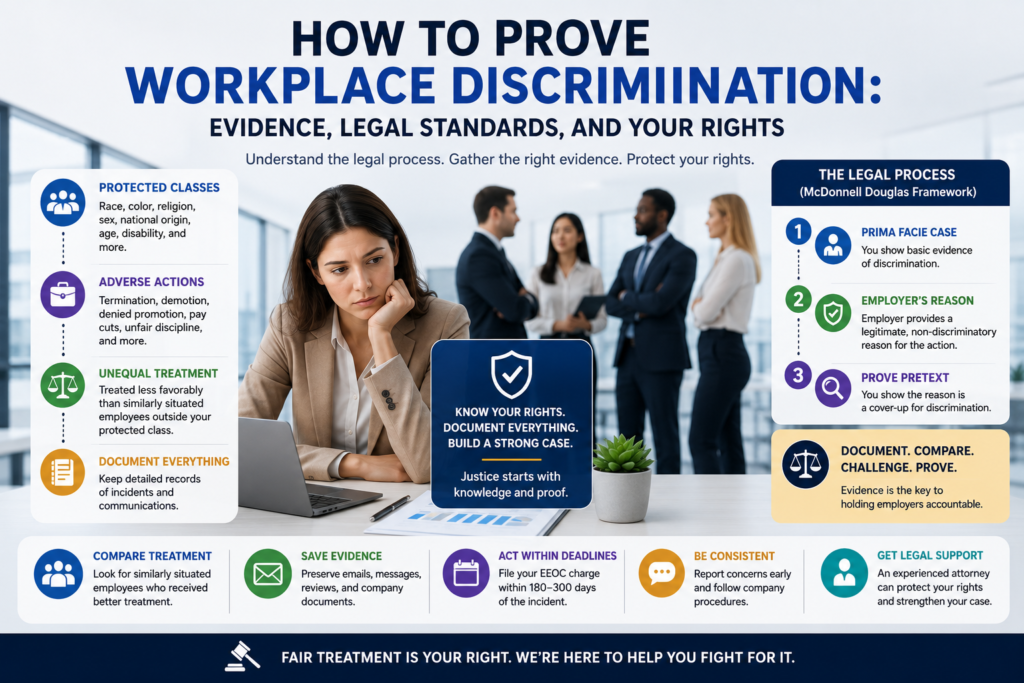
Did you know that proving workplace discrimination is not primarily a matter of showing that something unfair happened? It requires meeting a specific legal standard.
Workplace discrimination may be very hard to identify and prove. While the employee may feel that the discrimination is obvious to him or her, the employer will never admit to any motives for it.
Workplace discrimination is still a big problem across the United States. According to the United States Equal Employment Opportunity Commission, they received 88,531 discrimination charges during fiscal year 2024, which is up 9.2% from the year before. This is actually the highest level of claims since 2017.
How to prove discrimination at work in Florida and other states? In Florida and most other states, discrimination claims typically follow a burden-shifting framework. The employee must first establish a basic case of discrimination. The employer then provides a legitimate, non-discriminatory reason for its action.
People keep running into unfair treatment, and it’s not getting easier. So understanding which proof actually matters and how discrimination claims get evaluated can help protect the rights and go after legal remedies.
The McDonnell Douglas Framework: How Cases Are Actually Evaluated
The Supreme Court established the McDonnell Douglas burden-shifting framework in 1973 as the standard method for evaluating employment discrimination claims where direct evidence of discriminatory intent is not available, which describes the vast majority of cases.
Workplace discrimination is something that no American employee should experience. And in fact, according to Clark Employment Law, APC, there are various legal protections in place at the state and federal levels designed to prevent employees from encountering any form of discrimination.
Employers rarely document discriminatory intent. The framework accommodates this reality by allowing employees to prove discrimination through circumstantial evidence, organized in a specific sequence.
The framework basically goes through three stages:
Stage 1: The Employee Sets Up a Prima Facie Case
At this point, the employee is supposed to show the prima facie evidence of discrimination, and this means proving four elements.
- First, the employee must prove that they are a member of a protected class.
- Second, they must prove that they were qualified for the job or that they were performing the job well as per the standard required.
- Third, they were subjected to adverse employment action, including termination, demotion, no promotion, reduction in salary, or any alteration of the job responsibilities.
- Lastly, they were subjected to disparate treatment from other employees who are not members of the protected class, or they have been replaced by one.
In such cases, when the employee proves a prima facie case of discrimination, there is a rebuttable presumption of discrimination against the defendant employer.
Stage 2: The Employer Puts Forward a Legitimate Reason
After the employee creates a prima facie case, then the burden is on the employer to provide a reason that would be both legitimate and non-discriminatory for the adverse action taken.
This burden would merely be a burden of production, where the employer only needs to explain his reasoning behind the decision and not to prove his motive.
Stage 3: The Employee Shows the Reason Is Pretextual
When there is a reason offered by the employer, the burden falls back on the employee to prove that such a reason is merely a cover-up of the true cause of the adverse action taken.
This is the crucial part in any case of discrimination.
To prove pretext, it must be shown that either the reason given is false or has been inconsistently applied to other employees or is otherwise unbelievable.
Comparator Evidence: The Most Important Element Most Employees Overlook
Comparator evidence is an essential part of discrimination claims. This evidence proves the similarity of the circumstances of both employees, who garnered different outcomes and responses.
For example, similarly situated colleagues who are not in the protected class may have experienced a different treatment under similar conditions.
The comparator does not have to be identical to the plaintiff. They just need to share the same job, supervisor, work experience, and workplace policies.
In a situation where one worker faces disciplinary action, is denied promotion, or is terminated while the other colleague is spared from such treatment, it can be regarded as discrimination.
A lot of evidence necessary for comparison will be in the hands of the employer and can be gained through litigation.
It is crucial that workers document different treatment in observable ways, like promotions, disciplinary actions, performance standards, and encounters with those making the decision about it.
Direct vs. Circumstantial Evidence
Direct evidence of discrimination is a verbal or written statement that directly ties the protected trait to an employment action such as “We will not promote women to that level” and an email where the applicant was turned down based on their national origin.
Direct evidence is unusual. Most discrimination is communicated indirectly or not communicated at all. Circumstantial evidence is the standard in most cases. It includes:
- Questionable timing: an adverse action not long after a protected complaint, a disclosure about a disability, or coming back from leave
- Unclear remarks: statements that show possible awareness of a protected characteristic tied to an employment decision, yet they do not clearly say the decision was discriminatory
- Statistical trends: proof that people in a protected class are repeatedly refused opportunities, let go, or demoted more often than others
- Deviation from standard steps: an employer using a different procedure for this employee than it uses for other employees who are similarly situated
- Pretext indicators: a stated reason that is demonstrably false, not applied consistently, or not articulated until after a complaint was filed
The EEOC Charge: A Required Step Before Suing
Before you can initiate a case of federal employment discrimination, an employee should first file the charge of discrimination with the EEOC.
This deadline for filing the charge will normally be 180 days after the act of discrimination took place, but it could go up to 300 days in those states that have their own agencies for dealing with fair employment practices.
Following receipt of the notice of Right to Sue from the EEOC, the plaintiff will have 90 days to file the suit in federal court. The process of submitting the EEOC charge is available in the EEOC’s online public portal.
The EEOC might investigate the charge, mediate between the parties, or simply give a right-to-sue letter without much of the investigation.
It is true that most of the time, the charges do not lead to any determination of discrimination on the part of the EEOC, but this is the procedural requirement that cannot be avoided.
What to Document and When
In an employment discrimination case, the most important documentation is often the stuff created nearest to when the events happened. Courts generally view records made at the time of an incident as more convincing than later, reconstructed explanations.
If you are an employee and you think discrimination may be going on, you should preserve the following kinds of materials, even if it feels tiring at first.
- Keep a written log of incidents. Include dates, times, locations, the people involved, and what was said or done.
- Save copies of performance reviews, disciplinary notices, and promotion denials. Any written communications that touch job performance, or employment decisions are also valid
- Preserve emails, messages, or other written communications showing how the decision-maker talked about you or about others in the protected class.
- Document observations about how coworkers outside the protected class were treated by the same decision-maker under comparable circumstances.
- Keep copies of any human resources complaints you filed and also the replies that came back afterward or any follow-up answers you got.
When employment ends, the employer usually cuts off access to internal systems immediately, like email, HR portals, and performance management platforms.
Preserving the documentation that is still available while you’re employed is the most reliable method to make sure the comparative evidence and the pretext proof you need for the McDonnell Douglas analysis stay accessible.
Building a Case That Meets the Legal Standard
There is no requirement for the standard of proof in discrimination cases to show that there was discrimination in the mind of the manager.
Proof must be shown that a protected status factor contributed to an employment decision, using circumstantial evidence to show differential treatment and pretext.
The explanation of disparate treatment analysis by the Justice Department explains precisely what is required when using the McDonnell Douglas test for discrimination.
Knowledge of the McDonnell Douglas test prior to the collection of evidence ensures that appropriate evidence is collected, not just evidence that shows that something was perceived as being unfair.
FAQ’s
What do I need to prove workplace discrimination?
To prove workplace discrimination, you generally need to show that you belong to a protected class, were qualified for your position, suffered an adverse employment action, and were treated less favorably than similarly situated employees outside your protected class. In many cases, you must also show that the employer’s stated reason for its decision was a pretext for discrimination.
What is the McDonnell Douglas framework?
The McDonnell Douglas framework is a legal standard used in employment discrimination cases when there is no direct evidence of discrimination. It follows a three-step process where the employee establishes a prima facie case, the employer provides a legitimate reason for its action, and the employee then demonstrates that the reason is merely a pretext for discrimination.
What evidence is most helpful in a workplace discrimination case?
Useful evidence includes emails, text messages, performance reviews, disciplinary records, witness statements, HR complaints, and documentation showing that similarly situated employees outside your protected class were treated more favorably under similar circumstances.
Do I need direct evidence to win a discrimination claim?
No. Direct evidence is uncommon. Most successful workplace discrimination cases rely on circumstantial evidence, such as inconsistent explanations from the employer, comparator evidence, suspicious timing, or deviations from normal workplace procedures.
How long do I have to file a discrimination complaint with the EEOC?
In most cases, you must file a charge with the Equal Employment Opportunity Commission (EEOC) within 180 days of the alleged discriminatory act. The deadline may extend to 300 days in states with a qualifying fair employment practices agency.
What is comparator evidence in an employment discrimination case?
Comparator evidence involves showing that another employee with a similar job, supervisor, and work history, but who is not in your protected class, received more favorable treatment under similar circumstances. This type of evidence can be critical in proving discrimination.
Should I document discrimination before filing a complaint?
Yes. Keep detailed records of incidents, including dates, times, witnesses, emails, performance reviews, HR complaints, and any communications related to employment decisions. Documentation created close to the time of the events is generally considered the strongest evidence.