
2024 saw a staggering 718,428 Disability benefits claims awarded by the Social Security Administration (SSA), with close to 595,000 receiving SSDI payments.
Social Security disability benefits offer financial help for many Americans who have a severe illness and cannot work anymore. Social Security Disability Insurance (SSDI) and Supplemental Security Income (SSI) are two programs that provide monthly payments to qualified people to assist them in meeting their basic needs.
Most people who plan to apply for these programs find it hard to qualify for them. Many applicants face an initial denial before obtaining approval through the appeals process.
According to Social Security disability appeals lawyer Christian R. Ayers, receiving a denial after submitting an SSDI application should not discourage you from trying to fight for your benefits. Many people eventually receive benefits when they go through the appeals process with the help of a lawyer.
Let’s look at what to do if your claims are denied and how to appeal an unfavorable decision.
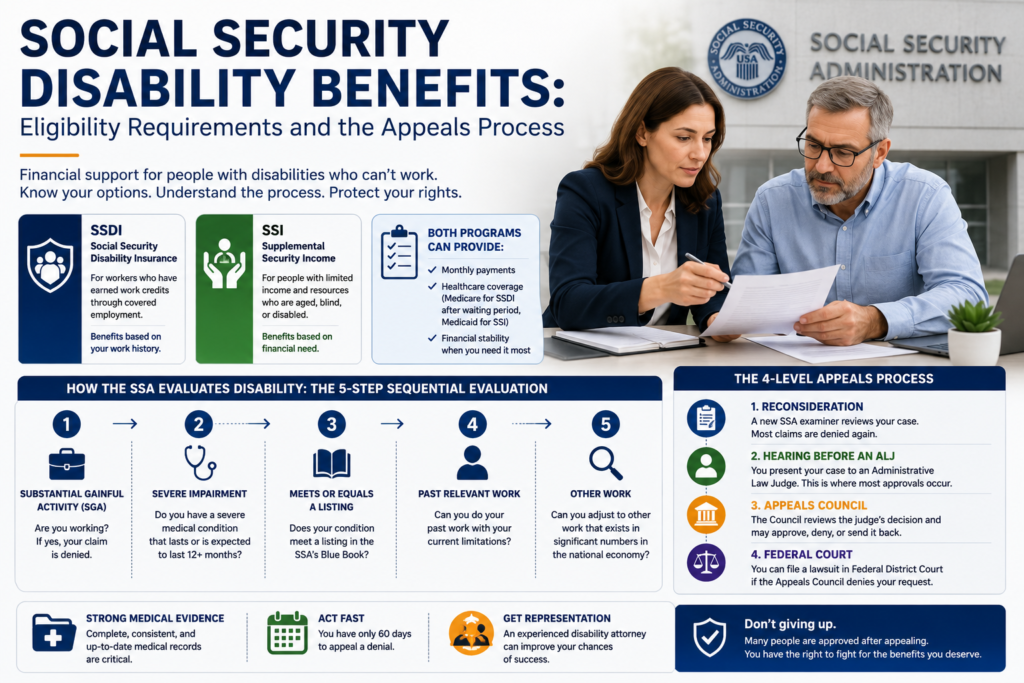
Two Separate Programs: SSDI and SSI
There are two different social security systems providing for disability insurance, but these have different requirements. SSDI requires an individual to prove their work history. To qualify, one must earn work credits by engaging in covered employment.
For those who have spent five out of the past ten years working prior to developing the disability, the exact number of credits depends on their age at the time the application was made. Social Security Disability Insurance (SSDI) benefits are derived from the income record. Upon approval, the applicant immediately qualifies for Medicare coverage following a two-year waiting period.
Meanwhile, the Supplemental Security Income (SSI) is a program that is based on needs so it does not require having a history of employment. SSI is offered to people who are aged, blind, or disabled. SSI can also be offered to individuals whose income and assets are below the program limits.
If an SSI applicant gets approved, they receive Medicaid coverage too. A person might possibly meet both programs at the same time if they satisfy the work credit condition and also stay within the SSI income and asset boundaries.
Eligibility also differs from state to state. Knowledge of Sacramento’s Social Security eligibility requirements is important for residents of that state. In most states, these programs require applicants to satisfy federal SSDI or SSI requirements regarding disability, work history, and income limits.
How the SSA Evaluates Disability: The Five-Step Sequential Evaluation
The Social Security Administration uses a five-step evaluation system in each and every disability case. Knowing this setup matters. It shows where a claim is examined and where it tends to fall apart.
Step one is checking if the applicant is currently doing substantial gainful activity (SGA). If yes, then the claim is denied, no matter what the medical condition is like. The SGA amount changes each year. For 2024 it is $1,550 a month for non-blind people. If the applicant is working above that number when they apply, then they do not pass the SGA requirement for disability.
Step two asks whether the person has a severe medically determinable impairment. It must have lasted or be expected to last for at least twelve months. The impairment is also eligible when it is expected to result in death. If the condition does not satisfy that duration point, or if it only causes minimal functional issues, then it will not count as a severe impairment that qualifies.
Step three then looks at whether the impairment meets the requirements of a listed impairment in the SSA’s Listing of Impairments, which is often referred to as the Blue Book. Disability requirements are satisfied if a claimed impairment is in the list.
Step four concerns whether or not the individual can do their previous work, taking into account the residual functional capacity (RFC). The RFC is the SSA’s evaluation of what the person can manage despite their limitations.
Step five then checks whether the applicant can adapt to other work that exists in significant numbers in the national economy. The SSA considers the RFC, age, schooling, and past employment history. If the agency decides the applicant can do other available work, the claim is denied at step five. If the SSA cannot point to other work the applicant can do, the claim is approved.
The Four-Level Appeals Process
The applicant gets 60 days to file an appeal after receiving the letter stating their application was rejected. There are four stages of the appeal process: reconsideration, hearing at the administrative level, the Appeals Council, and finally the federal court.
Reconsideration is a review done by another SSA examiner. This examiner must have nothing to do with the first decision. The rate of denial of reconsiderations is also high, usually more than 80 percent. Disability advocates view reconsideration as a required step before hearings. Failure to request reconsideration within the deadline will result in the loss of the opportunity to pursue an appeal.
FAQ’s
Who qualifies for Social Security disability benefits?
To qualify for Social Security disability benefits, you must have a medical condition that prevents you from working and meets the Social Security Administration’s definition of disability. Eligibility for SSDI depends on your work history and earned work credits, while SSI is based on financial need and limited income and resources.
What is the difference between SSDI and SSI?
SSDI (Social Security Disability Insurance) provides benefits to people who have worked and paid Social Security taxes. SSI (Supplemental Security Income) is a needs-based program for individuals with limited income and assets, regardless of their work history.
Why are so many Social Security disability claims denied?
Many disability claims are denied because applicants fail to provide sufficient medical evidence, earn more than the allowable income limit, do not meet the SSA’s definition of disability, or their condition is not expected to last at least 12 months.
How long do I have to appeal a denied disability claim?
You generally have 60 days from the date you receive your denial notice to file an appeal with the Social Security Administration. Missing this deadline may require you to submit a new application.
What are the stages of the Social Security disability appeals process?
The appeals process has four levels: reconsideration, a hearing before an Administrative Law Judge (ALJ), review by the Appeals Council, and, if necessary, a lawsuit in Federal District Court.
Do I need a lawyer for a Social Security disability appeal?
While legal representation is not required, many applicants choose to work with a Social Security disability attorney or accredited representative. They can gather medical evidence, prepare your case, represent you at the hearing, and question expert witnesses, which may improve your chances of success.
What happens if my Social Security disability appeal is approved?
If your appeal is approved, you may receive monthly disability benefits along with any eligible back pay. Depending on the program, you may also qualify for healthcare coverage through Medicare (for SSDI recipients after the waiting period) or Medicaid (for SSI recipients).