
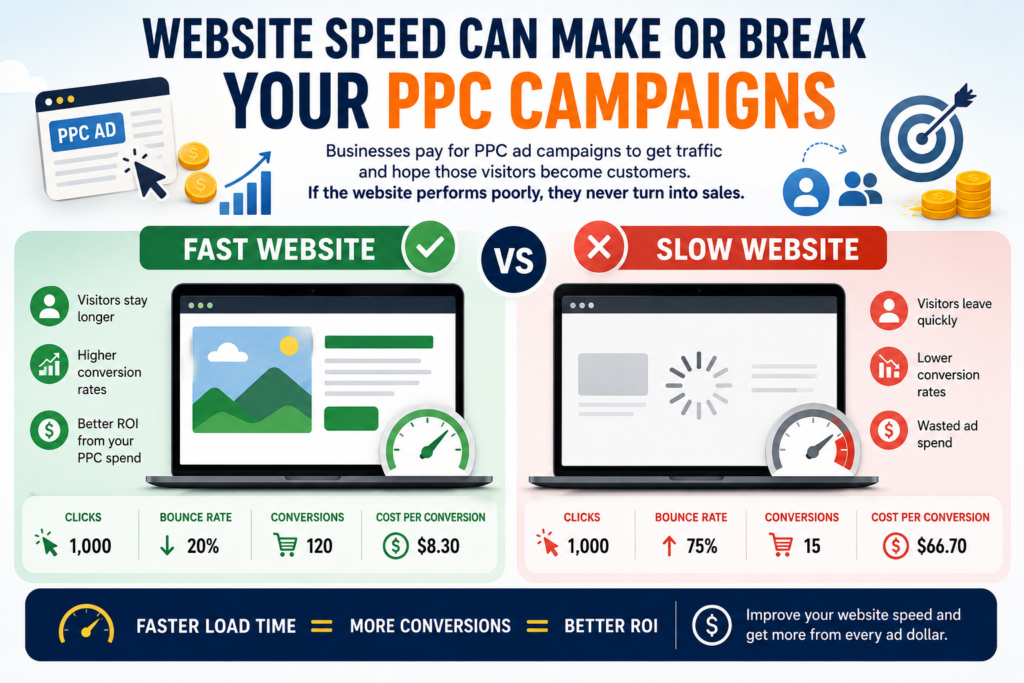
Marketing is no longer offline. The majority of businesses now rely on online marketing. And in online marketing, thousands of dollars are spent on a particular type of advertising called pay-per-click (PPC). It is a marketing model in which you get charged when someone clicks on your ad.
However, while pumping a lot of dollars into PPC campaigns, many forget one important thing: their website speed.
If your website loads slowly, people may leave before they even see your offer. As a result, you lose potential customers while still paying for every click.
How Slow Website Speed Can Hurt PPC Performance?
Businesses pay for PPC ad campaigns to get traffic and hope those visitors become customers. However, if the website performs poorly, those clicks may never turn into sales. And here are the key reasons behind that.
1. Visitors leave before a website loads
People expect websites to load quickly. If a page takes too long, many visitors leave immediately. According to a study, approx 40% of the visitors leave a website if it takes more than 3 seconds to load.
Think for yourself, you paid $5 for one click, but the visitor instantly leaves before the website loads. You lose the money and gain nothing in return.
2. Lower conversion rates
A slow website creates a poor user experience. Visitors become frustrated and less likely to:
- Fill out forms
- Request quotes
- Make purchases
- Sign up for newsletters
Even small delays can reduce conversions.
3. Poor mobile experience
Most PPC traffic now comes from mobile devices. A slow-loading website sometimes breaks the website structure and shows a broken layout to the user.
And believe us, mobile users often have less patience than desktop users. If your landing page loads slowly and appears broken, they will leave and choose a competitor instead.
4. Lower quality score
Quality Score is Google’s rating of your ads and landing pages. It helps determine how well your ads perform. A higher Quality Score can improve ad visibility and reduce costs.
However, when your website’s landing pages load slowly, the quality score is affected as well. This can also make you pay more for the same traffic.
This means:
- Higher advertising costs
- Lower profitability
- Reduced campaign performance
How to Speed Up Your PPC Landing Pages?
There are various factors that slow down the speed of your PPC landing page. Below, we are sharing some essentials that you should take care of. If implemented properly, these can help you improve the speed of your website’s landing pages.
1. Reduce image file size
Unnecessarily large image files are among the key troublemakers that slow down web page load times. To improve speed, the first step is to reduce the image file size.
However, it does not mean reducing image quality or making it blurry. Reduce the size wisely. Use a good image compressor that does not significantly impact image quality or make it look blurry.
2. Remove unnecessary scripts
Having too many unnecessary scripts on a landing page also slows it down. Remove anything you do not need.
We cannot ignore the CSS and HTML. If left unoptimized, it can also slow page load times. Minify CSS and HTML on the page too to make it load fast.
3. Use CDN
A Content Delivery Network (CDN) helps deliver website content faster to users around the world. It serves users the localized version nearest to their location.
4. Upgrade hosting
Cheap and shared hosting often leads to slow performance. Upgrading to a better hosting can improve loading speed.
Signs Your Website Speed Is Hurting PPC Campaigns
You may have a speed problem if you notice:
- High bounce rates
- Low conversion rates
- Expensive PPC campaigns with poor results
- Strong click-through rates but few leads
- Poor mobile performance
These warning signs often point to issues beyond the ads themselves.
How to Check Your Website Speed?
Checking a website’s speed is very simple. Simply go to Google and search for Page Speed Insights.
This is a tool that is owned and operated by Google itself. Simply run your website domain name through it.
Inside resutls you will get a clear preview of your website speed with technical issues highlighted that are causing any trouble.
Conclusion
A slow website can quietly drain your PPC budget. You pay for clicks, but visitors leave before they engage with your business. By improving page speed, you can reduce bounce rates, increase conversions, and get more value from every advertising dollar.
Before increasing your PPC budget, make sure your website is fast enough to support your campaigns.
Use Page Speed Insights to check the speed of your website. If it needs improvement, try the fixes we discussed in this post above. Implement them wisely, and they will fix your website speed, making it fast and smooth to load.
FAQ’s
Why is website speed important for PPC campaigns?
Website speed directly affects user experience. If your landing page loads slowly, visitors may leave before taking any action, leading to wasted ad spend, higher bounce rates, and fewer conversions.
Does website speed affect Google Ads Quality Score?
Yes. Landing page experience is one of the factors Google considers when calculating Quality Score. Faster, user-friendly pages can contribute to a better Quality Score, which may help lower your cost per click (CPC) and improve ad rankings.
What is a good page load speed for PPC landing pages?
Ideally, your landing page should load in under 3 seconds. Faster load times generally provide a better user experience and can improve conversion rates.
How can I check my website’s loading speed?
You can use tools such as Google’s PageSpeed Insights to analyze your website’s performance. The tool provides a speed score along with recommendations to improve loading times.
Will improving website speed increase PPC conversions?
In many cases, yes. Faster websites reduce bounce rates, improve user experience, and make visitors more likely to complete actions such as filling out forms, making purchases, or requesting quotes.
Does mobile website speed matter more than desktop speed?
Yes. Since a large percentage of PPC traffic comes from mobile devices, optimizing mobile page speed is essential. Mobile users typically expect fast-loading pages and are more likely to leave if a site is slow.
Can better hosting improve PPC performance?
Yes. Upgrading from slow or overloaded shared hosting to a higher-performance hosting solution can reduce page load times and improve the overall experience for visitors arriving from paid ads.
What is a CDN, and how does it improve website speed?
A Content Delivery Network (CDN) stores copies of your website on multiple servers worldwide and delivers content from the server closest to the visitor. This reduces loading times and improves performance for users in different locations.
Should I optimize my landing page before increasing my PPC budget?
Absolutely. Optimizing your landing page speed first helps ensure that more of your paid visitors stay on the site and convert, allowing you to get a better return on your advertising investment before spending more on clicks.