
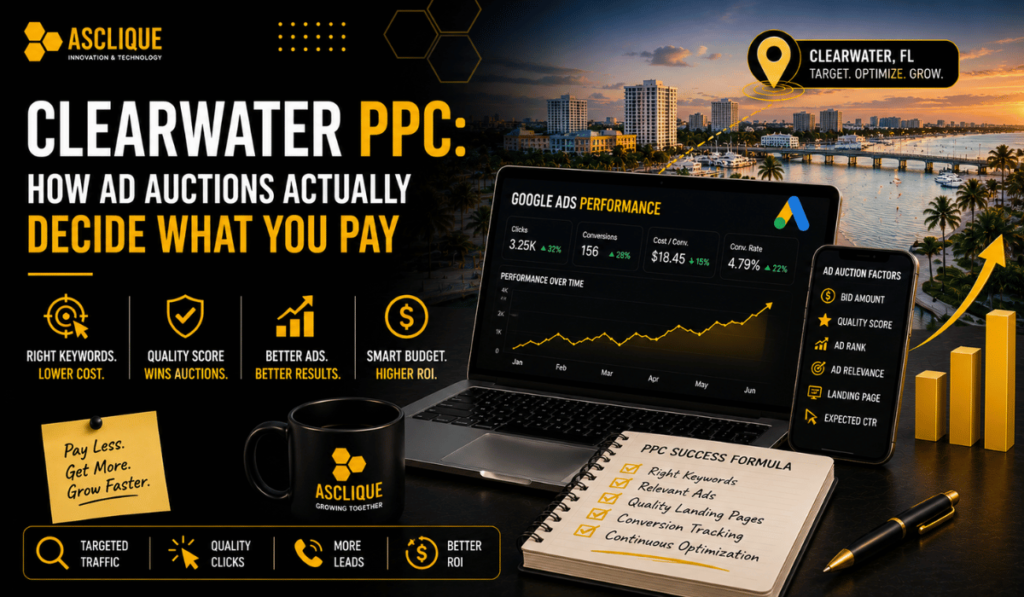
Running paid ads in Clearwater without understanding how the auction actually works is one of the fastest ways for a small business to burn through a marketing budget. Most PPC content either oversimplifies the process into a sales pitch or buries it in jargon that doesn’t help a business owner make better decisions. This guide breaks down what actually determines PPC cost, where budget typically leaks out of a Clearwater campaign, and which ad platform fits which type of business.
Key Takeaways
- PPC means paying for each click a business receives through ads, unlike SEO, which earns visibility organically over time without a direct cost per visit.
- Two Clearwater businesses can pay very different amounts for the same keyword since Google Ads pricing depends on quality score and Ad Rank, not just the highest bid.
- Most wasted PPC budget in competitive categories like home services and healthcare traces back to broad match keywords, missing negative keyword lists, or landing pages that don’t match the ad.
- Google Search Ads, Google Local Services Ads, and Meta Ads serve different goals, and picking the wrong platform for a business type is a common source of poor return.
- Conversion tracking is what separates a campaign a business can actually optimize from one that’s just spending money on faith.
- Asclique Innovation and Technology manages PPC campaigns for Clearwater businesses with a focus on conversion tracking, keyword efficiency, and reporting tied to actual leads.
What Is PPC and How Is It Different From SEO?
PPC, or pay-per-click advertising, is a model where a business pays each time someone clicks its ad, unlike SEO, which builds organic visibility without a direct cost per visit. A business bids on specific search terms and shows up instantly at the top of results, but that visibility disappears the moment the budget runs out.
SEO works on a different timeline. A ranking built through content and technical optimization can generate traffic for months without an ongoing per-click cost, but it typically takes far longer to build. Many Clearwater businesses run both, using PPC for immediate visibility while SEO builds in the background.
Why Do PPC Costs Vary So Much for Clearwater Businesses?
PPC costs vary widely in Clearwater because certain industries face far more competition per click than others. A personal injury attorney or an emergency plumber might pay several times more per click than a boutique retail shop, simply because more advertisers are bidding for the same limited ad space.
A roofing company competing after storm season, for example, can see cost per click spike sharply within days as every other roofer raises bids to capture the same sudden wave of demand. Businesses that don’t monitor this shift often keep bidding the same amount and quietly lose ad position to competitors who adjusted faster.
How Does Google Ads Actually Decide What You Pay Per Click?
Google Ads pricing is determined by quality score and Ad Rank together, not simply by the highest bid, which is why two businesses can pay very different amounts for the same keyword. Quality Score measures how relevant an ad and its landing page are to the search term, while Ad Rank combines that score with the bid amount to decide both ad position and final cost.
A business with a well-matched ad and landing page can sometimes pay less per click than a competitor bidding higher but running a generic, poorly targeted ad. A Clearwater dentist running an ad for “Emergency Dentist Clearwater” that links directly to an emergency booking page will typically pay less per click than one linking to a generic homepage, even at the same bid.
Where Does Most PPC Budget Get Wasted in Clearwater Campaigns?
Common sources of wasted PPC budget include broad match keywords, missing negative keyword lists, and landing pages that don’t match the intent of the ad. Broad match keywords can trigger a business’s ad for searches only loosely related to what they actually offer, burning through budget on clicks that were never going to convert.
A negative keyword list prevents this by explicitly blocking irrelevant searches. A Clearwater HVAC company running ads for “AC repair” without negative keywords might pay for clicks from people searching “AC repair jobs” or “AC repair training,” neither with any buying intent. Landing page mismatch causes a similar problem, since sending a paid click to a general homepage instead of a service-specific page tends to lower conversions and drag Quality Score down over time.
Google Search Ads vs. Local Services Ads vs. Meta Ads: Which Fits Your Business?
Each major ad platform is built around a different goal, and choosing the wrong one for a specific business is one of the more common reasons a PPC campaign underperforms.
| Ad Type | How It Charges | Best Fit |
| Google Search Ads | Cost per click | Businesses with clear, high-intent search terms (legal, medical, retail) |
| Google Local Services Ads | Cost per lead | Local service trades like plumbing, electrical, and home repair |
| Meta Ads | Cost per click or impression | Businesses that benefit from visual discovery, like restaurants and retail |
Google Local Services Ads charge per lead rather than per click and are built specifically for local service businesses like plumbers, electricians, and lawyers. That structure removes some of the guesswork around wasted clicks, since a business only pays when someone actually reaches out through the platform.
What Does Good PPC Campaign Management Actually Look Like?
Good PPC campaign management involves ongoing bid adjustment, active negative keyword maintenance, and conversion tracking set up before a dollar is spent. Without conversion tracking, a business has no reliable way to know which keywords or ads are generating calls and sales versus just generating clicks.
A well-managed campaign also gets reviewed regularly rather than left untouched after launch, since bid amounts and keyword lists need adjustment as competition shifts. A campaign performing well three months ago can quietly become inefficient if nobody’s watching it.
How Much Should a Clearwater Business Expect to Spend on PPC?
Monthly PPC spend for a Clearwater business depends on how competitive its industry is and how large a service area it needs to cover. A business in a lower-competition category might see solid results from a modest daily budget, while a legal or medical practice in a high cost-per-click category usually needs a larger budget to generate meaningful lead volume.
Rather than picking a number first, it makes more sense to start with a target number of leads or calls per month, then work backward to figure out what budget realistically supports that goal given current cost-per-click rates in that industry.
How Does Asclique Innovation and Technology Manage PPC for Clearwater Businesses?
Asclique Innovation and Technology manages PPC campaigns for Clearwater businesses with a focus on conversion tracking, keyword efficiency, and reporting tied to actual leads generated. Every campaign starts with conversion tracking in place, so performance can be measured against real business outcomes from day one rather than guessed at later.
From there, ongoing management includes regular negative keyword updates, bid adjustments based on shifting competition, and landing pages built to match each specific ad rather than routing every click to the same general page.
Conclusion
PPC rewards precision far more than budget size. A Clearwater business running a smaller campaign with tight keyword targeting, proper conversion tracking, and a landing page built for the ad often outperforms a competitor spending twice as much without those pieces in place. Getting the mechanics right first is what determines whether ad spend turns into leads or just disappears into the auction.
Frequently Asked Questions:
How quickly can a Clearwater business see results from PPC?
Traffic can start within days of launch, though it typically takes a few weeks of data before a campaign can be optimized based on real conversion numbers.
Does PPC make sense for a small firm on a tight budget?
Yes, as long as the budget focuses on a small set of high-intent keywords rather than spreading thin across broad terms.
Does PPC replace the need for SEO?
No. PPC delivers immediate visibility while active, while SEO builds traffic that continues without an ongoing per-click cost, and most businesses benefit from running both.
What’s the biggest mistake Clearwater businesses make with PPC?
Launching without conversion tracking in place, which makes it impossible to know which keywords are actually driving leads versus just clicks.
Can a business switch ad platforms if one isn’t working?
Yes, though it’s usually more effective to diagnose the underlying issue first, since poor performance is often a targeting or landing page problem rather than a platform problem.