
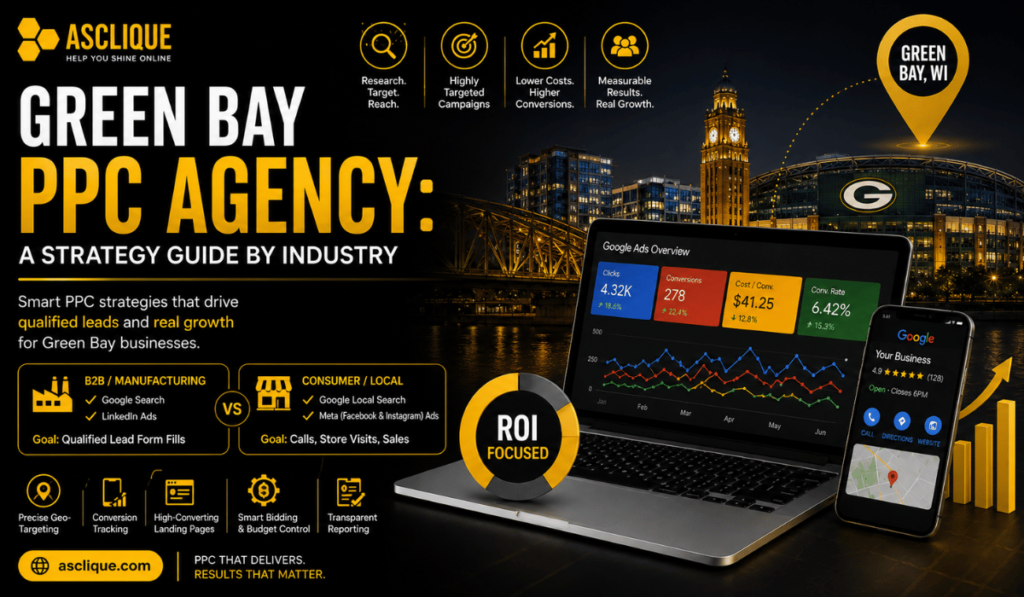
Every Green Bay business owner searching for a PPC agency hears the same pitch: more clicks, more leads, better ROI. What most agencies skip is that a manufacturing supplier and a local retailer need completely different campaigns to get there. This guide breaks down what a Green Bay PPC agency should actually be doing depending on the type of business you run.
Key Takeaways
- A Green Bay PPC agency needs a strategy built around the city’s dual economy: B2B and manufacturing on one side, consumer-facing businesses on the other.
- B2B and manufacturing companies in Green Bay typically get better ROI from LinkedIn and targeted Google Search campaigns than broad consumer platforms.
- Ad costs for generic “Green Bay” terms often spike during football season due to Packers-related search volume and advertiser competition.
- Green Bay businesses frequently compete for ad placement with agencies and advertisers based in Appleton, the Fox Valley, and Milwaukee.
- Real PPC success looks different by business type: cost per lead and form fills for B2B and calls and in-store visits for consumer businesses.
- Asclique Innovation and Technology manages PPC campaigns, conversion tracking, and reporting for Green Bay businesses across industries.
What Does a Green Bay PPC Agency Actually Do?
A Green Bay PPC agency manages paid search and paid social campaigns designed to reach buyers and customers within the Green Bay, Wisconsin market. In practice, that means setting up and running Google Ads, Microsoft Ads, and social platform campaigns, choosing which keywords or audiences to target, writing the ad copy, managing daily budgets, and tracking which clicks actually turn into calls, form fills, or sales. Naturally, the value of an agency comes down to whether it builds campaigns around how your specific customers search, not a generic template pulled from a national playbook.
Why Does Green Bay’s Mixed Economy Change PPC Strategy?
Green Bay’s economy runs on two very different engines: a strong manufacturing and paper industry base and a consumer market shaped heavily by the Green Bay Packers. Because of this split, a single PPC approach rarely works well across both. For example, a paper mill supplier and a local dental practice are chasing entirely different buyers, at entirely different price points, with entirely different search behavior. Consequently, a Green Bay PPC agency has to build separate strategies rather than applying one generic local ad template to every client.
How Should PPC Differ for B2B and Manufacturing vs. Consumer Businesses in Green Bay?
B2B and manufacturing businesses in Green Bay typically get stronger ROI from targeted Google Search and LinkedIn campaigns, while consumer-facing businesses benefit more from broader local search and social ad placement. This is because industrial buyers do specific, technical research before contacting a vendor, so campaigns built around niche keywords and gated content tend to perform better than broad awareness ads. Consumer businesses, on the other hand, are working with a customer who searches, decides, and acts quickly, which makes local search and map-based ad placement far more effective.
| Business Type | Best-Fit Platforms | Campaign Goal |
| B2B / Manufacturing | Google Search, LinkedIn Ads | Qualified lead form fills, gated content downloads |
| Consumer-Facing / Local | Google Local Search, Meta Ads | Calls, store visits, immediate conversions |
As the table shows, the platform choice alone can make or break a campaign’s return, which is exactly why a one-size-fits-all setup underperforms in a market like Green Bay.
Why Do Packers Season and Local Search Volume Affect Ad Costs?
Ad competition and cost-per-click for generic “Green Bay” search terms tend to rise during football season due to increased Packers-related search volume and advertiser activity. During this stretch, national brands, ticket resellers, and sports media outlets all bid into overlapping ad space, which drives up costs for anyone trying to advertise using broad city-name terms. As a result, local businesses often see better performance by shifting budget toward more specific, service-level keywords instead of competing directly for generic Green Bay terms during peak football months.
Why Do Green Bay Businesses Compete With Appleton and Milwaukee Advertisers?
Green Bay businesses often compete for ad visibility with agencies and advertisers based in Appleton, the Fox Valley, and Milwaukee. This regional overlap is especially common in service categories like healthcare, legal services, and home improvement, where larger firms from nearby markets extend their targeting radius to capture Green Bay searches too. Because of this, campaigns need tight geo-targeting and messaging that clearly signals local relevance, rather than a generic ad that could apply to any Wisconsin city.
What Should a Green Bay PPC Agency Deliver Technically?
Regardless of business type, a handful of technical fundamentals should always be in place:
- Precise geo-targeting that reflects your actual service area, not just the city name.
- Conversion tracking set up on calls, form fills, and purchases, so performance can be measured accurately.
- Dedicated landing pages built for each campaign rather than sending traffic to a generic homepage.
- Regular budget and bid adjustments based on real performance data, not a set-it-and-forget-it approach.
Without these basics, even a well-targeted campaign can quietly waste budget on clicks that never convert.
What Does Real PPC Success Look Like by Business Type?
Success metrics should match how each business actually generates revenue. For a consumer-facing business, the numbers that matter most are calls, form submissions, and in-store visits driven directly by ad clicks. For a B2B or manufacturing business, the better indicators are qualified lead form fills and cost-per-lead for niche industrial search terms, since a single high-value lead can be worth far more than dozens of consumer clicks. Therefore, an agency reporting identical generic metrics to every client, regardless of industry, is usually a sign the campaigns were not truly built around the business.
How Does Asclique Innovation and Technology Support Green Bay PPC Campaigns?
Asclique Innovation and Technology provides PPC campaign management, conversion tracking, and performance reporting for businesses across the Green Bay, WI market. Whether the goal is generating qualified leads for a manufacturing company or driving calls and store visits for a consumer-facing business, Asclique Innovation and Technology builds campaigns around how each business actually earns revenue, rather than applying the same generic setup to every client.
Conclusion
A generic PPC setup rarely performs well in a market as split as Green Bay’s. Businesses that treat paid advertising as one-size-fits-all tend to overspend on the wrong platforms and undertrack the metrics that actually matter to them. The agencies and businesses that see real results are the ones that build campaigns around their specific buyer, whether that buyer is a procurement manager comparing suppliers or a local customer searching for same-day service.
Frequently Asked Questions:
What does a Green Bay PPC agency typically manage?
A Green Bay PPC agency typically manages Google Ads, Microsoft Ads, and social platform campaigns, including keyword or audience targeting, ad copy, budget management, and conversion tracking.
Why are ad costs higher during football season?
Increased Packers-related search volume and advertiser competition during football season drive up cost-per-click for generic Green Bay search terms, making specific, service-level keywords a better investment during that period.
Should B2B and consumer businesses use the same PPC platforms?
No, B2B and manufacturing businesses generally see stronger results from Google Search and LinkedIn campaigns, while consumer-facing businesses tend to benefit more from local search and social ad placement.
How can I determine the effectiveness of my PPC campaigns?
Success should be measured against the metrics that reflect real revenue for your business, such as qualified lead form fills for B2B companies or calls and store visits for consumer-facing businesses, rather than generic click or impression counts.