
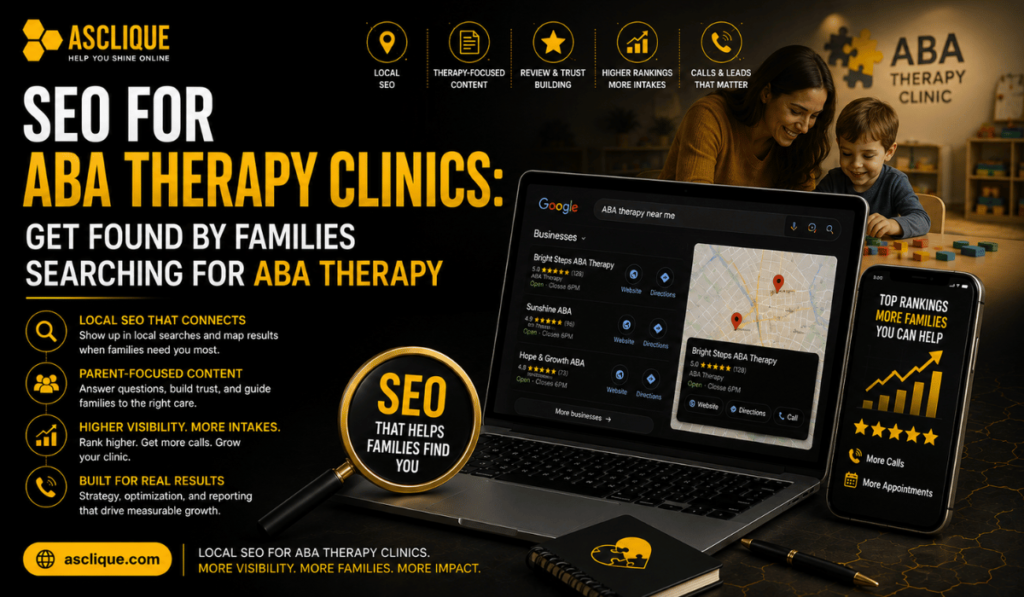
A parent sits at their kitchen table at 11 p.m., laptop open, typing “ABA therapy near me” into Google for the fourth time this week. Their child was just diagnosed; a waitlist at one clinic stretches four months, and every search result looks the same: generic stock photos, vague promises, and no phone number above the fold. They close three tabs before finding a practice that actually answers their questions. That moment, repeated thousands of times a day across the country, is exactly where SEO for ABA therapy clinics either wins a family or loses one to the next result on the page.
Autism diagnoses have climbed sharply in recent years. The CDC’s most recent surveillance data puts prevalence at roughly one in 31 children among the sites it tracks, a jump from one in 36 just two years earlier. That growth means more families are searching, more clinics are opening, and more competition is crowding local search results. Ranking well is no longer optional for an ABA practice trying to fill its intake pipeline; it’s the difference between a full caseload and empty chairs.
Why Search Visibility Matters More for ABA Clinics Than Most Healthcare Businesses
Families researching ABA therapy aren’t shopping the way someone shops for a dentist. They’re often searching in a state of stress, sometimes only days after a diagnosis, trying to understand insurance coverage, BCBA credentials, waitlist times, and whether a clinic even serves their child’s age group. Healthcare research broadly shows the majority of patients begin their provider search on Google before they call anyone, and mobile devices now account for the bulk of those healthcare-related queries. For ABA specifically, the stakes are higher: a delayed intervention can mean a delayed IEP goal, a missed regional center referral window, or months of lost early intervention time.
This urgency changes what “good SEO” looks like for an ABA clinic. It’s not enough to rank for “autism therapy.” Clinics need to show up for the searches families actually type when they’re overwhelmed and short on time: “ABA therapy that accepts [insurance name],” “BCBA near [city],” “autism early intervention [neighborhood],” or “ABA clinic taking new patients.” Those long-tail, intent-heavy phrases convert at a much higher rate than broad, generic terms, and they’re exactly where a focused SEO strategy for ABA clinics earns its return.
Building the Foundation: Technical and On-Page SEO
Before content or backlinks matter, the technical bones of the website need to be sound. Google’s Core Web Vitals measure how fast a page loads, how quickly it becomes interactive, and how stable the layout is while loading. A clinic website that takes five or six seconds to load on a parent’s phone, while they’re standing in a school pickup line, will lose that visitor before the page even renders. Compressing images, using a reliable host, and trimming unnecessary scripts are unglamorous but essential first steps.
On-page SEO for ABA clinics also means structuring the site around how families actually search, not how the clinic internally organizes its services. Each core offering—early intervention, in-home ABA, center-based ABA, social skills groups, and parent training—deserves its own page with a clear H1, descriptive meta title, and content written for both search engines and the parent reading it at midnight. Schema markup matters here too. Adding local business or medical business-structured data helps Google understand the practice’s name, address, phone number, hours, and service area, which feeds directly into how the clinic appears in local map results.
Local SEO: Where Most ABA Clinics Win or Lose the Search
For a service that’s inherently local, local SEO for ABA clinics carries more weight than almost any other tactic. Google’s local map pack, the three-listing block that appears above organic results for location-based searches, is often where families make their first click, sometimes calling directly from the map without ever visiting a website. Ranking there depends on relevance, distance, and prominence, and prominence is built through consistent NAP (name, address, and phone) data across the web, a fully optimized Google Business Profile, and a steady stream of recent, detailed reviews.
Reviews carry particular weight in ABA marketing because parents are evaluating trust as much as competence. A handful of reviews that mention specific, relatable details — a caring RBT, a smooth intake process, clear communication about insurance and prior authorization — do more to convert a hesitant parent than any paid ad. Clinics should build a simple, consistent process for asking satisfied families to leave reviews after positive milestones, not just at intake.
Content That Actually Helps Families (and Ranks)
Content marketing for ABA clinics works best when it treats families as people trying to solve a problem, not as leads to capture. Articles that walk through what a first ABA assessment looks like, how to read an insurance authorization letter, or what questions to ask before choosing between in-home and center-based therapy answer real questions Google is already seeing in search volume. That kind of content also naturally incorporates the semantic language search engines associate with topical authority: BCBA, RBT, applied behavior analysis, functional behavior assessment, individualized treatment plan, prior authorization, and regional center referral.
Location-specific content matters too, especially for clinics serving multiple cities or expanding into new markets. A page built for a specific city should reference genuine local details—nearby school districts, regional center or education authority names, and local insurance carriers common in that market—rather than swapping out a city name in an otherwise identical template. Google’s systems are increasingly good at recognizing thin, duplicated location pages, and families can tell the difference too.
Answer engine and generative engine optimization are no longer optional
Search behavior has shifted. A meaningful share of healthcare-related searches now trigger an AI-generated overview directly in the results, and a growing number of parents are using AI tools to compare providers before ever visiting a clinic’s website. This is pushing SEO for ABA therapy clinics beyond traditional ranking factors into what’s often called Answer Engine Optimization and Generative Engine Optimization: structuring content so that AI systems can extract clear, accurate answers about the clinic’s services, credentials, and coverage areas.
For clinics looking to adapt to this shift, answer engine optimization for ABA clinics focuses on creating content that directly answers the questions parents are asking, while generative engine optimization for ABA clinics helps make that information easier for AI-powered search platforms to understand, interpret, and reference.
Practically, this means writing content in a direct, question-and-answer-friendly format, using clear headers that match how people actually phrase questions, and making sure the clinic’s core facts—services offered, insurance accepted, age ranges served, and service area—are stated plainly rather than buried in marketing copy. Clinics that get this right show up not just in the traditional ten blue links but also inside AI summaries, increasingly sitting above them.
Turning Rankings Into Booked Consultations
Ranking is only half the job. Once a family lands on the site, the path to booking a consultation needs to be immediate and low-friction: a visible phone number, a short intake form, and clear next steps rather than a wall of clinical jargon. HIPAA compliance should be handled carefully throughout, especially on any intake or contact forms that collect information about a child’s diagnosis or health history.
SEO for ABA therapy clinics is ultimately about closing the gap between a family’s 11 p.m. search and a scheduled assessment. Clinics that invest in technical performance, honest local SEO, genuinely useful content, and readiness for how AI tools now summarize search results put themselves in front of families exactly when those families need them most, and that visibility compounds month after month in a way paid ads alone never will.
Ready to turn local search traffic into booked ABA assessments? Impactory Media builds SEO strategies exclusively for ABA therapy providers across the USA, Dubai, and Australia. combining technical SEO, local search optimization, and content that speaks directly to families searching for help. Reach out to Impactory Media at CWS-1V-223382, 26th Floor, Amber Gem Tower, Ajman, UAE, or call +971 567500457 to talk through a plan for your clinic.
Frequently Asked Questions
How long does SEO take to show results for an ABA therapy clinic?
Most ABA clinics start seeing measurable movement in rankings and organic traffic within four to six months, with stronger results building over nine to twelve months. Local SEO improvements, like an optimized Google Business Profile, can show impact sooner, while competitive keywords tied to services and locations take longer to climb as content and backlinks accumulate.
What’s the difference between SEO and PPC for ABA clinics?
SEO builds organic visibility that compounds over time without paying per click, while PPC (Google Ads) delivers immediate placement at the top of search results for a cost per lead. Many ABA clinics use PPC for fast intake volume while SEO grows in the background, eventually lowering overall cost per acquisition once rankings stabilize.
Do I need separate pages for each city my ABA clinic serves?
Yes, if each location has genuinely distinct details worth sharing, like different regional center relationships, insurance networks, or service offerings. Thin pages that only swap a city name rarely rank well and can actually hurt overall site authority, so each page needs real local specificity to justify its existence.
How important are Google reviews for ABA clinic SEO?
Reviews are one of the strongest local ranking and conversion factors a clinic has. They influence local map pack placement and directly affect whether a hesitant parent picks up the phone. Clinics should build a simple, consistent process for requesting reviews from satisfied families after positive milestones in care.
What keywords should an ABA clinic target first?
Start with high-intent, location-specific phrases families actually type when they need help, like “ABA therapy [city],” “BCBA near me,” or “autism early intervention [neighborhood],” rather than broad terms like “autism therapy.” These long-tail phrases have lower competition and much higher conversion rates because they reflect real search intent.
Does HIPAA compliance affect how an ABA clinic can market itself online?
Yes. Intake forms, chat widgets, and any tool that collects information about a child’s diagnosis or health history need to be handled with HIPAA-conscious practices, from secure form submissions to careful vendor selection. Marketing content itself should avoid implying specific patient outcomes tied to identifiable individuals without proper consent.