A lot of Norfolk businesses already have a Facebook page and an Instagram account. What most of them don’t have is a reason those accounts exist beyond “everyone else has one.” Posting a few photos a week without a clear idea of who’s supposed to see them, or why, rarely moves the needle on actual business results.
That gap between having social media and actually using it well shows up constantly in this market. A dive bar near the naval base and a pediatric dental practice near a residential neighborhood might both post three times a week, yet one is trying to reach off-duty sailors looking for a place to unwind while the other is trying to reach parents researching a provider for their kids. Treating those two audiences the same way wastes effort on both sides. This guide breaks down what social media marketing actually involves for a Norfolk business and how Asclique Innovation and Technology approaches it.
Key Takeaways:
- Social media marketing includes both organic content and paid advertising, and most Norfolk businesses need to understand the difference before choosing a strategy.
- Norfolk’s mix of retirees, military families, downtown professionals, and visitors means different businesses should be active on different platforms, not the same three by default.
- Posting frequency alone doesn’t determine results, since a well-targeted post to the right audience outperforms a high volume of posts to the wrong one.
- Asclique Innovation and Technology builds social media strategies for Norfolk businesses around audience fit, not a fixed package of weekly posts.
What Is Social Media Marketing for a Norfolk Business?
Social media marketing for a Norfolk business is the combined use of organic content and paid advertising across social platforms to build brand awareness, engage local customers, and generate leads. Specifically, organic social media covers the free posts, stories, and community interactions a business publishes, while paid social media covers targeted ads that reach a specific audience beyond a business’s existing followers.
For instance, a coffee shop near Colonial Avenue might post daily photos of its menu items as organic content, building a loyal following over time at no direct cost per post. That same coffee shop could also run a small paid campaign targeting people within a two-mile radius who’ve shown interest in local food and drink, reaching potential customers who’ve never heard of the shop before. Because these two approaches serve different purposes, a complete social media strategy for a Norfolk business typically uses both rather than relying on one alone.
Why Social Media Strategy Looks Different in Norfolk, Virginia
Social media strategy looks different in Norfolk because the city’s population includes several distinct audiences that rarely respond to the same content in the same way. Retirees and longtime residents in established neighborhoods, active-duty families cycling in and out on military assignments, downtown professionals working in the financial and legal firms near the courthouse, and weekend visitors passing through for a festival or sporting event all use social platforms for different reasons and follow completely different types of accounts.
As an example, a moving and storage company that serves military families relocating in and out of the area gets far more value from Facebook groups where spouses swap local recommendations than from a heavily visual Instagram strategy. Meanwhile, a boutique clothing store near the arts district relies almost entirely on Instagram’s visual format to showcase new inventory, a platform where the moving company would likely see very little engagement. Since these audiences don’t overlap much, a strategy built for one rarely transfers well to the other.
Different Audiences, Different Platforms
Even within Norfolk, the right platform depends entirely on who a business is trying to reach. A defense contractor supplying Naval Station Norfolk, for example, gets more value from a well-maintained LinkedIn presence connecting with procurement officers and industry partners than from consumer-facing platforms like TikTok or Instagram. On the other hand, a food truck that rotates locations around downtown benefits far more from real-time Instagram Stories and Facebook updates telling followers exactly where to find it that day.
Organic vs. Paid Social Media: What Norfolk Businesses Need to Know
Organic social media builds a following gradually at no direct media cost, while paid social media buys immediate reach to a specific audience beyond that following. In practical terms, organic content works well for building long-term trust and community, while paid social media works well for reaching new customers quickly or promoting a specific offer.
| Factor | Organic Social Media | Paid Social Media |
| Cost Structure | No direct media spend, requires time or content creation cost | Requires ongoing ad spend |
| Reach | Limited mostly to existing followers | Extends to targeted new audiences |
| Speed of Results | Builds gradually over months | Generates visibility within days |
| Best Use Case | Community building, brand trust, customer service | Promotions, lead generation, reaching new customers |
Because of these differences, most Norfolk businesses benefit from running both together rather than choosing one over the other. A new restaurant, for example, might use paid social ads to quickly build initial awareness in its opening weeks, then shift more effort toward organic content once a base of regular customers starts following along naturally.
Core Social Media Services Asclique Innovation and Technology Provides in Norfolk
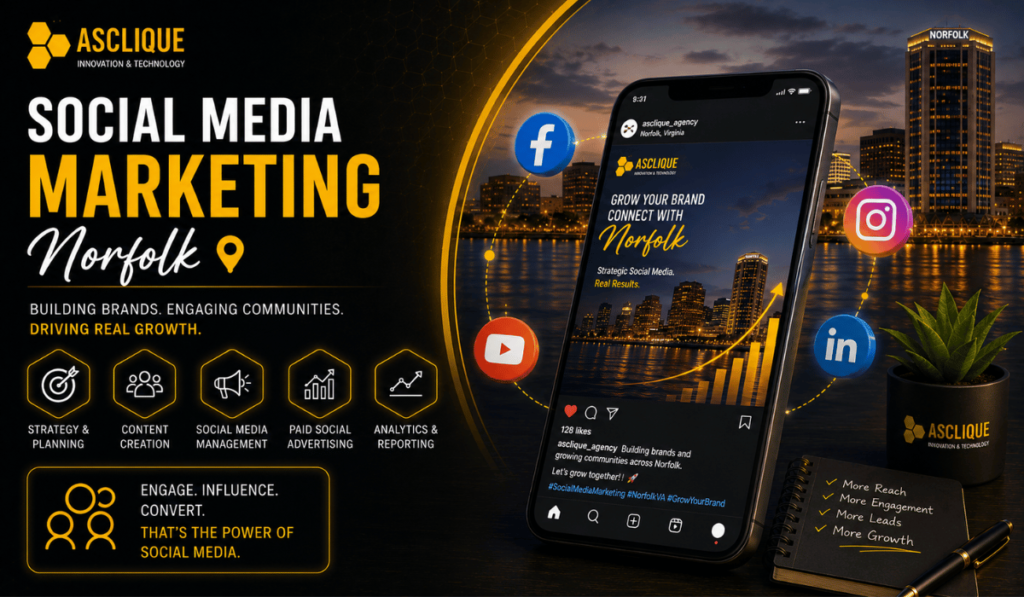
Asclique Innovation and Technology provides four core social media services for Norfolk businesses, covering content strategy, community management, paid advertising, and performance reporting. Each service addresses a different part of building an effective social media presence.
- Content Strategy and Creation: Planning and producing posts tailored to the specific platform and audience.
- Community Management: Responding to comments, messages, and reviews to maintain an active, trustworthy presence.
- Paid Social Advertising: Running targeted ad campaigns to reach new customers beyond an existing following.
- Analytics and Performance Reporting: Tracking which content and campaigns actually drive engagement and leads.
Content Creation and Community Management
Content creation and community management work together to keep a business’s social presence active and responsive rather than just occasionally updated. Specifically, this means planning posts around what a business’s actual audience cares about, then following through by replying to comments and messages in a timely way. A local auto repair shop that posts helpful maintenance tips but never responds to customer questions in the comments section sends a mixed signal, since the content suggests helpfulness that the lack of engagement doesn’t back up.
Paid Social Advertising
Paid social advertising extends a business’s reach to people who haven’t already found it organically, using targeting based on location, interests, or behavior. In Norfolk specifically, this often means layering in geographic targeting that accounts for the overlap with Virginia Beach and Chesapeake, since a business serving only Norfolk neighborhoods doesn’t want to pay for impressions shown to people well outside its service area. A home cleaning service running an untargeted campaign, for instance, might spend a large share of its budget reaching people who live too far away to ever book a service.
Analytics and Performance Reporting
Analytics and performance reporting turn raw engagement numbers into decisions about what to keep doing and what to change. Rather than just tracking likes and followers, meaningful reporting looks at which specific posts led to website visits, calls, or bookings. If a series of posts about a seasonal promotion consistently drives more inquiries than the account’s regular content, that’s a signal worth acting on rather than a coincidence to ignore.
Which Social Media Platforms Matter Most for Norfolk Businesses?
The right platform for a Norfolk business depends on its industry and target customer, not on which platforms happen to be most popular overall. Facebook and Instagram tend to work best for local retail, restaurants, and hospitality businesses reaching residents and visitors, while LinkedIn tends to work best for B2B companies and defense-adjacent suppliers connecting with other businesses and procurement contacts.
- Facebook: Strong for local community engagement, events, and businesses relying on word of mouth referrals.
- Instagram: Best suited to visually driven businesses like restaurants, retail, and hospitality.
- LinkedIn: Most effective for B2B companies, professional services, and maritime or defense-adjacent suppliers.
- TikTok: Useful for businesses targeting a younger consumer audience with short, engaging video content.
Ultimately, trying to maintain a strong presence on every platform at once often spreads a business’s time and budget too thin to do any of them well. A newer business typically sees better results focusing on the one or two platforms where its actual customers spend time, rather than attempting a scattered presence everywhere at once.
How to Tell If a Social Media Provider Actually Understands Norfolk
The fastest way to tell if a social media provider understands Norfolk is to ask them to describe your ideal customer’s daily routine, not just your target demographic in broad strokes. A provider who can only offer generic descriptors like “adults 25 to 54 interested in local business” hasn’t done the work of understanding who actually walks through your door.
For comparison, a strong answer for a Norfolk brewery near the waterfront might describe off-duty service members looking for a low-key spot after work, downtown residents who walk over on weekends, and out-of-town visitors staying near the cruise terminal for a weekend. That level of specificity signals a provider who builds content around real customer behavior instead of copying a generic small business playbook. If a provider can’t get more specific than “local customers” when asked, that’s usually a sign the strategy behind their posts won’t be much more specific either.
What Working With Asclique Innovation and Technology Looks Like
Working with Asclique Innovation and Technology starts with mapping out where your actual customers already spend time online, rather than setting up accounts on every platform by default. From there, content gets built around a consistent brand voice, so a follower who sees your Instagram post today recognizes the same tone and messaging if they later come across a paid ad or a Facebook update from the same campaign.
That consistency extends to how results get reported back. Instead of a monthly summary listing follower growth and likes, updates focus on which specific posts or campaigns led to a call, a booking, or a website visit, so decisions about what to keep doing are based on outcomes rather than vanity numbers. For a Norfolk business trying to figure out whether social media is actually contributing to growth, that distinction is often the difference between a report that looks good and one that’s actually useful.
Frequently Asked Questions
What does social media marketing include?
Social media marketing includes both organic content, such as regular posts and community engagement, and paid advertising that targets specific audiences beyond a business’s existing followers.
Are social media advertising and social media marketing the same thing?
No. Social media advertising refers specifically to paid campaigns targeting a defined audience, while social media marketing is the broader term that includes both paid advertising and organic content strategy.
Which social platforms should my Norfolk business use?
It depends on the industry a business is in and who its customers are. Local retail and hospitality businesses tend to do well on Facebook and Instagram, while B2B and defense-adjacent suppliers often see better results on LinkedIn.
How is organic social media different from paid social ads?
Organic social media builds a following gradually without direct media spend, while paid social ads require an ongoing budget but reach new audiences much faster than organic content alone.
Does Asclique Innovation and Technology manage content creation too?
Yes. Content strategy and creation are part of the core social media services provided, alongside community management, paid advertising, and performance reporting.
Begin Your Norfolk Social Media Marketing Journey
Social media only works when it’s built around who a business is actually trying to reach, not around how many posts go out each week. Asclique Innovation and Technology builds social media strategies for Norfolk businesses around real audience behavior, the right platform mix, and reporting tied to actual business outcomes.
Contact Asclique Innovation and Technology today to see how a tailored social media strategy could work for your Norfolk business.