
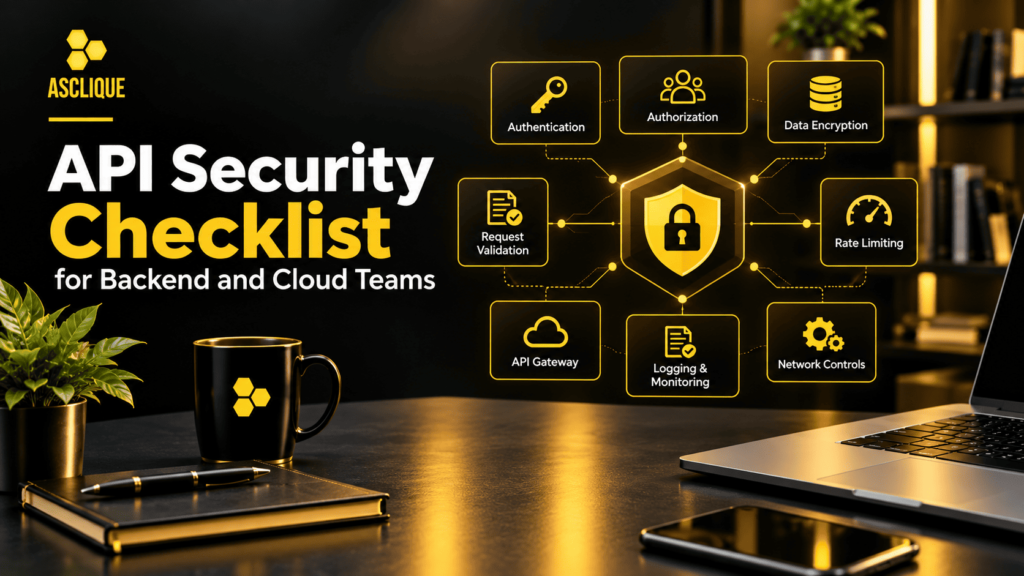
Modern backend and cloud infrastructure interacts with dozens of internal services and external platforms, so an API security checklist helps teams systematically audit their core defense mechanisms. A single microservice often accepts user traffic, queries persistent storage, and forwards customer data to partner endpoints at the same time. Each communication pathway requires dedicated protective controls.
Quick Answer
An API security checklist should cover authentication, authorization, encryption, request validation, rate limiting, API inventory, secrets management, network controls, third-party integrations, logging, and monitoring. Backend and cloud teams should treat API security as a continuous process because endpoints, integrations, permissions, and infrastructure change as applications evolve.
Key Facts And What Is Verified
- FACT: OWASP lists Broken Object Level Authorization as API1 in the 2023 API Security Top 10.
- FACT: Broken Authentication is API2, reinforcing the importance of correctly implemented authentication and token validation.
- FACT: OWASP identifies Unrestricted Resource Consumption as an API security risk, making rate limits and resource controls important parts of API architecture.
- FACT: Improper Inventory Management is API9, highlighting the security risks associated with undocumented, outdated, and forgotten API endpoints.
- FACT: Unsafe Consumption of APIs is API10. Information received from third-party APIs should still be validated rather than automatically trusted.
Table Of Contents
- Why an API Security Checklist Should Cover Every Backend Layer
- How API Security Best Practices Protect Authentication and Access
- API Security Best Practices Checklist for Request Validation and Limits
- API Security Checklist at a Glance
- How API Gateways and TLS Encryption Strengthen Cloud API Security
- Controlling Egress Traffic When Backend Services Call Partner APIs
- Common API Security Mistakes vs Better Practices
- Security Logging and Monitoring Complete the API Protection Process
- How Engineering Teams Review an API Security Checklist Regularly
- Frequently Asked Questions
Why an API Security Checklist Should Cover Every Backend Layer
Preparing an API security checklist involves reviewing absolutely every part of the pipeline:
- authentication mechanisms;
- encryption protocols;
- request thresholds;
- audit trails;
- network boundary policies;
- secret management settings.
Before tweaking specific configuration flags, engineers map the overall system topology to catalog every active communication path. This inventory helps uncover shadow APIs that appeared as the project evolved but were not included in the original documentation.
Technical audits must address several fundamental architectural questions:
- which public endpoints accept connections from the open internet;
- which microservices exchange data across internal private subnets;
- which identity tokens and cryptographic secrets handle service authorization;
- what payload schemas travel between internal architectural tiers;
- which external partner APIs the backend services invoke;
- where ingestion agents store access logs and diagnostic telemetry.
After mapping the interactions, specialists define requirements for each endpoint. Public interfaces usually require stricter control over incoming requests, while internal APIs also need authentication and proper access control.
How API Security Best Practices Protect Authentication and Access
The foundation of API security best practices relies on robust identity verification. An API must be able to clearly identify the client or service sending a request and then verify which operations that entity is authorized to perform.
For user-facing scenarios, OAuth 2.0 authentication may be used. When implementing JWT token validation, the server should verify the token signature, expiration time, issuer, audience, and other parameters required by the architecture. The mere presence of a JWT in a request does not prove that the request has the necessary permissions.
Authorization layers must enforce least privilege across every internal process. When services and users receive only the exact permissions needed for immediate actions, compromised tokens cause far less damage.
The team should also verify:
- access token expiration;
- correct handling of refresh tokens;
- separation of roles and permissions;
- protection of administrative endpoints;
- the ability to revoke compromised credentials.
Authentication should always run over TLS encryption. Modern TLS encryption protects data in transit, so even intercepted traffic doesn’t reveal bearer tokens or private customer payloads.
API Security Best Practices Checklist for Request Validation and Limits
A practical API security best practices checklist mandates strict inspection of every byte entering the runtime. The server should never automatically trust data received from a client. Input validation allows teams to check parameter types, sizes, formats, and acceptable values before the information reaches internal components.
Particular attention should be given to data used in database queries, file system operations, or interactions with other services. Server-side validation must remain mandatory even when the interface already performs preliminary validation.
The team should also review error handling. API responses should not expose internal file system paths, database structures, internal identifiers, or diagnostic information intended for developers.
When designing rate limiting rules, it is useful to consider several parameters:
- the maximum number of requests allowed within a defined period;
- the maximum size of an incoming request payload;
- the maximum depth or complexity of individual operations;
- restrictions on file uploads and heavy computing operations;
- API behavior and error responses when clients exceed thresholds.
These measures complement one another and create multiple layers of protection around backend components.
API Security Checklist at a Glance
| Security Area | What Engineering Teams Should Check |
|---|---|
| API Inventory | Document public, private, partner, internal, legacy, and deprecated endpoints. |
| Authentication | Require appropriate authentication for protected endpoints. |
| Authorization | Verify object-level and function-level permissions. |
| JWT Validation | Validate signatures, expiration, issuer, audience, and required claims. |
| TLS Encryption | Protect sensitive API traffic while it is in transit. |
| Input Validation | Validate data types, formats, sizes, and permitted values. |
| Rate Limiting | Restrict excessive requests and expensive operations. |
| Secrets Management | Protect API keys, access tokens, credentials, and cryptographic secrets. |
| Network Access | Restrict unnecessary service-to-service communication. |
| Egress Traffic | Control which external destinations backend services can access. |
| Logging & Monitoring | Record important security events while protecting credentials and sensitive payloads. |
How API Gateways and TLS Encryption Strengthen Cloud API Security
Any API security checklist in a cloud environment should take the API gateway and related network components into account. TLS encryption should be monitored across all relevant communication paths. Protecting an external connection should not create a false sense of security if sensitive data is transmitted inside the infrastructure without the required encryption.
The specific API security checklist for configuring a gateway includes verifying:
- which endpoints are accessible from external networks;
- which methods are permitted for each route;
- where authentication is performed;
- which restrictions are applied to incoming traffic;
- how errors and exceeded limits are handled;
- which events are sent to the monitoring system.
In distributed cloud systems, it is also important to separate services according to their purpose and restrict unnecessary network connections. Network policies, security groups, and firewall rules should reflect the actual application architecture rather than remain as generic configurations with excessive access.
Need a Stronger Digital Strategy for Your Business?Asclique helps businesses improve search visibility, strengthen their digital presence, and build strategies designed to generate measurable growth. | Talk to Our Team |
Controlling Egress Traffic When Backend Services Call Partner APIs
Controlling outbound traffic has a separate place in the API security checklist, because backends often communicate with partner APIs, payment systems, analytics platforms, and other external services. In such an architecture, it is important to determine in advance which destinations applications are allowed to access and how they should connect to partner resources.
For a controlled outbound connection, the backend can send requests to partner APIs through a dedicated proxy server with a static IP address. In this scenario, teams often buy fresh proxy server access, so it carries no history from previous users and clearly identifies the authorized traffic source.
The partner then adds that IP address to its allowlist, a practice known as IP allowlisting. This fixed pairing ensures third-party endpoints accept traffic exclusively from vetted corporate gateways. Platform teams maintain a live registry of these approved destinations and audit routing tables regularly to retire stale connections. Egress traffic control also helps restrict unexpected connections from the application to unknown external resources.
Common API Security Mistakes vs Better Practices
| Weak Approach | Better Approach | Why It Is Better |
|---|---|---|
| Trust every authenticated request | Check authorization for every protected operation | Authentication identifies the requester; authorization determines what it can access. |
| Rely on client-side validation | Validate important inputs server-side | Client-side controls can be bypassed. |
| Allow broad outbound network access | Restrict services to approved destinations | Reduces unnecessary connections and outbound exposure. |
| Keep old APIs running indefinitely | Inventory and retire deprecated endpoints | Reduces unmanaged attack surface. |
| Log complete API payloads | Redact tokens, passwords, keys, and sensitive data | Reduces the risk of credentials leaking through monitoring systems. |
| Use IP allowlisting as the only security control | Combine network restrictions with authentication and TLS | Creates multiple security layers instead of relying on network location alone. |
Security Logging and Monitoring Complete the API Protection Process
Another important element of the API security checklist involves logging and monitoring. API protection does not end after authentication and network rules have been configured. The team must be able to detect unusual requests and investigate security events.
Security logging and monitoring makes it possible to record significant events, including failed authentication attempts, exceeded limits, authorization errors, configuration changes, and unusual activity involving service accounts.
However, logging pipelines must never expose sensitive payloads. Sanitization filters must automatically redact database passwords, private encryption keys, and session tokens before flushing events to disk.
Engineers categorize event streams by operational risk, routing high-severity incidents straight to on-call response channels. Cloud teams pay close attention to configuration drift, monitoring unexpected modifications to IAM roles, security group boundaries, and API gateway routes.
How Engineering Teams Review an API Security Checklist Regularly
The final version of an API security checklist should be used not as a one-time document but as part of a regular security process. API architecture changes along with the application: new endpoints, partners, services, and data transfer methods are introduced over time.
Periodic reviews make it possible to compare the current configuration with project requirements and identify outdated permissions. When the architecture changes, the corresponding checklist items should also be updated.
With a thorough approach, an API security checklist turns into a practical control tool that pulls together multiple components, from authentication to secrets management. That helps backend and cloud teams keep the number of necessary access points to a reasonable minimum and reliably predict interactions between services.
FAQ’s
What should be included in an API security checklist?
An API security checklist should cover API inventory, authentication, authorization, TLS encryption, input validation, rate limiting, payload restrictions, secrets management, network controls, API gateways, third-party integrations, logging, monitoring, and API lifecycle management.
What are the most important API security best practices?
Important API security best practices include strong authentication, least-privilege authorization, server-side input validation, encrypted communications, secure secret storage, request limits, controlled network access, security monitoring, and regular reviews of active API endpoints.
What is the OWASP API Security Top 10?
The OWASP API Security Top 10 is an awareness resource covering significant security risks that developers, architects, and security teams should consider when designing and maintaining APIs. The 2023 edition includes risks involving object-level authorization, authentication, resource consumption, server-side request forgery, security misconfiguration, inventory management, and unsafe consumption of third-party APIs.
Is JWT enough to secure an API?
No. JWT is a token format rather than a complete API security solution. Servers still need to validate relevant token properties, while authorization logic determines what the authenticated user or service is permitted to do.
Should internal APIs require authentication?
Internal network location should not automatically be treated as proof that a request is trustworthy. Authentication and authorization requirements should reflect the sensitivity of the service, operation, and information being accessed.
Why is rate limiting important for API security?
Rate limiting restricts how frequently clients can perform operations. It can reduce automated abuse, excessive infrastructure consumption, and unexpectedly expensive API requests.
What are shadow APIs?
Shadow APIs are endpoints operating outside an organization’s established API inventory or management processes. These endpoints may not be included in normal documentation, monitoring, or security reviews.
Can a proxy server improve API security?
A proxy can provide a controlled egress point and predictable IP address for backend systems communicating with external services. This can support IP allowlisting, but it should complement rather than replace authentication, authorization, TLS, and application-level security controls.
What is IP allowlisting?
IP allowlisting restricts connections to predefined IP addresses. For example, a partner can configure its API to accept connections from an organization’s approved static egress IP.
What information should not be stored in API logs?
API logs should avoid exposing passwords, access tokens, refresh tokens, private cryptographic keys, session credentials, and other sensitive secrets.
How often should an API security checklist be reviewed?
Teams should review their API security checklist periodically and whenever significant architecture changes occur, including new endpoints, partner integrations, authentication systems, network configurations, or cloud services.
Need a Stronger Digital Strategy for Your Business?Asclique helps businesses improve search visibility, strengthen their digital presence, and build strategies designed to generate measurable growth. | Talk to Our Team |