
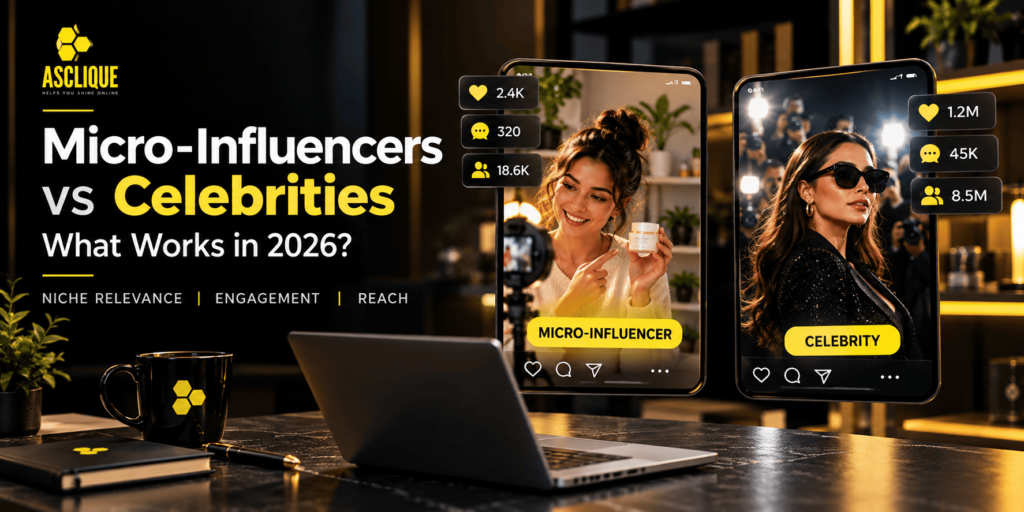
The business case for micro-influencers is not that smaller is always better. It is that reach only matters when the people being reached have some reason to care, which is why the micro influencers vs celebrities comparison increasingly comes down to relevance versus scale. Influencer Marketing Hub reported that 43% of marketers had increased their use of nano- and micro-influencers, while 24.9% were shifting budgets from macro and mega creators toward smaller ones.
This does not mean that the celebrity effect became outdated. An elite athlete, actor, or creative person is still capable of presenting the product to millions of people in the blink of an eye, whereas a smaller creator may require days or weeks to reach a fraction of that audience.
The difference is what happens after that reach.
A celebrity can create awareness at enormous scale. A micro-influencer can introduce a product to a smaller group of people who may already share a specific interest, problem, profession, hobby, or lifestyle.
That distinction has become increasingly important as brands pay closer attention to what happens after an impression. Visibility remains valuable, but marketers also want clicks, conversations, leads, purchases, and other measurable actions.
For brands planning their social media strategy, the real question in 2026 is therefore not simply who has more followers. It is which type of creator provides the right audience for the campaign objective.
Micro-Influencers vs Celebrities: What Is the Real Difference?

The most obvious difference is audience size, but that is only the beginning.
Celebrity influencers generally have extremely large audiences that can span countries, demographics, and interests. Their value is primarily scale. One post can introduce a product to millions of potential customers.
Micro-influencers operate differently. Their audiences are smaller, but they are often built around a particular subject.
A creator may focus almost entirely on running, skincare, home organization, personal finance, real estate investing, parenting, gaming, vegan cooking, or another specific interest.
That specialization changes the relationship between creator and follower.
Someone following a professional athlete may enjoy their personality without necessarily wanting advice about every product they promote. Someone following a creator whose entire account is dedicated to marathon training, however, probably has a stronger reason to pay attention when that creator discusses running shoes.
The differences become clearer when the two approaches are placed side by side.
Factor | Micro-Influencers | Celebrity Influencers |
|---|---|---|
Audience size | Smaller and more concentrated | Very large and broad |
Audience relevance | Often highly niche | Can span many interests |
Reach | Limited individually | Massive |
Engagement | Often more community-focused | Varies considerably |
Cost | Generally lower | Generally much higher |
Creator accessibility | Easier for brands to approach | Often managed through agencies |
Number of partnerships possible | Brands can work with several creators | Budget may support only one or a few |
Content style | Specialized and personal | Broad and highly visible |
Best suited for | Targeting, education, niche campaigns | Awareness and mass exposure |
Campaign testing | Easier to test multiple audiences | Fewer opportunities if budget is concentrated |
Community interaction | Often closer | Usually more distant because of scale |
Brand awareness potential | Builds gradually | Can increase rapidly |
Neither column represents an automatic advantage. A campaign requiring 10 million impressions has fundamentally different needs from one trying to reach 20,000 highly relevant potential buyers.
Why Are More Brands Using Smaller Creators?
Cost is certainly part of the answer.
A celebrity collaboration can consume a significant portion of a campaign budget. Working with smaller creators allows brands to distribute that budget across multiple partnerships instead.
But cost alone does not explain the shift.
Smaller creators can also give marketers greater control over audience targeting.
Imagine a sports nutrition company launching a new recovery product.
A celebrity athlete may provide enormous visibility. However, the audience could include casual sports fans, entertainment followers, general consumers, and people with little interest in purchasing sports nutrition products.
Alternatively, the company could work with multiple creators focused specifically on strength training, marathon running, CrossFit, cycling, or sports nutrition.
The combined audience may be smaller, but the percentage of people interested in the category could be considerably higher.
This approach also gives brands more content.
Instead of one major celebrity post, the company may receive dozens of videos, reviews, demonstrations, stories, and other pieces of creator content.
That content can potentially support a broader content marketing strategy rather than functioning as a single campaign asset.
Where Celebrity Influencers Still Have the Advantage
Smaller creators are not replacing celebrities.
There are campaign objectives where mass reach remains extremely valuable.
Major product launches are an obvious example.
If a global consumer brand launches a new smartphone, sneaker, beverage, or entertainment product, the goal may be to make millions of people aware of it within a very short period.
Celebrity creators can accomplish this quickly.
They also provide something smaller creators cannot easily reproduce: cultural visibility.
When a globally recognized athlete wears a particular shoe or a famous actor becomes the face of a beauty product, the partnership itself can become a topic of conversation.
The brand is not simply purchasing impressions. It is associating itself with a recognizable public identity.
For large consumer brands, that association can be strategically valuable even when direct conversions from an individual post are difficult to measure.
Celebrity partnerships can also create a halo effect around smaller marketing activities. Consumers may first encounter a product through a celebrity and later see the same product discussed by smaller creators, reviewers, customers, or friends.
In that situation, mass reach creates familiarity while smaller touchpoints provide additional information.
Niche Relevance Can Matter More Than Follower Count
Follower count is one of the easiest influencer metrics to understand, which is also why marketers can give it too much importance.
A creator with 5 million followers clearly has more potential reach than someone with 50,000.
But potential reach does not tell you whether those people are relevant.
Consider a software company selling an advanced analytics platform for ecommerce businesses.
A lifestyle celebrity with several million followers could promote the software, but most followers may have no reason to purchase an ecommerce analytics platform.
A creator with 40,000 followers who publishes Shopify tutorials may reach far fewer people while reaching a much larger percentage of potential customers.
The second creator has less reach but potentially greater audience relevance.
The same principle applies in industries where customers are searching for a very specific solution rather than general information. A large audience can create visibility, but relevance becomes more important when the user already has a defined need and is actively comparing options.
For example, a student searching pay to write my assignment at DoMyEssay has a much more specific intent than someone simply browsing general education or study content. Reaching thousands of unrelated users would offer limited value compared with reaching a smaller audience already interested in assignment support, academic productivity, or study resources.
This is one reason niche creators can be valuable for specialized products and services. Their followers often share a common interest or problem, allowing brands to place their message within a context that already makes sense to the audience.
However, relevance alone does not guarantee results. Brands still need to consider the creator’s credibility, audience quality, content style, and how naturally the promotion fits their usual content.
A highly targeted audience may notice quickly when a recommendation feels disconnected from what the creator normally discusses.
The strongest partnerships therefore balance reach with contextual relevance. Instead of asking only how many people a creator can reach, marketers should consider how closely those people match the customers they actually want to attract.
Micro-Influencers Can Create a Different Type of Trust
Smaller creators often interact with their audiences differently.
They may answer comments, respond to direct messages, participate in niche communities, and discuss highly specific subjects repeatedly.
Over time, followers can begin to see them as knowledgeable members of a community rather than distant public figures.
That relationship can make recommendations feel more contextual.
For example, someone who has followed a skincare creator for two years may have watched that person test dozens of products, explain ingredients, compare routines, and discuss different skin types.
When that creator recommends a new product, followers have substantial context for evaluating the recommendation.
The recommendation does not automatically become trustworthy simply because the creator has a small audience. Poor partnerships, irrelevant promotions, and excessive sponsorships can damage credibility at any audience size.
But niche creators have the opportunity to build authority around a specific subject in a way that broad celebrity accounts often cannot.
Brands considering this approach can also look at how micro-influencers generate revenue through sponsorships, affiliate partnerships, products, and other monetization models.
The Cost Difference Changes How Campaigns Can Be Tested
Another advantage of smaller creators is experimentation.
If most of a campaign budget is invested in one celebrity partnership, marketers have relatively few opportunities to test different audiences, messages, and creative formats.
Working with multiple smaller creators changes the structure.
A brand could test creators across several niches, platforms, audience sizes, and content formats.
Some may perform poorly.
Others may generate unexpectedly strong engagement or conversions.
The company can then increase investment in the creators and audience segments that perform best.
This makes influencer marketing less dependent on a single major partnership and more similar to performance marketing, where campaigns are continuously tested and optimized.
Brands using PPC services already follow a similar principle: test audiences and creative approaches, examine performance, and direct more resources toward the combinations producing stronger results.
One Celebrity or 20 Micro-Influencers?
There is no universal answer.
The decision depends on what the campaign needs to accomplish.
A celebrity may make more sense when the primary goal is massive brand awareness, rapid exposure, a major product launch, mainstream visibility, or reaching a broad consumer market.
Micro-influencers may make more sense when the campaign requires niche targeting, product education, multiple pieces of creator content, community engagement, or testing several audience segments.
The product itself matters too.
Mass-market products naturally benefit from broad exposure because almost anyone could become a customer.
Highly specialized products usually require more targeted audiences.
A soft drink company and a B2B cybersecurity company should not evaluate influencer reach in the same way.
Budget also changes the calculation. A large company may be able to combine several creator tiers in one campaign, while a smaller business may achieve more useful coverage by distributing its budget among carefully selected niche creators.
This is one reason influencer marketing for start-ups often emphasizes smaller creators, audience alignment, and measurable campaign objectives.
Why Engagement Rate Alone Is Not Enough
The growing interest in micro-influencers has also created another problem: marketers sometimes replace one oversimplified metric with another.
Follower count becomes engagement rate.
But a high engagement rate does not automatically produce business results.
A creator might receive hundreds of comments because their audience enjoys their personality while generating very little interest in the products they promote.
Brands therefore need to look beyond likes and comments.
Useful campaign metrics can include website visits, landing page engagement, promo code usage, email registrations, leads, purchases, cost per acquisition, revenue generated, new followers, and branded searches.
Tracking links, unique discount codes, landing pages, and analytics platforms can help marketers understand what happens after someone interacts with influencer content.
The objective is not simply engagement.
It is meaningful action.
Creator Content Has Value Beyond the Original Post
Influencer campaigns can also produce valuable marketing assets.
A well-made creator video may later be useful in paid advertising, product pages, social media campaigns, email marketing, or other promotional channels, depending on the usage rights negotiated with the creator.
This makes creative quality another important factor when selecting influencers.
A smaller creator who consistently produces strong videos may provide greater long-term value than an account with significantly more followers but weaker content.
Brands should therefore evaluate the creator as both a distribution channel and a content producer.
A creator who understands hooks, storytelling, product demonstrations, editing, and platform-specific formats can potentially provide assets that continue producing value after the original campaign has ended.
This also makes influencer marketing increasingly connected with social media marketing services, where creator content can become one component of a larger organic and paid social strategy.
Micro-Influencers Allow Brands to Reach Multiple Niches
Another benefit of working with several smaller creators is audience diversification.
A product rarely has only one type of customer.
Consider a travel backpack.
A celebrity partnership might expose the backpack to millions of people at once. Alternatively, the company could partner with creators covering backpacking, business travel, digital nomad lifestyles, photography, budget travel, hiking, and international study.
Each creator introduces the same product from a different perspective.
One might discuss storage.
Another could focus on airline carry-on requirements.
A photographer might demonstrate how camera equipment fits inside.
A business traveler could focus on laptop protection.
This creates multiple reasons for consumers to consider the same product.
The campaign is no longer simply repeating a promotional message. It is adapting that message to different audience needs.
Smaller Creators Can Also Support Search Discovery
Social platforms increasingly function as discovery engines.
People search TikTok, Instagram, YouTube, Reddit, and other platforms for product recommendations, tutorials, comparisons, reviews, and solutions.
That means creator content can continue influencing consumers after the initial publication date.
A useful product demonstration might appear when someone searches for the product category weeks or months later.
This gives informative creator content a different type of value from a temporary awareness campaign.
Brands can strengthen this effect by selecting creators who naturally produce searchable educational content rather than asking every influencer to publish a conventional promotional post.
This broader shift toward question-based discovery also explains why businesses are investing in Answer Engine Optimization services alongside traditional search and social strategies.
The Hybrid Strategy May Be the Most Practical
The micro-influencer versus celebrity debate sometimes assumes brands must choose one side.
They do not.
Large campaigns can combine both.
A celebrity or macro creator can introduce the campaign to a broad audience.
Micro-influencers can then reinforce the message inside individual communities.
For example, a fitness brand launching a new product could work with a recognizable athlete for the main launch while partnering with running coaches, fitness creators, nutrition specialists, and local athletes to explain and demonstrate the product.
The celebrity creates awareness.
The niche creators provide depth.
This approach allows marketers to combine scale and relevance instead of treating them as competing strategies.
Brands can also use creator performance data to decide where future spending should go. If particular niche creators consistently generate conversions, those relationships can develop into longer-term partnerships.
What Should Brands Measure in 2026?
Influencer marketing measurement needs to move beyond follower counts.
Brands should examine the entire journey from exposure to action.
Before selecting creators, marketers should define what the campaign is supposed to achieve.
If the objective is awareness, reach and impressions may be appropriate primary metrics.
If the objective is engagement, comments, saves, shares, and video completion rates may matter more.
If the objective is sales, marketers should focus on traffic, conversions, acquisition costs, and revenue.
Marketers should also consider whether the creator attracts new customers or repeatedly reaches people already familiar with the brand.
Incremental reach can matter when several creators have overlapping audiences.
The creator with the largest audience may not deliver the strongest result.
Likewise, the creator with the highest engagement rate may not generate the most customers.
The correct metric depends on the objective.
Brands that are still building their influencer strategy can also review practical approaches for finding micro-influencers based on niche, audience characteristics, engagement, and content quality.
Micro-Influencers vs Celebrities in 2026: Relevance or Reach?
The rise of smaller creators does not mean celebrity marketing is disappearing.
It means brands have more options.
Celebrity influencers remain exceptionally powerful when campaigns require massive visibility. Few marketing channels can place a product in front of millions of people as quickly.
Micro-influencers solve a different problem.
They allow marketers to reach smaller groups built around specific interests, professions, communities, and purchasing needs.
That can make every impression more relevant.
The smartest influencer strategy therefore begins with a simple question:
Do you need more people to see the message, or do you need the right people to see it?
For many campaigns, the answer will involve some combination of both.
FAQ’s
Are micro-influencers better than celebrities for marketing?
Neither option is automatically better. Micro-influencers can be useful when a brand wants to reach a specific niche and prioritize audience relevance, while celebrities provide much larger reach and rapid awareness. The right choice depends on the campaign objective, target audience, product, and available budget.
Why are brands using more micro-influencers?
Micro-influencers allow brands to target specific communities and distribute campaign budgets across multiple creators. They can also provide varied content and give marketers more opportunities to test audiences, messages, and creative approaches.
How many followers does a micro-influencer have?
Definitions vary between platforms and organizations, but micro-influencers are generally creators with relatively small audiences compared with macro or celebrity influencers. Audience size should not be evaluated alone because niche relevance and engagement quality can be equally important.
Are micro-influencers more cost-effective?
They can be, particularly for niche campaigns. Brands may be able to partner with several smaller creators for the cost of one major creator. However, cost-effectiveness should ultimately be determined by actual campaign outcomes rather than the price of an individual post.
When should a brand use a celebrity influencer?
Celebrity partnerships can make sense for major product launches, mass-market products, large awareness campaigns, and situations where a brand wants to reach a very large consumer audience quickly.
Can brands use celebrities and micro-influencers together?
Yes. A hybrid strategy can use celebrities or large creators to generate broad awareness while smaller creators provide more targeted content within specific communities.
What should brands look for when choosing an influencer?
Brands should consider audience demographics, niche relevance, engagement quality, content quality, previous partnerships, brand compatibility, follower authenticity, and measurable campaign objectives. Follower count should be considered alongside these factors rather than used as the only selection criterion.
How can brands measure influencer marketing results?
Measurement should reflect the campaign objective. Brands can track reach and impressions for awareness, engagement metrics for interaction, and website visits, leads, promo-code usage, conversions, acquisition costs, and revenue for performance-focused campaigns.
Is influencer marketing only useful for consumer brands?
No. Influencer and creator marketing can also work for specialized industries when the creator has access to the appropriate audience. In these cases, audience relevance can be more important than total follower count.
Should brands choose one large influencer or several smaller influencers?
It depends on the objective. One large influencer can provide rapid reach, while several smaller creators allow a brand to target different niches, test multiple messages, and diversify campaign risk. Some campaigns can benefit from combining both approaches.
Final Thoughts
The shift toward smaller creators is not evidence that mass reach has stopped working.
It shows that marketers are becoming more selective about the value of that reach.
A million impressions from a loosely relevant audience and 50,000 impressions from people deeply interested in a category serve very different purposes.
Celebrity creators can still deliver something that smaller creators cannot easily replicate: enormous exposure concentrated into a short period.
Micro-influencers offer a different advantage. Their audiences may be smaller, but those audiences can be built around precisely the subjects, problems, and interests a brand wants to reach.
The decision should therefore come after the campaign objective, not before it.
A company seeking nationwide awareness may prioritize scale. A specialized business trying to reach a defined customer group may prioritize relevance. A larger campaign may use celebrity reach at the top of the funnel and smaller creators to provide education, demonstrations, reviews, and repeated exposure further down the journey.
In 2026, successful influencer marketing is less about choosing the biggest name available and more about matching the creator, audience, content, and campaign objective.
Sometimes that will mean a celebrity.
Sometimes it will mean 20 micro-influencers.
And increasingly, it may mean using both.