
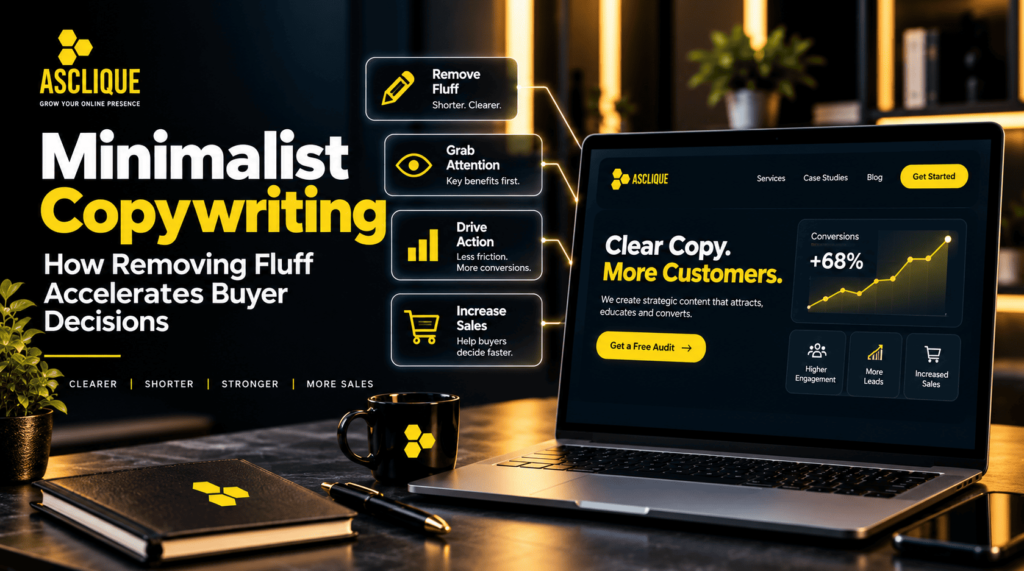
Shorter copy helps your prospect focus on your core offer, accelerating their journey to the checkout page. You rarely need a massive wall of text to persuade a modern buyer; in fact, over-explaining can often introduce unnecessary friction.
Your customers often operate with extreme urgency. They want to know what you sell, how it helps them, and what it costs without digging through paragraphs of text.
By stripping away the fluff, you respect the reader’s time and energy. This minimalist approach reduces cognitive load and helps prevent choice paralysis.
For businesses investing in digital marketing, this principle matters across almost every customer touchpoint. Website pages, landing pages, advertisements, emails, product descriptions, and even search snippets have limited time to communicate value. Effective copy gets the essential message across before the prospect loses interest.
This is particularly important when creating content designed to generate leads or sales. Asclique’s Content Marketing Services focus on creating content that supports traffic, engagement, lead generation, and conversions rather than simply increasing the amount of text published on a website.
The psychology of cognitive load
Cognitive overload is a frequent conversion killer. Faced with dense paragraphs, visitors can experience a spike in frustration and simply close the tab. Think about high-stress or urgent purchasing environments. When an overwhelmed student decides to pay Essayservice to write an essay, they want a fast, clear solution, not a manifesto on academic writing.
Despite this universal need for speed, one of the most common copywriting mistakes is assuming that longer pages automatically build more trust. In reality, clarity builds trust.
Eye-tracking studies consistently show that web users scan pages in an F-pattern rather than reading them word by word. Mastering the basics of copywriting means actively designing your text for this behavior. If your best selling point is buried in the middle of a thick paragraph, it is likely to be skipped entirely.
This behavioral reality means you should front-load your most important benefits. Put the ultimate payoff in your headline, rather than saving it for a concluding summary.
The same principle applies to SEO content. Ranking a page can bring users to a website, but the content still has to quickly demonstrate relevance once they arrive. Businesses therefore need to balance search optimization with readability and conversion intent.
As explained in Asclique’s guide to SEO content marketing services, SEO and content marketing work together when content is designed to attract the right audience while helping move those visitors toward a meaningful business action.
How to edit mercilessly
You have likely read countless copywriting articles that tell you to “write clearly,” but they rarely explain how to execute that on the page. Cutting your word count forces you to isolate the single most compelling benefit of your product.
Start by deleting introductory filler phrases. For example, “We are proud to announce that our software helps you” easily becomes “Our software helps you.” You lose absolutely no meaning, but you gain crucial momentum.
Similarly, hunting down and eliminating passive voice naturally trims your total word count. Raymond Miller, a blog writer for the essay writing service DoMyEssay, notes that passive voice is a primary momentum killer in digital writing because it drags the sentence out unnecessarily.
Notice how active phrasing creates a stronger, more direct promise:
Passive: Your productivity will be increased by our app.
Active: Our app increases your productivity.
Passive: Mistakes are prevented by our automated system.
Active: Our automated system prevents mistakes.
For business websites, editing should also consider search intent. A page can be concise without becoming vague. The objective is to remove sentences that do not contribute meaning while retaining the terminology, explanations, proof, and answers that visitors actually need.
This distinction becomes especially important when optimizing pages for organic search. Asclique’s AI SEO Services combine content optimization with search-intent and user-behavior insights, helping businesses structure content around what users are actually trying to accomplish.
Formatting as an editorial tool
Empty space on a webpage acts as a spotlight, naturally drawing the user’s eye to your most critical text. Surrounding a short headline with generous white space makes it difficult to ignore, giving your words room to breathe.
Along with white space, you must structure the words themselves for easy scanning. Replacing thick feature descriptions with bulleted lists increases comprehension because the brain processes individual items faster than connected sentences. Breaking up text gives the reader visual resting points as they scroll, preventing eye fatigue.
For example, notice how much easier it is to read punchy, scannable benefits instead of a bulky paragraph:
- Saves hours of administrative work
- Eliminates manual data entry
- Syncs across devices instantly
- Secures private client data
This scannable formatting becomes even more critical when writing for mobile screens. A three-sentence paragraph on a desktop computer easily morphs into an intimidating block of text on a smartphone. Keeping paragraphs to one or two sentences maximum accommodates their scrolling speed and keeps the narrative moving.
Formatting also affects how easily search engines and AI-driven systems can interpret information. Descriptive headings, concise explanations, lists, FAQs, and clearly separated sections make it easier to identify the purpose and hierarchy of information.
That principle is increasingly relevant as businesses optimize content not only for conventional search results but also for answer-driven experiences. Asclique’s Answer Engine Optimization Services use structured, answer-focused content to help businesses improve visibility across question-based searches, featured answers, and related search experiences.
Minimalist copywriting for landing pages
Landing pages are one of the clearest places to apply minimalist copywriting.
A visitor arriving through an advertisement or search result usually has a specific expectation. If the landing page forces that person to navigate through lengthy introductions before finding the offer, the copy creates unnecessary friction.
A strong landing page should quickly establish:
- What is being offered
- Who the offer is intended for
- What problem it solves
- What makes the offer different
- What the visitor should do next
Supporting details can follow once the primary value proposition is established.
This is especially relevant to paid campaigns because every unnecessary obstacle between an advertisement and conversion can reduce the value generated from paid traffic. Asclique’s PPC Services therefore combine advertising with landing-page creation and optimization to support conversion performance.
Crafting microcopy that removes friction
The tiny words on your buttons and error messages drastically impact whether a user actually completes a purchase. Good microcopy removes last-minute anxiety by anticipating the user’s hesitation right at the point of action.
Instead of a generic “Submit” button, try using action-oriented phrases like “Get my free guide.” This reminds the user of the concrete value they are receiving rather than the work they have to do to get it.
Placing risk-reversal text directly beneath your payment buttons can also ease tension. A simple “Cancel anytime” or “No credit card required” encourages immediate action without requiring a long explanatory paragraph.
Microcopy should therefore be treated as part of the conversion strategy rather than an afterthought.
Consider the difference between:
Submit
and:
Get My Free Audit
The second version communicates what happens after the click.
Similarly:
Sign Up
can become:
Start My Free Trial
The additional words are useful because they reduce uncertainty. Minimalist copywriting is not necessarily about choosing the shortest possible phrase. It is about communicating the necessary information with as little friction as possible.
Minimalist copywriting and SEO can work together
One misconception is that SEO requires unnecessarily long content.
Search-focused content should provide enough information to satisfy the intent behind the query. That does not mean every page needs thousands of words.
A commercial service page may need concise explanations, proof, benefits, FAQs, and a clear CTA. An informational guide addressing a complicated subject may legitimately require much greater depth.
The appropriate length therefore depends on the question the page needs to answer.
This is also why businesses should evaluate SEO content according to relevance and business outcomes rather than word count alone. Asclique’s guide to SEO services for small businesses discusses how structured, intent-focused content works alongside technical optimization, keyword research, and other SEO activities.
The objective should be comprehensive coverage without unnecessary repetition.
Minimalist copy across the customer journey
Minimalist principles can also improve consistency across different stages of digital marketing.
At the awareness stage, users need a clear explanation of their problem and potential solution.
During consideration, they need benefits, comparisons, evidence, and reasons to trust the business.
Near conversion, they need pricing information, risk reduction, clear next steps, and strong calls to action.
Trying to communicate every possible message at every stage creates clutter.
Instead, businesses should match the amount of information to the visitor’s intent.
This becomes particularly valuable for small businesses competing against larger brands. A complicated website does not automatically appear more authoritative. Clear positioning and straightforward communication can make a smaller company easier to understand and easier to buy from.
As Asclique explains in its guide to technical SEO services, website performance and user experience also contribute to the overall effectiveness of a site. Clear copy works best when the surrounding website is equally easy to navigate and use.
Avoiding extreme minimalism
Minimalism means removing unnecessary fluff, not hiding essential facts. When handling niche copywriting for complex software, B2B services, or high-ticket items, detailed proof is still required. You must always give the buyer enough information to justify their purchase.
Cutting vital product specifications just to make a page look sleek can damage buyer trust and increase customer support tickets. Instead of deleting necessary details, format them so they are easy to digest. Use expanding accordions or hidden toggles for heavy technical specs. This keeps the main page visually clean while fully satisfying buyers who need granular data.
Before hitting publish, ensure your stripped-down copy still clearly answers these fundamental questions:
- What exactly is this product?
- How will it solve my specific problem?
- Why should I trust this company?
- What happens immediately after I click the button?
If a sentence does not educate, persuade, or direct the user toward answering these core questions, consider cutting it. Your readers, and your conversion rates, will thank you.
A practical minimalist copywriting checklist
Before publishing a website page, landing page, product description, or marketing campaign, review the copy one final time.
Ask:
- Can the visitor understand the offer within a few seconds?
- Does the headline communicate a meaningful benefit?
- Is important information visible without searching through long paragraphs?
- Are sentences written primarily in active voice?
- Can any introductory filler be removed?
- Are paragraphs short enough for mobile users?
- Are important benefits easy to scan?
- Does every section serve a specific purpose?
- Are calls to action clear about what happens next?
- Have you retained the information necessary to make a buying decision?
If removing a sentence makes the page clearer without reducing its usefulness, remove it.
If removing a sentence creates uncertainty, keep it or rewrite it more efficiently.
That is the difference between minimalist copywriting and simply writing less.
Final thoughts
Minimalist copywriting is not a competition to produce the fewest words possible.
It is an editing discipline.
Every headline, sentence, bullet point, and CTA should earn its place on the page. Remove what distracts from the buying decision and strengthen what helps the customer understand the offer.
For businesses, that means replacing bloated website copy with content that communicates value quickly while still providing the depth customers and search engines need.
The strongest copy does not necessarily say less.
It says exactly enough.
FAQ’s
What is minimalist copywriting?
Minimalist copywriting is the practice of communicating a marketing message using only the information necessary to educate, persuade, and guide the reader. It removes filler, repetition, unnecessary jargon, and overly complicated explanations while retaining important benefits, proof, and buying information.
Does shorter copy always convert better?
No. Shorter copy is not automatically better. The ideal amount of copy depends on the product, audience, price, buying risk, and complexity of the decision. A simple low-cost product may require very little explanation, while expensive B2B software may require detailed specifications, demonstrations, case studies, and FAQs.
How does minimalist copywriting improve conversions?
Minimalist copy can reduce cognitive load and make important information easier to identify. Visitors can understand the offer, benefits, and next action more quickly instead of searching through unnecessary information.
Can minimalist copywriting help SEO?
Yes, when minimalism improves structure and removes unnecessary repetition without eliminating useful information. SEO content still needs to satisfy search intent and provide sufficient topical coverage. Concise headings, direct answers, FAQs, lists, and well-organized sections can also make information easier for users and search systems to interpret.
How short should website paragraphs be?
There is no universal paragraph length, but online paragraphs should generally be easy to scan, particularly on mobile devices. If a paragraph becomes visually dense, divide it into smaller sections without breaking the logical flow of the information.
What copy should never be removed from a sales page?
Do not remove information necessary for the customer to make an informed decision. Depending on the offer, this may include pricing, core features, limitations, product specifications, guarantees, delivery information, cancellation terms, trust signals, and explanations of what happens after purchase.
What is the difference between minimalist copy and thin content?
Minimalist copy removes unnecessary words while preserving useful information. Thin content fails to adequately answer the user’s question or provide meaningful value. A page can therefore be concise without being thin.
Should businesses use minimalist copywriting for PPC landing pages?
Yes. PPC visitors typically arrive with a specific intent created by the advertisement they clicked. Landing-page copy should quickly reinforce that message, explain the value proposition, address important objections, and provide a clear next action.