
SEO proxies help teams collect search results from different locations, monitor competitor visibility, and run repeated rank checks across large keyword sets. As reported by Google, more than 5 trillion searches are made annually, highlighting the scale of the search environment SEO teams need to monitor across keywords and markets. The quality of the proxy layer matters because search results can vary by location, network context, device environment, and request pattern.
For ongoing SEO research, the goal is not simply to access more IP addresses. Teams need location controls that match their target markets, reliable rotation for large query sets, stable sessions when continuity matters, and enough concurrency to monitor keywords and competitors without creating unnecessary bottlenecks.
Why Do SEO Tools Need Proxies for Rank Tracking?
Rank tracking can require thousands of repeated search queries across keywords, locations, devices, and reporting periods. Sending all of those requests through one connection can create request limits and make it difficult to reproduce search conditions for different markets.
Location-Specific Rankings
Search results can change between countries, states, and cities. A proxy lets an SEO tool route a query through an IP in the intended market instead of relying on the location of the server running the rank tracker. This is particularly important for local SEO, multi-location businesses, and campaigns where the same keyword needs to be measured separately across several markets.
Repeated SERP Queries
Rank trackers often check the same keyword set daily, weekly, or even more frequently. Rotating proxy pools distribute those queries across multiple IPs rather than repeatedly sending them through one address. The rotation policy still needs to match the workload. Changing IPs unnecessarily can introduce another source of inconsistency, while insufficient rotation can concentrate too many requests on the same addresses.
Parallel Keyword Checks
Large SEO datasets become difficult to collect sequentially. Proxy infrastructure allows multiple workers to check different keywords, locations, or competitors at the same time.
Concurrency becomes especially important for agencies, enterprise SEO teams, and platforms monitoring large keyword portfolios across several markets.
How Do Proxies Improve Competitor Research?
Competitor SEO research depends on observing search results consistently over time. Proxies help teams repeat those observations from relevant locations instead of treating one SERP as representative of every market.
- Competitor ranking changes: Repeat searches from comparable locations to identify changes in competitor positions over time.
- Keyword visibility: Track which competitors appear for important commercial, informational, and local queries.
- SERP feature tracking: Monitor local packs, featured results, shopping elements, and other search features that can alter organic visibility.
- Local competitor monitoring: Compare businesses that appear in different cities or regional search markets.
- Landing page checks: Review which competitor URLs rank for tracked queries and how those URLs change over time.
- Regional search differences: Compare the same keyword across locations to identify market-specific competitors and search behavior.
- Repeatable research: Keep location and session parameters controlled when running recurring competitor reports.
What Affects Rank Tracking Accuracy?
Proxy settings can directly affect the accuracy and consistency of rank tracking. Exit location, IP quality, rotation, and session behavior determine how closely each request matches the intended search environment. Keeping these variables consistent helps teams compare SERP results across keywords, locations, and repeated tracking cycles.
Exit IP Location
The exit IP needs to correspond closely to the market being tracked. Country targeting may be sufficient for national campaigns, while local SEO often requires state or city-level control. A generic US IP, for example, cannot automatically reproduce the same search context as an IP associated with the city being measured.
IP Quality and Reputation
Search engines can respond differently to addresses with different histories and traffic patterns. Poor-quality or heavily reused IPs can result in failed requests, additional verification, or inconsistent responses. Testing actual SERP targets is therefore more useful than evaluating a proxy network only by its advertised pool size.
Session and Rotation Behavior
Frequent rotation works well when a tracker needs to distribute a large number of independent keyword checks. Sticky sessions are more appropriate when several related requests need to retain the same network identity. The session policy should remain consistent across comparable measurements so that changes in proxy behavior do not become another uncontrolled variable.
Search Context
Proxies do not eliminate every source of SERP variation. Device type, mobile versus desktop context, language, search personalization, query history, and the search engine itself can all influence results. Accurate SEO monitoring therefore requires the proxy location to be controlled alongside the other parameters used by the rank-tracking system.
How Do the Best USA Proxies Support Local SEO Tracking?
The best USA proxies help SEO teams measure search visibility from the geographic markets they actually target. Depending on the campaign, this can mean using US, state, or city-level connections to collect more location-relevant SERPs and compare rankings across different markets.
- US-specific SERPs: Collect search results from US connections for national keyword monitoring and visibility analysis.
- State-level tracking: Compare rankings, competitors, and search behavior between different US regions when state targeting is available.
- City rank tracking: Measure local rankings and location-sensitive SERP features within individual cities instead of treating the US as one search market.
- Local competitor monitoring: Identify competing businesses and domains and compare regional keyword differences across specific local SERPs.
- Multi-market SEO: Run parallel rank tracking across multiple cities, states, or business locations while keeping the required geographic context for each market.
What Are the 8 Best SEO Proxies for Rank Tracking and Competitor Research?
The best SEO proxies for rank tracking and competitor research combine accurate geo-targeting, reliable IP rotation, flexible sticky sessions, and enough capacity for recurring SERP collection. The eight providers below support different SEO workloads, from localized rank checks and competitor monitoring to large-scale keyword tracking across multiple markets.
| Provider | Location Accuracy | Rotation / Sticky | Keyword Volume Fit | Competitor Monitoring | Best SEO Use |
| 1. Live Proxies | Country, city, ASN | Rotating / sticky up to 24 hours | High | Strong for recurring regional checks | Parallel localized tracking |
| 2. Oxylabs | Country, state, city, ZIP | Rotating / sticky up to 30 minutes | Very high | Large international datasets | Enterprise SEO monitoring |
| 3. Decodo | Country, state, city, ZIP, ASN | Rotating / sticky up to 24 hours | High | Recurring multi-market checks | Automated rank tracking |
| 4. Webshare | Country, state, city, ZIP, ASN | Rotating / sticky 1 minute–24 hours | High | Automated recurring checks | Developer-led SEO tools |
| 5. SOAX | Country, region, city, ISP | Rotating / sticky up to 60 minutes | High | Granular regional research | Geo-sensitive SEO |
| 6. IPRoyal | Country, state, city | Rotating / sticky 1 second–7 days | Medium–high | Local and recurring research | Flexible SEO projects |
| 7. Rayobyte | Country, state, city, ZIP, ASN on residential | Rotating / sticky 1–120 minutes | Medium–high | Persistent monitoring | Stable recurring checks |
| 8. ProxyEmpire | Country, region, city, ISP | Rotating / sticky up to 60 minutes | High | Multi-country research | International SEO |
1. Live Proxies
Live Proxies suit SEO teams that need recurring rank tracking and competitor research from controlled locations. Its rotating residential proxies provide millions of IPs across 55 countries, with strong coverage in the United States, Canada, and the United Kingdom. Private allocation, country, city, and ASN targeting, unlimited threads, and HTTP and SOCKS5 support help teams run parallel keyword checks with greater control.
Sticky sessions of up to 24 hours support longer research flows, while rotation helps distribute larger SERP collections. Teams comparing unmetered residential proxies should also review traffic terms, targeting precision, and concurrency.
Rank Tracking Strengths
- Country and city targeting: Run rank checks from the geographic markets represented in an SEO campaign.
- Private IP allocation: B2C users receive exclusive allocations, while B2B configurations reduce overlap by preventing allocated IPs from being used by another customer against the same or similar targets.
- Sticky sessions: Maintain the same IP for up to 24 hours when a tracking or research process needs continuity.
- Unlimited threads: Run parallel keyword, location, and competitor checks without restrictive thread limits.
- HTTP and SOCKS5: Support common browser, scraper, and SEO automation environments.
Competitor Research Fit
- Regional competitor monitoring: Compare competitor visibility from country- and city-specific connections.
- Recurring SERP checks: Use controlled sessions for repeated keyword and competitor observations.
- Multi-market research: Run location-specific checks across multiple campaigns and markets.
- Ongoing visibility tracking: Combine private allocation and flexible sessions for persistent SEO monitoring.
Pricing
Residential proxies start at $70 for 4GB with a 30-day validity period. Enterprise pricing starts at $2,000/month for 1TB, equivalent to $2/GB. A free trial is available for B2B customers.
2. Oxylabs
Oxylabs provides residential, ISP, datacenter, mobile, and dedicated ISP proxies, giving SEO teams several network options for different collection requirements. Its residential infrastructure is particularly relevant to enterprise operations that need broad geographic coverage and enough capacity to process large keyword portfolios across multiple markets.
For rank tracking, teams can use rotating connections for distributed SERP collection or sticky residential sessions of up to 30 minutes when several related requests need greater continuity. The combination is useful for international competitor monitoring, frequent rank checks, and larger SEO data pipelines where request volume and geographic reach are important.
Rank Tracking Strengths
- Broad geo coverage: Residential infrastructure supports geographically distributed search-data collection.
- High request capacity: Large proxy pools support parallel keyword and location workloads.
- Session controls: Residential proxies support rotation and sticky sessions of up to 30 minutes.
- Large keyword sets: The infrastructure can support enterprise SEO operations monitoring extensive keyword portfolios.
Competitor Research Fit
- International competitor tracking: Compare competitor search visibility across multiple geographic markets.
- Frequent SERP monitoring: Run recurring search-result collection at larger volumes.
- Large-scale research: Process extensive keyword and competitor datasets across markets.
- Enterprise data workflows: Support sustained SEO data collection within larger research pipelines.
Pricing
Mobile proxies start at $7.50/GB ($30 for 4GB/month), while residential proxies start at $6/GB ($30 for 5GB/month). Enterprise mobile proxies start at $2,500 for 715GB/month, while enterprise residential pricing starts at $2,500/month for 1TB ($2.50/GB).
3. Decodo
Decodo provides residential, ISP, datacenter, and mobile proxies for automated data collection and location-sensitive workflows. Its residential infrastructure combines granular geographic targeting with configurable rotation and sticky sessions of up to 24 hours, allowing SEO teams to adapt proxy behavior to different types of rank-tracking jobs.
This flexibility is useful when the same system needs to handle both large batches of independent keyword checks and longer research sequences from a consistent IP. For competitor research, the setup can support recurring regional monitoring, SERP change tracking, and automated comparisons across multiple search markets.
Rank Tracking Strengths
- Geo-targeted checks: Residential proxies support granular location controls for localized search research.
- Rotation controls: Use rotating sessions or sticky sessions lasting up to 24 hours according to the query pattern.
- Residential access: Residential infrastructure spans a broad international location set.
- Scalable automation: Proxy endpoints can support parallel keyword and location checks.
Competitor Research Fit
- Regional monitoring: Compare competitor positions from specific geographic markets.
- Recurring checks: Repeat SERP observations using controlled rotation and session settings.
- SERP change tracking: Distribute scheduled searches across proxy connections.
- Competitor visibility research: Collect location-specific search data across larger keyword portfolios.
Pricing
ISP and datacenter proxies start at $2.75/GB and $0.60/GB, respectively, while residential and mobile proxies start at $3.75/GB, with residential pay-as-you-go access available at $4/GB. Residential plans include 250GB for $625/month ($2.50/GB), while the 1TB enterprise plan costs $2,000/month ($2/GB).
4. Webshare
Webshare offers rotating residential, static residential, private static residential, and dedicated static residential proxies. This range gives developer-led SEO teams a choice between rotating infrastructure for distributing large numbers of SERP requests and more persistent IP configurations for workflows where connection stability matters.
Its rotating residential product supports sticky sessions from 1 minute to 24 hours, while API access makes proxy management easier to integrate into custom rank trackers and scheduled SEO workflows. This makes Webshare relevant to automated keyword monitoring, repeated competitor checks, and teams building proxy access directly into their own SEO tools.
Rank Tracking Strengths
- API access: Connect proxy configuration and management to internal SEO tooling.
- Rotation control: Rotating residential proxies support sticky-session durations from 1 minute to 24 hours.
- Scalable request volume: Scale proxy resources as keyword and location requirements increase.
- Automated keyword checks: Integrate proxy access into scheduled tracking and data-collection processes.
Competitor Research Fit
- Repeated competitor checks: Schedule recurring competitor queries through automated systems.
- Automated SERP monitoring: Integrate proxy connections into existing rank-tracking scripts.
- SEO tool integrations: API-oriented management suits custom SEO infrastructure.
- Cost-efficient recurring research: Match the proxy configuration to the size and persistence requirements of the monitoring workload.
Pricing
Rotating residential plans start at $3.50/GB, with larger packages reducing the rate to $2.75/GB for 10GB, $2.60/GB for 25GB, $2.25/GB for 100GB, and $1.40/GB for 3,000GB. Static residential proxies start at $0.30 per proxy, while custom plans are available for enterprise customers.
5. SOAX
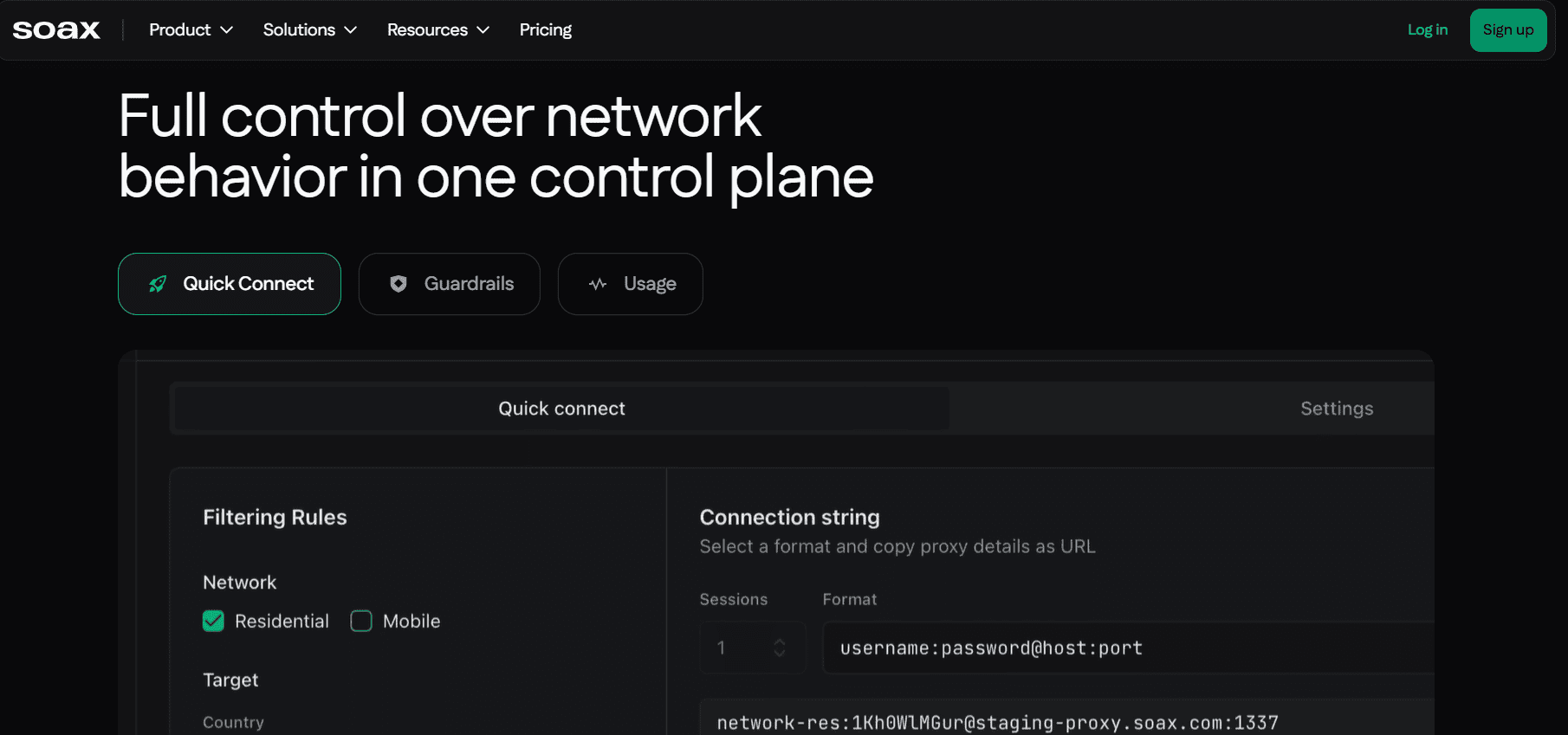
SOAX provides residential and mobile proxies for teams that need location-sensitive SEO research. Its targeting controls include country, region, city, and ISP parameters, making the network particularly relevant when rankings and competitor visibility need to be measured more precisely than a generic national connection allows.
Residential and mobile access also gives SEO teams flexibility when researching different search environments, while sticky residential sessions can remain active for up to 60 minutes. These controls fit local rank tracking, city-level competitor analysis, regional visibility comparisons, and multi-location campaigns where geographic precision is central to the dataset.
Rank Tracking Strengths
- Fine-grained targeting: Use country, region, city, and ISP controls for localized research.
- Residential and mobile access: Select a network context that fits the search environment being monitored.
- Session flexibility: Rotate addresses or maintain sticky residential sessions for up to 60 minutes.
- Localized SERPs: Granular location controls support local rank tracking and regional visibility analysis.
Competitor Research Fit
- City-level competitor tracking: Monitor competitors in individual local search markets.
- Mobile SERP research: Use mobile infrastructure when a workflow requires mobile-network context.
- Regional visibility checks: Compare competitors across cities and regions.
- Multi-location monitoring: Collect search data across geographically distributed campaigns.
Pricing
The Sandbox plan is free. The Builder plan costs $200/month plus VAT and includes 200 credits, with Tier 1 traffic priced at $3/GB, Tier 2 at $2.25/GB, and Tier 3 at $1.20/GB. Enterprise plans start at $3,000/month plus VAT, with traffic rates beginning at $0.85/GB for Tier 1 locations.
6. IPRoyal
IPRoyal provides residential, ISP, datacenter, and mobile proxies, covering both rotating and more stable proxy requirements. Its residential offering combines geographic targeting with flexible rotation and unusually broad sticky-session settings ranging from 1 second to 7 days, although the availability of an individual peer can affect how long the same residential IP remains online.
For SEO teams, this provides flexibility between short rank-checking jobs and longer research sessions that benefit from a consistent network identity. The service can therefore fit local rank tracking, recurring SERP research, competitor monitoring, and moderate-volume projects where teams want to adjust session behavior to the workflow.
Rank Tracking Strengths
- Residential and ISP access: Choose between rotating residential access and stable ISP infrastructure according to the workflow.
- Sticky sessions: Residential sticky-session settings range from 1 second to 7 days, although peer availability can affect how long an individual residential IP remains online.
- Geo-targeting: Location controls support local search research.
- Flexible traffic: Residential access can accommodate projects with changing traffic requirements.
Competitor Research Fit
- Local competitor checks: Run research from geographic markets relevant to the campaign.
- Recurring SERP research: Revisit the same keyword sets on a defined schedule.
- Stable sessions: Longer sticky-session settings support research that benefits from a persistent network identity.
- Moderate-volume monitoring: Flexible purchasing can fit SEO workloads that grow gradually.
Pricing
ISP proxies start at $2.40 per proxy, while residential proxies start at $1.75/GB. Enterprise rotating residential plans start at $1,500 for 1TB ($1.50/GB), with custom plans of 5TB or more starting from $0.75/GB.
7. Rayobyte
Rayobyte provides residential, static ISP, rotating ISP, static datacenter, rotating datacenter, and mobile proxies. The range allows SEO teams to choose between rotating infrastructure for distributed rank checks and static options for recurring workflows where retaining a consistent IP is more important.
Residential sticky sessions can be configured from 1 to 120 minutes, providing another option between rapid rotation and fully static infrastructure. This mix can support repeated SERP checks, ongoing competitor monitoring, and longer-running SEO research where different projects require different balances of location context, rotation, and IP persistence.
Rank Tracking Strengths
- Stable IP options: Static ISP and static datacenter products support workflows where IP consistency matters.
- ISP and residential access: Teams can select the network type according to the required balance of stability and location context.
- Rotation controls: Residential sticky sessions can be configured from 1 to 120 minutes.
- Repeated SERP checks: Different proxy types can be matched to recurring or higher-volume SEO collection.
Competitor Research Fit
- Long-running monitoring: Stable proxy options can support recurring research processes.
- Persistent research sessions: Static infrastructure fits workflows where the same IP needs to be reused.
- Recurring competitor checks: Residential or ISP infrastructure can be selected according to location and consistency requirements.
- Dedicated SEO workflows: Separate proxy configurations can be used for different recurring monitoring processes.
Pricing
Static ISP proxies start at $5/IP, rotating ISP proxies at $3.75/GB, and rotating residential proxies at $3.50/GB. Residential and mobile enterprise plans start at $0.50/GB for 5TB+, while rotating datacenter and rotating ISP plans above 1TB require a custom quote.
8. ProxyEmpire
ProxyEmpire offers rotating residential, unlimited residential, static residential, rotating mobile, dedicated mobile, and rotating datacenter proxies. Its combination of residential and mobile infrastructure is relevant to SEO teams collecting search data across multiple countries and regional markets rather than monitoring only one location.
Rotating residential connections can distribute larger SERP workloads, while sticky sessions of up to 60 minutes provide continuity for related queries and research sequences. These options fit international rank tracking, regional competitor monitoring, and market-by-market comparisons where teams need to keep geographic settings separate across recurring SEO jobs.
Rank Tracking Strengths
- Residential and mobile access: Select the network context according to the search environment being researched.
- Geo-targeting: Use location controls for market-specific rank tracking.
- Rotation control: Residential sessions can rotate automatically or remain sticky for up to 60 minutes.
- International coverage: Run SEO research across multiple geographic markets.
Competitor Research Fit
- Multi-country monitoring: Compare competitors across national search markets.
- Regional competitor tracking: Narrow collection to relevant regional markets.
- International SERP research: Collect search data through geographically distributed proxy infrastructure.
- Market-by-market comparisons: Keep location settings separate when comparing competitor visibility between regions.
Pricing
Rotating residential proxies start at $2.85/GB, with a pay-as-you-go plan priced at $3.50/GB. Enterprise rotating residential pricing is $1,500 for 1TB ($1.50/GB). Static residential proxies start at $3.50/IP per month, while rotating mobile proxies start at $4.17/GB.
How Does Geo-Targeting Change SEO Data?
Geo-targeting determines where the proxy exit IP appears to originate, making it an important control in location-sensitive SEO research. More precise targeting helps teams compare SERPs under the geographic conditions relevant to national, local, and international campaigns.
- Country-level SERPs: Measure national visibility without mixing search environments from unrelated countries.
- City-level rankings: Track local campaigns from connections associated with individual cities and compare visibility between target markets.
- Local competitors and intent: Identify competing domains, landing pages, and SERP features that differ between geographic markets.
- Language and international SEO: Compare rankings across countries and regional sites where language and location can jointly affect search results.
- Mobile and desktop results: Combine the appropriate location and network context with device configuration when comparing different search environments.
When Are Sticky and Rotating Proxies Better for SEO?
Sticky and rotating proxies solve different parts of an SEO monitoring workload. Rotation is useful for distributing independent queries, while sticky sessions provide continuity when several requests belong to the same research process.
Sticky Sessions
Sticky sessions keep the same exit IP for a defined period. They are useful when changing the network identity during a sequence could make the resulting dataset less consistent.
- Repeated queries: Recheck related searches through a consistent connection.
- Stable workflows: Reduce unnecessary IP changes during one research sequence.
- Multi-step research: Keep continuity while moving between SERPs and ranking pages.
- Persistent sessions: Maintain one network identity for longer monitoring or validation tasks.
Rotating Sessions
Rotating sessions distribute requests across multiple exit IPs. They become more useful as the number of independent queries, markets, and parallel workers increases.
- Large keyword sets: Spread thousands of independent rank checks across the available pool.
- Parallel checks: Support multiple workers collecting SERPs simultaneously.
- Broad SERP collection: Rotate between requests when individual searches do not require continuity.
- High-volume monitoring: Reduce reliance on a small group of IPs during recurring collection.
How Do SEO Teams Scale Rank Tracking?
Scaling rank tracking is primarily a request-management problem. Adding more proxy IPs does not automatically create a reliable monitoring system; the tracker also needs to control how requests are distributed, repeated, and validated across keywords and locations.
Query Distribution and Concurrency
Large keyword sets can be divided between multiple workers so requests are not concentrated on a small number of connections. Concurrency should increase only to the level that the proxy infrastructure and target can handle consistently without creating excessive failures or unstable results.
Rotation and Location Pools
Rotation rules determine whether IPs change per request, after a defined interval, or between tracking jobs. Teams can also separate proxy pools by country, state, or city to keep each request aligned with the geographic market represented in the SEO dataset.
Scheduling and Retry Logic
Large monitoring jobs can be distributed across appropriate intervals rather than generating unnecessary request spikes. Retry logic should distinguish temporary connection or access failures from genuine ranking changes before results enter the tracking dataset.
Error Monitoring and Cost
Teams should track failed requests, unexpected locations, verification pages, malformed responses, and other issues that can reduce usable SERP coverage. Measuring cost per successful SERP provides a more practical view of scaling efficiency than comparing proxy plans only by advertised traffic or IP price.
Which Metrics Matter When Testing SEO Proxies?
A proxy provider should be tested against the actual search engines, locations, keyword volumes, and collection tools used by the SEO workflow. Headline pool size alone does not show whether the network will produce consistent rank-tracking data.
- SERP success and block rate: Measure how many requests return usable search results and how often CAPTCHAs, failed requests, or other access issues prevent collection.
- Location accuracy: Verify that exit IPs correspond to the requested country, state, or city.
- Response time: Measure how long successful queries take under realistic concurrency and tracking volumes.
- Session stability: Check whether sticky connections remain consistent for the required workflow duration.
- Result consistency: Repeat controlled queries to identify unexpected variations in collected SERP data.
- Cost per successful query: Include failed requests and retries when calculating the real cost of the proxy infrastructure.
Conclusion
The best SEO proxy setup depends on how the rank tracker collects data. Large keyword portfolios require scalable rotation and concurrency, while local SEO depends more heavily on accurate geographic targeting. Competitor research adds another requirement: the ability to repeat comparable searches across the same markets over time.
Before rolling a provider out across a full SEO operation, test it with the actual keyword set, search markets, concurrency level, and tracking software. Comparing location accuracy, SERP success, session behavior, scale, and cost per usable result provides a more practical basis for selecting proxy infrastructure than pool size or entry price alone.
FAQ’s
What is an SEO proxy?
An SEO proxy routes search requests through another IP address and location. SEO teams use proxies for rank tracking, competitor research, localized SERP monitoring, and large-scale keyword analysis across different geographic markets.
Which proxy type is best for SEO rank tracking?
Residential proxies are often suitable for location-sensitive rank tracking because they provide IPs associated with real residential networks and typically offer granular geo-targeting. ISP and datacenter proxies can also work well when speed, stability, or persistent IPs are more important.
Are rotating or sticky proxies better for SEO?
It depends on the task. Rotating proxies are better for distributing large numbers of independent keyword and SERP requests. Sticky proxies are more useful when multiple related requests need to maintain the same IP and network identity for a defined period.
Can proxies improve local SEO rank tracking accuracy?
Yes. Proxies can help rank-tracking systems collect SERPs from IP addresses associated with specific countries, states, or cities. However, location is only one ranking variable. Device type, language, personalization, search history, and other search-context factors can also affect results.
What should I look for when choosing an SEO proxy provider?
Prioritize location accuracy, SERP success rate, IP quality, rotation controls, sticky-session support, concurrency, response time, and cost per successful request. The provider should also support the countries and cities included in your SEO campaigns.
How many proxies do I need for rank tracking?
There is no fixed number. Requirements depend on the number of keywords, locations, search engines, tracking frequency, concurrency, and rotation strategy. A small local SEO campaign may require relatively little capacity, while an enterprise rank tracker can process very large numbers of SERP requests.
Can SEO proxies be used for competitor research?
Yes. SEO teams can use proxies to compare competitor rankings, landing pages, SERP features, and keyword visibility across different geographic markets. Keeping location and session parameters consistent also makes recurring competitor comparisons more meaningful.
What is the difference between residential and datacenter proxies for SEO?
Residential proxies use IP addresses associated with residential internet connections, while datacenter proxies originate from hosting or data-center infrastructure. Residential networks generally provide stronger geographic and network diversity, while datacenter proxies can offer faster and more predictable infrastructure at a lower cost.
Do proxies guarantee accurate Google rankings?
No. A proxy controls the network location and IP used for a request, but Google search results can also vary according to device, language, personalization, query context, and other factors. Reliable rank tracking requires controlling as many relevant variables as possible.
Are SEO proxies useful for international SEO?
Yes. Geo-targeted proxies allow teams to collect search results from different countries and regions without physically operating in those markets. This can help compare international rankings, competitors, SERP features, and market-specific search visibility.
How should SEO teams test a proxy provider?
Test providers against the actual search engines, keywords, locations, and tracking volumes used by your workflow. Measure SERP success rate, block rate, location accuracy, response time, session stability, result consistency, and cost per successful query rather than relying only on advertised IP pool size.