
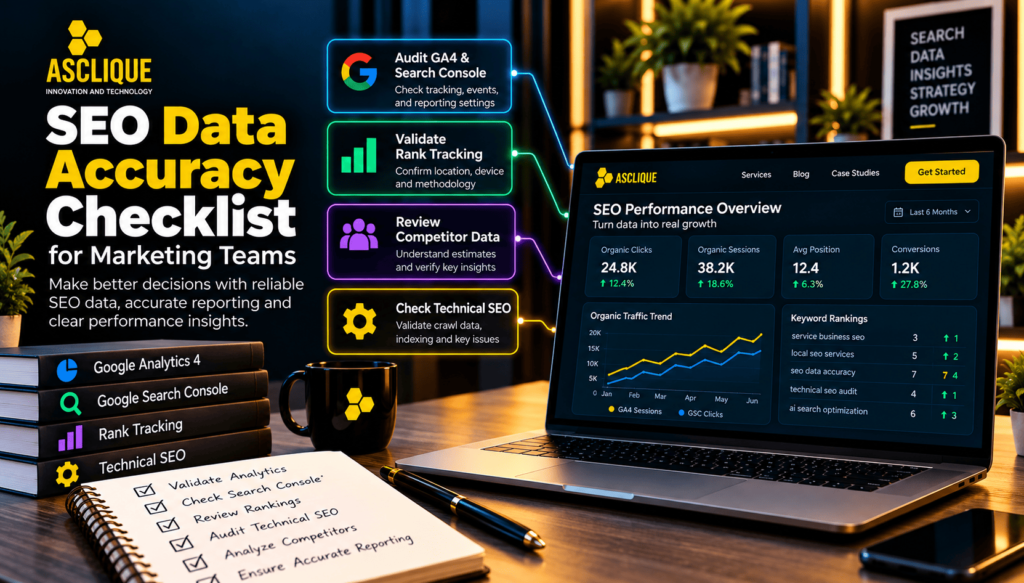
SEO Data Accuracy matters when agencies and marketing teams need to make reliable decisions from search, analytics, ranking, competitor, and technical SEO data. SEO campaigns generate enormous amounts of information, but collecting more data does not automatically lead to better marketing decisions. Different platforms measure different activities, and inconsistencies between them can make it difficult to determine what is actually improving.
A website might show a 30% increase in organic sessions while qualified enquiries remain unchanged. A keyword might appear in the top three positions in one ranking platform but outside the top ten in another. Google Search Console might report significantly more clicks than Google Analytics 4 records as organic sessions.
These situations do not necessarily mean that an SEO campaign is failing. They may indicate differences in measurement methods, tracking configurations, geographic conditions, or reporting definitions.
For agencies managing several clients, inaccurate data can create larger problems. Incorrect performance conclusions may influence campaign budgets, content investments, technical recommendations, and client expectations. Even a small configuration error can become difficult to identify when information flows through multiple reporting platforms.
SEO data accuracy is therefore an essential part of modern search engine optimization. It helps marketing teams distinguish genuine performance changes from measurement problems and ensures that decisions are based on evidence rather than assumptions.
This guide provides a practical SEO data accuracy checklist covering Google Analytics 4, Google Search Console, keyword rankings, SERP research, competitor analysis, technical SEO, and performance reporting. It also explains how agencies can establish repeatable validation workflows that improve the reliability of their SEO decisions.
Quick Answer
An SEO data accuracy checklist is a structured process for verifying that search performance metrics are collected, interpreted, and reported correctly. It includes reviewing analytics configurations, validating conversion tracking, standardizing keyword ranking conditions, checking technical SEO findings, and confirming that reports use consistent definitions.
For agencies and marketing teams, the most effective approach combines first-party data from Google Analytics 4 and Google Search Console with validated third-party research. Rather than expecting every platform to produce identical figures, teams should understand how each metric is calculated and whether the information accurately represents the business objective being measured.
A reliable SEO data validation process should be completed before important campaign decisions, client reporting, or major website changes.
Key Facts and What Is Verified
- FACT: Google Analytics 4 and Google Search Console measure different activities. Google Search Console reports Google Search clicks, impressions, and average position, while GA4 measures website interactions, sessions, and events.
- FACT: GA4 sessions are not equivalent to search clicks. A session represents a period of user interaction with a website or application. The default inactivity timeout is 30 minutes, although it can be adjusted.
- FACT: Google Search Console average position is not a fixed ranking. It is calculated from search impressions and can vary according to query, location, device, and search context.
- FACT: Third-party organic traffic estimates are not verified website analytics. SEO platforms use proprietary keyword databases and estimation models.
- FACT: Technical SEO findings require validation. A crawler flag does not automatically establish how Google has processed a URL.
- FACT: Accurate reporting requires consistent measurement conditions, including tracking configuration, geographic targeting, keyword sets, attribution methods, and reporting periods.
Table of Contents
- What Is SEO Data Accuracy?
- Why SEO Data Accuracy Matters for Agencies and Marketing Teams
- How to Audit Google Analytics 4 and Google Search Console Data
- How to Improve Keyword Ranking Accuracy
- SERP Data Collection and Research Infrastructure
- How to Validate Competitor SEO Research
- Technical SEO Data Validation
- Building an SEO Data Quality Assurance Workflow
- Common SEO Data Accuracy Mistakes to Avoid
- What Is Not Proven About SEO Data Accuracy?
- How to Measure SEO Data Quality
- Asclique Recommendations for Accurate SEO Reporting
- Final Thoughts
- SEO Data Accuracy Checklist
- Frequently Asked Questions
- Need Help With SEO Data Accuracy?
What Is SEO Data Accuracy?
SEO data accuracy refers to the reliability of information used to evaluate a website’s search engine performance. It involves confirming that data collection methods are configured correctly, reported metrics represent what they claim to measure, and comparisons are made under appropriate conditions.
For example, an agency tracking the keyword “emergency plumber Sydney” needs to know whether its ranking platform is collecting results from Sydney or another geographic location. The agency also needs to understand whether the reported position represents mobile or desktop results and whether the tracking methodology has changed between reporting periods. Without this context, a ranking improvement may be misleading.
The same principle applies to website analytics. A sudden increase in recorded conversions may reflect improved business performance, but it could also result from a newly configured event firing multiple times.
SEO data accuracy does not mean eliminating every difference between platforms. Different tools serve different purposes, and their measurements will not always match. Instead, accurate SEO measurement requires reliable data collection, correct interpretation, and transparent reporting.
Why SEO Data Accuracy Matters for Agencies and Marketing Teams
SEO agencies depend on performance data to demonstrate the value of their work. Clients want to understand whether their investment is generating greater search visibility, qualified website traffic, leads, or revenue. However, these outcomes cannot always be explained through a single metric.
Consider a hypothetical local service business receiving 10,000 organic sessions in one month and 12,500 the following month. The increase appears positive, but further analysis reveals that most additional traffic came from informational articles targeting users outside the company’s service area. Meanwhile, enquiries from its primary commercial landing pages declined.
If the agency reports only the 25% increase in sessions, the client receives an incomplete picture of performance. Accurate reporting would distinguish informational traffic growth from commercially relevant traffic and explain why the additional visitors did not produce more qualified enquiries.
Reliable data helps agencies determine whether to prioritize technical improvements, new content, existing page optimization, local SEO, or authority-building activities. A structured approach to search engine optimization services connects these performance signals with the actions most likely to improve organic growth. It also makes it easier to explain why numbers differ and what the available evidence actually demonstrates.
Not Sure Whether Your SEO Reports Are Telling the Full Story?Asclique can review your search data, analytics, rankings and technical reporting to identify measurement gaps and turn performance data into clearer marketing decisions. | Request an SEO Audit |
How to Audit Google Analytics 4 and Google Search Console Data
Google Analytics 4 and Google Search Console are two of the most important measurement platforms used in SEO. They provide complementary information about search visibility and website behavior, but they should not be treated as interchangeable reporting systems.
Google Search Console primarily explains how a website performs within Google Search. It provides information about impressions, clicks, queries, pages, and average positions. Google Analytics 4 focuses on interactions that occur after visitors reach a website or application. It can measure sessions, engagement, important events, and revenue when correctly configured.
Agencies should inspect the Google tag implementation, web data stream, and Google Tag Manager configuration where applicable. Duplicate tracking installations can result in repeated events, while missing tags can prevent important interactions from being recorded. Conversion tracking requires particular attention.
A difference between Search Console clicks and GA4 sessions is not automatically an error. A user may click a search result but leave before analytics tracking executes. Consent settings or browser restrictions may also affect measurement. The appropriate response is to compare trends and investigate substantial unexplained discrepancies.
How to Improve Keyword Ranking Accuracy
Keyword ranking data helps agencies understand how visible a website is for important search queries. However, ranking positions are influenced by geographic location, device type, language, search context, and other conditions that must be considered before comparing results.
For local businesses, geographic accuracy is particularly important. This is especially important for businesses using local SEO services to improve visibility across specific cities, suburbs, and service areas. A company targeting customers in Sydney may appear prominently for a keyword when searched from one suburb but have weaker visibility in another. Reporting a single national ranking would not necessarily represent the business’s actual local search performance.
Agencies should configure rank tracking around the markets that matter to the business and maintain consistent settings across comparable reports. Mobile and desktop performance should be separated when device-specific visibility matters.
A ranking improvement is most valuable when it increases relevant visibility and contributes to the campaign’s objectives. Moving from position eight to position four for a high-intent commercial keyword may be more valuable than reaching position one for an unrelated informational query.
SERP Data Collection and Research Infrastructure
Search engine results pages provide valuable information about keyword competition, search intent, local visibility, and changes in the search landscape. However, collecting SERP information consistently can be challenging, particularly for agencies monitoring large keyword portfolios across multiple markets.
SEO teams can collect search information through commercial rank-tracking platforms, supported APIs, manual research, and custom research systems. Each method serves a different purpose. For any automated collection method, agencies should review applicable platform terms, access requirements, and permitted usage.
Geographic location is an important consideration when researching search results across different markets. Some permitted research workflows use geographically targeted proxy connections to support market-specific observations. A proxy’s location is only one factor affecting the results returned; device configuration, language, search context, and collection methodology must also be considered.
When agencies operate custom research systems that require proxy infrastructure, reliability should be evaluated against the actual workload. Important considerations include geographic coverage, connection stability, response success rates, session management, and compatibility with existing tools.
Teams evaluating providers can buy fresh proxy server access through Proxy-Seller for supported research and network workflows.
How to Validate Competitor SEO Research
Competitor research helps agencies identify content opportunities, keyword gaps, market trends, and changes in organic visibility. However, much of the information available through third-party SEO platforms is estimated.
Tools use proprietary databases and models to estimate organic traffic and keyword performance. These estimates can support competitive analysis, but they are not equivalent to direct access to a competitor’s analytics. An agency should therefore avoid presenting estimated competitor traffic as a verified measurement.
Keyword research platforms also provide estimated search volume, ranking difficulty, and related search terms. These metrics should support research rather than determine strategy independently. Before recommending new content, agencies should examine the current search results and determine whether the proposed page can satisfy the underlying intent.
Content-gap tools can identify topics covered by competitors but missing from a client’s website. However, identifying a gap does not automatically justify creating a new page. A stronger approach combines competitive research with original expertise, accurate information, and clear user benefits.
Technical SEO Data Validation
Technical SEO audits help identify issues affecting website discovery, crawling, rendering, indexing, and usability. However, technical reports can become misleading when findings are interpreted without considering the tools and conditions used to collect them.
Before relying on a technical audit, agencies should confirm that the crawler is configured appropriately. A crawler operating with restricted settings may miss JavaScript-generated links or content. Authentication requirements may prevent access to important pages, while URL exclusion rules can produce incomplete site inventories.
Crawling and indexing are separate processes. A page that returns a successful HTTP response is not automatically indexed. Similarly, a page blocked by robots.txt may still be known to Google through links or other references.
Important technical findings should be validated through appropriate methods. Agencies should prioritize confirmed problems according to the number of affected pages, their business importance, likely impact on search visibility, and confidence level of the diagnosis.
Related resource: Robots.txt: Complete Guide for SEO Teams
Building an SEO Data Quality Assurance Workflow
SEO data validation should be a repeatable operational process rather than an activity performed only when a report appears incorrect. Agencies managing multiple clients benefit from documented workflows that establish consistent standards for collecting, reviewing, and interpreting performance information.
A practical quality assurance system should begin with a baseline. Before implementing major SEO changes, record the current tracking configuration, important keyword rankings, organic search performance, conversion measurements, and known technical issues.
Identify every platform contributing information to the SEO reporting process and document what each platform measures. When two platforms report different results, determine whether the difference is expected or requires investigation. Prioritize issues according to their impact on reporting reliability and business decisions.
When a measurement problem is identified, record the cause, correction, and implementation date. After making changes, confirm that the corrected configuration behaves as expected. Regular monitoring should continue after website redesigns, migrations, major content releases, analytics changes, and other significant technical updates.
Common SEO Data Accuracy Mistakes to Avoid
- Assuming all organic traffic growth is positive. Additional traffic may come from informational queries, irrelevant geographic markets, or pages with limited commercial value.
- Failing to document analytics changes. Website redesigns, tag updates, consent-management changes, and conversion tracking adjustments can alter reported performance.
- Comparing ranking platforms without context. Different platforms may use different collection methods, locations, devices, and update schedules.
- Presenting competitor estimates as verified data. Competitor traffic, keyword difficulty, and estimated search volume depend on third-party models.
- Reporting too many metrics without guidance. A report containing hundreds of numbers may appear comprehensive while providing little practical direction.
What Is Not Proven About SEO Data Accuracy?
SEO tools provide useful insights, but their outputs should not be treated as complete representations of search engine behavior. No third-party ranking platform can guarantee that its reported position matches every search experience encountered by real users.
Competitor traffic estimates cannot establish a website’s actual organic visitor count without access to its underlying analytics. Proxy infrastructure also does not guarantee exact geographic search-result reproduction. It may influence network location, but other search-context variables remain relevant.
Agencies should avoid assuming that a ranking change was caused by a specific website update without sufficient evidence. Search performance is influenced by multiple factors, including competition, search demand, indexing conditions, and changes in search systems.
At Asclique, we recommend separating confirmed facts from observations and hypotheses. When evidence is incomplete, document the uncertainty and identify how the assumption could be tested.
Are Your SEO Decisions Based on Reliable Data?Start with an audit of your analytics, search visibility, ranking methodology, technical findings and reporting definitions. | Request an Audit |
How to Measure SEO Data Quality
SEO data quality should be evaluated through more than the absence of visible reporting errors. Agencies need to understand whether information is complete, consistent, timely, and appropriate for the decisions being made.
A dataset may be accurate for the information it contains while still missing important observations. Consistency requires comparable definitions and measurement conditions. Timeliness matters because some platforms process data with delays, while others update keyword rankings according to scheduled collection intervals.
A technically accurate metric may still provide limited business value. Tracking rankings for irrelevant keywords may produce reliable numbers without helping the company attract qualified customers. The most useful SEO reporting connects accurate information with meaningful business objectives.
Asclique Recommendations for Accurate SEO Reporting
At Asclique Innovation and Technology, we recommend treating SEO data validation as part of the optimization process rather than a separate reporting activity.
A successful SEO campaign requires more than collecting keyword positions and traffic figures. Agencies must understand how users discover a website, whether the content satisfies their search intent, and whether organic visibility contributes to meaningful business outcomes.
The process should begin with an audit of existing tracking systems and search performance. Once the baseline is established, teams can identify measurement gaps, investigate technical issues, and prioritize improvements based on their likely business impact.
For websites expanding into AI-driven search experiences, measurement becomes even more important. Traditional organic rankings, AI-generated search visibility, answer-focused discovery, and website conversions may require different evaluation methods.
Explore Asclique’s 8 Best SEO Proxies for Rank Tracking and Competitor Research in 2026, and Answer Engine Optimization Services.
Final Thoughts
SEO data accuracy is one of the foundations of effective search engine optimization. Without reliable measurement, agencies may struggle to distinguish genuine improvements from tracking errors, interpret ranking fluctuations, or explain how their work contributes to business results.
The solution is not necessarily to invest in more tools or produce larger reports. Instead, marketing teams should focus on collecting appropriate information, understanding measurement limitations, validating important findings, and maintaining consistent reporting standards.
Google Analytics 4 and Google Search Console provide valuable first-party information. Rank-tracking and competitor research platforms add useful context. Technical crawlers help identify potential website issues. However, the value of these tools depends on how accurately their information is interpreted and applied.
For agencies, a repeatable SEO data quality assurance process can improve decision-making, strengthen reporting transparency, and reduce the risk of acting on misleading information. For businesses, it creates a clearer connection between SEO investments and measurable outcomes.
SEO Data Accuracy Checklist
- Confirm GA4 is installed correctly and check for duplicate tags and events.
- Validate important conversion actions and document tracking changes.
- Confirm the correct Google Search Console property, date range, and filters.
- Analyze relevant queries and landing pages rather than relying only on sitewide averages.
- Verify keyword tracking locations, devices, keyword lists, and methodology.
- Identify SERP data sources and validate geographic conditions.
- Distinguish estimated competitor metrics from verified measurements.
- Validate crawler configuration and review crawling and indexing separately.
- Confirm important technical findings before prioritizing changes.
- Maintain consistent reporting definitions and compare equivalent periods.
- Connect visibility metrics with conversions and business outcomes.
- Complete a final human review before sharing client reports.
FAQ’s
What is an SEO data accuracy checklist?
An SEO data accuracy checklist is a structured set of validation steps used to confirm that website analytics, search performance metrics, keyword rankings, and technical SEO information are reliable. It helps agencies identify tracking errors, inconsistent reporting methods, and misleading conclusions before making campaign decisions.
Why do Google Analytics 4 and Google Search Console show different numbers?
GA4 and Google Search Console measure different activities. Search Console records performance within Google Search, while GA4 measures interactions that occur on a website or application. Differences in tracking, consent, attribution, and measurement methods can produce different totals.
How can SEO agencies improve reporting accuracy?
Agencies can improve reporting accuracy by validating analytics configurations, documenting metric definitions, standardizing keyword tracking conditions, reviewing technical findings, and maintaining consistent reporting periods. Significant changes should be investigated before being presented as campaign results.
How often should SEO data be audited?
SEO tracking should be reviewed after major website changes, analytics modifications, migrations, or unexpected performance fluctuations. Agencies should also include routine validation within their monthly reporting process.
Are keyword ranking tools completely accurate?
Keyword ranking tools provide useful observations, but no single measurement represents every possible search experience. Rankings can vary by location, device, language, and search context.
Can proxies improve SEO research accuracy?
Proxies can support location-sensitive research by routing permitted requests through network endpoints associated with different geographic markets. However, they do not guarantee exact search-result reproduction. Accurate research also requires consistent settings, collection methods, and result validation.
What is the difference between SEO data accuracy and SEO data quality?
SEO data accuracy concerns whether information correctly represents what it is intended to measure. SEO data quality is broader and includes completeness, consistency, timeliness, relevance, and reliability.
Are competitor traffic estimates reliable?
Competitor traffic estimates can help identify trends and compare websites, but they are based on third-party models rather than direct access to a competitor’s analytics. They should be used as research indicators rather than confirmed visitor counts.
Which SEO metrics are most important for agencies?
Important metrics depend on campaign objectives. Common examples include organic clicks, relevant keyword visibility, qualified sessions, conversion events, revenue, and technical website health.
Can inaccurate SEO data affect business revenue?
Yes. Inaccurate data can cause businesses to invest in the wrong keywords, overlook conversion problems, misinterpret campaign performance, or make unnecessary website changes.
Need Help With SEO Data Accuracy?
Asclique can audit your SEO measurement setup, identify tracking and reporting gaps, review technical SEO data, and help connect search visibility with meaningful business outcomes. The goal is to build a reporting framework that helps your team make better decisions rather than simply producing more metrics.
Turn SEO Data Into Better Marketing DecisionsGet a practical SEO strategy connecting technical SEO, content optimization, search visibility, analytics and performance measurement to your business objectives. | Talk to Asclique |