
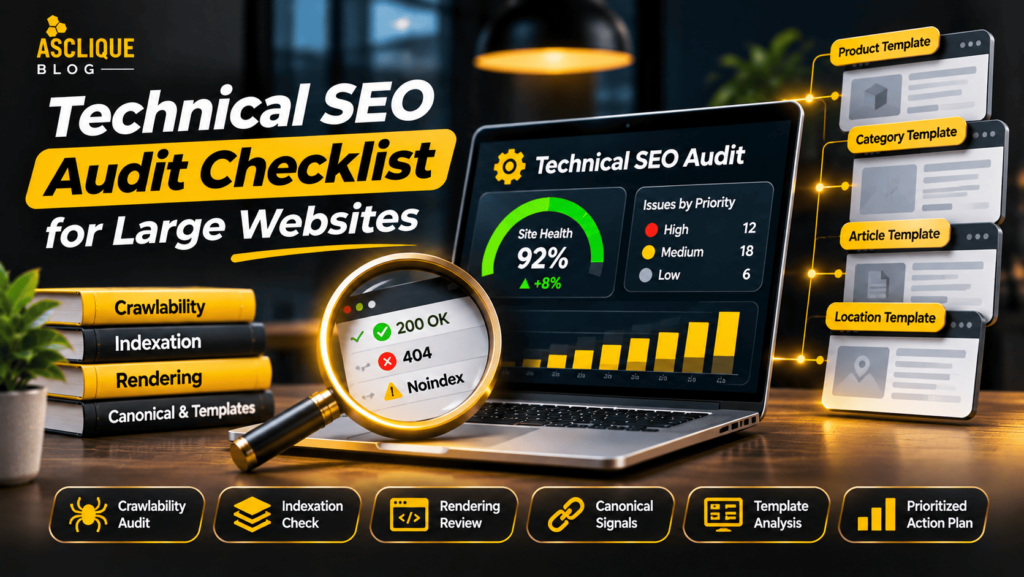
Whether you manage a small marketing team or a complex multi-template website, technical SEO audit becomes more useful when the process is repeatable, evidence-based and linked to an outcome. The steps below are designed for implementation, not just reporting.
Quick Answer
Audit crawlability, indexation, rendering, canonicalization and templates across large sites with a prioritized remediation queue.
Begin with a reliable baseline, prioritize the highest-value pages, document the action and confirm the outcome after implementation.
Key Facts
- Segment findings by template and business value.
- Validate a sample of URLs manually before applying bulk rules.
- A blocked URL and a noindexed URL require different remedies.
Asclique Workflow
Our recommended sequence is: discover the issue, validate it against independent evidence, estimate business impact, implement a controlled fix and monitor the result. This avoids spending weeks on technical changes that have no credible path to improved user experience or business performance.
Use a shared issue log with columns for affected URLs, evidence, priority, owner, dependency, deployment date and post-launch result. Capture screenshots or exports when necessary so future reviews can distinguish genuine improvements from measurement changes.
Inventory site sections and templates
Split templates into product, category, article, location and utility pages before sampling. The practical objective is to make this decision auditable: record the affected URL group, the source of the evidence, the person responsible, and the specific observation that would show the work is complete. Do not assume that a tool warning, a ranking change, or a competitor example proves the cause. Confirm the issue on real pages and distinguish measured facts from working hypotheses.
For example, take a representative sample of pages and document their current state before editing. Apply the same check after implementation, noting exceptions rather than hiding them in an average. This gives the team a reproducible method for inventory site sections and templates and makes it easier to explain why the chosen work deserves time and budget.
For example, select one commercially important page group, review its current search performance and technical behavior, and write down what a successful change would look like. Keep an untouched comparison group where possible. If evidence is incomplete, label the hypothesis as unconfirmed and investigate before making a sitewide change.
Professional search engine optimization services can help businesses evaluate large website structures, identify technical SEO issues, and prioritize improvements based on search visibility and business value.
Audit robots and crawl paths
Export indexable URLs, XML sitemap entries, internal links, canonical targets and server responses. The practical objective is to make this decision auditable: record the affected URL group, the source of the evidence, the person responsible, and the specific observation that would show the work is complete. Do not assume that a tool warning, a ranking change, or a competitor example proves the cause. Confirm the issue on real pages and distinguish measured facts from working hypotheses.
For example, take a representative sample of pages and document their current state before editing. Apply the same check after implementation, noting exceptions rather than hiding them in an average. This gives the team a reproducible method for audit robots and crawl paths and makes it easier to explain why the chosen work deserves time and budget.
For example, select one commercially important page group, review its current search performance and technical behavior, and write down what a successful change would look like. Keep an untouched comparison group where possible. If evidence is incomplete, label the hypothesis as unconfirmed and investigate before making a sitewide change.
Understanding robots.txt best practices helps technical SEO teams manage crawler access, identify accidentally blocked resources, and ensure important website sections remain accessible to search engines.
| Need help with technical seo audit? Asclique can help turn findings into an actionable SEO plan. Request a review of your priorities and measurement approach. | Contact Asclique |
Review index coverage and canonical signals
Check robots directives and noindex on representative pages; do not confuse blocked crawling with excluded indexing. The practical objective is to make this decision auditable: record the affected URL group, the source of the evidence, the person responsible, and the specific observation that would show the work is complete. Do not assume that a tool warning, a ranking change, or a competitor example proves the cause. Confirm the issue on real pages and distinguish measured facts from working hypotheses.
For example, take a representative sample of pages and document their current state before editing. Apply the same check after implementation, noting exceptions rather than hiding them in an average. This gives the team a reproducible method for review index coverage and canonical signals and makes it easier to explain why the chosen work deserves time and budget.
For example, select one commercially important page group, review its current search performance and technical behavior, and write down what a successful change would look like. Keep an untouched comparison group where possible. If evidence is incomplete, label the hypothesis as unconfirmed and investigate before making a sitewide change.
Inspect rendering and internal links
Inspect rendered HTML for key content and navigation that may be missing from initial responses. The practical objective is to make this decision auditable: record the affected URL group, the source of the evidence, the person responsible, and the specific observation that would show the work is complete. Do not assume that a tool warning, a ranking change, or a competitor example proves the cause. Confirm the issue on real pages and distinguish measured facts from working hypotheses.
For example, take a representative sample of pages and document their current state before editing. Apply the same check after implementation, noting exceptions rather than hiding them in an average. This gives the team a reproducible method for inspect rendering and internal links and makes it easier to explain why the chosen work deserves time and budget.
For example, select one commercially important page group, review its current search performance and technical behavior, and write down what a successful change would look like. Keep an untouched comparison group where possible. If evidence is incomplete, label the hypothesis as unconfirmed and investigate before making a sitewide change.
Professional website development services can help resolve rendering problems, improve website navigation, strengthen internal linking structures, and address technical issues affecting content accessibility.
Assess sitemaps and pagination
Review duplicate URL parameters, pagination and canonical consistency against the preferred URL set. The practical objective is to make this decision auditable: record the affected URL group, the source of the evidence, the person responsible, and the specific observation that would show the work is complete. Do not assume that a tool warning, a ranking change, or a competitor example proves the cause. Confirm the issue on real pages and distinguish measured facts from working hypotheses.
For example, take a representative sample of pages and document their current state before editing. Apply the same check after implementation, noting exceptions rather than hiding them in an average. This gives the team a reproducible method for assess sitemaps and pagination and makes it easier to explain why the chosen work deserves time and budget.
For example, select one commercially important page group, review its current search performance and technical behavior, and write down what a successful change would look like. Keep an untouched comparison group where possible. If evidence is incomplete, label the hypothesis as unconfirmed and investigate before making a sitewide change.
Following XML sitemap best practices helps large websites maintain accurate URL inventories, improve search engine discovery, and identify inconsistencies between submitted URLs and preferred canonical pages.
| Need help with technical seo audit? Asclique can help turn findings into an actionable SEO plan. Request a review of your priorities and measurement approach. | Contact Asclique |
Evaluate performance and mobile usability
Measure LCP, INP and CLS using field data where available; lab diagnostics explain causes but are not equivalent. The practical objective is to make this decision auditable: record the affected URL group, the source of the evidence, the person responsible, and the specific observation that would show the work is complete. Do not assume that a tool warning, a ranking change, or a competitor example proves the cause. Confirm the issue on real pages and distinguish measured facts from working hypotheses.
For example, take a representative sample of pages and document their current state before editing. Apply the same check after implementation, noting exceptions rather than hiding them in an average. This gives the team a reproducible method for evaluate performance and mobile usability and makes it easier to explain why the chosen work deserves time and budget.
For example, select one commercially important page group, review its current search performance and technical behavior, and write down what a successful change would look like. Keep an untouched comparison group where possible. If evidence is incomplete, label the hypothesis as unconfirmed and investigate before making a sitewide change.
Improving Core Web Vitals helps businesses identify performance issues related to loading speed, responsiveness, and visual stability. These metrics provide useful evidence when prioritizing technical improvements across large website templates.
Test structured data
Validate structured data eligibility and accuracy against page-visible content and current platform rules. The practical objective is to make this decision auditable: record the affected URL group, the source of the evidence, the person responsible, and the specific observation that would show the work is complete. Do not assume that a tool warning, a ranking change, or a competitor example proves the cause. Confirm the issue on real pages and distinguish measured facts from working hypotheses.
For example, take a representative sample of pages and document their current state before editing. Apply the same check after implementation, noting exceptions rather than hiding them in an average. This gives the team a reproducible method for test structured data and makes it easier to explain why the chosen work deserves time and budget.
For example, select one commercially important page group, review its current search performance and technical behavior, and write down what a successful change would look like. Keep an untouched comparison group where possible. If evidence is incomplete, label the hypothesis as unconfirmed and investigate before making a sitewide change.
Create an engineering-ready backlog
Prioritize systemic template faults and verify fixes across staging and production samples. The practical objective is to make this decision auditable: record the affected URL group, the source of the evidence, the person responsible, and the specific observation that would show the work is complete. Do not assume that a tool warning, a ranking change, or a competitor example proves the cause. Confirm the issue on real pages and distinguish measured facts from working hypotheses.
For example, take a representative sample of pages and document their current state before editing. Apply the same check after implementation, noting exceptions rather than hiding them in an average. This gives the team a reproducible method for create an engineering-ready backlog and makes it easier to explain why the chosen work deserves time and budget.
For example, select one commercially important page group, review its current search performance and technical behavior, and write down what a successful change would look like. Keep an untouched comparison group where possible. If evidence is incomplete, label the hypothesis as unconfirmed and investigate before making a sitewide change.
Weak vs. Better
| Weak approach | Better approach |
|---|---|
| Treat every URL as equal | Segment pages by traffic potential, user intent and business value |
| Act on a single tool warning | Validate with first-party data and a manual URL sample |
| Promise a fixed uplift | Use scenarios, assumptions and clear confidence limits |
| Mark the task done at deployment | Check live behavior and outcomes after release |
Common Mistakes
- Crawling only the homepage
- Bulk-changing canonicals without testing
- Treating every excluded URL as an error
- Prioritizing scores over discoverability
The common thread is overconfidence. Before changing many pages, verify the problem, confirm its scope and preserve a rollback path. A technically valid change may still be commercially unhelpful if it targets the wrong audience or removes useful content.
Not Proven
No responsible practitioner can guarantee a ranking, a specific volume of AI citations or a fixed revenue gain from technical SEO audit. Search interfaces change, measurement is incomplete and competitors respond. Treat estimated uplift as a scenario, not an invoiceable outcome. Likewise, third-party SEO scores are diagnostic signals rather than Google ranking formulas.
Measure Success
Create a before-and-after scorecard with Search Console clicks, impressions, click-through rate and relevant query groups; analytics landing-page sessions and meaningful events; and CRM-qualified leads or revenue where available. Record the exact comparison dates, filters and attribution assumptions.
Evaluate leading indicators such as resolved indexation issues or improved internal discovery separately from lagging indicators such as sales. Annotate releases, seasonality and tracking changes. Where possible, compare affected templates against a similar unaffected group instead of attributing every sitewide movement to one change.
Checklist
- Document the business objective and the current baseline.
- Identify the affected page types, owners and dependencies.
- Validate important findings with at least two relevant evidence sources.
- Estimate priority using potential impact, confidence, effort and risk.
- Test the change on representative URLs before a broad rollout.
- Verify live implementation and capture a deployment record.
- Review results at agreed intervals and update the backlog.
FAQs
What data should be collected before starting?
Begin with a dated URL inventory, Search Console exports, GA4 landing-page reports and a record of recent website changes. For Technical SEO Audit Checklist for Large Websites, also capture the relevant business outcome, the page templates involved and any known data gaps. Save raw exports so later comparisons do not depend on screenshots or changing dashboard filters.
How should a team prioritize the first improvements?
Rank the work by affected business value, evidence strength, number of impacted URLs and implementation effort. In this topic, a verified problem affecting important landing pages should normally take precedence over a low-confidence warning on a page that serves no meaningful search demand. Assign an owner and a measurable acceptance test to each selected action.
Which mistakes can invalidate the findings?
The most damaging mistake is treating correlation as proof. A decline after a redesign does not automatically mean the redesign caused it; similarly, a ranking gain after an edit does not isolate the effect of that edit. Check dates, seasonality, tracking, search demand and concurrent releases before making a confident claim about technical seo audit checklist for large websites.
What should be checked after implementation?
Check the live production version, not only the CMS preview. Verify HTTP status, canonical and robots signals when relevant, inspect rendered content, test internal links and confirm that analytics events fire correctly. Record sample URLs and results. Follow-up checks should cover both immediate implementation accuracy and subsequent search or business outcomes.
How should results be explained to stakeholders?
Explain the baseline, the intervention, the expected mechanism and what the observed data actually supports. Separate leading indicators such as crawl health and impressions from outcomes such as qualified leads and sales. Where evidence is incomplete, give a confidence range and identify the next validation step instead of promising a specific traffic or revenue gain.
Can the process work for a small business?
Yes. A smaller business can use a spreadsheet, Search Console, GA4 and a short monthly review rather than buying an enterprise platform. Focus on the few service or product pages that drive meaningful enquiries. The same principles apply: verify the problem, document the change and evaluate whether customer outcomes improved.
What changes when the site is very large?
At scale, template-level issues, crawl sampling, automation and ownership become more important. A single incorrect canonical rule can affect thousands of URLs, while a single successful template fix can resolve many pages. Use page groups, automated regression checks and representative manual review rather than assuming a full crawl alone proves quality.
How can AI search affect the analysis?
AI answer interfaces may change how often searchers click through to websites, but most analytics setups cannot observe every answer impression or citation. Track identifiable AI referrals as a separate channel where possible and label manual answer samples as observations. Do not add assumed AI citations to organic clicks or present an AI visibility estimate as verified revenue.
Recommendation
Approach technical SEO audit as a sequence of measurable decisions. Start with the pages and user journeys that matter most, make changes in controlled batches, and keep evidence of what changed. A focused plan with verified outcomes is more valuable than an extensive audit that nobody implements.
Need Help?
Asclique supports SEO planning, technical reviews and performance measurement. Share your website, goals and current constraints to discuss an appropriate scope.
| Need help with technical seo audit? Asclique can help turn findings into an actionable SEO plan. Request a review of your priorities and measurement approach. | Contact Asclique |