Google’s DORA research tracks this gap. Its 2024 report linked a 25% rise in AI adoption to a 7.2% drop in delivery stability. The 2025 report saw throughput recover, although instability persisted. The pattern points to the delivery process as the real constraint.
This plan covers 90 days of moving from AI-assisted coding to an AI-native SDLC (software development lifecycle), with checkpoints you can report to the board.
Quick Answer
Moving to an AI-native SDLC requires redesigning how engineering teams manage requirements, coding, testing, reviews, and releases. A practical 90-day transition starts with delivery benchmarks during days 1–30, introduces structured specifications and independent validation during days 31–60, and expands successful workflows with governance controls during days 61–90. Human accountability remains essential throughout the process.
Key Facts and What Is Verified
- Research finding: Google’s 2024 DORA report associated increased AI adoption with reduced delivery stability.
- Research finding: The 2025 DORA report identified improvements in throughput while highlighting continuing stability challenges.
- Key distinction: AI-assisted coding improves individual tasks, while an AI-native development process coordinates work across the lifecycle.
- Measurement: Delivery performance should be evaluated using lead time, deployment frequency, change failure rate, and recovery time.
- Governance: Independent validation, repository permissions, audit logs, and human approval are important controls.
- Implementation: A 90-day pilot can help teams evaluate a new workflow before expanding adoption.
Table of Contents
- AI-Native SDLC vs Adding AI Tools to an Old Process
- Days 1–30: Baseline and First Workflow
- Days 31–60: Specs, Gates, and Agents
- Days 61–90: Scale and Govern
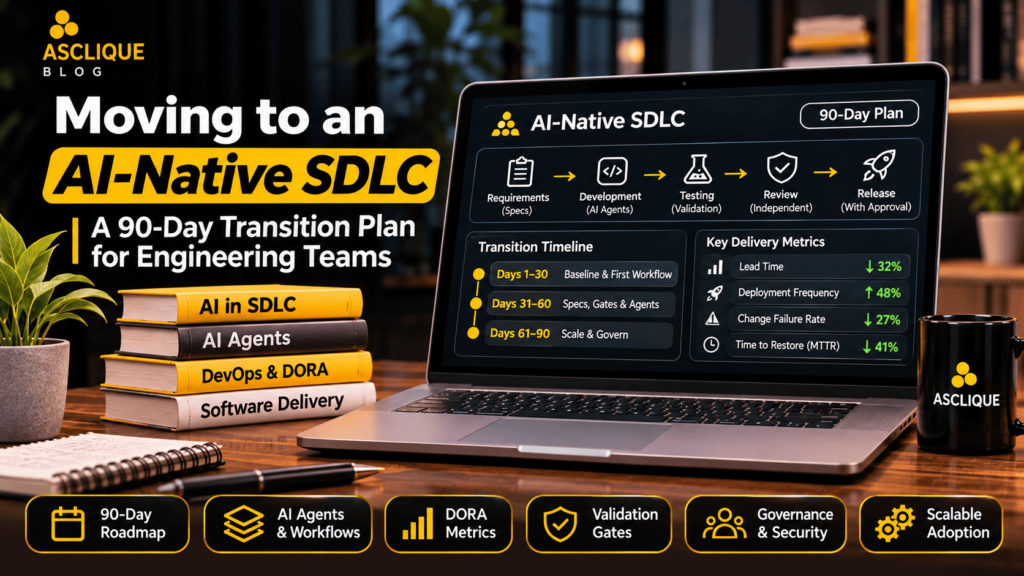
- 90-Day Transition Timeline
- A Practical Asclique Workflow
- Weak Approach vs Better Approach
- Common Transition Mistakes
- What Is Not Proven
- How to Measure Success
- AI-Native SDLC Implementation Checklist
- Getting Expert Help With an AI-Native SDLC
- FAQs
- Asclique Recommendation
AI-Native SDLC vs Adding AI Tools to an Old Process
Why Copilots Alone Do Not Change Delivery
A copilot speeds up one step: writing code. Requirements still arrive vague, and reviewers now face more code per day than before. Faster typing moves the bottleneck to review and testing, where DORA’s stability losses show up.
What “AI-Native” Means for the Whole Lifecycle
In an AI-native SDLC, AI agents (models that complete multi-step tasks with tools) hold defined roles across requirements, coding, testing, and review. Humans set direction at the start and accept results at the end. Every handoff passes a gate with clear criteria, so nothing reaches production because an agent said it was done.
Days 1–30: Baseline and First Workflow
Establishing a baseline is equally important when improving website performance. A technical SEO audit helps identify existing issues, measure technical health, and prioritize improvements before making changes.
Measure Current Delivery Metrics
Without a baseline, nobody can prove the change worked. Record lead time for changes, deployment frequency, change failure rate, and time to restore service. Add rework rate and the share of review comments caused by unclear requirements.
Pick One Team and One Product Area
Choose a team with a stable backlog and a product area with moderate risk. An internal tool or reporting module works better than a payments core. By day 30, one workflow should run end to end and produce comparable numbers.
Days 31–60: Specs, Gates, and Agents
Clear architecture is essential when multiple teams or systems work together. The same principle applies to SEO site architecture, where well-defined information hierarchies help search engines understand website structure and improve content discoverability.
Introduce Spec-Driven Requirements
Agents perform only as well as the instructions they receive. To that end, replace loose tickets with structured specs: acceptance criteria, constraints, dependencies, and links to architecture decisions. Before coding starts, an agent checks each spec against the others and against the architecture. Contradictions surface in hours rather than at the sprint review.
Add Validation and Independent Review Gates
The agent that writes code should never review it. A separate agent runs tests and static analysis, then a named engineer accepts or rejects the change. Track how often each gate catches defects. A gate that never fails is likely set too loosely.
Days 61–90: Scale and Govern
Expand to More Teams
Compare pilot numbers against the baseline. If lead time and change failure rate improved, extend the workflow to two or three teams. The pilot team can coach the rest.
Security, IP, and Model Usage Policies
Define which models may access which repositories, where prompts and code are stored, and who owns AI-generated output under your contracts. Log every agent action so security teams can trace a change back to its spec and approver.
90-Day AI-Native SDLC Transition Timeline
| Period | Key Actions | Outcome | Risk to Watch |
|---|---|---|---|
| Days 1–30 | Capture delivery metrics, choose pilot team and scope | Baseline and one working pilot workflow | Choosing a business-critical pilot |
| Days 31–60 | Spec templates, requirement validation, independent review gates | Less rework and fewer review cycles | Engineers bypassing gates under deadline pressure |
| Days 61–90 | Rollout to more teams, model and IP policies, audit logging | Repeatable process with governance in place | Scaling before pilot metrics confirm gains |
A Practical Asclique Workflow
For teams evaluating an AI-native development process, Asclique recommends treating the transition as a measurable operational change rather than a software purchasing exercise.
- Audit: Document the existing development lifecycle, delivery metrics, review process, testing practices, and current AI tool usage.
- Diagnose: Identify where work slows down. Determine whether the main constraint is unclear requirements, code review, testing, deployment, or coordination.
- Prioritize: Select a moderate-risk workflow with measurable outcomes and sufficient engineering support.
- Implement: Introduce structured specifications, defined agent responsibilities, and independent validation gates.
- Validate: Confirm that generated code passes automated checks, meets acceptance criteria, and receives human approval before release.
- Measure: Compare delivery speed, stability, rework, and review effort against the original baseline.
- Iterate: Improve the workflow based on observed results before expanding it to additional teams.
A similar structured approach applies to website optimization. An effective internal linking strategy helps organize information, establish relationships between pages, and create clearer navigation paths. Like an AI-native development workflow, it relies on defined processes rather than isolated improvements.
Structured workflows are equally valuable in content production. Asclique’s content marketing services use defined processes for planning, creating, reviewing, and optimizing content to support consistent quality and measurable performance.
Weak Approach vs Better Approach
| Weak Approach | Better Approach | Why It Is Better |
|---|---|---|
| Buy more AI coding licenses. | Redesign requirements, validation, and delivery workflows. | Addresses process bottlenecks rather than one coding task. |
| Start without delivery benchmarks. | Record baseline metrics before implementation. | Makes improvements and regressions measurable. |
| Allow an agent to approve its own output. | Use independent validation and named human approval. | Introduces separation of responsibilities and accountability. |
| Roll out across every team immediately. | Test one workflow before expanding. | Limits operational risk and supports controlled learning. |
| Address security after implementation. | Define repository access, model policies, and audit requirements early. | Reduces avoidable security and governance gaps. |
Common Transition Mistakes
- Buying more AI licenses and calling it a new process.
- Skipping the baseline, which leaves only opinions to argue over.
- Letting agents review their own output.
- Rolling out company-wide before any gate has been tested.
- Treating governance as a final step rather than part of the design.
What Is Not Proven
AI adoption does not automatically improve software delivery performance. Faster code generation may increase output without improving deployment stability, review efficiency, or business value.
Research findings about AI adoption and engineering performance describe observed relationships. They do not establish that AI alone caused every measured change.
A 90-day transition also does not guarantee improved lead time, deployment frequency, or change failure rate. Outcomes depend on existing engineering practices, team capabilities, system complexity, and the quality of validation controls.
Teams should treat projected improvements as hypotheses and test them against their own delivery data.
How to Measure Success
The transition should be evaluated using engineering delivery metrics and operational indicators rather than AI usage alone.
This focus on measurable outcomes also applies to search engine optimization services. Tracking visibility, technical performance, and conversions helps businesses understand whether their optimization efforts are producing meaningful results.
| Measurement Layer | Examples | Use |
|---|---|---|
| Delivery Speed | Lead time for changes and deployment frequency. | Determine whether work reaches production more efficiently. |
| Delivery Stability | Change failure rate and time to restore service. | Identify whether faster delivery introduces additional operational risk. |
| Review Quality | Review cycles, rejected changes, and defects detected by validation gates. | Evaluate whether independent review controls are effective. |
| Requirements Quality | Rework rate and review comments caused by unclear requirements. | Measure improvements in specification quality. |
| Governance | Agent activity logs, policy compliance, and documented approvals. | Confirm accountability and traceability. |
| Efficiency | Engineering effort, rework costs, and time spent reviewing generated code. | Assess whether the new process reduces overall delivery effort. |
AI-Native SDLC Implementation Checklist
- Document the existing software development workflow.
- Record baseline delivery metrics.
- Select one moderate-risk pilot team and product area.
- Define measurable goals for the 90-day transition.
- Create structured requirement specifications.
- Assign clear responsibilities to AI agents.
- Introduce independent testing and validation gates.
- Require named human approval for completed deliverables.
- Define model access and repository permissions.
- Establish prompt, code, and audit logging policies.
- Compare pilot results against baseline performance.
- Expand only when the evidence supports broader adoption.
Getting Expert Help With an AI-Native SDLC
Building this in-house takes time most teams already spend on delivery. Some companies work with a partner that runs an AI-native SDLC in production. Altamira’s version keeps people accountable at both ends. A Requirements Manager defines what to build, and an Architect approves the architecture before any build starts. Role-scoped agents write, test, and review the code, with each piece checked by a different agent. A named person then signs off every finished deliverable. Teams can adopt the model through an embedded squad or hand over the full build.
FAQ’s
What Is an AI-Native SDLC?
An AI-native software development lifecycle integrates AI agents into multiple stages of software delivery, including requirements, development, testing, and review. Unlike basic coding assistants, an AI-native process defines agent responsibilities, validation checkpoints, and human approval requirements.
How Is an AI-Native SDLC Different From AI-Assisted Coding?
AI-assisted coding primarily helps developers write, complete, or explain code. An AI-native SDLC extends automation across the development lifecycle while coordinating requirements, implementation, testing, and validation through structured workflows.
Can Engineering Teams Transition to an AI-Native SDLC in 90 Days?
Ninety days can provide enough time to establish a baseline, test a pilot workflow, introduce validation gates, and evaluate whether broader adoption is appropriate. A complete organization-wide transformation may require more time depending on team size, system complexity, and governance requirements.
Which Metrics Should Teams Track During the Transition?
Teams should monitor lead time for changes, deployment frequency, change failure rate, and time to restore service. Additional indicators include rework, review cycles, defects detected by validation gates, and engineering effort.
Why Are Structured Specifications Important?
Structured specifications define acceptance criteria, constraints, dependencies, and architecture requirements before development begins. They help reduce ambiguity and provide a consistent reference for AI agents and human reviewers.
Should AI Agents Review Their Own Code?
Independent validation is preferable because the same agent that generates code may repeat or overlook its original mistakes. Separate testing and review responsibilities, supported by human approval, provide stronger accountability.
What Are the Biggest Risks of AI-Native Development?
Common risks include unclear requirements, insufficient validation, excessive repository access, intellectual property concerns, unreliable generated code, and weak audit trails. These risks should be addressed through defined policies and review controls.
How Can Teams Measure Whether AI Improves Delivery?
Compare performance before and after implementation using consistent metrics and similar types of work. Evaluate both delivery speed and stability rather than focusing only on code generation volume or AI tool adoption.
When Should an AI-Native SDLC Pilot Expand to More Teams?
Expansion should follow evidence that the pilot workflow improves relevant delivery outcomes without introducing unacceptable stability, security, or quality risks. Teams should document the results and ensure the process can be repeated.
Does an AI-Native SDLC Replace Software Engineers?
An AI-native SDLC changes how engineering work is organized rather than eliminating the need for human judgment. Engineers remain responsible for architecture decisions, validation, security, acceptance, and production accountability.
Asclique Recommendation
Moving to an AI-native SDLC is a process change first and a tooling decision second. Ninety days is enough to prove one workflow against a baseline and set guardrails before scaling. The teams that keep their gains measure before they automate and keep a named person accountable for every release.
For engineering leaders, the most practical starting point is a controlled pilot supported by measurable delivery benchmarks, structured requirements, independent validation, and clear governance responsibilities.
AI-driven workflows are also transforming digital marketing. Asclique’s AI SEO services help businesses explore AI-supported search optimization while maintaining a focus on content quality, search visibility, and measurable business outcomes.
Need Help With Your Digital Strategy?
Asclique helps businesses improve their digital presence through SEO, content strategy, website optimization, and performance measurement. A structured digital strategy connects technical improvements with audience needs and measurable business outcomes.