
Quick Answer
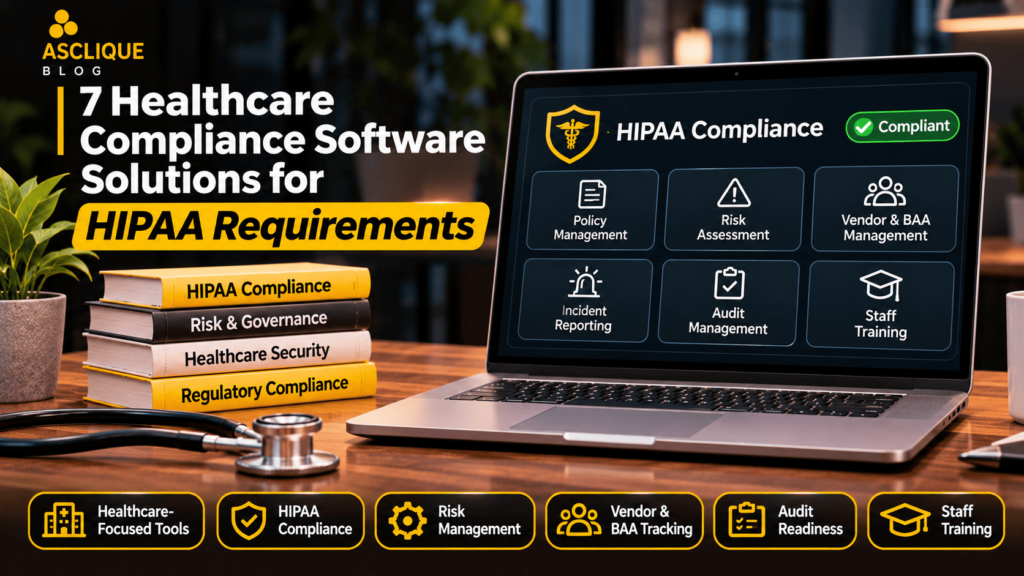
Healthcare compliance software helps organizations manage HIPAA-related policies, security risk assessments, vendor relationships, incident documentation, training, and audit evidence. The seven solutions covered here are ComplyAssistant, SAI360, HealthStream, MetricStream, Secureframe, Sprinto, and Drata.
ComplyAssistant is positioned for healthcare-specific governance, risk, and compliance workflows. SAI360 and MetricStream support broader enterprise GRC programs. HealthStream focuses on workforce training and credentialing, while Secureframe, Sprinto, and Drata emphasize compliance automation for technology-driven organizations.
Key Facts and What Is Verified
- HIPAA requirements: Covered entities and applicable business associates must address administrative, physical, and technical safeguards under the HIPAA Security Rule.
- Compliance software: Platforms can centralize risk assessments, policies, evidence, incident records, and vendor oversight.
- Healthcare-specific needs: Hospitals and health systems may require facility audits, clinical workflows, and business associate tracking.
- Technology-focused needs: Health tech and SaaS companies may prioritize integrations, automated evidence collection, and continuous control monitoring.
- Framework coverage: HIPAA, HITRUST, NIST, SOC 2, ISO 27001, and PCI DSS serve different purposes and should not be treated as interchangeable.
- Important distinction: Using compliance software does not automatically establish HIPAA compliance.
- Pricing: Several vendors require custom quotes. Published or third-party pricing estimates should be confirmed directly before purchasing.
Verification note: Vendor-specific statistics, awards, customer counts, and pricing figures below are retained from the supplied article and should be checked against current vendor disclosures before publication.
Table of Contents
- Why Healthcare Organizations Need HIPAA Compliance Software
- Healthcare Compliance Software Comparison
- ComplyAssistant
- SAI360
- HealthStream
- MetricStream
- Secureframe
- Sprinto
- Drata
- Capabilities to Evaluate in Compliance Platforms
- A Practical Asclique Workflow
- Weak Approach vs Better Approach
- Common Mistakes
- What Is Not Proven
- How to Measure Success
- Implementation Checklist
- Frequently Asked Questions
- Bottom Line
- Asclique Recommendation
Why Healthcare Organizations Need HIPAA Compliance Software
Without a purpose-built system, HIPAA compliance becomes a documentation problem that gets worse with every passing audit cycle. Policies end up scattered across shared drives, risk assessments sit in spreadsheets nobody touches between reviews, and vendor agreements lapse without anyone catching it. When OCR investigators show up, or when a ransomware incident forces a breach analysis, organizations that leaned on manual processes almost always struggle to produce the evidence trail regulators need to see.
Purpose-built software fixes this by pulling policy management, risk registers, vendor tracking, and incident records into one auditable system. The real payoff isn’t just being ready for audits; it’s spotting gaps before they turn into violations. And with HIPAA civil monetary penalties potentially reaching substantial amounts depending on the violation and circumstances, catching those gaps early carries real financial weight, not just operational weight.
A similar assessment-first approach applies to website performance. A technical SEO audit helps businesses identify existing issues, prioritize improvements, and maintain a healthier digital presence.
Healthcare Compliance Software Comparison
The following comparison summarizes the primary focus and organizational fit of the seven platforms.
| Software | Primary Focus | Best Fit | Pricing |
|---|---|---|---|
| ComplyAssistant | Healthcare-specific GRC and consulting | Hospitals, health systems, healthcare MSPs | Contact vendor |
| SAI360 | Enterprise GRC and compliance learning | Large, multi-industry organizations | Custom quote |
| HealthStream | Training and credentialing | Hospitals and healthcare networks | Contact vendor |
| MetricStream | Enterprise risk, audit, and cyber GRC | Large enterprises and health systems | Custom quote |
| Secureframe | Automated compliance evidence | Health tech and SaaS companies | Custom quote |
| Sprinto | Autonomous compliance monitoring | Technology-focused businesses | Custom quote |
| Drata | Continuous control monitoring | Digital health and SaaS organizations | Custom quote |
1. ComplyAssistant
ComplyAssistant is a healthcare-specific GRC platform built from the ground up for hospitals, health systems, and MSPs/MSSPs, pairing software with hands-on HIPAA, HITRUST, and cybersecurity consulting under one roof.
Who it fits: Hospitals, multi-facility health systems, long-term care networks, home health providers, and MSPs/MSSPs that white-label the platform for their own healthcare clients.
Capabilities
- Policy and document management
- Risk register with six-step PHI threat scoring
- Automated audit task assignment with a mobile audit app for facility walkthroughs
- Vendor risk management with unlimited business associate records
- Incident reporting with an attorney-developed HIPAA breach-risk assessment questionnaire
- A flexible regulations engine covering HIPAA, HITRUST, NIST, PCI, ISO 27001, SOC 2, FFIEC, and more
- Security risk assessments, HIPAA-HITECH audits, virtual CISO services, and disaster recovery planning delivered by the same team that built the software, with findings logged directly into the platform
- Founded in 2002, ComplyAssistant serves 100+ healthcare organizations including Cape Regional Health System, AtlantiCare Healthcare, and Inspira Health Network
- Endorsed by the DC Hospital Association and Hospital Association of Southern California
2. SAI360
SAI360 is a cloud and AI-driven GRC platform designed for enterprise-scale compliance and risk programs across multiple industries, including healthcare.
Who it fits: Larger organizations needing a broad GRC platform with regulatory monitoring, ethics training, and ESG capabilities alongside compliance tracking.
Capabilities
Compliance and policy management, regulatory monitoring, business continuity management, audit management, and compliance training delivered through SAI360 GRC and SAI360 Learning. SAI360 has been named a Leader in the 2025 Verdantix Green Quadrant for GRC Software and has received six Brandon Hall Learning and Development awards, including three gold. Clients include Colgate-Palmolive, Kraft Heinz, and NERC, and the platform manages compliance for more than 6,000 named accounts.
Subscription pricing comes in three editions (Essentials, Professional, and Enterprise), starting in the $500 to $1,000 range per recent analysis, with a custom quote required for a final figure.
SAI360’s breadth is a strength for multi-industry enterprises, but healthcare-specific organizations should confirm how deeply HIPAA workflows are built into the platform rather than configured on top of a general-purpose framework.
3. HealthStream
HealthStream is a SaaS workforce development and credentialing platform purpose-built for healthcare organizations, with a strong footprint in learning management and provider privileging.
Who it fits: Hospital systems and healthcare networks prioritizing staff training compliance, provider credentialing, and simulation-based education over broad GRC functionality.
Capabilities
- Learning management
- HIPAA and safety training (SafetyQ®/ComplyQ®)
- Provider credentialing and privileging via CredentialStream
- Talent management and performance assessment
- Works with more than 4,000 healthcare organizations representing more than 70% of U.S. hospital and healthcare systems
- Has more than 4.5 million active platform subscribers
- Named to G2’s 2026 Best Healthcare Software list with more Top 50 placements than any other vendor in that cycle
- Has received more than 30 Brandon Hall Excellence in Technology Awards
Pricing is not publicly listed. HealthStream generates the majority of its revenue from subscription services, and buyers need to engage the sales team directly. Organizations looking primarily for policy management and risk assessment tools rather than workforce training may find the platform’s focus doesn’t match their main need.
Build a Stronger Digital StrategyImprove your website’s search visibility, content quality, and measurable digital performance with a structured strategy. | Contact Asclique |
4. MetricStream
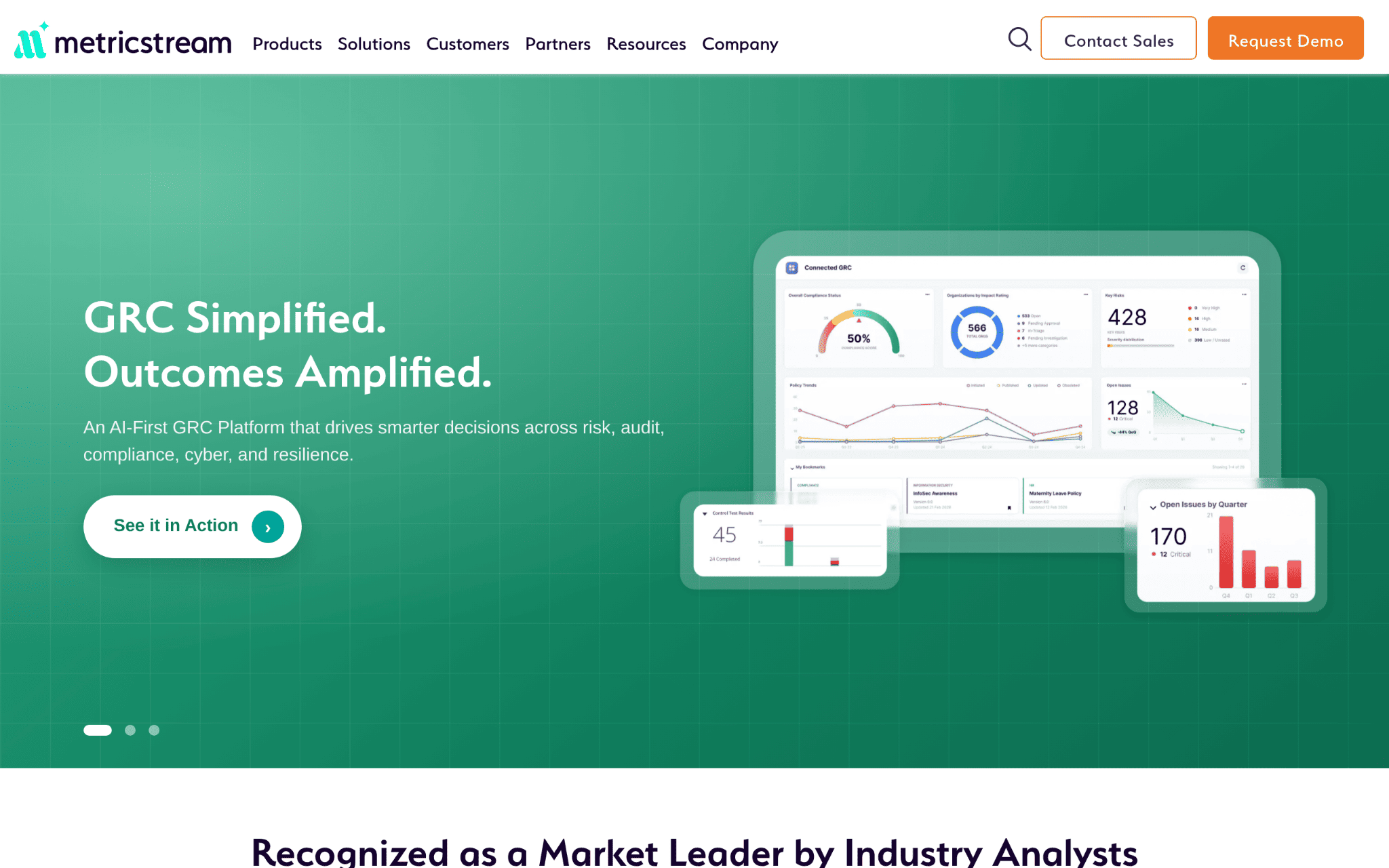
MetricStream is an AI-first GRC cloud platform serving enterprises across healthcare, financial services, energy, and other regulated industries with products spanning risk, audit, cyber GRC, and third-party risk.
Who it fits: Large enterprises or health systems that need a broad, low-code GRC platform capable of handling complex multi-framework compliance, third-party risk at scale, and internal audit programs.
Capabilities
- Automated compliance management across frameworks
- Internal audit and SOX compliance
- Cyber GRC for IT risk
- Third-party risk management on a single low-code/no-code platform
- AI tools positioned to reduce repetitive GRC tasks by 80 to 90%, per the company’s own estimates
- Trusted by over 1 million GRC professionals across 35+ countries
- Clients include Shell, Siemens Energy, Zurich Insurance, Fitch Ratings, and Glencore
- Ranked as a Leader across all five domains in Chartis Research’s Governance, Resilience, and Compliance Solutions 2025 report
- Named #1 in Operational Risk and audit categories in the Chartis RiskTech AI 50 2025
Pricing details aren’t publicly available; organizations need to contact MetricStream directly. The platform’s enterprise focus means setup can be involved for smaller or mid-size healthcare organizations.
5. Secureframe
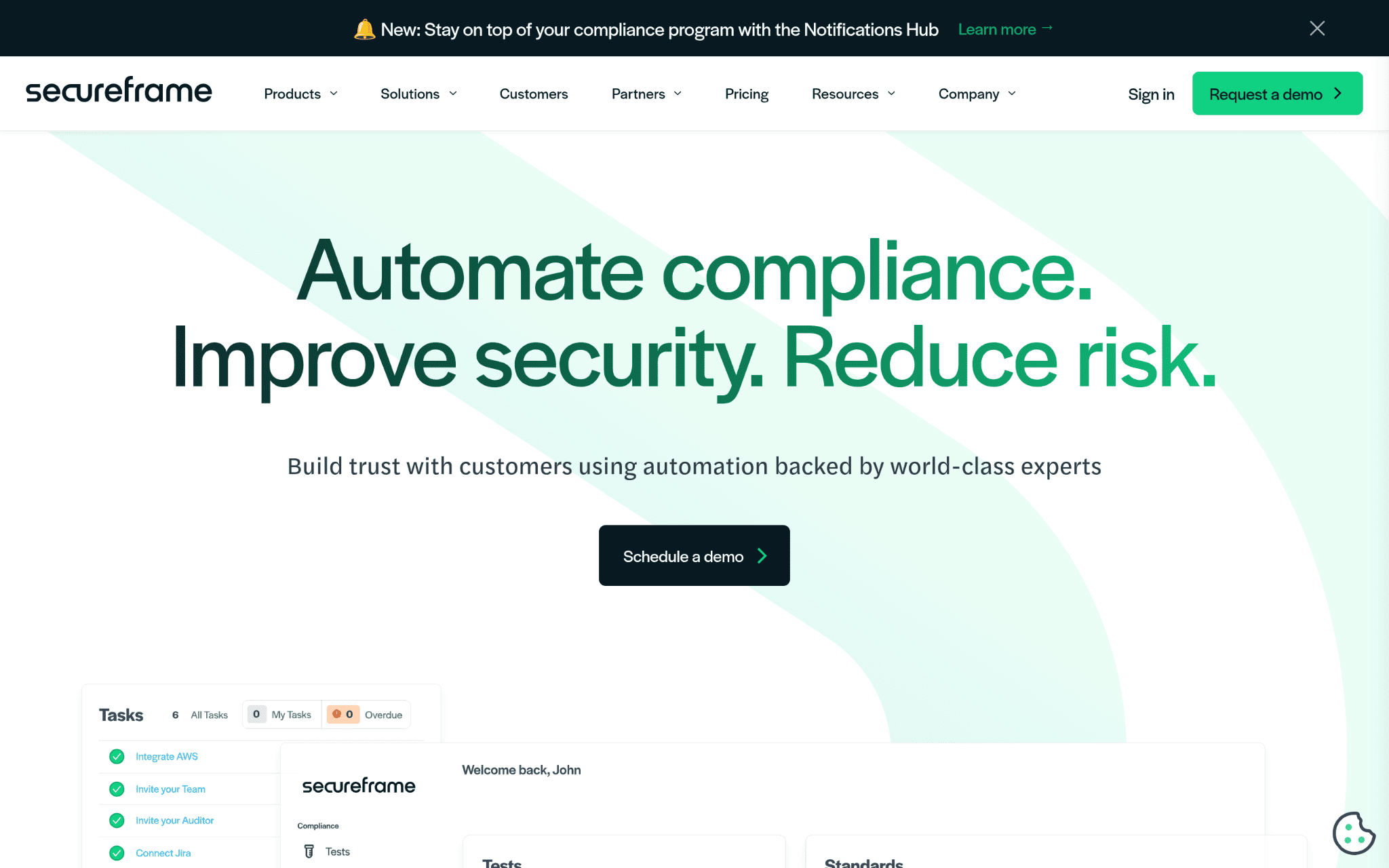
Secureframe is a compliance automation platform aimed at fast-growing technology and SaaS businesses, supporting HIPAA alongside SOC 2, ISO 27001, PCI DSS, and GDPR.
Who it fits: Startups and growing tech companies that handle PHI and need to achieve HIPAA compliance quickly alongside other security certifications, particularly those already using AWS, Google Cloud, Azure, GitHub, JAMF, or Okta.
Capabilities
Automated evidence collection across 100+ integrations, continuous compliance monitoring, policy management, risk management, and a dedicated compliance expert (former auditor) assigned to each customer account. Secureframe was named a “Hot Company, Compliance Automation” at Cyber Defense Magazine’s RSA event in 2025, is a G2 Leader across five categories, and was one of the first platforms to support NIST’s AI Risk Management Framework and ISO/IEC 42001.
Pricing is fully custom; the average reported across 16 companies is $20,000 per year, with two packages available (Fundamentals and Complete) and quotes provided after contact.
Secureframe’s tech-company orientation means its HIPAA support is real but not built around hospital workflows. Buyers with clinical operations, paper-based processes, or facility walkthrough needs should weigh that carefully.
6. Sprinto
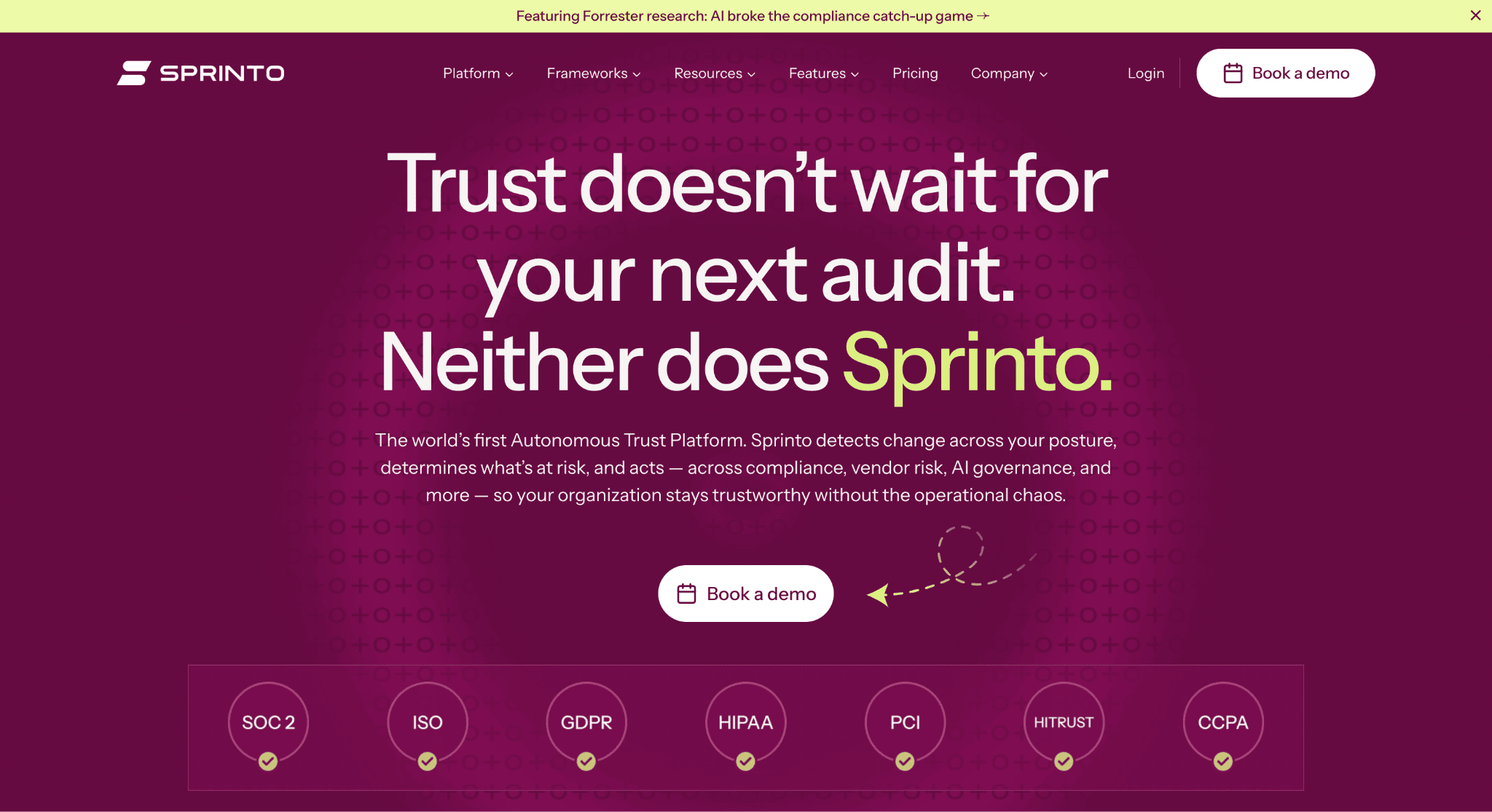
Sprinto is an autonomous compliance platform built for tech companies managing multiple security and privacy frameworks simultaneously, with strong automation across 200+ global standards.
Who it fits: SaaS and technology businesses, including health tech vendors, that need to achieve and maintain HIPAA, SOC 2, ISO 27001, and GDPR compliance with minimal manual overhead.
Capabilities
- Continuous control monitoring
- Automated evidence collection across 300+ integrations
- Risk assessment
- Vendor risk management
- AI governance support
- When controls drift, the platform acts to close gaps rather than simply alerting the team
- Sprinto has 3,000+ customers across 75 countries, with examples including Fyle achieving SOC 2 compliance in under 30 days and Apty completing ISO 27001 certification in two weeks
- The company has raised $32.2 million across four rounds including a $20 million round led by Accel
- Had 316 employees as of July 2026, reflecting 63% year-over-year headcount growth
Pricing isn’t publicly listed. Sprinto’s autonomous positioning is built for dev-forward teams; healthcare organizations with non-technical compliance staff may need more hands-on setup support than the platform assumes by default.
7. Drata
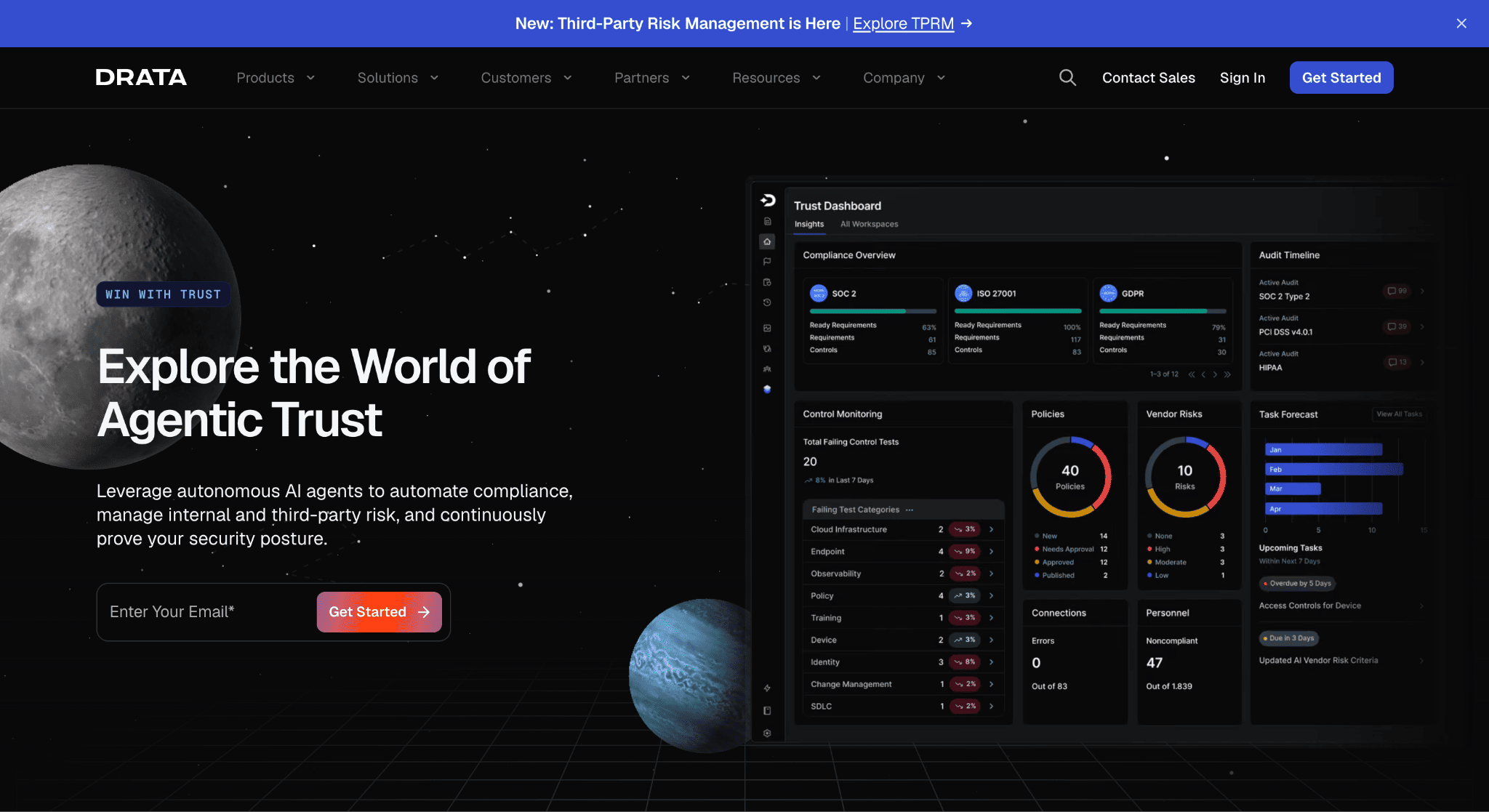
Drata is a security and compliance automation platform focused on continuous control monitoring and audit readiness, supporting HIPAA, SOC 2, ISO 27001, GDPR, and 14+ frameworks.
Who it fits: Companies, including health tech vendors and digital health startups, that want automated evidence collection and real-time control monitoring as their compliance foundation.
Capabilities
- Automated evidence collection
- Continuous security control monitoring
- Risk management
- Employee setup and exit tracking
- Automated asset tracking
- 75+ integrations including AWS, GitHub, Okta, Cloudflare, and Docusign
- Over 4,000 customers worldwide including Fivetran, Vercel, Notion, Postman, and Lemonade
- Valued at $2 billion as of 2022 after achieving unicorn status in 2021
- Pricing is not publicly listed on Drata’s website; AWS Marketplace data puts starting costs at $7,500 per year, with mid-sized organizations pursuing SOC 2 Type II commonly spending $20,000 to $45,000 annually depending on framework add-ons and platform scope
Drata has acquired SafeBase, oak9, and Harmonize to broaden its platform. Its design, though, was built around software companies rather than clinical environments. Hospital compliance teams dealing with physical safeguards and paper-based workflows will find themselves doing considerably more configuration work than vendors might suggest.
Capabilities to Evaluate in Compliance Platforms
Not every platform on this list treats HIPAA the same way. Some handle it as one framework sitting alongside dozens of others; others are built specifically around healthcare workflows. Before shortlisting vendors, organizations should measure their own situation against a few concrete criteria.
Healthcare-Specific vs. General-Purpose
Platforms built specifically for healthcare, covering clinical workflows, facility walkthroughs, and OCR audit protocols, behave differently than general enterprise GRC tools that support HIPAA as a checkbox. The right answer depends on whether the organization is a hospital or a tech company that handles PHI.
Software vs. Software-Plus-Consulting
Several tools on this list are self-serve SaaS products; others pair software with delivered consulting services like security risk assessments and virtual CISO support. Organizations without in-house compliance experience often find the consulting layer more valuable than they expected, especially during an OCR investigation or a HITRUST certification cycle.
Mobile and Field Capabilities
For organizations with physical facilities, the ability to conduct on-site audits from a phone with photos, preloaded issue checklists, and direct sync to the platform matters more than features designed for a desk-based compliance analyst.
Vendor and Third-Party Risk Management
Business associate agreements are an important part of HIPAA compliance oversight. Platforms that automate BAA tracking, tier vendors by PHI access, and surface overdue renewals solve a problem that manual spreadsheets consistently miss.
Framework Flexibility
Healthcare compliance programs rarely stop at HIPAA. Organizations dealing with HITRUST, NIST, PCI, state-specific privacy laws, or cyber insurance requirements benefit from a platform that can hold multiple frameworks in a single system rather than requiring separate tools per regulation.
A Practical Asclique Workflow
For organizations comparing HIPAA compliance platforms, Asclique recommends a structured evaluation process that prioritizes actual operational needs over vendor marketing claims.
- Audit: Document current compliance responsibilities, existing systems, policies, risk assessments, and evidence management practices.
- Diagnose: Identify gaps in documentation, vendor oversight, staff training, incident response, and audit readiness.
- Prioritize: Separate essential HIPAA-related workflows from optional enterprise GRC capabilities.
- Evaluate: Compare vendors according to healthcare specialization, integrations, reporting, support, and total implementation costs.
- Validate: Request demonstrations using realistic compliance scenarios and confirm how each platform handles documentation and approvals.
- Measure: Establish performance indicators for evidence completeness, remediation timelines, and compliance task completion.
- Improve: Review results regularly and refine workflows as regulations, organizational needs, and risks evolve.
This is an evaluation framework, not a claim that Asclique provides HIPAA certification, legal advice, or specialist healthcare compliance consulting.
Well-organized systems also support effective website management. Understanding SEO site architecture helps businesses structure information clearly, improve navigation, and make important content easier to discover.
Weak Approach vs Better Approach
| Weak Approach | Better Approach | Why It Matters |
|---|---|---|
| Choose software based only on the number of supported frameworks. | Evaluate how deeply HIPAA workflows are supported. | Framework coverage does not guarantee healthcare-specific functionality. |
| Keep risk assessments and vendor records in disconnected spreadsheets. | Centralize documentation and assign clear ownership. | Improves consistency and audit evidence retrieval. |
| Assume automation eliminates compliance responsibilities. | Maintain human oversight and documented review processes. | Supports accountability for compliance decisions. |
| Select a platform without evaluating implementation requirements. | Review onboarding, integrations, support, and training. | Reduces unexpected costs and adoption difficulties. |
| Treat compliance as an annual documentation exercise. | Monitor controls, risks, and remediation activities continuously. | Helps identify issues between formal reviews. |
Common Mistakes When Choosing HIPAA Compliance Software
- Assuming every GRC platform provides the same depth of healthcare-specific functionality.
- Choosing a platform based on automation features without evaluating clinical workflows.
- Overlooking business associate agreements and third-party risk management.
- Failing to account for onboarding, configuration, and ongoing administrative effort.
- Relying on software without assigning responsibility for policies, risk decisions, and remediation.
- Comparing subscription prices without considering consulting and implementation costs.
- Assuming that purchasing compliance software automatically satisfies HIPAA requirements.
What Is Not Proven
Compliance automation can reduce repetitive administrative work, but software adoption alone does not prove that an organization meets every applicable HIPAA requirement.
Vendor claims about time savings, automated remediation, and implementation speed may depend on the organization’s existing infrastructure, integrations, internal resources, and compliance maturity.
Customer counts, award rankings, integration totals, and reported implementation outcomes should be evaluated in context. They do not necessarily demonstrate better results for every healthcare organization.
Pricing estimates from third-party sources may also differ from actual proposals because contract terms, organizational size, support requirements, and selected modules vary.
Organizations should validate platform capabilities through demonstrations, references, contractual documentation, and internal security and compliance reviews.
Turn Digital Improvements Into Measurable ResultsStrengthen your digital presence with a clear approach to SEO, content, website optimization, and performance measurement. | Get in Touch |
How to Measure Success
Organizations should evaluate HIPAA compliance software based on improvements in documentation, risk visibility, task completion, and operational efficiency rather than the number of automated features alone.
The same measurement-focused approach applies to digital marketing. Professional search engine optimization services help businesses track organic visibility, technical performance, and website conversions to evaluate the results of their SEO efforts.
| Measurement Area | Example Metrics | What It Shows |
|---|---|---|
| Documentation | Percentage of policies reviewed and approved on schedule | Whether compliance documentation remains current |
| Risk Management | Open risks, overdue remediation items, assessment completion | Whether identified risks receive appropriate follow-up |
| Vendor Oversight | BAA coverage, vendor reviews, overdue agreements | Visibility into business associate relationships |
| Training | Training completion rates and overdue assignments | Whether workforce training obligations are being managed |
| Incident Management | Incident documentation completeness and response timelines | How consistently incidents are documented and reviewed |
| Operational Efficiency | Time spent collecting evidence and preparing audit reports | Whether software reduces administrative effort |
HIPAA Compliance Software Implementation Checklist
- ☐ Identify applicable HIPAA obligations and organizational responsibilities.
- ☐ Document existing compliance processes and tools.
- ☐ Review current security risk assessments and remediation activities.
- ☐ Identify requirements for policy and document management.
- ☐ Evaluate vendor risk management and BAA tracking capabilities.
- ☐ Confirm incident reporting and breach assessment workflows.
- ☐ Assess workforce training and credentialing needs.
- ☐ Review integrations with existing technology systems.
- ☐ Confirm access controls, data handling practices, and audit logging.
- ☐ Request vendor demonstrations using realistic healthcare scenarios.
- ☐ Compare licensing, implementation, consulting, and support costs.
- ☐ Assign internal owners for platform administration and compliance decisions.
- ☐ Establish measurable goals and review them after implementation.
FAQ’s
What Is HIPAA Compliance Software?
HIPAA compliance software helps covered entities and business associates organize activities related to privacy, security, risk assessments, policies, workforce training, vendor management, and incident documentation. Its purpose is to support compliance processes and maintain evidence of completed activities.
What Is the Best HIPAA Compliance Software for Hospitals?
The best option depends on the hospital’s operational requirements. Healthcare-specific platforms such as ComplyAssistant may be worth evaluating when facility audits, healthcare risk management, and specialist consulting are priorities. Larger organizations may also consider enterprise GRC platforms such as SAI360 and MetricStream.
Can HIPAA Compliance Software Make an Organization Fully Compliant?
No software purchase automatically establishes HIPAA compliance. Organizations remain responsible for implementing applicable safeguards, conducting risk assessments, maintaining policies, training personnel, and addressing identified risks.
How Much Does HIPAA Compliance Software Cost?
Pricing varies by vendor, organizational size, required frameworks, integrations, support, and implementation complexity. Many platforms use custom pricing. Buyers should request detailed proposals that include setup, training, consulting, and ongoing subscription costs.
What Features Should Healthcare Organizations Prioritize?
Common priorities include security risk assessments, policy management, incident documentation, vendor oversight, BAA tracking, audit trails, workforce training, and reporting. Organizations with physical facilities may also require mobile inspection and walkthrough capabilities.
What Is the Difference Between HIPAA and HITRUST?
HIPAA is a U.S. legal and regulatory framework governing certain healthcare information privacy and security obligations. HITRUST provides an assurance framework and assessment approach that organizations may use to evaluate security and compliance controls. HITRUST certification does not automatically replace HIPAA obligations.
Is HIPAA Compliance Software Necessary for Health Tech Startups?
Health tech startups that qualify as covered entities or business associates must meet applicable HIPAA requirements. Software can help organize compliance work, but whether a particular platform is necessary depends on the organization’s responsibilities, complexity, resources, and existing controls.
How Does Compliance Software Help With HIPAA Audits?
Compliance platforms can centralize policies, risk assessments, approvals, training records, vendor agreements, and remediation evidence. This may reduce the time required to locate records and demonstrate how compliance activities are managed.
What Is Business Associate Agreement Tracking?
BAA tracking helps organizations maintain records of agreements with applicable business associates, monitor agreement status, assign responsibility, and identify missing or outdated documentation. It supports vendor oversight but does not replace the need to assess business associate risks.
How Should Organizations Compare HIPAA Compliance Vendors?
Start with the organization’s actual compliance requirements. Compare healthcare specialization, risk assessment functionality, incident management, vendor oversight, reporting, integrations, implementation support, security controls, and total costs. Request demonstrations and validate important claims before selecting a platform.
Bottom Line
Healthcare compliance software for HIPAA requirements differs widely in scope, industry focus, and how much it assumes buyers already know what they’re doing. Enterprise GRC platforms like SAI360 and MetricStream suit large organizations that need broad compliance infrastructure spanning multiple industries. Automation-first tools like Drata, Secureframe, and Sprinto fit health tech vendors and SaaS companies that need certifications fast. HealthStream stands out for workforce training and credentialing.
Organizations running clinical operations, managing multi-facility footprints, or working with limited in-house compliance staff should pay close attention to how much healthcare-specific depth a platform actually offers, and whether the vendor brings setup support or leaves configuration entirely to the buyer.
Asclique Recommendation
The right healthcare compliance platform depends on the organization’s operating environment, regulatory responsibilities, and available internal expertise.
Hospitals and multi-facility healthcare organizations should prioritize solutions that support healthcare-specific workflows, facility-level assessments, business associate oversight, and practical implementation assistance.
Health tech companies may place greater weight on automated evidence collection, technology integrations, and continuous monitoring across multiple security frameworks.
Before making a final decision, request a demonstration based on actual organizational requirements, confirm pricing and support arrangements, and involve the appropriate compliance, legal, and security stakeholders.
Beyond choosing the right software, healthcare technology companies also need to communicate their expertise online. Asclique’s AI SEO services focus on improving content discoverability across traditional search engines and AI-powered search experiences.
Recommendation: Choose a platform based on the compliance work it can reliably support, not simply the number of features or frameworks listed in its marketing materials.
Need Help With Your Digital Strategy?
Asclique helps businesses strengthen their digital presence through SEO, content strategy, website optimization, and performance measurement.
For healthcare technology companies and service providers, a clear digital strategy can help communicate complex solutions, improve online discoverability, and connect with relevant business audiences.
A strong content strategy also depends on how information is connected across a website. An effective internal linking strategy helps visitors discover related resources and supports clearer website navigation.
Note: Asclique’s digital marketing services are separate from HIPAA compliance assessments, certification, and legal or cybersecurity consulting.
Ready to Strengthen Your Digital Presence?Build a stronger online presence with targeted SEO, useful content, and a measurable digital marketing strategy. | Request a Consultation |