
Quick Answer
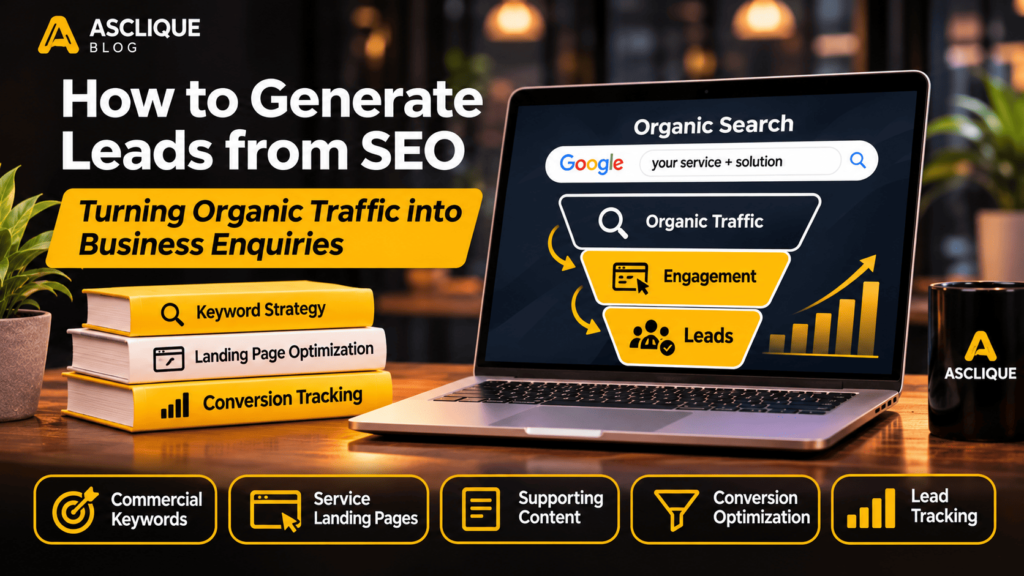
To generate leads from SEO, target keywords with commercial intent, create dedicated service landing pages, publish supporting content, improve conversion elements, and track enquiries through analytics and CRM systems.
The objective is to attract visitors who are likely to become customers rather than simply increasing organic traffic.
A lead-focused SEO strategy connects search visibility with clear calls to action, useful service information, trust signals, and measurable business outcomes.
Key Facts and What Is Verified
- Search intent: Commercial and transactional queries often indicate stronger purchase or enquiry intent than broad informational searches.
- Landing pages: Dedicated service pages help match search intent with relevant information and conversion opportunities.
- Content marketing: Supporting articles can attract potential buyers earlier in their research and guide them toward commercial pages.
- Conversion optimization: Clear CTAs, mobile usability, trust signals, and accessible contact options can influence lead generation.
- Lead attribution: Google Analytics 4, Google Search Console, CRM systems, and call tracking can help evaluate organic search performance.
- Lead quality: Qualified enquiries and revenue are more meaningful business outcomes than organic traffic alone.
- SEO timelines: Results depend on competition, existing rankings, website authority, and conversion performance.
- Important distinction: More traffic does not automatically produce more leads.
Table of Contents
- Why Traffic Alone Is Not Enough
- Step 1: Target Keywords With Commercial Intent
- Step 2: Build Dedicated Landing Pages
- Step 3: Build Content That Supports Commercial Pages
- Step 4: Optimize Commercial Pages for Conversion
- Step 5: Track Leads by Source
- What a Lead-Generating SEO Program Looks Like
- A Practical Asclique Workflow
- Weak Approach vs Better Approach
- Common SEO Lead Generation Mistakes
- What Is Not Proven
- How to Measure SEO Lead Generation Success
- SEO Lead Generation Checklist
- Frequently Asked Questions
- Asclique Recommendation
Why Traffic Alone Is Not Enough
A site can generate tens of thousands of monthly organic visits and still produce almost no leads.
This happens when:
- The site ranks for informational keywords with little commercial intent.
- The landing pages are not designed to convert visitors into enquiries.
- There is no clear next step for visitors who are ready to engage.
- The audience being targeted is not the buyer. It may be a researcher, student, or competitor.
Generating SEO leads starts with building an organic search strategy around commercial intent, not just search volume.
For example, a business may attract thousands of visitors through broad educational articles while receiving very few enquiries. Another business may attract fewer visitors through targeted service pages but generate more qualified leads because those visitors are actively looking for a provider.
The important question is not simply how many people visit the website. It is whether the website attracts the right people and gives them a reason to take the next step.
Step 1: Target Keywords With Commercial Intent
The keywords that generate leads are often different from the keywords that generate traffic.
High-traffic informational keywords such as “what is content marketing” attract researchers. Commercial keywords such as “content marketing agency for SaaS” are more likely to attract potential buyers.
Commercial Intent Keyword Patterns
- Service + location: “SEO agency [city]” or “plumber near me.”
- Comparison queries: “Ahrefs vs Semrush” or “best email marketing software.”
- Vendor selection queries: “Digital marketing agency for ecommerce” or “white label SEO for agencies.”
- Problem-specific queries: “How to fix Google penalty” or “website not ranking on Google.”
- Pricing queries: “SEO services cost” or “how much does PPC management cost.”
These queries may have lower search volume than broad informational terms, but they can attract visitors who are closer to making a purchase decision.
For example, a page generating 200 visits from “SEO agency for law firms” could produce more leads than a page generating 2,000 visits from “what is SEO,” depending on the audience, landing page, and conversion rate.
How to Prioritize Commercial Keywords
Evaluate keywords based on search intent, relevance to your services, ranking difficulty, and potential business value.
Do not select keywords based only on monthly search volume. A lower-volume keyword that closely matches a profitable service may be more valuable than a broad keyword attracting unrelated visitors.
A commercial keyword strategy should connect search demand with the services that generate business value. Professional search engine optimization services can help businesses identify relevant opportunities and improve their visibility for high-intent searches.
Step 2: Build Dedicated Landing Pages for Each Service
A common mistake is driving commercial keyword traffic to a generic homepage or a broad “Services” overview page.
Each important service should have its own dedicated landing page designed for both ranking and conversion.
Creating individual service pages also requires a clear website structure. A well-planned SEO site architecture helps organize commercial landing pages, supporting content, and navigation so visitors can find relevant services more easily.
What a Lead-Generating Service Page Includes
A clear, specific headline. Not “Our Services,” but “SEO for Law Firms: Organic Growth for Legal Practices.”
A direct explanation of what you do and who it is for. Avoid jargon and vague positioning. Specific information is usually more useful than general promises.
Trust signals. Client logos, case study summaries, testimonials with specific results, certifications, the number of clients served, or years in operation can help establish credibility when the claims are accurate and authorized.
Clear social proof. A testimonial with a verifiable customer identity and relevant details can be more persuasive than an anonymous review, provided the customer has agreed to its publication.
A primary CTA above the fold. The most important call to action, such as “Get a Free Audit,” “Book a Consultation,” or “Contact Us,” should be easy to find without unnecessary scrolling.
Secondary CTA options. Not everyone is ready to book immediately. A secondary offer, such as downloading a guide, viewing pricing, or reading case studies, gives mid-funnel visitors another way to engage.
FAQs that address objections. Common concerns about price, timelines, processes, and guarantees should be addressed directly on the page.
Match the Landing Page to Search Intent
A visitor searching for “SEO services for dentists” should arrive on a page that clearly explains how the service applies to dental practices.
Sending that visitor to a generic marketing page creates additional work for the user and may reduce the likelihood of an enquiry.
The closer the page matches the searcher’s needs, the easier it becomes to explain the service and present a relevant next step.
Turn Organic Traffic Into Qualified LeadsBuild an SEO strategy focused on commercial keywords, high-converting landing pages, and measurable business enquiries. | Contact Asclique |
Step 3: Build Content That Supports the Commercial Pages
Content marketing generates organic traffic, but its role in lead generation is often misunderstood.
Blog content may not always convert directly into leads. Its value often comes from reaching buyers at an earlier stage of their research and guiding them toward commercial pages.
A structured internal linking strategy helps connect informational articles with relevant service pages, creating clearer paths for visitors who are ready to explore solutions or submit an enquiry.
Content That Supports Lead Generation
Problem-aware content. Articles that help potential buyers understand a problem and the available solutions. Examples include “Signs Your SEO Strategy Is Not Working” and “Why Your Google Business Profile Is Not Showing Up.”
Comparison and evaluation content. Articles for buyers comparing options, such as “Agency vs In-House SEO: Which Is Right for Your Business?” or “What to Look for in an SEO Agency.”
Case studies and results content. Detailed breakdowns of actual client results can build credibility and attract buyers searching for evidence that a service works.
FAQ and objection-handling content. Articles addressing common questions about pricing, processes, and timelines help inform buyers and reduce friction during the sales process.
Connect Blog Content to Commercial Pages
Each content piece should link naturally to the relevant service page.
For example, a post about “how to choose an SEO agency” should link to the SEO services page using clear anchor text and a contextual CTA.
Internal links help visitors move from educational information to relevant service details. They also help search engines understand the relationship between supporting articles and commercial pages.
Step 4: Optimize for Conversion on Every Commercial Page
Getting organic traffic to a landing page is only half the work.
Conversion rate optimization, or CRO, on commercial pages can increase lead volume without requiring additional traffic.
Key Conversion Elements
Contact form above the fold. On a service or contact page, make the form or primary enquiry action easy to find. Multi-step forms may reduce perceived effort in some situations, but their effectiveness should be tested against simpler alternatives.
Phone number prominently displayed. Many buyers prefer calling rather than completing a form, particularly for urgent or high-value services. A visible, clickable phone number helps capture these enquiries.
Page load speed. Slow-loading pages can frustrate visitors, especially on mobile devices. Review Core Web Vitals and address performance problems on important commercial pages.
Mobile optimization. Mobile usability matters for both consumer and business audiences. Forms, buttons, navigation, and contact information should work properly across screen sizes.
Trust signals near the CTA. Place relevant testimonials, client logos, certifications, or case study references near the enquiry form or CTA where appropriate.
Reduce Friction Before the Enquiry
Visitors should understand what happens after they submit a form or book a consultation.
Explain the next step clearly, whether it involves a discovery call, an audit, a quote, or a response from the sales team.
Only request the information needed to handle the initial enquiry. Long forms asking for unnecessary details can discourage potential customers.
Step 5: Track Leads by Source
You cannot optimize what you cannot measure. Set up lead attribution before using conversion data to make decisions.
Google Analytics 4 Conversion Tracking
Configure relevant lead-generation events, such as successful form submissions, and mark the appropriate events as key events in GA4.
Review performance by traffic source and landing page to understand which organic entry points contribute to enquiries.
Where possible, distinguish genuine submissions from form errors, spam, or duplicate events.
UTM Parameters for Campaigns
Use UTM parameters for paid advertising, email campaigns, and other tagged marketing links so their traffic can be identified separately from organic search.
Avoid adding campaign UTMs to ordinary internal website links because doing so can interfere with attribution.
CRM Integration
If possible, pass lead source information into the CRM so the journey from initial enquiry to closed deal can be evaluated.
Platforms such as HubSpot, Salesforce, and Pipedrive can support lead management and attribution workflows, although the available reporting depends on the configuration and integrations used.
Call Tracking
Call tracking platforms can help identify which pages and marketing sources generate phone enquiries.
Services such as CallRail and ResponseTap support call attribution. Dynamic number insertion can be used when appropriate while keeping the business’s primary contact details consistent in important listings.
Connect SEO Leads to Revenue
A completed form is not always a qualified lead.
Where possible, measure which enquiries become sales opportunities, customers, or completed purchases.
This helps distinguish pages that generate activity from pages that generate meaningful business value.
What a Lead-Generating SEO Program Looks Like
A lead-focused SEO program typically develops through several overlapping stages.
| Timeline | Key Actions | Primary Objective |
|---|---|---|
| Months 1–2 | Audit existing service pages, improve above-the-fold CTAs, add trust signals, and fix mobile issues. | Improve conversion readiness. |
| Months 2–4 | Launch or update commercial landing pages targeting high-intent keywords. | Improve visibility for buyer-focused searches. |
| Months 3–6 | Publish supporting blog content and build internal links to commercial pages. | Connect informational traffic with service enquiries. |
| Months 4–8 | Develop relevant backlinks through legitimate digital PR, editorial contributions, and outreach. | Strengthen authority and discoverability. |
| Months 6–12 | Review lead attribution data and prioritize pages producing qualified enquiries. | Improve lead quality and business returns. |
These stages are illustrative. Businesses with established organic rankings may generate leads sooner, while newer websites or highly competitive industries may require more time.
A Practical Asclique Workflow for SEO Lead Generation
Asclique recommends treating SEO lead generation as a connected process involving search intent, landing page quality, conversion optimization, and performance measurement.
- Audit: Review existing organic traffic, service pages, conversion tracking, and current lead volume.
- Research: Identify commercial keywords relevant to the business’s services, customers, and geographic markets.
- Prioritize: Focus on high-value services and search queries with realistic opportunities to attract qualified buyers.
- Optimize: Improve landing page content, CTAs, forms, mobile usability, and trust signals.
- Connect: Build supporting content and contextual internal links that guide visitors toward relevant service pages.
- Track: Configure GA4 key events, lead attribution, call tracking, and CRM reporting where appropriate.
- Validate: Review whether enquiries are relevant, legitimate, and progressing through the sales process.
- Improve: Refine keywords, landing pages, and content based on lead quality and conversion performance.
The objective is to build an organic search program that produces measurable business opportunities rather than simply increasing website visits.
Supporting content is an important part of connecting organic visibility with potential customers. Asclique’s content marketing services help businesses develop relevant articles and supporting resources that address customer questions and guide visitors toward appropriate services.
Weak Approach vs Better Approach
| Weak Approach | Better Approach | Why It Matters |
|---|---|---|
| Target keywords based only on search volume. | Prioritize commercial intent and business relevance. | Attracts visitors more likely to become customers. |
| Send all traffic to a generic homepage. | Create dedicated service landing pages. | Improves relevance and provides clearer next steps. |
| Publish blogs without connecting them to services. | Use contextual internal links and relevant CTAs. | Helps readers move from research to enquiry. |
| Track only rankings and organic sessions. | Measure qualified leads and business outcomes. | Connects SEO activity with revenue opportunities. |
| Assume every form submission is a valuable lead. | Review lead quality and CRM outcomes. | Separates genuine sales opportunities from low-quality enquiries. |
Common SEO Lead Generation Mistakes
- Targeting high-volume keywords without evaluating commercial intent.
- Sending service-related searches to generic homepage content.
- Failing to explain who a service is for and what problems it solves.
- Publishing informational content without relevant internal links.
- Using unclear or difficult-to-find calls to action.
- Asking for unnecessary information in enquiry forms.
- Ignoring mobile usability and website performance.
- Displaying unsupported testimonials, statistics, or results claims.
- Failing to configure reliable conversion tracking.
- Measuring lead volume without evaluating lead quality.
- Assuming higher organic traffic automatically means more revenue.
What Is Not Proven
There is no universal conversion rate that every SEO landing page should achieve.
Conversion performance depends on industry, search intent, traffic quality, pricing, page design, and the definition of a lead.
Similarly, a four-to-six-month SEO timeline does not guarantee that every business will begin generating qualified enquiries within that period.
High-intent keywords can attract more relevant visitors, but they do not guarantee higher conversion rates for every business.
Backlinks may contribute to search visibility, but acquiring links does not automatically improve rankings. Link quality, relevance, editorial legitimacy, and compliance with search engine policies matter.
Businesses should treat projected traffic, conversion rates, and lead volumes as hypotheses until they are supported by their own performance data.
Get More Value From Your Organic TrafficIdentify the pages, keywords, and conversion improvements that can help turn search visibility into business enquiries. | Get in Touch |
How to Measure SEO Lead Generation Success
SEO lead generation should be evaluated using both search performance and business outcomes.
| Measurement Area | Example Metrics | What It Shows |
|---|---|---|
| Search Visibility | Commercial keyword rankings and organic search clicks | Whether relevant buyers can discover the website |
| Organic Traffic | Organic sessions and commercial landing page visits | Whether target pages are attracting visitors |
| Lead Conversion | Form submissions, calls, bookings, conversion rate | Whether visitors are taking meaningful actions |
| Lead Quality | Qualified leads, sales-accepted leads, spam rate | Whether enquiries match the target customer profile |
| Sales Outcomes | Opportunities, customers acquired, closed revenue | Whether SEO contributes to business growth |
| Efficiency | Cost per qualified lead and lead-to-customer rate | How efficiently organic search produces customers |
Review these metrics by landing page, service category, and relevant traffic source.
Use Google Search Console to understand which queries generate search clicks, GA4 to evaluate on-site behavior and key events, and CRM data to assess lead quality and sales outcomes.
Because Google Search Console and GA4 use different reporting methods, keyword-level lead attribution is not always directly available. Avoid presenting inferred keyword conversions as exact measurements.
SEO Lead Generation Implementation Checklist
- ☐ Identify the services that generate the most business value.
- ☐ Research commercial and transactional keywords.
- ☐ Review existing organic landing pages.
- ☐ Create dedicated pages for important services.
- ☐ Match page headlines and content to search intent.
- ☐ Add clear primary calls to action.
- ☐ Provide secondary engagement options where appropriate.
- ☐ Add accurate testimonials, case studies, and trust signals.
- ☐ Improve mobile usability and page load performance.
- ☐ Simplify contact forms and enquiry processes.
- ☐ Publish supporting problem-aware and comparison content.
- ☐ Add contextual internal links to relevant service pages.
- ☐ Configure GA4 key events for lead actions.
- ☐ Connect lead source information to the CRM where possible.
- ☐ Implement call tracking when phone enquiries are important.
- ☐ Review lead quality and sales outcomes.
- ☐ Test and improve landing page conversion elements.
- ☐ Prioritize future SEO work using qualified lead data.
FAQ’s
How Long Does SEO Take to Generate Leads?
With a focused commercial keyword strategy and optimized landing pages, some businesses begin seeing organic leads within a few months. A four-to-six-month period is a reasonable planning scenario for certain established websites, while competitive industries or newer domains may take eight to twelve months or longer to generate meaningful lead volume. Results are not guaranteed.
Can I Generate Leads From SEO Without a Large Content Strategy?
Yes. If service pages are optimized for commercial keywords and the website has sufficient authority to rank, businesses can generate leads without publishing a large volume of blog content. Supporting articles can expand visibility and help buyers during earlier research stages, but they are not the only source of organic leads.
Should I Focus on Local or National SEO for Lead Generation?
This depends on the business model. Service businesses with defined geographic coverage should generally prioritize local SEO. Agencies, SaaS companies, and businesses serving customers across the country may benefit from national commercial keyword targeting. Some businesses need both approaches.
What Conversion Rate Should I Expect From SEO Traffic?
Conversion rates vary significantly by industry, search intent, landing page, and lead definition. Some B2B service pages may achieve conversion rates in the low-to-mid single digits or higher, while informational content often converts at lower rates. Rather than relying on a universal benchmark, track page-level conversion rates and compare performance against your own historical data.
How Do I Know Which SEO Keywords Are Actually Generating Leads?
Use GA4 to track lead-generation key events and review organic search landing pages. Google Search Console shows the queries driving impressions and clicks to those pages. Combining these reports helps identify likely keyword opportunities, although exact keyword-to-lead attribution is limited. CRM and call tracking data can provide additional context.
What Is the Difference Between SEO Traffic and SEO Leads?
SEO traffic refers to visitors arriving through unpaid search results. SEO leads are visitors who take an identifiable action that indicates potential interest in a product or service, such as submitting an enquiry, requesting a quote, booking a consultation, or calling the business.
Which SEO Keywords Generate the Most Qualified Leads?
Keywords indicating service needs, vendor comparisons, pricing research, and purchase intent are often valuable. The best keywords depend on the business’s services, target audience, location, and customer decision process.
Do Blog Posts Generate SEO Leads?
Yes, although results vary by topic and search intent. Some blog posts attract visitors who are ready to enquire, while others support earlier research stages. Contextual internal links and relevant calls to action can help readers move toward commercial pages when appropriate.
How Can I Improve SEO Leads Without Increasing Traffic?
Improve conversion elements on existing high-traffic pages. This may include clearer headlines, better service explanations, stronger trust signals, easier contact options, improved mobile usability, and simpler forms. Test changes and measure whether they increase qualified enquiries.
What Tools Should I Use to Track SEO Leads?
Google Analytics 4 and Google Search Console provide useful search and website performance information. CRM platforms can help track lead quality and sales outcomes, while call tracking tools support attribution for phone enquiries. The right combination depends on the business’s sales process and reporting requirements.
Asclique Recommendation
SEO lead generation starts with attracting the right audience, not simply increasing search traffic.
Businesses should prioritize commercial keywords, dedicated service landing pages, clear conversion opportunities, and reliable lead tracking.
Supporting content should help potential buyers understand their options and guide them toward relevant services without forcing promotional messages into every article.
Conversion optimization and lead attribution are equally important. Without them, a business may increase traffic and rankings without knowing whether SEO contributes to enquiries or revenue.
Our recommendation: Start by identifying the services and search terms most likely to attract qualified buyers. Improve the corresponding landing pages, establish reliable conversion tracking, and use lead quality data to guide future SEO investments.
Need Help Generating Leads From SEO?
Asclique builds SEO programs focused on commercial outcomes, not just rankings.
Our SEO services include commercial keyword strategy, landing page optimization, content development, technical SEO improvements, and performance measurement designed to support lead generation.
Whether your website already receives organic traffic or you are building a new SEO strategy, the objective is to connect search visibility with meaningful business enquiries.
Contact Asclique to discuss what a lead-focused SEO program could look like for your business.
Ready to Turn SEO Traffic Into Business Enquiries?Build an organic search strategy that attracts qualified buyers, improves landing page conversions, and supports measurable business growth. | Request a Consultation |