
For many cleantech companies, PR delivers the strongest results when it works alongside the rest of the marketing strategy. Media relations can introduce a brand to new audiences, but sustained awareness and visibility depend on consistent messaging and amplification across social media, search engines, thought leadership platforms, industry publications, and events.
Agencies that combine communications with broader marketing expertise are often better positioned to help cleantech companies build mindshare and customer trust. This is particularly important in climate tech and clean energy, where companies may need to communicate complex technologies to buyers, investors, journalists, policymakers, partners, and other stakeholders.
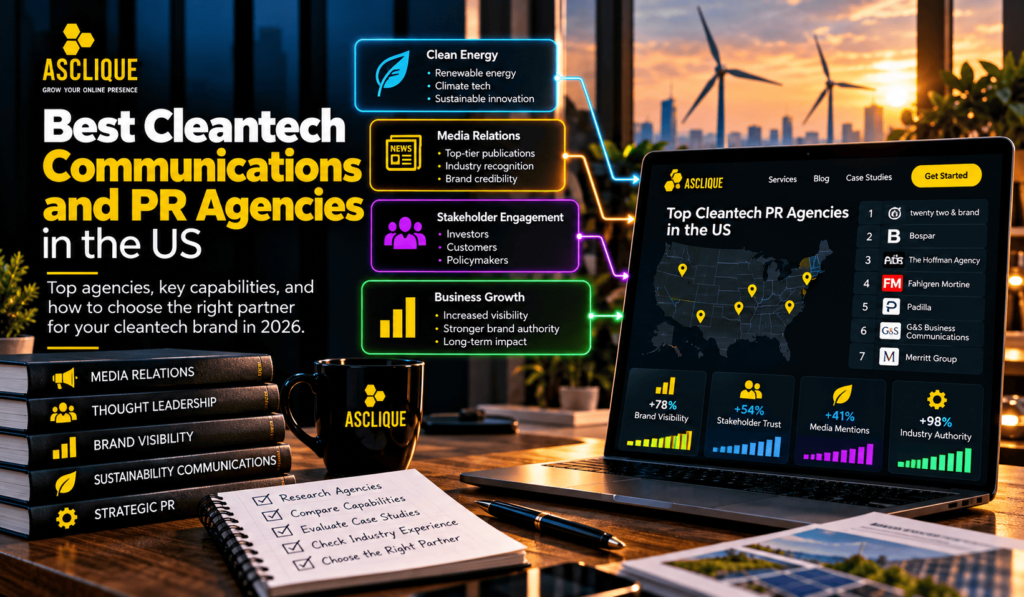
We compiled this list to save you from reviewing dozens of agency websites, case studies, and service pages on your own. Each agency included here has public evidence of relevant work and offers communications or marketing services for cleantech, climate tech, renewable energy, clean energy, or closely related sectors.
The goal is to help you compare credible options faster and choose the right cleantech PR agency for your brand in 2027.
Table of Contents
- Comparison at a Glance
- twentytwo & brand
- Bospar
- The Hoffman Agency
- Fahlgren Mortine
- Padilla
- G&S Business Communications
- Merritt Group
- Selection Criteria Applied
- Asclique Perspective: What Cleantech Brands Should Look for in a PR Agency
- When to Use Which Agency
- PR Should Not Operate in Isolation
- How to Evaluate a Cleantech PR Agency
- Measuring Cleantech PR Beyond Media Placements
- Frequently Asked Questions
- Final Consideration
Comparison at a Glance
| Agency | Headquarters | Cleantech Practice Evidence |
|---|---|---|
| twentytwo & brand | United States | 100+ cleantech clients across solar, storage, renewable fuels, waste-to-energy, and smart grid technology |
| Bospar | San Francisco, CA | Batteries, Cleantech, Energy, and Solar domain expertise |
| The Hoffman Agency | San Jose, CA | Lightship EV RV launch and Fremont clean tech city branding |
| Fahlgren Mortine | Columbus, OH | Energy sector practice within integrated communications |
| Padilla | Minneapolis, MN | Renewable Energy and Sustainability + Environment practices |
| G&S Business Communications | New York, NY | Advanced Manufacturing & Energy and Clean Technology practices |
| Merritt Group | Washington, D.C. / San Francisco | Emerging technologies, security, and government practices |
twentytwo & brand
twentytwo & brand is a full-service marketing communications agency built specifically for B2B cleantech, climate tech, and renewable energy companies. The agency provides brand strategy, public relations, digital marketing, advertising, social media, web design, SEO/GEO, and lead generation under one team, structured around the operational reality of climate and energy companies working with lean marketing teams.
Integration is central to the model. While many agencies in the space focus primarily on either creative or communications, twentytwo & brand combines storytelling, communications strategy, design, and digital marketing. That can be particularly useful for complex technologies that need to be clearly understood by technical buyers, investors, partners, and other industry stakeholders.
The agency also provides cleantech public relations services designed to help climate and energy companies build visibility, communicate complex innovations, and strengthen relationships with key audiences.
The agency has worked with more than 100 cleantech brands across solar, wind, energy storage, renewable fuels, smart grid software, carbon tech, and the broader energy transition. Notable named engagements include GameChange Energy, where twentytwo & brand reports driving a 50% year-over-year increase in media coverage; Burnham RNG, which achieved 70% year-over-year growth in LinkedIn followers; and esVolta, which saw a 900% increase in website impressions after partnering with the agency.
The agency has also been recognized with a w3 Gold Award for Social Content & Marketing in the Environment and Sustainability category and as a top B2B Marketing Agency in 2027 by PR Daily.
Best suited for: Cleantech and renewable energy companies looking for PR, brand, creative, digital marketing, and lead generation within one specialized agency relationship.
Bospar
Bospar is a San Francisco-based technology public relations agency operating across multiple domain areas, including B2B technology, healthcare, financial services, and cleantech.
The firm maintains a dedicated Batteries, Cleantech, Energy, and Solar domain expertise area covering sustainable energy, cleantech, and climate tech categories. Its published sector content also addresses areas such as the role of AI and data analytics in supporting growth across energy and cleantech markets.
Bospar operates with a distributed model designed to provide senior-level engagement across geographies and has received recognition across industry rankings for its work in technology PR.
Its cleantech capabilities extend across renewable energy, solar, energy storage, batteries, and adjacent technologies, with services including earned media, executive positioning, thought leadership, and integrated communications.
Bospar’s positioning as a multi-sector technology PR agency with defined cleantech capability makes it particularly relevant for climate technology businesses that sit at the intersection of software, energy, data, and emerging technology.
Best suited for: Cleantech SaaS, battery technology, energy storage, and technology-led climate companies looking for strong technology PR expertise.
The Hoffman Agency
The Hoffman Agency is a global B2B technology public relations agency headquartered in San Jose, California. Its footprint includes North American operations alongside offices across major Asia-Pacific markets.
The firm specializes in B2B technology communications, with services spanning earned media, content marketing, social media, earned search, crisis communications, corporate communications, branding and design, and employee communications.
The Hoffman Agency’s cleantech work includes the launch campaign for Lightship, America’s first all-electric recreational vehicle company, which introduced the battery-powered Lightship L1 travel trailer in March 2023.
The campaign generated media coverage across publications including TechCrunch, The Verge, and InsideEVs and received recognition including a Platinum MarCom Award for Strategic Communications of a Product/Service Launch and a Platinum dotCOMM Award for earned media.
The firm has also supported the City of Fremont’s Think Silicon Valley initiative, positioning the city around areas including advanced manufacturing, clean technology, and life sciences.
Its combination of international technology communications capabilities and named cleantech engagements makes The Hoffman Agency particularly relevant to companies with ambitions beyond the US market.
Best suited for: Technology-driven cleantech companies planning US and international communications programs, particularly businesses with Asia-Pacific market or manufacturing interests.
Fahlgren Mortine
Fahlgren Mortine is an integrated communications agency headquartered in Columbus, Ohio, with decades of experience across sectors including B2B, consumer goods, economic development, energy, healthcare, higher education, manufacturing, logistics, retail, technology, and tourism.
The agency operates as part of The Shipyard Collective and provides integrated capability across paid, earned, and owned media.
Its work in the energy sector spans multiple categories, while its broader approach combines data, design, creative strategy, and communications. This makes the agency relevant to cleantech companies that need communications programs extending beyond traditional media relations.
For larger organizations, this integrated model can be particularly valuable when PR campaigns need to coordinate with advertising, digital campaigns, creative production, content, and other channels.
Best suited for: Mid-market and enterprise cleantech organizations looking for coordinated communications across earned, paid, and owned media.
Padilla
Padilla is a full-service communications agency headquartered in Minneapolis, Minnesota. The agency operates across several US cities as an AVENIR GLOBAL company and is a founding member of the Worldcom Public Relations Group.
Its wider agency family includes specialized capabilities spanning performance communications, food and nutrition affairs, and brand strategy.
Padilla maintains a dedicated Renewable Energy industry practice focused on helping renewable energy organizations communicate through integrated campaigns across earned media, digital marketing, content creation, and social channels.
Its Sustainability + Environment practice provides communications support around sustainability initiatives and combines technical subject matter with sustainability-focused storytelling.
The firm’s Corporate Strategic Advisory capabilities also support organizations navigating business strategy changes, growth initiatives, operational changes, M&A, crisis situations, and financial and capital markets communications.
That broader strategic capability can become particularly important as cleantech companies mature and communications requirements expand beyond product awareness.
Best suited for: Cleantech and renewable energy companies dealing with corporate reputation, sustainability communications, M&A, capital markets activity, or complex stakeholder engagement.
G&S Business Communications
G&S Business Communications is an independent B2B communications agency with operations in the US and Europe and access to additional international markets through PROI Worldwide.
The agency specializes across sectors including Advanced Manufacturing & Energy, Agribusiness, Financial & Professional Services, Healthcare & Wellness, and Home & Building.
Its Clean Technology practice focuses on communications strategies designed to support the adoption of cleantech technologies, manufacturing processes, and business practices.
G&S also has connections to the Research Triangle cleantech ecosystem and works across areas including cleantech, cleantech venture capital, ESG reporting and disclosure, corporate reputation, sustainability and CSR, advanced manufacturing, and energy.
This combination can be valuable for companies where clean technology intersects with industrial manufacturing, infrastructure, engineering, or energy markets.
Best suited for: Industrial cleantech, advanced manufacturing, energy technology, and climate companies requiring B2B communications across US and international markets.
Merritt Group
Merritt Group is a strategic communications agency with offices in Washington, D.C. and San Francisco. Founded in 1996, the firm provides marketing, public relations, and digital strategy services to organizations ranging from venture-backed startups to large enterprises.
Its expertise spans areas including government, security, emerging technologies, healthcare, and other B2B markets.
For cleantech companies, the combination of emerging technology and government experience is particularly relevant for businesses operating in markets influenced by federal agencies, public-sector procurement, infrastructure programs, regulation, or utility relationships.
The agency’s Washington, D.C. presence also provides proximity to federal agencies, policy stakeholders, industry organizations, and regulatory conversations that can influence cleantech markets.
Best suited for: Cleantech companies with federal contracting ambitions, government-market exposure, policy-related communications requirements, or audiences spanning both commercial and public sectors.
Selection Criteria Applied
The seven agencies profiled above were evaluated against four primary criteria.
US headquarters or substantial US operations: Each agency maintains a US headquarters or significant operations serving American businesses.
Multi-sector positioning with cleantech relevance: Each agency operates across multiple industries while maintaining a defined cleantech, energy, sustainability, renewable energy, or advanced manufacturing capability.
Public evidence of cleantech work: Agencies were selected based on publicly available sector pages, case studies, client engagements, memberships, or other evidence demonstrating relevant experience.
Communications and PR capability: Each agency provides communications and public relations as a significant offering, with capabilities that may include media relations, corporate reputation, executive positioning, thought leadership, digital communications, and integrated campaigns.
Asclique Perspective: What Cleantech Brands Should Look for in a PR Agency
From Asclique’s perspective, the strongest cleantech communications strategies do more than generate media coverage. PR should support the broader digital presence of the company, including organic search visibility, branded search demand, thought leadership, social media, authoritative mentions, backlinks, and increasingly, visibility across AI-powered search and discovery platforms.
This matters because cleantech companies often sell products and services that require considerable research before a decision is made. A journalist may encounter the company through a press announcement, an investor through industry coverage, a potential customer through Google, and another stakeholder through an AI-generated answer or executive LinkedIn post.
Those experiences should reinforce one another rather than communicate different versions of the company.
PR should also work alongside a strong content marketing strategy, helping brands turn earned visibility into useful resources, thought leadership, and sustained organic discovery.
When evaluating a cleantech PR agency, companies should therefore look beyond the number of media placements promised. Consider whether the agency understands the technical nature of the product, the audiences influencing purchasing and investment decisions, and how earned coverage can be amplified across search, social media, content, executive thought leadership, and digital channels.
Credible third-party coverage can also create assets that extend beyond the initial publication date. Relevant coverage may generate referral traffic, earn editorial backlinks, strengthen branded search results, provide material for social amplification, and support sales or investor communications.
At Asclique, we recommend evaluating PR alongside metrics such as branded search growth, referral traffic, authoritative backlinks and mentions, organic visibility, engagement with thought-leadership content, qualified leads, and visibility across relevant AI search experiences.
Media coverage remains important, but its value increases when it contributes to a broader and measurable search and digital marketing strategy.
As AI-powered platforms become part of the research journey, brands should also consider how their content and earned coverage contribute to AI search optimization.
When to Use Which Agency
Full-service cleantech marketing communications: twentytwo & brand is positioned for cleantech and renewable energy companies that want brand, PR, digital, creative, and lead generation capabilities under one team built specifically around the sector.
Cleantech technology PR with multi-sector reach: Bospar and The Hoffman Agency are positioned for companies operating within the broader technology ecosystem. Bospar provides defined cleantech domain expertise, while The Hoffman Agency provides substantial international technology communications capabilities.
Integrated multi-channel communications for mid-market and enterprise cleantech: Fahlgren Mortine is positioned for organizations that need coordinated programs spanning earned, paid, and owned media.
Corporate reputation and complex stakeholder communications: Padilla and G&S Business Communications provide broader corporate and industry capabilities. Padilla brings sustainability and corporate strategic advisory expertise, while G&S combines clean technology with Advanced Manufacturing & Energy experience.
Federal and policy-adjacent communications: Merritt Group is positioned for cleantech companies with government-market exposure, federal contracting ambitions, or communications requirements involving commercial and regulatory audiences.
PR Should Not Operate in Isolation
One factor that cleantech companies should consider when choosing an agency is what happens after coverage is earned.
A strong article in an industry publication can be more than a PR win. It can become part of the company’s broader digital authority strategy.
The coverage may support branded search results, generate referral traffic, attract additional citations or backlinks, strengthen executive credibility, provide content for social channels, support sales conversations, and create another independent source through which customers and AI systems can discover information about the company.
Social media marketing can extend the lifespan of earned coverage by distributing media wins, executive commentary, and thought leadership to relevant audiences.
The same principle applies in reverse. Strong SEO and content programs can create research, data, expert commentary, and other assets that PR teams can use when pitching journalists.
Useful content → PR opportunities → authoritative coverage → amplification → search and brand visibility → additional discovery.
The objective should not be to force every PR placement to produce an SEO benefit. Editorial independence matters. Instead, marketing teams should ensure that PR, SEO, content, social media, and executive communications reinforce the same positioning and business objectives.
How to Evaluate a Cleantech PR Agency
Before selecting an agency, cleantech companies should examine more than its client list. A recognizable logo does not necessarily demonstrate that the agency handled the type of work your company needs.
Ask potential agencies about their experience communicating technically complex products, relationships with relevant industry media, approach to executive thought leadership, measurement framework, and how communications integrates with other marketing activities.
Companies should also determine who will actually manage the account. Senior executives may lead the pitch, while day-to-day execution is handled by a different team.
For businesses operating in highly technical or regulated markets, subject-matter understanding is particularly important. The agency does not necessarily need to be an engineering consultancy, but its team should be capable of translating technical information accurately without oversimplifying claims.
Finally, establish what success means before the engagement begins. Media placements alone rarely provide enough information to evaluate the commercial impact of communications.
Measuring Cleantech PR Beyond Media Placements
Coverage level: Measure relevant media placements, journalist relationships, publication quality, share of voice, executive quotes, and message penetration.
Digital visibility level: Monitor referral traffic, branded searches, authoritative mentions, earned backlinks, organic search visibility, and discovery across relevant digital platforms.
Companies can also consider Answer Engine Optimization as part of their broader visibility strategy as audiences increasingly use AI-powered tools to research companies, technologies, and industry topics.
Engagement level: Evaluate how audiences interact with thought leadership, social amplification, executive content, newsletters, and supporting website resources.
Commercial level: Examine qualified inquiries, influenced opportunities, assisted conversions, investor engagement, partnerships, recruitment impact, and other outcomes connected to the company’s actual objectives.
Not every PR activity will produce an immediately attributable lead. The goal is to combine short-term campaign indicators with longer-term evidence that the company’s reputation, visibility, and ability to reach relevant audiences are improving.
FAQ’s
How much does a US cleantech communications engagement cost?
Pricing varies significantly based on agency size, scope, market, and the complexity of the communications program. Boutique cleantech-capable agencies may begin in the mid-four-figure monthly range for focused programs, while larger integrated engagements can reach five figures per month or substantially more.
Companies should request a scope-specific proposal rather than selecting an agency based on an assumed industry average.
How long does it take to see results from a cleantech communications engagement?
Some media opportunities can emerge relatively quickly, particularly when a company already has a strong announcement or timely story. Broader outcomes such as category positioning, executive recognition, reputation development, and sustained brand awareness generally require a longer-term communications program.
Rather than treating a specific 60- or 90-day window as guaranteed, establish baseline metrics and evaluate progress against agreed objectives throughout the engagement.
What communications capabilities do cleantech companies typically need?
Common requirements include media relations, thought leadership, executive positioning, funding and product announcement support, analyst relations, sustainability communications, social amplification, and integrated content programs.
More mature companies may also require capital markets communications, crisis and issues management, government or policy communications, and stakeholder engagement across investor, regulatory, employee, partner, and community audiences.
Can a US cleantech communications agency support international programs?
Yes. Some US agencies maintain their own international offices, while others work through global agency networks or regional partners.
Companies with international requirements should ask which markets the agency serves directly, which are handled through partners, who manages the overall strategy, and how messaging and reporting are coordinated across regions.
Should cleantech PR and SEO work together?
They can support one another when managed appropriately. PR can generate authoritative coverage, brand mentions, referral traffic, and editorial backlinks, while SEO and content teams can create research and useful resources that give journalists stronger reasons to reference the company.
The objective should not be manufacturing backlinks through PR. The stronger model is to earn legitimate coverage and ensure the company’s PR, content, search, and digital strategies reinforce the same expertise and positioning.
Final Consideration
There is no single best cleantech PR agency for every company. The right choice depends on the organization’s growth stage, technology, audience, geographic markets, communications objectives, internal resources, and the type of expertise it needs from an external partner.
A specialized cleantech company may benefit from an agency deeply embedded in energy and climate markets. A technology-led startup may need stronger technology media relationships. An enterprise business may prioritize corporate reputation and integrated communications, while a company selling into government may require policy and public-sector expertise.
The wider digital strategy should also be part of that decision.
Connecting SEO and social media marketing with PR can help companies amplify credible third-party coverage and build visibility beyond the original media placement.
Rather than treating earned media as a standalone channel, Asclique recommends connecting credible third-party coverage with SEO, content marketing, social media, thought leadership, analytics, and AI-search visibility where appropriate.
The strongest outcome is not simply more coverage. It is a more credible and discoverable brand across the places where customers, investors, journalists, partners, and other stakeholders research the company and make decisions.