
Quick Answer
Canonical Tags Explained starts with a clear distinction between discovery, crawl access, index eligibility, and actual search performance. Audit important pages first, make changes based on evidence, and validate results rather than assuming a technical setting automatically improves rankings.
Key Facts
- Being crawlable does not guarantee indexing or ranking.
- Google Search Console reports are useful but should be interpreted alongside live checks.
- Technical fixes should be prioritized by impact on important pages.
- Changes to templates can affect many URLs at once, so test carefully.
Table of Contents
Identify duplicate sets
Find parameter variants, print pages, trailing-slash versions, and overlapping category or product paths.
The practical objective is to establish what the site currently does, why that behavior occurs, and whether it prevents a useful page from being discovered or understood. Evaluate representative URLs before applying a template-wide fix.
A detailed Technical SEO Audit Checklist can help you identify duplicate URLs, conflicting canonical signals, and other technical issues that may affect search performance.
Compare the page’s intended audience and purpose with its actual technical signals, then document the change so the outcome can be verified later.
How to check it
For a repeatable check, select a high-value example URL, record its response and directives, inspect how it is linked, and compare the live page with the information reported by your search tools. If an issue is confirmed, test the smallest safe change on a limited set of URLs before expanding it.
Choose the preferred URL
Select the version that best represents the content and aligns with internal links, sitemaps, and redirects.
Consistent internal linking and a clear website structure also support a stronger linking strategy. Explore Link Building Services to strengthen your website’s authority through relevant link opportunities.
A well-planned SEO Site Architecture also helps maintain clear internal linking paths and makes it easier for search engines to understand the relationship between important website pages.
Start by examining how the website functions, what causes its existing behavior, and whether important pages face crawling or indexing barriers. Assess representative URLs before introducing broader fixes. Compare their intended roles with the technical signals they send, and maintain a record of changes to measure their impact.
How to check it
For a repeatable check, select a high-value example URL, record its response and directives, inspect how it is linked, and compare the live page with the information reported by your search tools. If an issue is confirmed, test the smallest safe change on a limited set of URLs before expanding it.
Implement canonicals
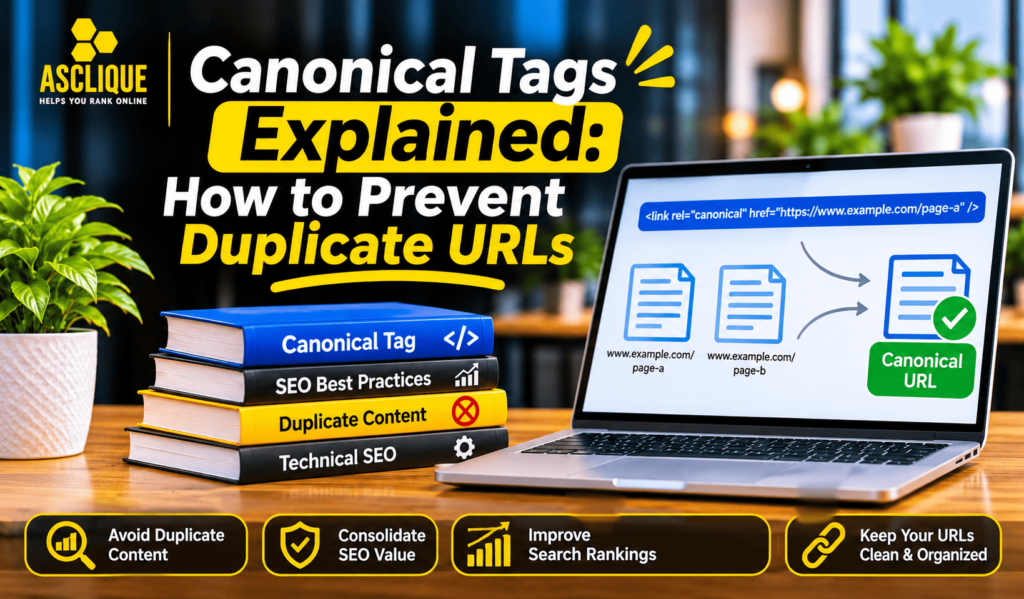
Place a valid canonical link in the document head, or use supported HTTP headers for suitable non-HTML resources.
Along with canonical implementation, Technical SEO Services can help identify configuration issues and improve the technical structure of a website.
The priority is to identify what is happening across the website and understand the reasons behind it. Determine whether current technical settings limit search engines’ ability to find or interpret valuable pages. Test selected URLs first, review their purpose and technical signals, and document every adjustment for later review.
How to check it
For a repeatable check, select a high-value example URL, record its response and directives, inspect how it is linked, and compare the live page with the information reported by your search tools. If an issue is confirmed, test the smallest safe change on a limited set of URLs before expanding it.
Avoid contradictions
Do not canonicalize a page to a broken URL or simultaneously send conflicting signals across templates.
A useful assessment begins with understanding the site’s existing technical setup and the reasons behind its behavior. Identify whether any configuration issues interfere with page discovery or search engine understanding. Review individual URLs before applying template-level corrections, ensuring that each change supports the page’s intended purpose and can be checked afterward.
How to check it
For a repeatable check, select a high-value example URL, record its response and directives, inspect how it is linked, and compare the live page with the information reported by your search tools. If an issue is confirmed, test the smallest safe change on a limited set of URLs before expanding it.
Understand selection
Canonical is a strong hint, not an absolute command; search engines may select a different representative.
The objective is to investigate the website’s current technical behavior and uncover any issues affecting valuable content. Examine sample URLs to determine whether search engines can discover and understand them correctly. Match each page’s intended function with its actual technical signals, then document the implemented fixes and their results.
How to check it
For a repeatable check, select a high-value example URL, record its response and directives, inspect how it is linked, and compare the live page with the information reported by your search tools. If an issue is confirmed, test the smallest safe change on a limited set of URLs before expanding it.
Verify outcomes
Inspect Google-selected canonical and compare it with the declared canonical after deployment.
Focus on determining how the website currently operates, why specific technical conditions exist, and whether they affect important pages. Begin with a review of representative URLs rather than immediately changing entire templates. Evaluate page intent alongside crawling and indexing signals, and keep clear records to verify whether the corrections achieve the desired outcome.
How to check it
To check consistently, choose a high-value example URL, record its response and directives, inspect its internal links, and compare the live page with the data from your search tools. Once you confirm an issue, test the smallest safe change on a limited number of URLs before applying it more broadly.
A Practical Workflow
Begin by identifying the URLs that matter to your business, including service pages, product pages, and evergreen resources. Export those URLs and note their intended index status. Crawl the site to find response codes, directives, canonical targets, and internal link pathways. Compare the crawl with Search Console to find discrepancies.
Next, group problems by shared cause rather than treating each URL as an isolated ticket. A faulty canonical template can affect hundreds of pages, while a single outdated link may require only a targeted edit. Assign each group an owner, test a representative correction, and deploy changes with a rollback plan.
For businesses looking to improve their website’s technical foundation, Search Engine Optimization Services can support website audits, technical improvements, and organic search performance.
Finally, re-crawl the affected pages and monitor Search Console and analytics. Technical validation can confirm that a directive or link changed; it cannot by itself prove that Google will index the page or improve its position. Keep both observations separate in your reporting.
Weak vs. Better Approach
| Weak approach | Better approach |
|---|---|
| Fix every reported exclusion | Identify which exclusions are unintended and affect valuable pages |
| Request indexing repeatedly | Resolve the underlying technical or content problem first |
| Measure only a site-health score | Track affected URLs, crawl access, index signals, and business outcomes |
Common Mistakes
One common mistake is confusing a tool warning with a business-critical issue. Not every redirect, excluded URL, or duplicate is a problem. Another is making large changes without recording the previous behavior, which makes it difficult to determine whether the fix helped or caused a new issue.
A third mistake is expecting instant results. Crawling, indexing, and ranking happen on different timelines. Finally, avoid using robots.txt, noindex, canonical tags, and redirects interchangeably. They solve different problems and can conflict when implemented without a clear URL policy.
What Is Not Proven
No checklist can guarantee inclusion in Google or a particular AI-generated answer. An XML sitemap does not force indexing; a canonical tag does not force canonical selection; and valid structured data does not guarantee a rich result. Treat each mechanism as a way to communicate site intent, then verify observed behavior.
What to Measure
Track the number of important URLs with successful responses, unexpected noindex directives, conflicting canonical signals, broken internal links, and unresolved server errors. Use Search Console to monitor index coverage patterns and analytics to observe organic landing traffic. Annotate deployments so changes can be compared with the baseline.
Action Checklist
- Identify priority canonical URLs and their intended index status.
- Test response codes, robots rules, and noindex directives.
- Inspect canonical signals and XML sitemap inclusion.
- Confirm crawlable internal links to important pages.
- Group issues by shared template or underlying cause.
- Test fixes before rolling them out broadly.
- Re-crawl and monitor indexing and organic traffic.
Frequently Asked Questions
How long does it take to see results?
There is no universal timeline. Google may detect a technical correction during its next crawl, but indexing decisions and changes in organic performance may take longer. Record when the change went live and compare outcomes over several weeks.
Does this guarantee higher rankings?
No. Technical improvements remove barriers and make important content easier to process. Rankings also depend on relevance, content quality, competition, and many other signals.
Should every URL be indexed?
No. Utility pages, duplicate variants, thin search-result pages, and intentionally private or temporary content often should not be indexed. Focus on valuable canonical pages.
Can I use only Google Search Console?
Search Console is essential but not sufficient for a full diagnosis. Combine it with a crawler, CMS exports, analytics, and server logs where available.
Is an XML sitemap enough for discovery?
No. Sitemaps supplement discovery but do not replace crawlable internal links or guarantee indexing. Build clear navigation and contextual connections.
Do I need a developer to make changes?
An SEO specialist can update some CMS settings, but developers may need to handle and test template logic, rendering, redirect rules, and server configurations.
How often should I audit this?
Review critical errors after deployments and migrations. A monthly or quarterly audit cadence can work for many smaller sites; large or frequently changing sites need closer monitoring.
What should I measure first?
Start with affected important URLs, successful crawl responses, index eligibility, Google-selected canonicals, and organic landing-page performance. Avoid using a single score as the definition of success.
Conclusion
Effective technical SEO is a process of making important content accessible, understandable, and measurable. Prioritize real obstacles, preserve intentional exclusions, and validate changes with evidence. Alongside technical improvements, a consistent content strategy helps businesses maintain useful, relevant website resources. Explore Content Marketing Services to support your broader organic growth strategy. A structured workflow is more useful than chasing every automated warning.