
Setting consulting fees is one of the most important and often most challenging parts of running a consulting business.
Price your services too low, and you risk undervaluing your expertise. Charge too much without a clear strategy, and potential clients may hesitate to move forward. The key is finding a pricing approach that reflects the value you bring while remaining fair and competitive in your market.
Equally important is having a professional billing process that makes it easy for clients to understand what they’re paying for and when payment is due. Whether you’re an independent consultant or part of a growing consulting firm, this guide will walk you through practical strategies for pricing your services and billing clients with confidence.
What Are Consulting Fees?
Consulting fees are the charges consultants collect in exchange for providing professional advice, specialized expertise, or strategic services to clients. These fees vary depending on factors such as the consultant’s experience, industry knowledge, project scope, business requirements, and the value delivered.
Unlike products with fixed prices, consulting services are often customized to meet each client’s specific needs. Whether you charge by the hour, per project, or through a monthly retainer, setting the right consulting fee ensures you’re fairly compensated while giving clients a clear understanding of the investment required for your services.
Fee Structures Of Consulting Businesses
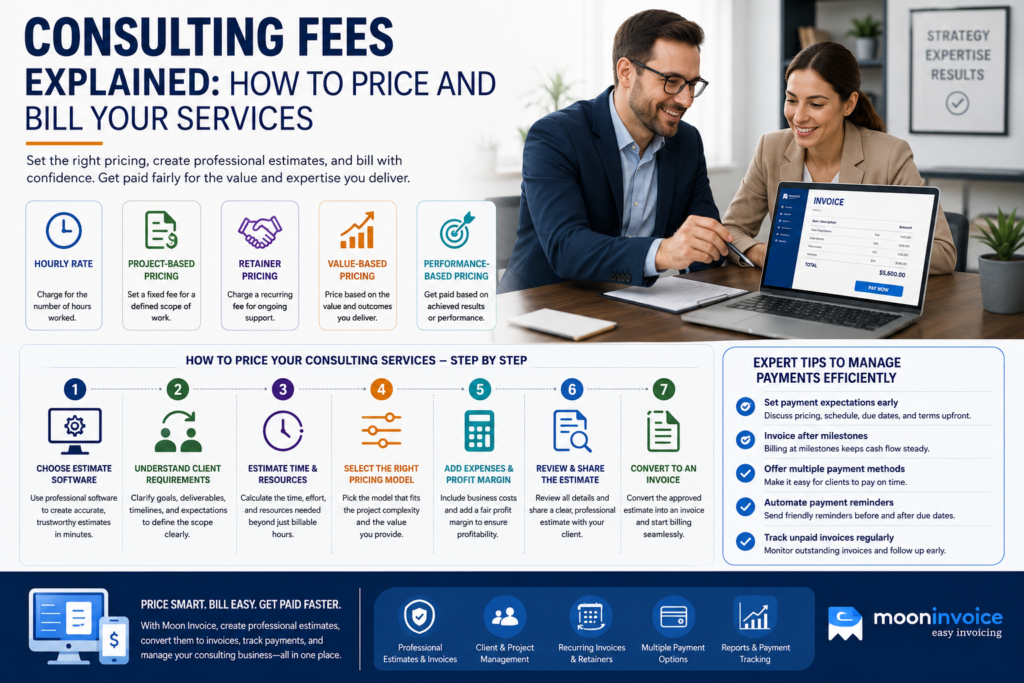
Choose the right pricing models that keep your business’s billing consistent and profitable. After that, you can automate collections with smart billing and invoicing software. Here is a list of common fee structures of consulting businesses.
1. Hourly Rate
Hourly pricing charges clients based on the number of hours worked. It is commonly used by legal, IT, and business consultants for projects with flexible scopes or ongoing advisory services.
2. Project-based Pricing
Project-based pricing sets a fixed fee for completing a defined scope of work. It works best for consulting projects with clear deliverables, timelines, and agreed-upon client expectations.
3. Retainer Pricing
Retainer pricing involves clients paying a recurring monthly or quarterly fee for ongoing consulting support. It is widely used by marketing, HR, financial, and business strategy consultants.
4. Value-based Pricing
Value-based pricing is determined by the business value or outcomes delivered rather than the time spent. It suits experienced consultants solving high-impact business challenges with measurable results.
5. Performance-based Pricing
Performance-based pricing ties consultant compensation to predefined outcomes or performance metrics. It is commonly used for sales, growth, and operational consulting engagements where success can be measured objectively.
How to Price Your Consulting Services?
Pricing your consulting services starts with a well-prepared estimate. Following a structured approach helps you quote confidently, maintain profitability, and set clear client expectations.
1. Choose Professional Estimate Software
The easiest way to prepare consulting estimates is to use dedicated estimate software rather than spreadsheets or manual documents. A solution like Moon Invoice simplifies estimate creation with automated calculations, client management, and easy editing, helping you prepare accurate quotes in minutes.
It also offers customizable templates, including a consulting invoice template, that give your documents a professional look, save time, build credibility, and help you win more consulting projects.
2. Understand The Client’s Requirements
Before assigning a price, take time to understand exactly what the client needs. Discuss project objectives, deliverables, timelines, expected outcomes, and any special requirements. A clear understanding of the project scope helps you prepare a realistic estimate and reduce the risk of unexpected work later.
It also allows clients to know exactly what they are paying for, creating transparency from the beginning of the engagement.
3. Estimate The Time And Resources Required
Once the project scope is finalized, estimate the time, effort, and resources needed to complete the work successfully. Consider research, planning, meetings, revisions, travel, software subscriptions, or collaboration with external specialists if required.
Looking beyond billable hours ensures your estimate reflects the actual cost of delivering quality consulting services and protects your business from underpricing complex engagements.
4. Select The Right Pricing Model
Choose a pricing model that aligns with the project’s complexity and the value you provide. Hourly pricing works well for flexible engagements, while fixed project pricing suits clearly defined work.
Retainer agreements are ideal for ongoing consulting, and value-based pricing is appropriate when your expertise directly contributes to measurable business outcomes. Selecting the right model creates fair expectations for both you and your client.
5. Add Business Expenses And Profit Margin
Your consulting fee should cover more than just your time. Include business expenses such as software subscriptions, administrative costs, taxes, travel expenses, and any outsourced services involved in the project.
Once your costs are accounted for, add a reasonable profit margin that reflects your expertise and business goals. This ensures every consulting project remains financially sustainable while delivering value to your clients.
6. Review And Share The Estimate With The Client
Before sending your estimate, review every detail carefully. Verify pricing, project scope, timelines, deliverables, payment terms, and any assumptions included in the proposal. A well-reviewed estimate minimizes misunderstandings and demonstrates professionalism.
When clients receive a clear, organized estimate, they can evaluate your proposal more confidently, making the approval process smoother and helping establish trust before work begins.
7. Convert The Approved Estimate Into An Invoice
After your client approves the estimate, convert it into an invoice to begin billing. Using software that transforms estimates into invoices eliminates duplicate data entry and ensures consistency between the quoted price and the final bill.
This not only saves time but also reduces errors, keeps financial records organized, and creates a seamless experience for both your consulting business and your clients.
Expert Tips To Manage Consulting Payments Efficiently
Strong payment management practices help consultants maintain healthy cash flow and build lasting client relationships. Here are a few expert tips that can make your billing process more efficient.
- Set payment expectations early – Discuss your pricing model, billing schedule, due dates, and payment terms before starting the project.
- Invoice immediately after milestones – Don’t wait until the project ends. Billing at agreed milestones helps maintain a steady income and avoids large outstanding balances.
- Offer multiple payment methods – Accept credit cards, ACH transfers, digital wallets, and other convenient payment options to make it easier for clients to pay promptly.
- Automate payment reminders – Schedule friendly reminders before and after the due date to reduce follow-ups while maintaining a professional client experience.
- Track unpaid invoices regularly – Review outstanding invoices every week so you can address overdue payments before they affect your business finances.
Price Your Consulting Services Effortlessly With Estimate Software
Setting the right consulting fee is about more than assigning a number—it requires a clear understanding of your expertise, project scope, business costs, and the value you deliver. A well-prepared estimate helps establish trust, sets clear expectations, and creates a strong foundation for a smooth billing process.
Using estimate software makes this process faster by automating calculations, organizing client information, and helping you create professional documents with ease. Many solutions also include customizable resources such as a consulting invoice template, making it simple to transition from an approved estimate to a polished invoice.
With Moon Invoice, you can create accurate estimates, convert them into invoices, and manage consulting payments from one intuitive platform.
FAQ’S
What is the best pricing model for consulting services?
The best pricing model depends on the type of consulting services you provide and the nature of your projects.
* Hourly pricing is ideal for projects where the scope may change or when clients need ongoing advice.
* Project-based pricing works well when deliverables, timelines, and requirements are clearly defined.
* Retainer pricing is best for long-term partnerships where clients need consistent support each month.
* Value-based pricing allows experienced consultants to charge based on the results they deliver rather than the time they spend.
* Performance-based pricing is suitable when success can be measured using specific business outcomes or performance metrics.
Many consultants combine multiple pricing models depending on the client and project to maximize flexibility and profitability.
How do I calculate my consulting fees?
Start by calculating all the costs involved in delivering your services, including your time, business overhead, software subscriptions, travel expenses, taxes, and any outsourced work. Then add a profit margin that reflects your experience and the value you provide.
When setting your fee, also consider:
* Your level of expertise and years of experience.
* Industry standards and competitor pricing.
* The complexity and duration of the project.
* The business value your recommendations will create for the client.
Rather than competing solely on price, focus on pricing your services according to the results and expertise you bring to the engagement.
What should a consulting invoice include?
A professional consulting invoice should clearly outline all the information a client needs to process payment. It typically includes your business details, the client’s information, invoice number, issue date, payment due date, a detailed description of the consulting services provided, pricing, applicable taxes, the total amount due, and accepted payment methods.
Including clear payment terms, milestone references (if applicable), and any agreed-upon late payment policies helps prevent misunderstandings and encourages faster payments. Using invoicing software can also help maintain consistency and reduce administrative work.
How can consultants ensure they get paid on time?
Getting paid promptly starts with setting expectations before the project begins. Always provide a written estimate or proposal that outlines pricing, payment schedules, due dates, and billing terms.
To improve payment collection:
* Invoice immediately after completing milestones or delivering work.
* Offer multiple payment methods to make paying easier.
* Send automatic payment reminders before and after the due date.
* Monitor outstanding invoices regularly and follow up professionally on overdue payments.
* Consider requesting an upfront deposit for larger or longer-term consulting projects.
A structured billing process reduces delays and helps maintain healthy cash flow.
Why should consultants use estimate and invoicing software?
Estimate and invoicing software helps consultants save time, improve accuracy, and present a more professional image to clients. Instead of manually creating estimates and invoices, the software automates calculations, stores client information, tracks payments, and reduces the risk of billing errors.
Many platforms also allow consultants to convert approved estimates directly into invoices, eliminating duplicate work and ensuring consistency between the original quote and the final bill. Additional features such as payment tracking, recurring invoices, financial reporting, and automated reminders make it easier to manage the entire billing process while allowing consultants to focus more on serving their clients.