
Quick Answer
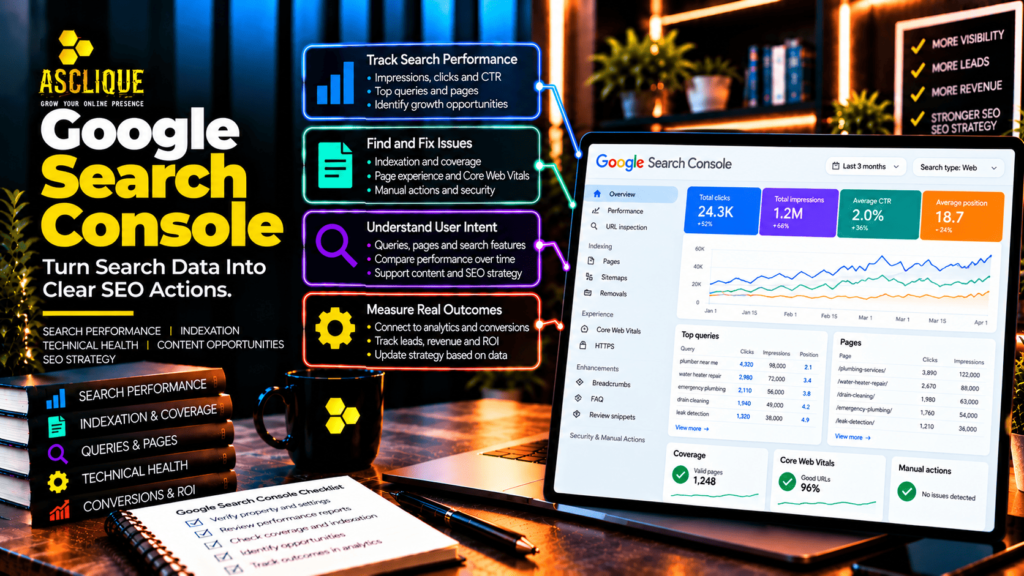
Google Search Console should be approached as a measurable optimization process, not a one-time trick. Audit the current state, verify platform requirements with primary documentation, improve the page or system for users first, connect it to the wider site architecture, and measure whether the change improves relevant visibility and business outcomes.
Key Facts and What Is Verified
- FACT: Search Console and analytics answer different questions and their numbers should not be expected to match exactly.
- FACT: Forecasts are scenarios based on assumptions, not guarantees.
- FACT: Rankings are useful diagnostic metrics but are not a substitute for qualified traffic, leads or revenue.
- FACT: Attribution becomes less complete as users move across devices, channels and privacy boundaries.
Table of Contents
What Is Google Search Console?
In this guide, Google Search Console refers to the set of decisions and actions used to improve how a website, page, brand or piece of information performs for the relevant search objective. The term is useful only when it leads to a clear implementation. Teams should be able to explain what is changing, which users or systems are affected, what evidence supports the change and which metric will indicate success.
A common mistake is to define Google Search Console only through tools or tactics. Tools can reveal problems and speed up work, but they do not decide whether a page deserves to exist, whether the information is accurate, whether the intent is correct or whether a result contributes to the business. Those decisions still require strategy and editorial judgment.
Why Google Search Console Matters
The value of Google Search Console is usually indirect: it removes friction between a user need and the information or action that satisfies it. For search teams, that may mean better discovery, clearer relevance, stronger indexation, more useful snippets, more qualified traffic or a cleaner path to conversion. For content teams, it may mean fewer overlapping pages, stronger evidence and a more coherent topic library.
The business case should therefore be stated before implementation. If the goal is qualified leads, the team should not celebrate an isolated visibility metric while conversions decline. If the goal is technical recovery, the team should verify crawling and indexation before attributing performance changes to content. Good SEO work connects the intervention to the outcome.
How Google Search Console Works in Practice
Define the Decision
Start with the business question the report or forecast needs to answer. Apply this specifically to Google Search Console teams by documenting the current state and the expected effect before making the change.
Choose the Right Source
Use Search Console for Google Search performance and analytics for on-site behavior and conversions. Apply this specifically to Google Search Console teams by documenting the current state and the expected effect before making the change.
Separate Inputs and Outcomes
Track visibility, clicks and engagement separately from leads, revenue and retention. Apply this specifically to Google Search Console teams by documenting the current state and the expected effect before making the change.
Document Assumptions
State conversion rates, seasonality, click-through assumptions and data gaps. Apply this specifically to Google Search Console teams by documenting the current state and the expected effect before making the change.
Build Scenarios
Use conservative, base and upside cases instead of one false-precision forecast. Apply this specifically to Google Search Console teams by documenting the current state and the expected effect before making the change.
Review Variance
Compare forecast to actuals and update assumptions as new evidence arrives. Apply this specifically to Google Search Console teams by documenting the current state and the expected effect before making the change.
A Practical Asclique Workflow
- Audit: Collect the relevant URLs, queries, technical signals, content, competitors and conversion data. Record the baseline before editing.
- Diagnose: Separate symptoms from causes. A traffic decline, for example, can come from demand, ranking, indexation, tracking, seasonality or site changes.
- Prioritize: Score opportunities by expected business impact, confidence, effort and dependency. Fix blockers before cosmetic improvements.
- Implement: Make the smallest coherent change that solves the identified problem. Document what changed and when.
- Validate: Check the implementation technically and editorially. Confirm that the live page matches the intended change.
- Measure: Compare post-change results with the baseline and account for seasonality, other releases and data limitations.
- Iterate: Keep what works, revise what does not and update the playbook with evidence from the site.
Weak Approach vs Better Approach
| Weak Approach | Better Approach | Why It Is Better |
|---|---|---|
| Copy a competitor page and change the wording | Research the same intent independently and build a stronger Asclique resource | Creates original value and reduces factual/copyright risk |
| Apply every checklist item | Diagnose the specific problem first | Prevents unnecessary changes and makes results easier to interpret |
| Use a secondary blog as proof | Trace important claims to the original source | Improves accuracy and makes updates easier |
| Report rankings alone | Connect visibility to qualified traffic and conversions | Shows whether the work contributes to business outcomes |
| Publish and forget | Schedule review dates for changing claims and declining pages | Protects accuracy and long-term performance |
Common Mistakes to Avoid
- Treating Google Search Console teams as a guaranteed ranking factor or shortcut when the platform has not documented that claim.
- Publishing generic content that adds no first-hand evidence, original analysis, useful examples or decision support.
- Using outdated screenshots, product behavior, structured-data features or platform documentation without checking the current version.
- Creating overlapping pages for minor keyword variations instead of assigning one clear intent to each URL.
- Making a major sitewide change without a baseline, change log or validation plan.
- Confusing correlation with causation after rankings or traffic move.
- Optimizing for an SEO metric while ignoring the quality of traffic and conversions.
What Is Not Proven
There is no reason to present every industry theory about Google Search Console teams as established fact. Search systems are complex, platform behavior changes, and many public experiments are observational rather than controlled. Where evidence is incomplete, Asclique recommends labeling the statement as an observation, hypothesis or recommendation and describing how it could be tested on the site.
This distinction is particularly important for AI-search claims, link-value claims, entity theories and algorithm speculation. A useful article can explain an industry hypothesis without pretending the platform has confirmed it.
How to Measure Success
| Measurement Layer | Examples | Use |
|---|---|---|
| Visibility | Impressions, relevant query coverage, rankings or presence in the target search surface. | Use with the baseline and business objective; do not interpret in isolation. |
| Engagement | Qualified sessions, engaged sessions, useful navigation and interaction with the intended content. | Use with the baseline and business objective; do not interpret in isolation. |
| Technical Health | Indexation, crawl behavior, status codes, enhancement validity or performance metrics when relevant. | Use with the baseline and business objective; do not interpret in isolation. |
| Conversion | Leads, calls, demos, purchases, signups or another defined business action. | Use with the baseline and business objective; do not interpret in isolation. |
| Quality | Lead quality, revenue, assisted conversions, retention or downstream sales feedback. | Use with the baseline and business objective; do not interpret in isolation. |
| Efficiency | Time and cost required to produce, maintain and improve the result. | Use with the baseline and business objective; do not interpret in isolation. |
Google Search Console Checklist
- Define the primary user or technical problem.
- Confirm the page or system has one clear purpose.
- Review current first-party platform documentation.
- Record the baseline before changes.
- Verify important facts and statistics with original sources.
- Add original value: examples, data, screenshots, frameworks or expert review.
- Use descriptive headings and internal links.
- Validate the live implementation.
- Measure qualified outcomes, not vanity metrics.
- Schedule a review date for fast-changing information.
FAQ’s
What is Google Search Console?
Google Search Console is best understood as a practical part of a broader search and digital-marketing system. The exact implementation depends on the page, platform and business objective. Start by defining the user need, verifying the technical and factual requirements, and choosing measurable outcomes rather than treating the tactic as an isolated ranking trick.
Is Google Search Console still relevant in 2026?
Yes, when it solves a real discovery, usability or measurement problem. The implementation should follow current platform documentation because search features and supported capabilities change over time.
How should a business start with Google Search Console?
Start with an audit. Document the current state, identify the highest-impact gap, implement one controlled improvement, and measure the result. Expand only after the team understands what changed and why.
What is the biggest mistake with Google Search Console?
The most common mistake is applying a checklist without diagnosing the underlying problem. A tactic can be technically correct and still produce no value if it targets the wrong intent, page, audience or metric.
How do you measure Google Search Console?
Use metrics that match the objective. Combine leading indicators such as visibility, coverage or crawl/index status with business outcomes such as qualified visits, leads, revenue, signups or other conversions.
Asclique Recommendation
Treat Google Search Console teams as part of a connected search system. Start with evidence, make the implementation useful to the audience, keep technical signals consistent, and measure the effect against a defined business objective. If the site has multiple issues, prioritize the change that removes the biggest blocker before adding advanced tactics.
Need Help With This?
Asclique can audit your current Google Search Console setup, identify the highest-impact gaps, build a prioritized implementation plan and connect the work to SEO, content, analytics and AI-search measurement where relevant. The goal is a defensible roadmap based on your site and data, not a generic checklist.