
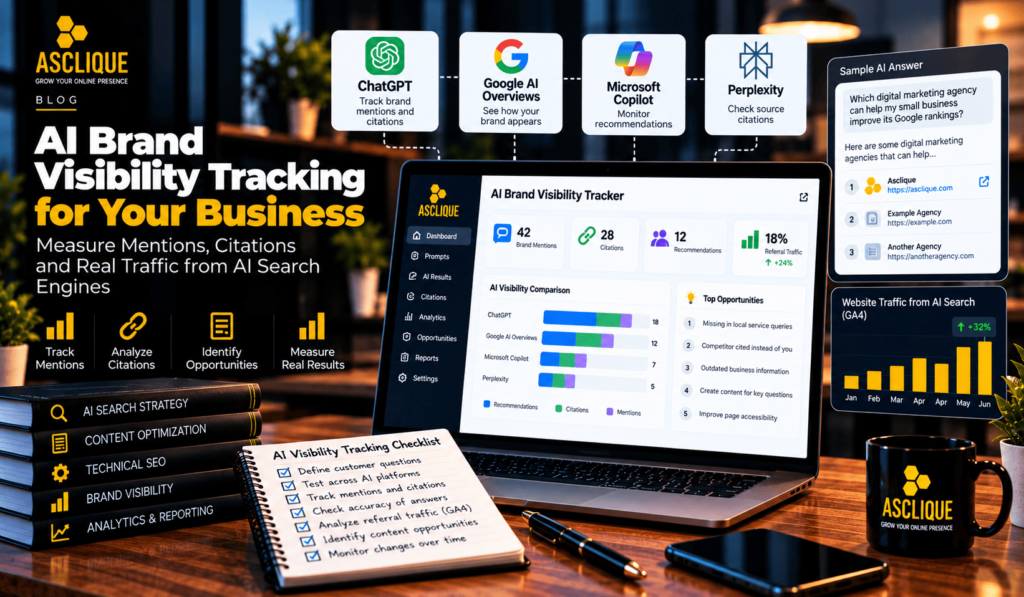
This guide explains how to select customer questions, test assistants consistently, distinguish citations from mentions, investigate missing or inaccurate answers, and connect observable referrals to business results. It also explains what the available evidence cannot prove.
Quick Answer
Build a fixed set of realistic customer prompts. Test each prompt under documented conditions, then record whether your company is mentioned, recommended, or linked as a source. Repeat the same sample over time and use GA4 to measure separately identifiable referral traffic and conversions. Do not describe a sample score as total AI market share.
Key Facts
- AI responses can vary across prompts and sessions; a single response is not a universal ranking.
- GA4 can measure identifiable visits and key events, not every time a brand appears in an AI answer.
- Google Search Console reports Google Search performance, not a complete list of mentions across third-party assistants.
- Search Console URL Inspection can help verify whether a page is indexed by Google.
- Google documents how site owners can make content accessible to Search, but does not guarantee AI citations for specific pages.
Reference: GA4 traffic acquisition; Search Console URL Inspection.
Table of Contents
- What Is AI Brand Visibility Tracking?
- Why Tracking AI Brand Visibility Matters
- How AI Brand Visibility Tracking Works – Step by Step
- Tools You Should Use
- Common Errors and How to Fix Them
- Weak Approach vs Better Approach
- Common Mistakes to Avoid
- What Is Not Proven
- How to Measure Success
- Checklist
- Frequently Asked Questions
- Asclique Recommendation
- Need Help With This?
What Is AI Brand Visibility Tracking?
AI brand visibility tracking records whether an AI assistant mentions your company, describes its services accurately, or cites pages from your website when answering relevant customer questions. It is an observation process, not an official ranking report. A brand may be named without a link, a page may be cited without a brand recommendation, and an answer may discuss a competitor instead. These are different outcomes and should be recorded separately.
For example, a plumbing company might test “Who provides emergency drain repairs in my city?” and “What should I check before hiring a drain cleaning company?” The first question tests commercial recommendations; the second tests whether its educational resources are cited. Neither result represents every user’s experience.
The goal is to establish a repeatable sample of prompts, platforms, dates, and answers. A team can then investigate changes and connect them cautiously to observable website visits and qualified leads.
Why Tracking AI Brand Visibility Matters
People increasingly use conversational interfaces to research options, compare providers, and understand technical questions. For a business, being absent from an answer that addresses its specialty may indicate a content gap, a discoverability problem, or simply the system’s selection on that occasion. Testing helps distinguish those possibilities.
A tracked response can reveal concrete issues. An assistant might describe an outdated service area, cite an old pricing page, or confuse two similarly named companies. Those observations give marketers a reason to update authoritative pages, clarify organization details, or correct inconsistent profiles.
The value comes from disciplined diagnosis, not chasing a single screenshot. AI answers can vary with the wording of a prompt, conversation history, location, product settings, and model updates. A useful report makes these limitations visible rather than concealing them.
Understand Where Your Brand Appears in AI AnswersConnect a reproducible visibility baseline with the technical SEO improvements that matter to your customers. | Explore SEO Services |
How AI Brand Visibility Tracking Works – Step by Step
Step 1: Define the questions customers actually ask
Interview sales and support staff, review Search Console queries, and examine common presales objections. Create a balanced list of informational, comparison, local, and purchase-intent questions. Exclude prompts designed merely to force your company name into the answer. Record why each prompt matters and which service or page it represents.
Step 2: Fix the prompt wording and test conditions
Save each prompt exactly as written. Document the assistant, access method, test date, country or locale when known, and whether the conversation is fresh. If personalization or prior chat history may affect the answer, record that limitation. Rewriting prompts between months makes comparisons unreliable.
Step 3: Capture mentions, citations, and accuracy separately
For every answer, mark brand mentioned yes or no, cited URL if any, recommendation context, and factual accuracy. A passing reference in a list is different from an explicit recommendation. Store a screenshot or response export with the record, but avoid sharing personal or confidential prompts.
Step 4: Inspect the cited source pages
Open every cited URL and verify that it still loads, answers the question, and accurately describes the business. Check canonical URLs, robots directives, page headings, and visible contact details. When another publisher is cited, note the evidence or format that may make that source useful rather than assuming a backlink is the only difference.
Step 5: Separate platform observations from web analytics
In GA4, review session source and referrer information for identifiable visits from AI platforms. Referral attribution may be incomplete when referrers are stripped or traffic is routed through other surfaces. Record identifiable sessions and conversions as observed data; do not estimate total AI-driven demand from them alone.
Step 6: Repeat the same sample and explain changes
Retest the same prompt set on a consistent schedule, such as monthly. Record platform or model changes when known. If visibility changes, check whether prompts, site content, competitor pages, or reporting methods also changed. Treat a small swing in a small sample cautiously.
Step 7: Turn findings into a prioritized content backlog
Group inaccuracies, missing answers, access issues, and conversion gaps. Assign an owner and a verification date. Retest without assuming causation.
Tools You Should Use
ChatGPT and other AI assistants
Use each product directly to collect observed answers to your fixed prompts. Record product and test conditions; do not assume that one interface represents every deployment or every user.
Google Search Console
Use Performance reports to identify existing search queries and pages worth testing. URL Inspection can help investigate whether an important page is indexed, but Search Console does not provide a complete report of ChatGPT brand mentions.
Google Analytics 4
Inspect Traffic acquisition and landing-page reports for attributable referral sessions and key events. Check the actual source labels in your property instead of assuming all AI platforms will be grouped automatically.
Spreadsheet or reporting database
Maintain columns for prompt ID, intent, platform, date, brand mention, citation URL, accuracy, evidence, and reviewer. A shared schema makes the audit reproducible.
Browser developer and crawl tools
Check status codes, canonical links, and rendered content for pages that assistants fail to cite.
Common Errors and How to Fix Them
A reliable audit separates sampling errors from website problems. The following failures frequently make AI visibility reports less useful.
Weak Approach vs Better Approach
The stronger approach explains exactly what was tested and why the result matters. This protects teams from overinterpreting small or biased samples.
Common Mistakes to Avoid
Avoid testing only prompts that already include your brand. Those prompts answer whether the assistant recognizes a named business, not whether it discovers your company when a customer has not chosen a provider.
Do not merge mentions, citations, and recommendations into one number. An assistant may cite a blog post while recommending a competitor, or mention your company without linking to your website. These outcomes require different follow-up actions.
Finally, do not report unexplained percentage changes without sample sizes. Moving from two mentions to three mentions may look like a 50% improvement, but it is only one additional occurrence. Keep the raw counts visible.
Get a Reproducible AI Visibility AuditReview the prompts, source citations, page accessibility, and attribution evidence before choosing what to improve. | Request an Audit |
What Is Not Proven
No public, universal formula guarantees that publishing a particular schema type, adding an FAQ, or repeating a brand name will secure a recommendation from ChatGPT or another assistant. AI outputs depend on systems and contexts that publishers do not control.
A manually calculated “AI share of voice” is only a proportion within the prompts and conditions tested. It is not a census of all user questions, and it cannot be equated with market share. Likewise, an increase in AI referrals cannot automatically be attributed to one content change without additional evidence.
At Asclique, we recommend treating visibility checks as directional research and presenting verified analytics separately from observations and hypotheses.
How to Measure Success
Measure the testing process and customer outcomes in separate groups. A brand-mention rate describes your controlled sample; attributable referral sessions describe observed website activity. Neither substitutes for the other.
Checklist
- Define the customer questions and search intent for every prompt.
- Include nonbranded, comparison, and decision-stage questions.
- Record the exact prompt wording and its version.
- Log the assistant, date, locale, and conversation conditions.
- Distinguish brand mentions from recommendations.
- Record cited URLs separately from unlinked mentions.
- Check the accuracy of services, locations, and claims.
- Inspect cited and uncited pages for technical accessibility.
- Review identifiable AI referrals and conversions in GA4.
- Retest the same sample at a documented interval.
- Preserve evidence and disclose the sample size.
- Assign owners to content corrections and follow-up checks.
FAQ’s
Can I see how often ChatGPT recommends my company?
You can measure how often it appears in a defined set of tests, but you cannot infer the total number of recommendations delivered to all users from that sample. Save prompts and testing conditions. Present the percentage as sample coverage, not universal exposure.
Does ChatGPT provide a brand visibility dashboard?
There is no general first-party publisher dashboard that reports every mention of your brand in private user conversations. Third-party tools may sample prompts and estimate visibility. Evaluate their coverage and methodology before using their scores.
Should I count a citation and a brand mention as the same thing?
No. A cited page can appear as evidence without an endorsement, and a brand can be recommended without a clickable source. Maintain separate fields for the mention, cited URL, and recommendation context. This prevents misleading trend reports.
How many prompts should a small business test?
There is no official minimum that makes a sample representative. Begin with a practical set covering your major services and buying stages, then keep it consistent. The quality and relevance of the questions matter more than an arbitrary volume.
Can GA4 measure traffic from AI assistants?
GA4 can report visits when the referral or campaign information reaches your site and is captured. Some visits may not be identifiable as AI-driven. Use GA4 for attributable traffic and conversions, not as a complete record of AI exposure.
What if an AI answer contains incorrect business information?
Capture the exact claim, prompt, and date. Verify the correct facts on your official site and important business profiles, then update stale information you control. Retest later, recognizing that corrections may not appear immediately or consistently.
Will structured data guarantee that AI systems cite my pages?
No markup guarantees a citation. Publish accurate, accessible information and assess citations as observations, not promised outcomes.
Asclique Recommendation
Start with a manageable prompt set that reflects the questions your customers actually ask. Preserve the wording, distinguish branded from nonbranded searches, and record which pages are cited. Prioritize inaccuracies and missing customer information before attempting speculative optimization tactics.
Review results alongside conventional search performance, crawlability, and lead quality. If a competitor is repeatedly cited for a useful explanation your website lacks, build a genuinely better resource with examples and clear sourcing. If your site is already cited but produces no qualified inquiries, investigate landing-page relevance and conversion paths.
A transparent monthly report is more valuable than a large proprietary score with no disclosed methodology. Keep the sample small enough to audit and consistent enough to compare.
Need Help With This?
Asclique can help define a realistic AI visibility test set, review cited and missing pages, and connect the findings with technical SEO and analytics. The work should begin with questions your customers ask and a clear statement of what the available data can establish.
A useful engagement produces a reproducible baseline, prioritized page improvements, and a measurement plan. It should not promise guaranteed placement in AI-generated answers.
Build an AI Visibility Report You Can DefendTurn observed mentions, source links, and actual referral data into a practical improvement plan. | Talk to Asclique |