
Link building is the practice of acquiring hyperlinks from other websites to your own. It remains one of the most significant factors in how Google ranks pages for competitive search queries. But not all link building is equal, and the strategy behind it matters more than the volume.
This guide covers how to build an effective link building strategy—which tactics work, which to avoid, and how to prioritize effort based on your site’s current authority and the keywords you want to rank for.
Why Links Still Matter in 2026
Google’s core algorithm has used links as a primary ranking signal since its inception—the original PageRank algorithm was built around the premise that links are votes of confidence from one site to another. Despite the rise of content quality signals, AI overviews, and entity-based understanding, links remain a top-three ranking factor
The logic holds: an editorially placed link from a relevant, authoritative site represents a genuine endorsement. It is harder to fake than on-page keyword optimization, which is why it retains signal value.
What has changed: Google is better at identifying and discounting manipulative link schemes. Mass guest posting to low-quality sites, PBN links, and purchased link networks produce less effect and higher penalty risk than in previous years. The bar for what counts as a valuable link has risen.
Before Building Links: Audit What You Have
Before acquiring new links, understand your current backlink profile:
Current referring domains: Use Ahrefs’ Site Explorer or Semrush to see all domains currently linking to your site. How many unique referring domains? What is the DR range? Are there obvious spam link patterns?
Link distribution: Are links concentrated on the homepage or distributed across service pages and content? A well-distributed link profile with links to multiple pages ranks individual pages more effectively.
Lost referring domains: Check “Lost Backlinks” in Ahrefs to see valuable links recently lost. Reinstating a lost link from a high-DR site is often easier than acquiring a new one.
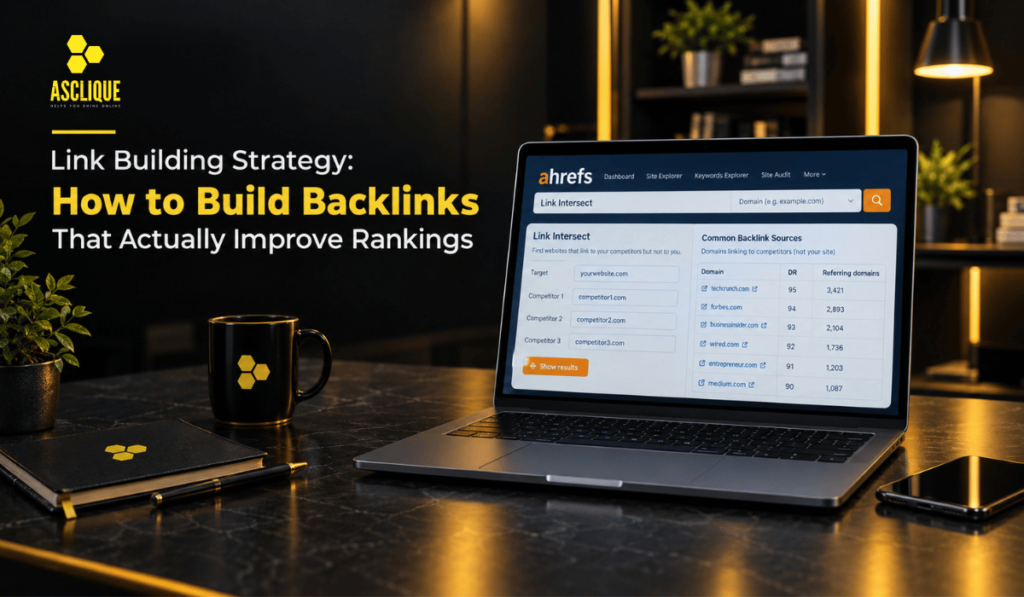
Competitor comparison: Use Ahrefs’ Link Intersect to see which domains link to your competitors but not to you. This produces a pre-qualified list of relevant sites that are willing to link in your space.
The Core Link Building Strategies That Work
Digital PR
Digital PR is the highest-value link building strategy available for most businesses. It involves creating newsworthy content—original research, data studies, expert opinions, or compelling stories—and pitching it to journalists and editorial publications.
Why it works: A single placement in a major publication (Forbes, Business Insider, a major industry trade publication) can produce a DR 80–90+ link that carries more value than 50 lower-quality links.
How to implement:
- Conduct original research (customer surveys, industry data, analysis of publicly available datasets) and publish the findings
- Identify journalists covering your industry using Ahrefs’ Content Explorer, Twitter/X, or media monitoring tools
- Pitch timely, relevant angles—tie your research to current industry trends or news hooks
- Use journalist request platforms (HARO/Connectively, Qwoted, SourceBottle) to respond to active source requests
Time investment: High. Digital PR requires story development, media research, pitching, and follow-up. A well-run digital PR program produces 2–5 high-value links per month.
Guest Posting on Relevant Publications
Contributing original articles to industry publications in exchange for a byline and contextual link. This is effective when done at quality and with editorial relevance.
What makes a guest post valuable:
- Published on a site that is genuinely relevant to your industry
- The site has real editorial standards and an engaged readership
- The link is contextual—embedded naturally in the article content
- The content adds real value to the publication’s audience
What makes guest posting a waste of time or risky:
- Mass outreach to low-quality “write for us” sites
- Sites that openly sell guest posts without editorial review
- Sites with no organic traffic and no real audience
- Posting the same article (or near-duplicate) to multiple sites
Identify target publications: Search “[your industry] + ‘write for us'” or “[your industry] + ‘contribute an article.’ “Check each site’s DR in Ahrefs, verify it has real organic traffic, and assess content quality.
Resource Page Link Building
Many websites maintain resource pages—curated lists of useful links on a specific topic (“Useful tools for digital marketers,” “Resources for small business owners”). If you have created something genuinely useful (a guide, a tool, a template, original research), getting listed on relevant resource pages can produce consistent link acquisition.
Process:
- Identify resource pages using Google search operators: [keyword] inurl:resources, [keyword] intitle:”useful links,” [keyword] site:.edu “resources”
- Evaluate the quality of each page (DR, relevance, and whether it appears actively maintained)
- Create the content asset first—you need something genuinely resource-worthy
- Pitch to resource page owners with a short, specific email explaining what your resource is and why it fits their list
Broken Link Building
Find broken outbound links on authoritative sites in your niche, create content that matches what the broken link pointed to, and notify the site owner.
Process:
- Find pages in your niche with many outbound links (resource pages, link roundups, reference articles)
- Check for broken links using a browser extension (Check My Links) or Ahrefs’ broken link checker
- Create or identify existing content that matches the broken link’s intended destination
- Email the site owner, noting the broken link and suggesting your page as a replacement
Conversion rates are modest (3–8% typically), but the links acquired are genuinely editorial and high quality.
Linkable Asset Creation
Creating content specifically designed to attract links organically. Types that work:
Original research and data: Surveys, studies, and data analysis attract links from news publications, blogs, and industry sites that cite statistics. A survey of 500 industry professionals produces dozens of citable statistics.
Free tools and calculators: A useful calculator (SEO ROI calculator, PPC budget planner, salary calculator) gets bookmarked, shared, and linked to consistently.
Comprehensive definitive guides: The longest, most thorough guide on a topic in your niche tends to attract links from other content creators citing it as a reference.
Industry reports and benchmarks: Annual industry benchmark reports attract consistent links because they are referenced year after year.
Competitor Backlink Replication
Use Ahrefs’ Link Intersect to find sites linking to two or three of your competitors but not to your site. Then work to acquire links from those sites through the relevant tactic (pitching a guest post, suggesting your resource, or pursuing a HARO placement).
This approach produces a qualified list of link targets in your space—you already know these sites link to content like yours.
Link Building Tactics to Avoid
Private Blog Networks (PBNs): Networks of sites built to sell links. When detected by Google, these produce manual actions and ranking drops. The short-term ranking boost is not worth the risk.
Link farms and mass directory submissions: Submitting to hundreds of low-DR directories produces no meaningful authority.
Reciprocal link schemes: Exchanging links at scale (“I’ll link to you if you link to me”) is a pattern Google identifies and discounts.
Paying for do-follow links without disclosure: Google’s guidelines require that paid links be disclosed with rel=”sponsored.” Buying undisclosed do-follow links is a policy violation and a penalty risk.
How to Prioritize Link Building Efforts
The right approach depends on where your domain is in the authority spectrum:
New or low-DR site (DR 0–20): Focus on foundational citations, resource page links, and modest guest posting. Build a diverse base of referring domains before pursuing high-DR targets.
Mid-authority site (DR 20–50): Digital PR becomes viable. Target trade publications, industry blogs, and resource pages. A consistent guest posting program to DR 40–60 publications moves the needle.
Established site (DR 50+): Major publication digital PR, original research, and high-profile resource links. At this level, a few high-DR links per month matter more than many mid-tier ones.
Regardless of DR, always prioritize relevance over raw authority. A DR 55 link from a directly relevant industry publication is typically more valuable than a DR 70 link from an unrelated general news site.
Tracking Link Building Progress
Track monthly in Ahrefs:
- New referring domains acquired (by DR range)
- Lost referring domains (catch regressions)
- Domain Rating trend
- Target keyword ranking movement correlated with link acquisition
Set a monthly referring domain acquisition target based on the competitive gap. If your target keywords are held by sites with 200 referring domains and you have 80, that gap informs how many links per month are needed to compete.
Frequently Asked Questions
How many backlinks do I need to rank on page 1?
There is no universal number. The links needed depend on the keyword’s competition. Use Ahrefs’ SERP overview for your target keyword to see the referring domain count of currently ranking pages. That gives a specific benchmark for your situation.
Is link building still necessary with AI search?
Yes. Links remain a primary trust and authority signal for Google’s traditional search and continue to influence which content is cited in AI Overviews. Pages with high link authority are more likely to be pulled into AI-generated summaries.
How long does it take for new backlinks to affect rankings?
Newly acquired backlinks are typically indexed by Google within days to weeks. Ranking impact is usually visible within 4–8 weeks, though this varies by keyword competition and how significant the link is.
What is the best tool for link building?
Ahrefs is the most comprehensive link research tool: backlink analysis, competitor gap analysis, lost link tracking, and outreach prospecting. Semrush provides similar capabilities. For outreach management, tools like Pitchbox, BuzzStream, or Hunter.io streamline the prospecting and email process.
How do I find my competitors’ best backlinks?
In Ahrefs’ Site Explorer, enter a competitor domain and go to “Backlinks” → sort by DR descending. This shows the highest-DR links pointing to the competitor. Use “Best Links” filter for a curated view of their strongest link acquisitions.
Asclique’s link building services combine digital PR, editorial guest posting, and systematic outreach to build domain authority from genuinely relevant, high-quality sources. Contact us to discuss a link building strategy for your business.