
B2B content marketing operates differently from consumer content marketing. The audience is smaller, the buying cycle is longer, the decision involves multiple stakeholders, and the content needs to demonstrate genuine expertise — not just visibility.
This guide covers how to build a B2B content marketing program that builds organic authority, attracts qualified prospects, and supports the sales process.
How B2B Content Marketing Is Different
In B2C content marketing, you are writing for individuals who can decide in minutes. In B2B, you are often writing for multiple people across a company — a manager who first reads the content, a director who approves the evaluation, a procurement team that reviews the contract.
The content needs to:
Build trust before asking for anything. B2B buyers research extensively before contacting vendors. They read blog posts, download guides, watch webinars, and compare options for weeks or months before engaging. Content is what earns their attention during this phase.
Demonstrate expertise at a level buyers can evaluate. A CMO reading a guide on B2B demand generation will know within two paragraphs whether the author actually understands the topic. Generic content does not build trust with expert buyers.
Address multiple roles. The person who reads the content first and the person who signs the contract may have different concerns. A practitioner wants tactical depth; an executive wants business outcomes. Effective B2B content addresses both.
Support sales conversations. Content does not only generate leads — it equips salespeople with resources to share, answers objections before the sales call, and keeps prospects engaged between touchpoints.
Defining Your B2B Content Strategy
Identify the Audience and Their Questions
Start with the personas you are trying to reach — not generic descriptions but specific roles. What does a Head of Marketing at a 200-person B2B company care about when they are considering an SEO agency? They care about ROI, timeline, how to evaluate quality, what results look like, and how to make the internal case for the investment.
Map content to the questions those buyers ask at each stage:
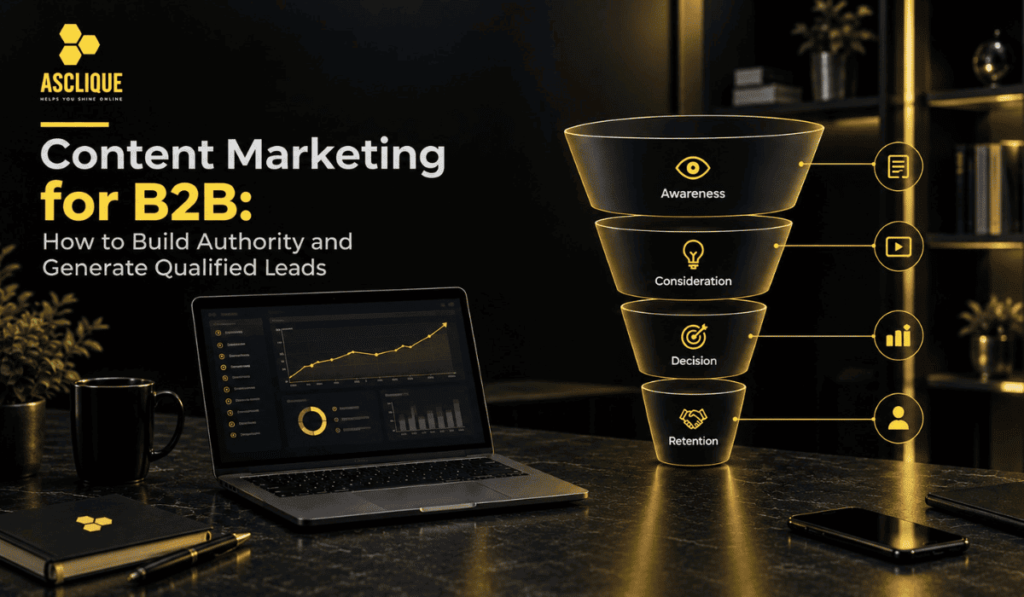
Awareness stage: They have a problem but are not yet looking for a solution. “Why is our organic traffic declining?” or “What is topical authority?” — educational content that addresses the problem.
Consideration stage: They know they need a solution and are evaluating options. “How to choose an SEO agency,” “In-house SEO vs. agency,” “Is performance-based SEO worth it?,” “What does good SEO reporting look like?” — evaluation content that helps them make better decisions.
Decision stage: They have narrowed down to a few options. Case studies, detailed service pages, pricing guides, and comparison content help them choose. “SEO agency for B2B companies,” “SEO for professional services firms” — specific positioning content.
Choose Content Formats Based on Audience Behavior
B2B audiences consume content across multiple formats:
Long-form blog content and guides: The primary format for SEO-driven B2B content. A 2,000–4,000 word guide on a relevant topic can rank for multiple related queries and builds topical authority.
Gated content (whitepapers, research reports, templates): Longer, more detailed resources that justify a name and email address exchange. Valuable for capturing leads in the consideration stage.
Case studies: Detailed accounts of client results — the problem, the approach, and the outcome. Case studies are the most persuasive content for decision-stage buyers and sales support.
Webinars and video: Effective for demonstrating expertise and building a relationship with buyers before a sales conversation. Webinar registrations produce qualified leads.
LinkedIn content: Original posts, short-form insights, and repurposed blog content distributed through professional networks where B2B buyers spend time.
Email newsletters: For businesses with existing audiences or content programs, email nurtures leads through the buying cycle with relevant content delivered directly.
SEO for B2B Content Marketing
B2B content marketing without SEO produces content that lives only as long as you actively promote it. SEO gives content an asset life — it keeps driving traffic and leads after publication.
B2B keyword research focuses on commercial and transactional queries:
- Industry problem keywords: “how to measure B2B content marketing ROI”
- Comparison keywords: “HubSpot vs Marketo,” “in-house vs outsourced SEO”
- Service/solution keywords: “B2B SEO agency,” “demand generation consultant”
- Tool and platform keywords: “best CRM for B2B sales,” “account-based marketing software”
B2B commercial keywords often have lower search volume than consumer terms but much higher conversion value. A keyword with 400 monthly searches that produces a $25,000 annual contract is worth significantly more than a 40,000-search keyword producing $50 consumer purchases.
Topic clusters for B2B SEO:
Build clusters around the core topics your audience cares about. An SEO agency might build a cluster around “B2B content marketing” with:
- Hub page: “B2B Content Marketing: A Complete Guide”
- Spoke pages: “B2B Content Strategy,” “B2B Keyword Research,” “B2B Content Distribution,” “Measuring B2B Content Marketing ROI,” “B2B Content Case Studies”
All spoke pages link to the hub and to each other. This signals topical authority to Google and provides buyers with a structured exploration path.
Distribution: Getting Content in Front of B2B Buyers
Creating content is only half the work. B2B content needs to reach the right buyers.
LinkedIn: B2B buyers are disproportionately on LinkedIn. Share blog content, key insights, and original commentary as posts. LinkedIn article reposts (publishing full content on LinkedIn) can reach audiences who would not find your blog organically.
Email: A newsletter to your existing contact list keeps prospects and customers engaged with new content. Even modest email lists (500–2,000 contacts) can produce significant engagement and re-engagement with buyers at different stages.
Guest contributions to industry publications: Publishing articles in publications your buyers read builds authority with that audience and produces valuable backlinks. Identify the trade publications and industry blogs your buyers reference.
SEO (ongoing): Well-optimized content continues driving organic traffic for months or years after publication. Each piece is a long-term asset, not a one-time campaign.
Sales enablement: Share relevant content in sales conversations — “I thought this guide might answer the question you had about [topic].” Content that helps move sales conversations forward is producing ROI even if it does not generate leads directly.
Measuring B2B Content Marketing Performance
B2B content marketing has a longer ROI cycle than most channels. Attributing a closed deal to a blog post read 6 months before the sales conversation is genuinely difficult.
Practical measurement approach:
Leading indicators (track monthly):
- Organic traffic to content pages
- Rankings for target keywords
- Time on page and scroll depth for key content
- Email subscriber growth from gated content
- LinkedIn engagement rates
Pipeline indicators (track quarterly):
- Leads attributed to organic search (content-driven)
- Leads who engaged with content before requesting a demo or inquiry
- Content pieces cited or referenced by prospects in sales conversations
Outcome indicators (track semi-annually):
- Customers who list content as part of their discovery path
- Revenue attributed to organic/content channels in CRM
- Content marketing contribution to pipeline compared to other channels
Most B2B content marketing programs see meaningful pipeline results after 6–12 months of consistent execution. The compounding nature of SEO means month 18’s results are typically significantly better than month 6’s with the same content investment.
Common B2B Content Marketing Mistakes
Creating content for topics the audience is not actually searching. Vanity content that speaks to internal priorities rather than buyer questions generates traffic only while actively promoted.
Too much brand promotion, not enough useful content. B2B buyers tolerate promotional content poorly. Every piece should provide genuine value first.
No calls to action or next steps. Content that does not guide the reader toward a next step (read this related article, download this guide, contact us about this) leaves traffic on the table.
Publishing without promoting. A blog post published without any distribution plan gets seen only by existing readers and search crawlers. Distribute every piece through email, LinkedIn, and relevant communities.
Inconsistent publishing. B2B content requires sustained investment. Inconsistent publishing — a burst of content followed by months of nothing — disrupts the compounding effect of SEO and frustrates audiences who expect regular value.
Frequently Asked Questions
How many blog posts per month does a B2B company need?
Quality beats volume in B2B. Two thoroughly researched, well-written posts per month that rank and generate leads outperform eight thin posts that neither rank nor resonate. Start with 2–4 posts per month, assess what is getting traction, and scale what works.
How long does B2B content marketing take to show results?
Most B2B content marketing programs begin showing measurable organic traffic results in 4–6 months. Lead generation from content typically appears in month 6–12. Revenue attribution takes longer, as B2B sales cycles can span months. A 12–18 month investment horizon is realistic for assessing content marketing ROI.
Should a B2B company gate content?
Gate high-value, in-depth resources (original research, comprehensive templates, detailed guides) that justify an email exchange. Ungated content (blog posts, shorter guides) should be freely accessible to maximize SEO and reach. Gating everything reduces both organic traffic and credibility with buyers who prefer to research without friction.
Is LinkedIn content marketing a substitute for blogging?
LinkedIn content and blogging serve different purposes. LinkedIn content reaches your existing network and LinkedIn’s algorithm-driven audience. Blogging builds SEO assets that drive organic traffic independent of any platform. Both contribute to B2B content marketing — they are complementary, not substitutes.
How do we create content when our subject matter experts are too busy?
Interview-based content creation involves a content writer conducting a 30-minute interview with an SME, then transforming that into a polished article. This requires minimal time from the expert while capturing their genuine knowledge. Recorded webinars and presentations are another source of expert content that can be repurposed.
Asclique provides content marketing services for B2B companies, including content strategy, SEO-focused article production, and content distribution planning. If you want a content program that builds your organic authority and generates qualified leads, contact us.