
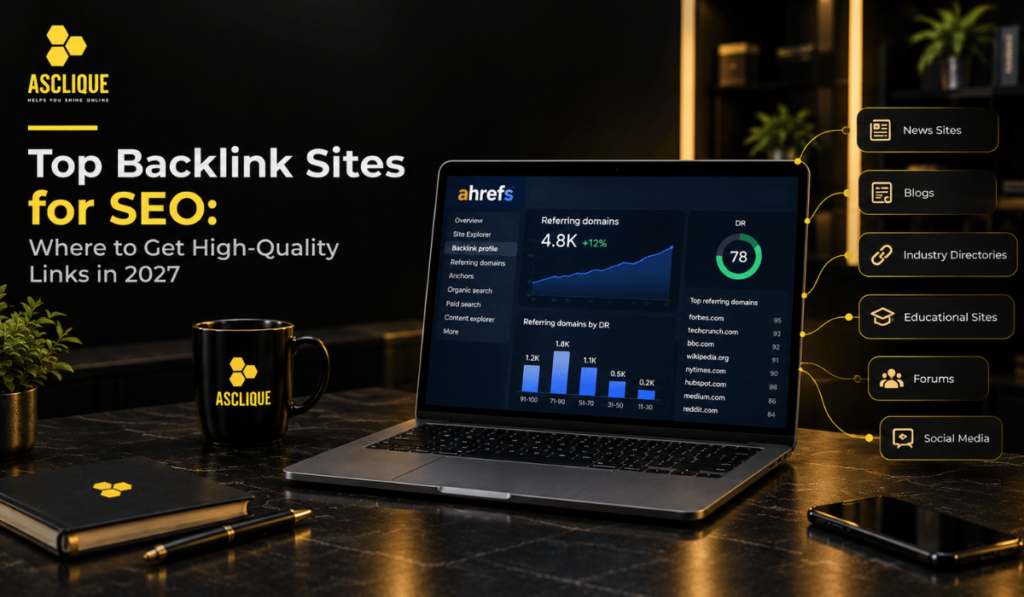
Not all backlinks are created equal. A link from a major industry publication with a DR of 80 carries significantly more SEO value than ten links from low-quality directories. The quality, relevance, and editorial standards of a linking site determine whether a backlink helps or hurts.
This guide covers where to actually get high-value backlinks — organized by type and method — with realistic guidance on what requires effort, what you can submit directly, and what you need to earn.
What Makes a Backlink Valuable?
Before listing sources, it helps to understand what makes a backlink worth acquiring:
Domain Rating (DR): Higher DR linking sites pass more link equity. A DR 70 site’s link is worth more than a DR 20 site’s link, all else equal. If you are new to the metric, our guide explains what Ahrefs Domain Rating measures and how it is calculated.
Relevance: A link from an industry-specific publication is more valuable than a link from an unrelated site, even if the unrelated site has a higher DR. Relevance signals to Google that the link was editorially appropriate.
Editorial placement: Links embedded in editorial content (an article, a news story, a resource guide) carry more value than links in author bios, sidebars, or footer sections.
Dofollow vs. nofollow: Dofollow links pass link equity. Nofollow links (most social media, many directories) signal credibility but pass less direct ranking value. Google has indicated it treats nofollow as a hint rather than an absolute directive.
Number of outbound links on the page: A page linking to 200 other sites passes much less per link than a page with 3 outbound links.
High-Value Backlink Sources by Category
News and Media Publications
Links from major news sites (Forbes, Business Insider, The Guardian, TechCrunch, Wired) have DR scores above 90 and are among the most valuable links available. They are also the hardest to earn.
How to get them: Digital PR — pitching original research, expert commentary, or newsworthy stories to journalists. This requires a PR approach: identifying what is genuinely newsworthy, writing compelling pitches, and building media relationships.
Platforms that connect sources with journalists:
- HARO (Help a Reporter Out) / Connectively: Journalists post source requests; you respond with expert quotes
- Qwoted: Similar to HARO with a focus on expert sources
- Terkel / SourceBottle: Platforms connecting brands with journalist requests
Success rate varies widely but even a 5% response-to-placement rate from consistent HARO engagement can produce 1–3 high-DR media links per month.
Industry Publications and Trade Press
Industry-specific publications (marketing, legal, healthcare, technology, construction, etc.) typically have DR scores of 40–75 and editorial standards that make their links genuinely valuable. They also serve the relevant audience, making them contextually strong links.
How to get them: Guest articles, contributed thought leadership pieces, data and research features. Most trade publications accept guest contributions; the bar is whether the content adds genuine value to their audience.
Identify target publications using Ahrefs’ Content Explorer or by searching “[your industry] publications” or “[your industry] online magazines.”
Business and Professional Directories
Certain directories carry genuine SEO value because they are editorially curated or widely referenced:
General business:
- Better Business Bureau (BBB) — DR 91, accreditation required
- Clutch.co — DR 79, B2B service provider reviews (requires client reviews to build a profile)
- G2 — DR 91, software and business services reviews
- Crunchbase — DR 91, startup and business data
Professional and local:
- Chamber of Commerce directories (local chambers vary in DR; many are 40–60+)
- Industry association member directories
- Google Business Profile (adds authority to the brand; GBP itself is not a traditional backlink source but GBP citation data supports local SEO)
Avoid: Directories with DR below 20 that accept any submission without review. These add noise without meaningful SEO value and in large quantities can appear manipulative.
Educational and Government Links (.edu, .gov)
Links from .edu and .gov domains carry particular authority due to these domains’ established trust. They are hard to earn and cannot be bought, but several strategies can produce them:
Scholarship links: Create a legitimate scholarship program and list it on university financial aid pages. Many universities maintain resource pages for scholarship opportunities and will link to verified programs.
Research citations: Original research published on your site can be cited by academic papers, university resource pages, and government reports.
Resource page inclusion: Universities and government agencies often maintain curated resource lists (“Useful links for small businesses,” “Digital marketing resources for students”). Identifying and pitching for inclusion requires finding relevant pages and making a genuine case for the resource.
Blog and Content Sites
High-quality blogs in relevant niches with established readership and editorial standards can provide valuable links. The key word is “high-quality” — a blog with DR 45, 10,000 monthly readers, and an engaged audience is a valuable link source. A “blog” set up specifically to sell guest posts with no real readership is not.
Guest posting: Contributing genuinely useful content to relevant blogs in exchange for a byline and contextual link. The content must match the site’s editorial standards. Mass guest posting to low-quality sites at scale is a link scheme Google discounts.
Roundup inclusion: Industry roundups (“Top 25 marketing agencies in [city]”), tool lists, and resource round-ups often include editorial links. Getting listed requires visibility in the right communities.
Resource and Tool Pages
Pages that curate links to useful tools, calculators, templates, or resources are natural link targets. Create genuinely useful free resources (an SEO audit template, a keyword research spreadsheet, an industry benchmark report) and identify resource pages in your niche to pitch for inclusion.
Search operators to find resource pages:
- [keyword] inurl:resources
- [keyword] intitle:”useful links”
- [keyword] site:edu “resources”
Link Sources to Avoid
PBNs (Private Blog Networks): Networks of sites built specifically to sell links. Google actively devalues and penalizes PBN links when detected. The short-term ranking boost is not worth the penalty risk.
Low-quality general directories: Directories that accept any business without editorial review (often DR 10–20 with thousands of outbound links on each page). Bulk directory submissions were a tactic in 2005; they produce no value today.
Paid guest posts on sites that openly sell links: If a blog openly advertises “sponsored posts” or “paid guest posts” without editorial oversight, the links are viewed as paid links by Google and are supposed to be nofollowed under Google’s guidelines. Buying dofollow links from such sites is a policy violation.
Link exchanges: Reciprocal link arrangements (“I’ll link to you, you link to me”) provide minimal value and, at scale, can appear manipulative.
Building a Backlink Acquisition System
One-off link building is less effective than a consistent, systematic approach:
- Monthly digital PR push: Identify 2–3 data angles or expert commentaries to pitch to journalists and trade press each month
- Guest posting pipeline: Maintain a list of 20–30 target publications; pitch one per week; rotate through the list
- Resource page outreach: Identify and reach out to 10–15 resource pages per month with genuinely useful content
- HARO monitoring: Respond daily to relevant journalist source requests
- Competitor backlink analysis: Review Ahrefs’ Link Intersect monthly to find new link opportunities from sites linking to competitors but not to you
Frequently Asked Questions
How many backlinks do I need to rank?
There is no fixed number. The number of referring domains needed to rank for a keyword depends on the competition — specifically, the link profiles of currently ranking pages. Use Ahrefs or Semrush SERP overview to see how many referring domains the top-ranking pages have, then build toward that as a benchmark.
Are nofollow links worthless for SEO?
Not entirely. Google has indicated it treats nofollow as a hint rather than a directive, and may still pass some equity through nofollow links. More importantly, nofollow links from high-traffic sources drive referral traffic and build brand visibility, which contributes to branded searches and indirect SEO signals.
Is guest posting still effective for link building in 2027?
Yes, when done at quality. Google’s concern is with mass guest posting to low-quality sites purely for link manipulation. Genuine contributions to authoritative publications with editorial standards still produce valuable links. The emphasis is on quality of placement, not volume.
How do I check the quality of a site before pursuing a backlink?
Check DR in Ahrefs or DA in Moz. Review the site’s content quality, frequency of publication, and evidence of real traffic. Use Ahrefs’ Site Explorer to see the site’s own backlink profile and organic traffic. A site with 1,000 outbound links, minimal content, and no organic traffic is not a valuable link source regardless of its DR.
Should I disavow bad backlinks?
Disavow should be used conservatively. Google’s spam systems are sophisticated at discounting low-quality links. Disavow files are primarily useful when your site has received a manual action for unnatural links, or when you have clear evidence of a negative SEO attack with a high volume of toxic links. Disavowing links out of caution can sometimes remove links that are contributing value.
Asclique’s link building services focus on quality referring domain acquisition through digital PR, editorial guest posting, and resource outreach. If you need a systematic approach to building domain authority, contact us to discuss a link building strategy.