
If you have ever noticed an ad for a brand you recently researched appearing across different websites, you may have encountered programmatic retargeting.
This guide explains how programmatic advertising works, the main channels, targeting options, costs, and when it makes sense to include it in your advertising strategy.
Quick Answer
Programmatic advertising uses automated technology to buy and sell digital advertising placements across websites, apps, video platforms, connected TV, audio services, and digital screens.
Advertisers use demand-side platforms (DSPs) to select audiences, set budgets, and bid on eligible advertising opportunities. Publishers use supply-side platforms (SSPs) and other advertising technology to make inventory available.
Programmatic advertising is particularly useful for businesses seeking broad audience reach, retargeting opportunities, cross-channel campaigns, and scalable brand awareness.
However, it is not automatically the best option for every business. Smaller advertisers focused on immediate enquiries may achieve better initial results through high-intent search campaigns or other more focused advertising channels.
Key Facts and What Is Verified
- Definition: Programmatic advertising automates digital media buying and selling through advertising technology platforms.
- Buying methods: Programmatic transactions include real-time bidding, private marketplaces, preferred deals, and programmatic guaranteed arrangements.
- Core technology: DSPs, SSPs, ad exchanges, and ad servers support different parts of the buying and delivery process.
- Advertising formats: Programmatic buying can include display, video, connected TV, audio, native advertising, and digital out-of-home inventory.
- Targeting: Available options may include contextual, geographic, demographic, behavioral, and first-party audience targeting.
- Pricing: CPM is common, but actual costs vary significantly by format, audience, inventory quality, market, and buying arrangement.
- Privacy: Audience targeting depends on applicable privacy laws, consent requirements, platform policies, and available identifiers.
- Measurement: Reach, frequency, conversions, brand lift, and incrementality can help evaluate campaign effectiveness.
- Important distinction: Programmatic advertising is a buying method, not a guarantee of better targeting, lower costs, or stronger performance.
Table of Contents
- What Is Programmatic Advertising?
- How Programmatic Advertising Works
- The Technology Behind Programmatic Advertising
- Programmatic Advertising Channels
- Programmatic vs Social Advertising vs Search
- Targeting in Programmatic Advertising
- What Programmatic Advertising Costs
- When Programmatic Advertising Makes Sense
- A Practical Asclique Workflow
- Weak Approach vs Better Approach
- Common Programmatic Advertising Mistakes
- What Is Not Proven
- How to Measure Programmatic Advertising Success
- Programmatic Advertising Implementation Checklist
- Frequently Asked Questions
- Asclique Recommendation
What Is Programmatic Advertising?
Programmatic advertising is the use of automated technology to purchase digital advertising inventory.
Instead of negotiating every individual advertising placement directly with a publisher, advertisers use software to manage bidding, targeting, budgets, frequency, and campaign delivery.
Traditional advertising often involved contacting a magazine, television network, or website to negotiate placement, pricing, and scheduling.
Programmatic technology automates many of these processes and allows advertisers to evaluate advertising opportunities across multiple publishers and channels.
Not all programmatic advertising uses open auctions. Some transactions involve negotiated arrangements, reserved inventory, or guaranteed delivery.
The defining characteristic is the use of automated technology to execute and manage media buying.
Before investing in additional advertising traffic, businesses should also review their website’s technical performance. A technical SEO audit can help identify website issues that may affect the visitor experience.
How Programmatic Advertising Works
Many programmatic campaigns use real-time bidding (RTB), where advertising opportunities are evaluated and purchased through automated auctions.
The Core Process
- A visitor opens a website or app. The publisher has advertising inventory available for eligible advertisers.
- An advertising opportunity becomes available. The publisher’s advertising technology may generate a bid request containing information about the placement, page context, device, and permitted audience signals.
- Demand-side platforms evaluate the opportunity. Advertisers’ DSPs determine whether the impression matches their campaign targeting, budget, and bidding criteria.
- Eligible advertisers submit bids. The auction system evaluates bids according to the exchange’s auction rules, deal priorities, and applicable requirements.
- An advertisement is selected and delivered. The winning eligible creative is served through the advertising delivery process.
- Performance is recorded. The platform records relevant delivery and engagement information for reporting and billing.
These automated decisions generally happen very quickly, often within fractions of a second. However, there is no universal auction duration of exactly 100–150 milliseconds.
The advertiser commonly pays using a CPM model, although other commercial arrangements are available.
What Is CPM?
CPM stands for cost per mille, meaning the cost per 1,000 advertising impressions.
For example, if an advertiser purchases 100,000 impressions at a $5 CPM, the media cost would be approximately $500 before any additional platform, data, creative, or management fees.
CPM measures the cost of advertising exposure. It does not directly measure whether those impressions generated customers or revenue.
The Technology Behind Programmatic Advertising
Several advertising technology systems work together to support automated media buying.
Demand-Side Platforms (DSPs)
DSPs are platforms advertisers use to purchase digital advertising inventory programmatically.
Examples include The Trade Desk, Google Display & Video 360, Amazon DSP, and Yahoo DSP.
DSPs allow advertisers to manage targeting, bidding, budgets, creative delivery, frequency controls, and reporting.
Supply-Side Platforms (SSPs)
SSPs help publishers manage advertising inventory and make eligible placements available to buyers.
Publishers use these systems to manage demand sources, pricing rules, and advertising transactions.
Ad Exchanges
Ad exchanges facilitate transactions between advertising buyers and sellers.
Examples include Google Ad Exchange, OpenX, and exchanges operated by other advertising technology providers.
Some companies provide multiple functions, so the distinction between SSPs and exchanges is not always absolute.
Data Management Platforms (DMPs)
DMPs help organize and activate audience information for advertising purposes.
Traditional DMPs have often relied on third-party audience data and identifiers. Their role is evolving as privacy requirements and identity technologies change.
Many advertisers increasingly use first-party data systems, customer data platforms, and privacy-conscious audience activation methods alongside or instead of traditional DMP workflows.
How the Technology Connects
A simplified programmatic advertising flow looks like this:
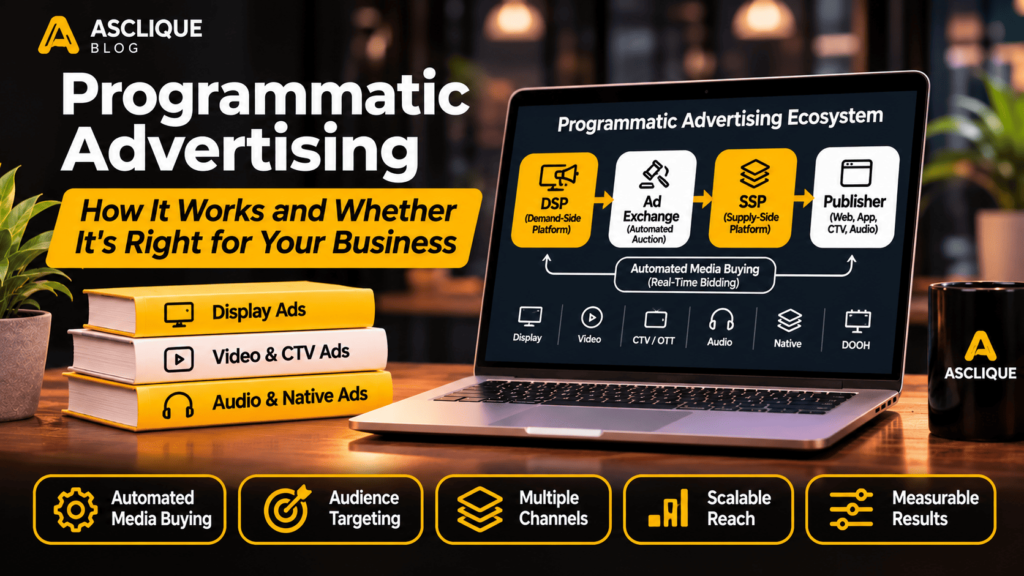
Advertiser → DSP → Ad Exchange / SSP → Publisher → Audience
Actual transactions may involve additional ad servers, identity systems, verification providers, and deal-management technology.
Programmatic Advertising Channels
Programmatic buying is available across multiple digital advertising formats.
Display Advertising
Display advertising includes banner ads, responsive creative formats, and rich media served across websites and applications.
Programmatic display can support brand awareness, prospecting, and retargeting campaigns.
Google Display Network campaigns also use automated advertising technology, although their buying environment and available controls differ from those of independent DSPs.
Programmatic Video
Programmatic video includes pre-roll, mid-roll, and out-stream advertising across eligible video inventory.
Video inventory may be available through websites, streaming applications, and other supported environments.
Access to specific platforms, including YouTube, depends on the advertising product and buying arrangements available to the advertiser.
Connected TV (CTV) and OTT
Connected TV advertising reaches viewers through internet-connected televisions and streaming applications.
OTT refers more broadly to video content delivered over the internet rather than through traditional television distribution.
CTV advertising combines television-style creative with digital buying, targeting, and reporting capabilities.
However, targeting precision, inventory availability, and measurement capabilities vary by streaming platform and buying arrangement.
Programmatic Audio
Programmatic audio includes advertising delivered through eligible music streaming services, digital radio, and podcast inventory.
Platforms such as Spotify and iHeartMedia offer digital audio advertising opportunities, although buying methods and programmatic access vary.
Audio advertising can support awareness and frequency-building campaigns where the audience regularly consumes streaming content.
Native Advertising
Native advertising is designed to fit the presentation and format of the surrounding content while remaining identifiable as advertising.
Platforms such as Taboola and Outbrain provide native advertising distribution opportunities.
Native advertising can support content promotion, audience discovery, and certain direct-response objectives.
Programmatic advertising can also complement social media marketing services by extending brand exposure beyond individual social platforms.
Digital Out-of-Home (DOOH)
Programmatic DOOH involves buying advertising placements on eligible digital billboards, transit displays, and other digital signage.
Campaigns may use location, time of day, venue type, and other permitted contextual signals to guide delivery.
DOOH is particularly relevant for businesses seeking visibility in specific geographic areas.
Build a Smarter Paid Advertising StrategyUnderstand where programmatic advertising fits alongside search, social, and other paid media channels. | Contact Asclique |
Programmatic vs Social Advertising vs Search
Programmatic advertising serves a different role from social and search advertising, although the channels can overlap in targeting, buying methods, and campaign objectives.
For businesses focused on customer acquisition, understanding how to generate leads from SEO can help clarify the role of organic search alongside paid advertising.
| Factor | Programmatic Display / Video | Social Advertising | Search Advertising |
|---|---|---|---|
| Typical Intent | Audience and contextual targeting | Audience, interest, and engagement targeting | Query-based intent |
| Targeting | Contextual, geographic, audience, and retargeting signals | Platform audience, demographic, and engagement signals | Keywords, search intent, geography, and audience signals |
| Reach | Broad reach across eligible publishers and channels | Reach within participating social platforms and networks | Limited by relevant search demand |
| Brand Awareness | Strong potential for scalable reach | Strong potential through visual and video creative | Useful for visibility during relevant searches |
| Common Uses | Awareness, prospecting, retargeting, CTV | Awareness, lead generation, ecommerce | Lead generation and direct response |
| Common Pricing | CPM | CPM, CPC, and other bidding models | Often CPC-based, with automated bidding options |
Programmatic advertising can be valuable for advertisers seeking broad reach, cross-channel exposure, and retargeting opportunities.
Search advertising is often particularly relevant when potential customers are actively searching for a product or service.
Social advertising can support both awareness and conversion campaigns using platform-specific audience and engagement signals.
The strongest media mix depends on the business’s objectives, audience, budget, and ability to measure results.
Businesses comparing paid advertising channels can explore Asclique’s PPC management services to understand how search-focused campaigns can support lead generation and customer acquisition.
Targeting in Programmatic Advertising
Programmatic advertising offers multiple targeting methods, although their availability and accuracy depend on the platform, publisher, market, consent status, and available data.
Behavioral Targeting
Behavioral targeting uses permitted signals about user activity, interests, or previous interactions to identify potentially relevant audiences.
Its effectiveness depends on the availability and quality of audience data and applicable privacy requirements.
Contextual Targeting
Contextual targeting places advertisements alongside content relevant to the advertised product or service.
For example, a car insurance advertisement may appear on an automotive review website.
Contextual targeting is useful because it can rely on page content and other contextual signals rather than requiring individual cross-site tracking.
Retargeting and Remarketing
Retargeting allows advertisers to reach eligible users who previously visited their website or interacted with their brand.
Programmatic retargeting may extend across participating websites, applications, and advertising environments.
However, retargeting reach depends on consent, identifiers, platform policies, and available audience matching methods.
Lookalike Audiences
Lookalike or modeled audiences aim to reach people who share relevant characteristics with an advertiser’s existing customers or visitors.
The availability of these features varies by DSP and data provider.
Demographic and Geographic Targeting
Advertisers may target eligible inventory using age ranges, geographic locations, household characteristics, or other available demographic signals.
These attributes may be modeled or inferred rather than directly verified for every impression.
First-Party Data Activation
Businesses may use appropriately collected customer information, CRM records, or consented audience data to support targeting and audience exclusions.
First-party data can be valuable because it originates from the business’s own customer relationships.
However, its use must comply with relevant privacy laws, consent requirements, and advertising platform policies.
What About Third-Party Cookies?
Third-party cookie availability differs across browsers and advertising environments.
Some browsers restrict third-party cookies, while other platforms continue to support certain cookie-based advertising functions.
Advertisers should not assume that third-party cookies have disappeared universally or that one replacement technology works across every environment.
A resilient programmatic strategy should evaluate contextual targeting, first-party data, privacy requirements, and platform-specific identity solutions.
What Programmatic Advertising Costs
Programmatic advertising is commonly priced using CPM, but costs vary substantially by format, inventory quality, audience, geography, seasonality, and buying arrangement.
The following figures are illustrative planning ranges rather than verified industry averages or guaranteed market prices.
| Advertising Format | Illustrative CPM Range | Important Considerations |
|---|---|---|
| General Display | $0.50–$5 | Inventory quality and targeting affect costs. |
| Premium Display / PMP | $5–$15 | Publisher quality and negotiated arrangements influence pricing. |
| Programmatic Video | $5–$20 | Placement type, completion rates, and publisher quality matter. |
| Connected TV | $15–$50 | Premium streaming inventory and audience targeting may increase costs. |
| Native Advertising | $3–$10 | Publisher, placement, and campaign objectives influence pricing. |
Additional Programmatic Advertising Costs
Media spend is not always the total campaign cost.
Additional expenses may include:
- DSP platform or technology fees.
- Third-party audience data fees.
- Creative production and adaptation.
- Campaign management fees.
- Ad verification and brand safety services.
- Measurement and attribution technology.
Technology and data costs can represent a meaningful percentage of total campaign expenditure, but a fixed 10–25% fee should not be assumed for every DSP or campaign.
Minimum Programmatic Advertising Budgets
Minimum budgets vary by platform, contract, agency arrangement, and inventory type.
Some enterprise DSP relationships require substantial spending commitments, while managed-service providers and other buying platforms may offer different entry points.
Advertisers should confirm current minimums directly with their chosen provider rather than assuming that every platform requires $10,000–$50,000 per month.
Businesses should also consider whether their budget is sufficient to generate useful reach, frequency, and measurement data.
When Programmatic Advertising Makes Sense
Programmatic advertising can be valuable when its targeting, reach, and buying capabilities align with the business’s marketing objectives.
Programmatic Advertising Is Often a Strong Fit For:
- Brand awareness campaigns requiring broad reach across multiple publishers.
- Retargeting eligible audiences across participating digital channels.
- B2B advertisers seeking to reach relevant professional audiences through available audience data.
- Connected TV campaigns supported by appropriate video creative and measurement capabilities.
- Businesses with sufficient budgets to test audience segments and optimize campaign performance.
- Advertisers looking to coordinate display, video, audio, and other eligible media formats.
Programmatic May Be Less Suitable For:
- Businesses with very limited advertising budgets.
- Campaigns focused exclusively on capturing existing high-intent search demand.
- Advertisers without the creative resources needed for relevant formats.
- Businesses lacking clear conversion tracking or campaign measurement.
- Campaigns that cannot support adequate testing and optimization.
For many smaller businesses, search advertising or focused social campaigns may be a more practical starting point.
Programmatic can become more useful as the business develops its audience strategy, creative capabilities, measurement systems, and media budget.
A Practical Asclique Workflow for Programmatic Advertising
Asclique recommends evaluating programmatic advertising as part of the wider paid media strategy rather than treating it as a standalone solution.
- Define: Establish the campaign objective, such as awareness, reach, qualified traffic, retargeting, or conversions.
- Evaluate: Review the current performance of search, social, and other advertising channels.
- Research: Identify relevant audiences, publishers, formats, and targeting opportunities.
- Budget: Estimate media spend, platform fees, creative costs, and measurement requirements.
- Prepare: Develop suitable creative assets and confirm landing page readiness.
- Configure: Set up campaign targeting, bidding, frequency controls, exclusions, and brand safety settings.
- Launch: Begin with a controlled campaign designed to produce useful performance data.
- Measure: Review reach, viewability, engagement, conversions, and other relevant outcomes.
- Improve: Adjust audiences, placements, creative, frequency, and budget allocation based on results.
The objective is to determine whether programmatic advertising adds measurable value to the existing media mix.
Weak Approach vs Better Approach
| Weak Approach | Better Approach | Why It Matters |
|---|---|---|
| Choose programmatic because it sounds advanced. | Evaluate it against business objectives and existing channels. | Helps avoid unnecessary advertising complexity. |
| Focus only on the lowest CPM. | Evaluate inventory quality, viewability, and outcomes. | Prioritizes meaningful advertising exposure. |
| Target broad audiences without testing. | Test relevant segments and contextual opportunities. | Improves budget allocation decisions. |
| Ignore frequency and placement quality. | Use frequency controls and brand safety settings. | Reduces unnecessary exposure and placement risks. |
| Measure only impressions and clicks. | Track reach, engagement, conversions, and incremental impact. | Connects campaign delivery to business objectives. |
Common Programmatic Advertising Mistakes
- Choosing programmatic advertising without defining the campaign objective.
- Assuming automated buying always produces lower advertising costs.
- Comparing channels using CPM alone.
- Ignoring inventory quality and advertisement viewability.
- Failing to configure brand safety and suitability controls.
- Using broad audience targeting without evaluating relevance.
- Running campaigns without sufficient creative variations.
- Overlooking frequency caps and repeated exposure.
- Failing to account for DSP, data, verification, and management fees.
- Using audience data without reviewing privacy and consent requirements.
- Relying entirely on view-through conversions to claim campaign success.
- Launching campaigns without reliable measurement or conversion tracking.
- Expecting programmatic awareness campaigns to perform like high-intent search campaigns.
What Is Not Proven
Programmatic advertising does not automatically outperform search advertising, social advertising, or direct publisher buying.
Its effectiveness depends on campaign objectives, audience quality, inventory, creative execution, budget, and measurement.
Published CPM ranges should not be treated as guaranteed pricing. Actual costs vary across publishers, platforms, markets, and campaign conditions.
Similarly, there is no universal monthly budget that guarantees successful programmatic advertising.
Automated targeting does not guarantee that every impression reaches the intended individual. Audience data may be incomplete, modeled, or inaccurate.
View-through conversions also do not automatically demonstrate that an advertisement caused a purchase or enquiry.
Advertisers should use appropriate attribution methods, controlled testing, and incremental measurement where practical.
Make Your Advertising Budget Work HarderEvaluate the right combination of programmatic, search, and social advertising for your audience and business goals. | Get in Touch |
How to Measure Programmatic Advertising Success
Programmatic advertising should be evaluated using metrics that reflect the campaign’s actual objectives.
| Measurement Area | Example Metrics | What It Shows |
|---|---|---|
| Delivery | Impressions, spend, CPM | How efficiently advertising inventory is purchased |
| Reach and Frequency | Estimated unique reach, average frequency | How broadly and repeatedly the audience is exposed |
| Inventory Quality | Viewability, invalid traffic, placement reports | Whether advertisements are delivered in suitable environments |
| Engagement | Clicks, CTR, video completion rate | How audiences interact with advertising creative |
| Conversions | Leads, purchases, CPA, ROAS | Whether campaigns contribute to measurable actions |
| Brand Impact | Brand lift, branded search trends, awareness surveys | Whether campaigns may influence brand recognition |
| Incrementality | Holdout tests, lift studies, incremental conversions | Whether advertising produces outcomes beyond what would happen without it |
For brand awareness campaigns, reach, frequency, viewability, and brand lift may be particularly relevant.
For retargeting and direct-response campaigns, advertisers should also evaluate conversions, acquisition costs, and revenue.
View-through conversions can provide supporting information, but they should not be treated as definitive proof of incremental impact.
Programmatic Advertising Implementation Checklist
- ☐ Define the primary campaign objective.
- ☐ Identify the target audience and relevant markets.
- ☐ Compare programmatic with existing search and social campaigns.
- ☐ Determine which advertising formats support the objective.
- ☐ Evaluate DSP capabilities and available inventory.
- ☐ Confirm platform minimums and contractual requirements.
- ☐ Estimate media spend and additional technology fees.
- ☐ Review audience data quality and privacy requirements.
- ☐ Prepare appropriate creative assets.
- ☐ Confirm landing page relevance and usability.
- ☐ Configure geographic and audience targeting.
- ☐ Establish brand safety and suitability controls.
- ☐ Set frequency caps and placement exclusions.
- ☐ Configure conversion tracking and campaign reporting.
- ☐ Review viewability and invalid traffic reporting.
- ☐ Monitor reach, engagement, and conversion outcomes.
- ☐ Test audience segments and creative variations.
- ☐ Evaluate incremental impact where practical.
- ☐ Adjust budget allocation based on performance.
FAQ’s
What Is the Difference Between Programmatic Advertising and Google Display Network?
Google Display Network is an advertising network available through Google Ads. Programmatic advertising is a broader method of automated media buying that can operate across multiple exchanges, publishers, and formats. A DSP may offer additional inventory access and buying controls, but available features depend on the platform.
Is Programmatic Advertising Effective for B2B Businesses?
Programmatic advertising can support B2B awareness, account-based marketing, and retargeting. Advertisers may use available business audience data to reach relevant professional groups outside individual social platforms. However, job-title and company-level targeting accuracy varies by provider and data source.
What Is a Private Marketplace (PMP) in Programmatic Advertising?
A private marketplace is a programmatic buying arrangement where selected advertisers can access inventory offered by participating publishers under specific deal conditions. PMPs may provide additional inventory selection and commercial controls compared with open auctions, but they do not automatically guarantee better performance or brand safety.
How Do I Measure Programmatic Advertising Effectiveness?
Use metrics aligned with campaign objectives. Awareness campaigns may focus on reach, frequency, viewability, and brand lift. Conversion-focused campaigns may track leads, purchases, CPA, and ROAS. Controlled incrementality tests can provide stronger evidence of advertising impact than attribution reports alone.
What Is Brand Safety in Programmatic Advertising?
Brand safety involves reducing the risk of advertisements appearing alongside unsuitable or harmful content. Advertisers can use inventory exclusions, publisher controls, and verification technology. Providers such as Integral Ad Science and DoubleVerify offer relevant measurement and verification services, although no system eliminates every placement risk.
Is Programmatic Advertising Better Than Google Ads?
Neither is universally better. Google Ads search campaigns can be effective for reaching people actively looking for products or services. Programmatic buying may be more suitable for broad audience reach, cross-publisher exposure, and certain video or connected TV campaigns. The appropriate choice depends on campaign goals and economics.
How Much Budget Do I Need for Programmatic Advertising?
Budget requirements depend on the DSP, buying arrangement, audience, advertising format, and campaign objective. Some enterprise platforms require substantial commitments, while other providers offer different entry points. Businesses should calculate whether the available budget can produce meaningful reach and measurement data before launching.
Can Small Businesses Use Programmatic Advertising?
Yes, although it may not be the most efficient starting point for every small business. Companies with limited budgets and immediate lead-generation goals may benefit from prioritizing search or focused social campaigns first. Programmatic becomes more attractive when broader reach, retargeting, or cross-channel advertising is needed.
What Is the Difference Between Programmatic Advertising and Real-Time Bidding?
Programmatic advertising refers to automated media buying more broadly. Real-time bidding is one method used within programmatic advertising, where eligible impressions are purchased through automated auctions. Programmatic guaranteed and other negotiated deals can also use automated technology without relying on open RTB auctions.
Does Programmatic Advertising Work Without Third-Party Cookies?
Yes. Programmatic campaigns can use contextual targeting, geographic signals, first-party data, and other supported targeting methods. However, audience reach and measurement capabilities vary by browser, publisher, platform, and privacy environment.
Asclique Recommendation
Programmatic advertising can be a valuable part of a paid media strategy, particularly for businesses seeking scalable awareness, broader audience reach, retargeting, and access to multiple digital advertising formats.
However, programmatic technology should not be treated as a replacement for clear campaign objectives, effective creative, relevant targeting, and reliable measurement.
For businesses focused primarily on immediate leads or purchases, search advertising may deserve priority because it can capture existing customer demand.
For businesses with established advertising programs and broader awareness objectives, programmatic may provide additional opportunities across display, video, connected TV, audio, and other channels.
Our recommendation: Evaluate programmatic advertising against your existing media performance, audience requirements, creative resources, and available budget. Start with a clearly defined objective, test appropriate inventory, and measure whether the campaign contributes meaningful value beyond existing advertising channels.
Need Help With Your Paid Advertising Strategy?
Asclique helps businesses evaluate paid advertising opportunities across search, social, and other digital media channels.
Our approach focuses on selecting relevant channels, understanding audience intent, improving campaign performance, and connecting advertising investments with measurable business outcomes.
Whether you are considering programmatic advertising for the first time or reviewing an existing paid media strategy, the objective is to invest in channels that support your marketing goals.
Contact Asclique to discuss your audience, campaign objectives, and advertising budget.
Ready to Improve Your Paid Media Performance?Explore the right mix of programmatic, search, and social advertising to reach relevant audiences and support measurable business growth. | Request a Consultation |