Answer engine optimization tools help in-house marketing teams track how their brands appear in AI-generated answers. But tracking mentions is only the beginning. The bigger challenge is proving what those numbers mean to leadership and identifying which improvements deserve attention.
With ChatGPT, Gemini, Google AI Overviews, AI Mode, and Perplexity influencing how people discover and compare businesses, traditional SEO reporting no longer captures every form of search visibility.
For CMOs, the question is straightforward: Is our brand becoming more visible in AI search, how do we compare with competitors, and what should we do next?
This guide compares eight answer engine optimization tools based on AI platform coverage, prompt tracking, reporting capabilities, pricing, and their usefulness in an in-house marketing program.
Quick Answer: What Are the Best AEO Tools for 2027?
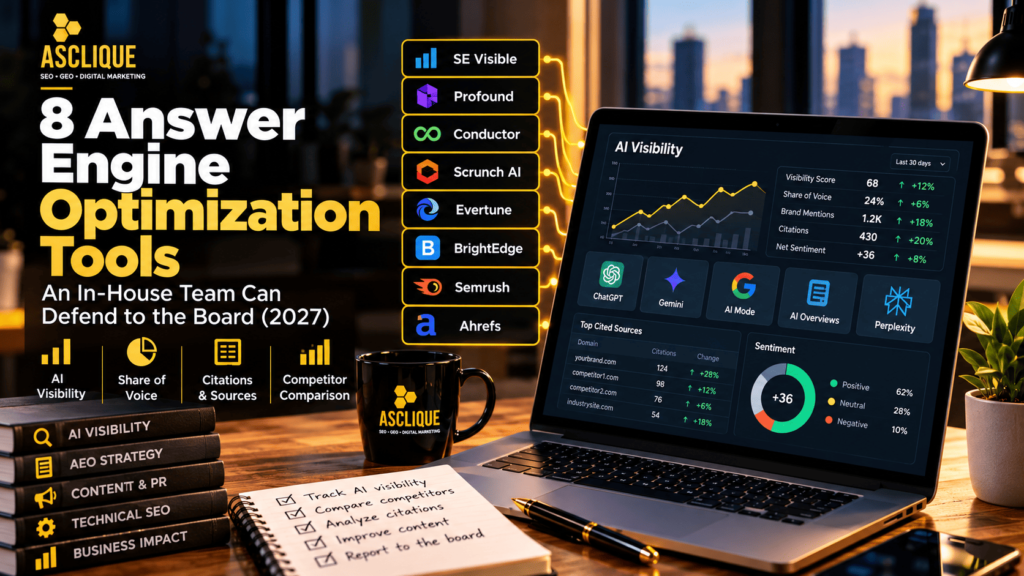
The eight answer engine optimization tools worth evaluating for 2027 are SE Visible, Profound, Conductor, Scrunch AI, Evertune, BrightEdge, Semrush AI Visibility Toolkit, and Ahrefs Brand Radar.
SE Visible is a strong choice for executive AI visibility reporting, with an AI brand visibility dashboard that tracks visibility score, average position, share of voice, and sentiment.
Profound and Conductor are suitable for enterprise programs connecting AI visibility with content operations and business reporting. Scrunch AI focuses on AI monitoring and agent experiences, while Evertune supports brand perception research.
BrightEdge, Semrush, and Ahrefs provide AI visibility capabilities alongside established SEO workflows.
For leadership, the most useful metrics are AI visibility, share of voice, brand mentions, citations, and competitive performance. The right platform should measure these consistently, explain changes over time, and provide evidence behind the numbers.
Key Facts and What Is Verified
- FACT: AEO tools measure how brands appear in AI-generated answers across supported platforms.
- FACT: AI visibility and referral traffic are different. A brand can appear in an AI answer without receiving a website visit.
- FACT: Share of voice provides competitive context by comparing brand presence across selected prompts.
- FACT: Brand mentions and citations are separate measurements.
- FACT: Prompt selection, AI platform coverage, and geography influence reported results.
- FACT: AI-generated answers can change across reporting periods.
- FACT: Vendor visibility scores are not standardized across platforms.
- FACT: AEO tools measure performance, but content, PR, and technical SEO teams must act on the findings.
- IMPORTANT: Vendor features and pricing reflect the research available in October 2026. Confirm current capabilities before making a purchasing decision for 2027.
Table of Contents
- What Are AEO Tools, and What Should They Measure for Leadership?
- How Do the 8 Answer Engine Optimization Tools Compare?
- What Are the 8 Best AEO Tools for In-House Programs?
- How to Choose the Right AEO Tool
- What Should an AEO Report Include for Leadership?
- Common Mistakes When Evaluating AEO Software
- Key Takeaways
- Frequently Asked Questions
- Final Thoughts
What Are AEO Tools, and What Should They Measure for Leadership?
AEO tools (answer engine optimization tools) record whether, and in what terms, a brand shows up in answers from ChatGPT, Gemini, Google AI Overviews, AI Mode, and Perplexity, which sources they cite, and how competitors compare.
The split that matters is measure versus act.
Answer engine optimization tools measure visibility, share of voice, sources, and sentiment. Content, PR, and technical SEO teams act on those findings.
Every fix needs a named owner outside the AI search team, which can take longer to agree on than the tracking itself.
The board metric is visibility and share of voice, not referral traffic alone. A brand can be named in an AI-generated answer and earn no click.
The original research reported that Google.com accounted for 17.42% of all AI Mode citations in February 2026, up from 5.7% in June 2025. These figures should be checked against the original study before publication.
For teams establishing their approach, Asclique’s Answer Engine Optimization (AEO) guide explains how answer-focused content and traditional SEO work together.
Which AEO Metrics Matter Most?
- AI visibility score: How frequently the brand appears across monitored AI responses.
- Share of voice: How the brand compares with competitors across selected prompts.
- Brand mentions: How often AI-generated answers reference the company.
- Source citations: Which websites and individual URLs AI platforms use as supporting sources.
- Net sentiment: Whether AI-generated answers describe the brand positively, negatively, or neutrally.
These metrics should be reviewed together. A higher visibility score may not indicate stronger competitive performance if other brands are gaining visibility faster.
For a closer look at the difference between mentions and cited sources, see Asclique’s AI Citation Tracking guide.
How Do the 8 Answer Engine Optimization Tools Compare?
This is the view I’d show a CMO before any demo: the top answer engine optimization software compared by engines, whose prompts they track, and what reaches leadership.
Prices are vendor-stated.
| Platform | Engines Named | Prompts | Leadership Output | Starting Price |
|---|---|---|---|---|
| SE Visible | ChatGPT, Gemini, AI Mode, AI Overviews, Perplexity | Yours, organized into topics | Looker Studio, API, CSV/XLSX | Free trial |
| Profound | Up to 9 (Enterprise) | Yours (Enterprise) | CSV, JSON, API | 7-day trial; custom |
| Conductor | ChatGPT, Gemini, Copilot, Claude | Yours, topic-based | ROI reporting, Data API | Custom |
| Scrunch AI | 4 Core, 9 Enterprise | Yours | Board reporting | $250/mo Core |
| Evertune | 9 named | Vendor panel | Not stated | $800/mo Pro |
| BrightEdge | 5 plus other AI platforms | Vendor-built | Dashboards, PNG, CSV | Custom |
| Semrush AI Visibility Toolkit | ChatGPT, AI Mode, AI Overviews, Gemini | Both | Scheduled reports, CSV | $99/mo toolkit |
| Ahrefs Brand Radar | 6 index engines, Claude custom | Both | Via Ahrefs plans | From $50/mo |
The important difference is not simply how many AI platforms a tool supports. In-house teams also need to understand how prompts are selected, how frequently responses are collected, and whether reporting definitions remain consistent.
What Are the 8 Best AEO Tools for In-House Programs?
Each platform below is evaluated for its role in an in-house AEO program.
Every review closes with “What the CMO sees”, focusing on the information that should reach the monthly leadership review.
1. SE Visible
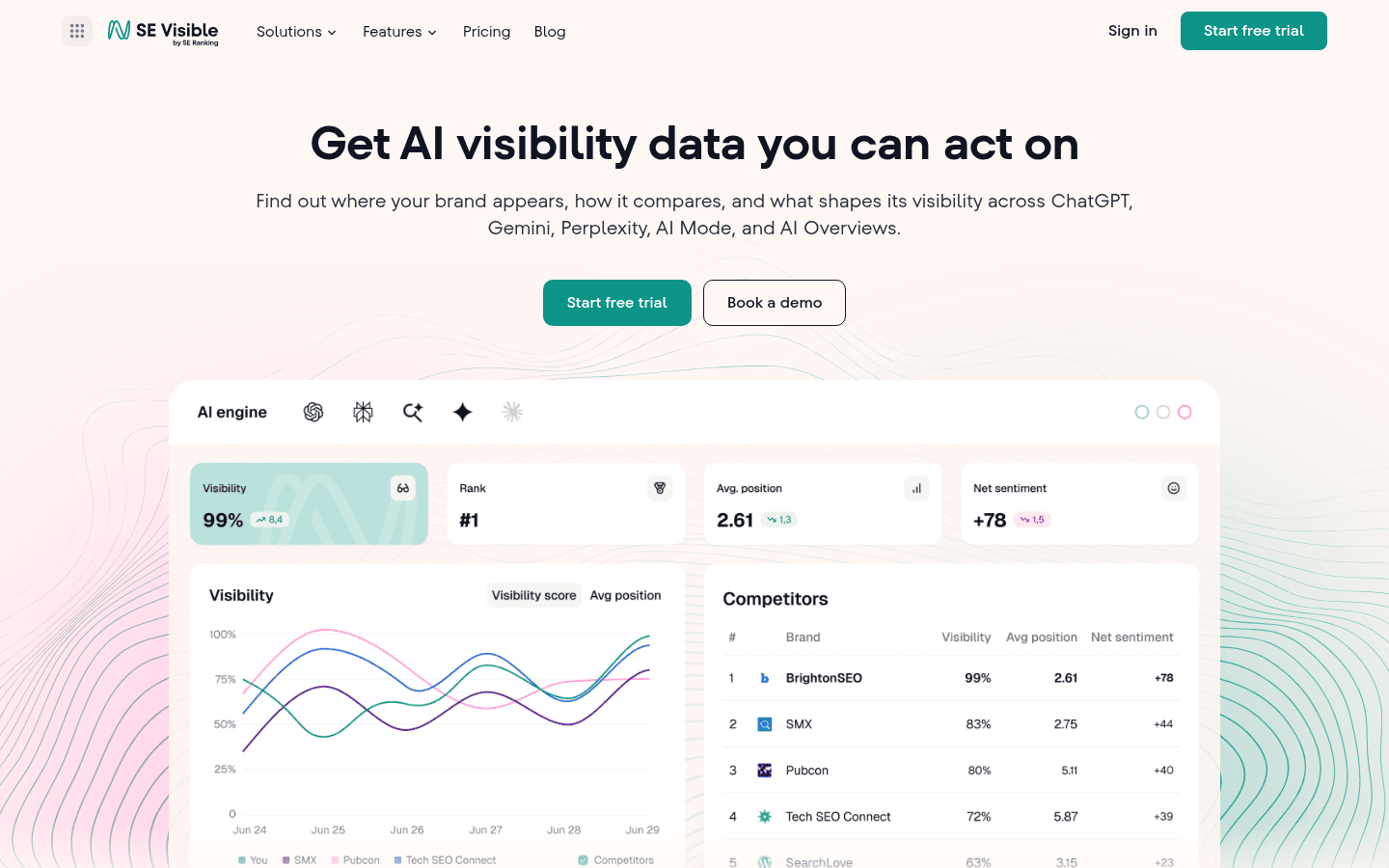
SE Visible is an AI visibility platform built for a reporting line: four headline numbers per market and engine, each traceable to its answer.
Best for: In-house AI search leads who owe the CMO one monthly metric, split by market and engine, with evidence behind every figure.
Standout Feature
The AI brand visibility dashboard leads with visibility score, average position, share of voice, and net sentiment, each with absolute and percentage changes against the previous period.
Net sentiment runs from -100 to +100.
SE Visible collects answers through real browser sessions, reflecting the interfaces buyers see when using AI search platforms.
Pros
- Tracks ChatGPT, Gemini, Google AI Mode, Google AI Overviews, and Perplexity on every plan, in a country or a specific city or region.
- Sends numbers to Looker Studio, beside GA4 and Search Console, or through the API included on all plans.
- Breaks out the domains and URLs every engine cites. The “Brand is mentioned” filter shows content and PR teams where to start.
Cons
- The platform covers AI visibility only. SEO work, from rank tracking and keyword research to site audits, lives in SE Ranking.
- Native reporting is still maturing, so the board slide comes from Looker Studio or exports for now. Claude support is planned as the platform grows.
Pricing: Current plans are listed on SE Visible’s website. A free trial is available.
What the CMO Sees
The same four numbers each month, per market, against the same competitor set, with the stored answer one click away when a figure is challenged. Tracking is daily by default and adjustable. If your metric must hold its definition through a budget cycle, start the shortlist here.
2. Profound
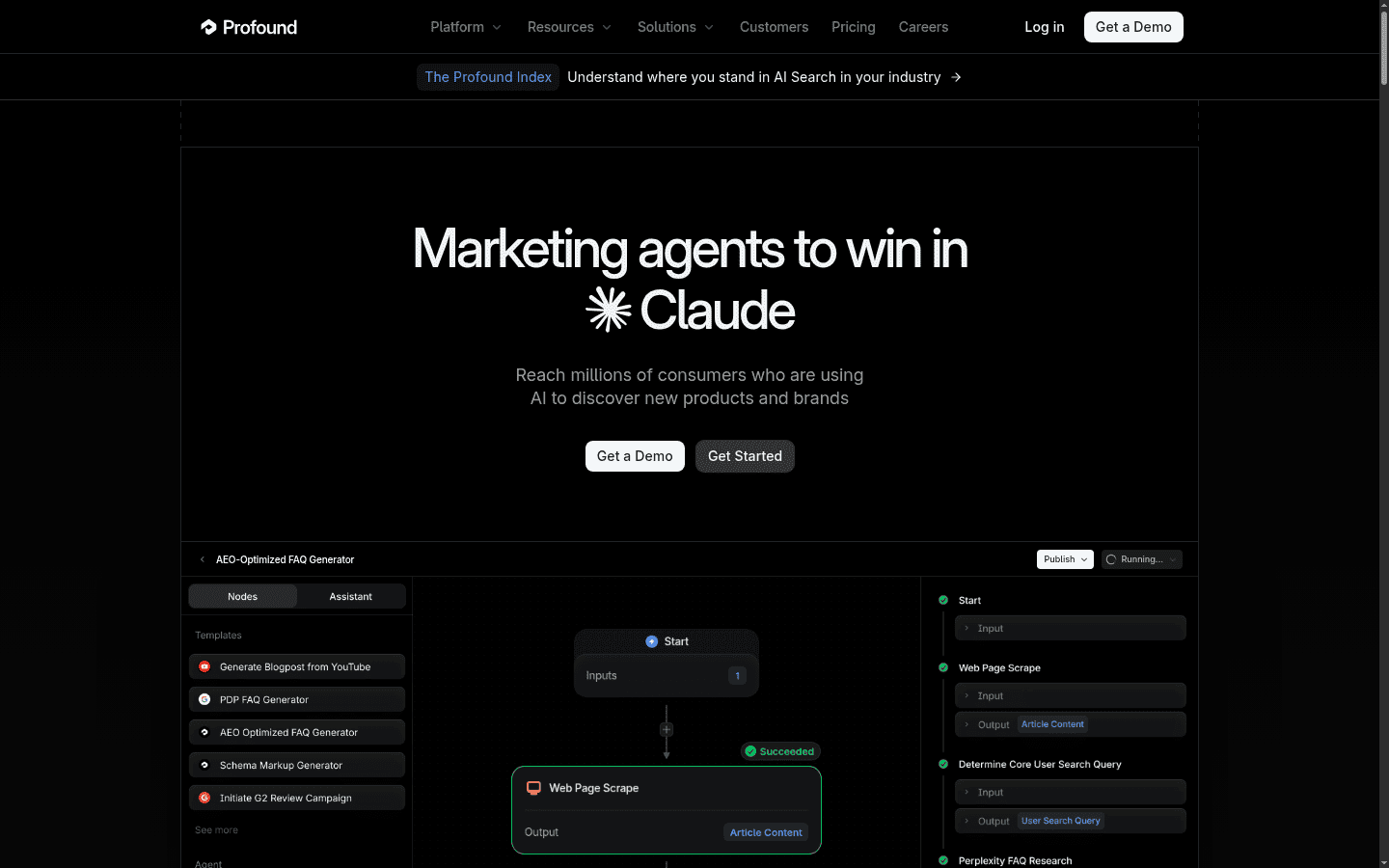
Profound is an AI marketing platform pairing answer tracking with agents that rewrite and stage pages.
Best for: Enterprise programs wanting tracking and content agents in one contract.
Standout Feature
Profound Enterprise tracks up to nine answer engines, including ChatGPT, Google AI Mode, Gemini, and Claude.
Agents find pages with citation decay, rewrite them, and stage the new versions in your CMS.
The content owner receives a draft to review rather than another chart.
Pros
- Customize prompts on Enterprise.
- CSV and JSON exports, plus an API.
- Supports IT review requirements with SSO/SAML and SOC 2.
Cons
- Trial prompts are fixed, so your preferred tracking definition goes untested before procurement.
- Custom pricing is harder to forecast at budget time.
Pricing: Seven-day free trial; custom Enterprise packages.
What the CMO Sees
Among the answer engine optimization tools here, Profound ends the review with work queued: the visibility report, followed by rewritten pages in the CMS. Content signs off on each rewrite. The analyst keeps prompts tied to the reporting definition.
3. Conductor
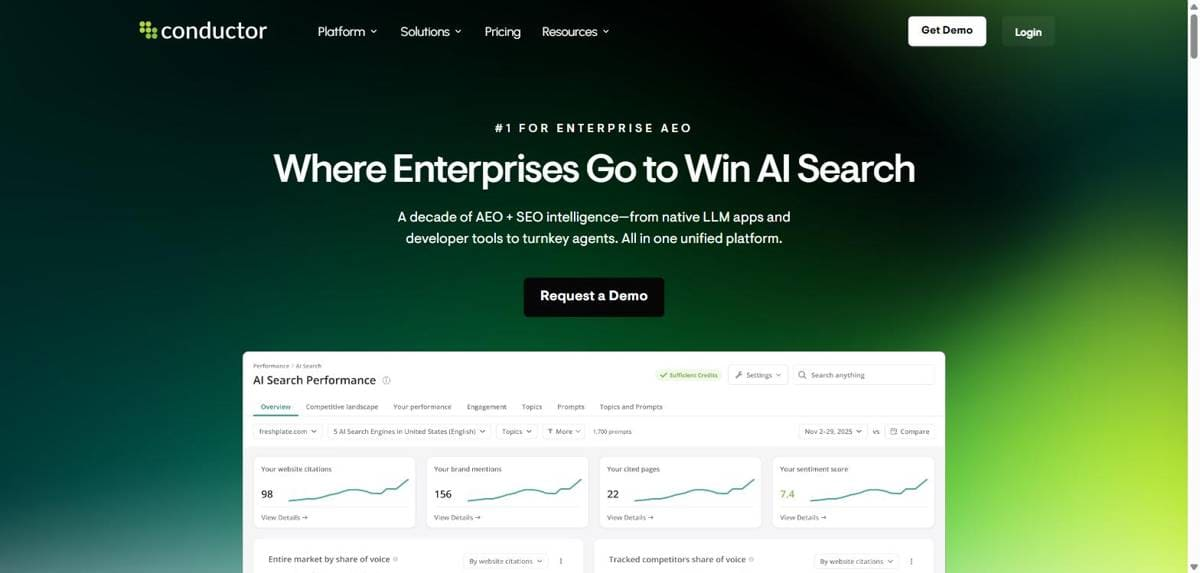
Conductor is an AEO platform inside an AEO and SEO suite, linking AI visibility to revenue.
Best for: In-house programs whose SEO and content work already lives in Conductor.
Standout Feature
Conductor puts AI citations, mentions, and referral traffic in one view with web analytics, rankings, Search Console, and site health.
Prompts are customizable and topic-based, with personas and regional insights.
Conductor states that its AI visibility insights come from official LLM APIs.
Pros
- Report AI visibility against revenue.
- Track all brands and domains together.
- API or MCP capabilities for custom builds.
Cons
- No published prices, so the budget line waits on a quote.
- No complete engine list, so your coverage footnote needs a vendor answer.
Pricing: Custom, usage-based; free trial on Essentials.
What the CMO Sees
If SEO reporting already reaches leadership from Conductor, AI visibility lands in the same dashboards. That creates one reporting line instead of two. Before the numbers reach the board, document which engines they cover and how the responses are collected.
4. Scrunch AI
Scrunch AI combines monitoring with Agent Pages, an optimized version of your site for AI agents.
Best for: Enterprise programs that also shape what AI agents read.
Standout Feature
Scrunch is the only one of these answer engine optimization tools listing “Exec / Board Reporting” on its pricing page under Enterprise services.
Enterprise also tracks nine LLMs, including Claude, Gemini, Google AI Mode, and Grok, across unlimited countries, with Looker Studio access and API.
Pros
- Multi-brand, multi-region deployments on Enterprise.
- Measures AI agent and bot traffic.
- Controls access with SAML or OIDC SSO.
Cons
- Board reporting, Looker Studio, and API are Enterprise-only.
- Core covers one country, which will not support a multi-market reporting definition.
Pricing: Core costs $250 per month after a seven-day free trial. Enterprise pricing is available by quote.
What the CMO Sees
A vendor-supported executive report for the board presentation, with Looker Studio for the monthly view. Ownership is split: the analyst runs monitoring, and the web team owns Agent Pages. That second owner is worth identifying before implementation.
5. Evertune
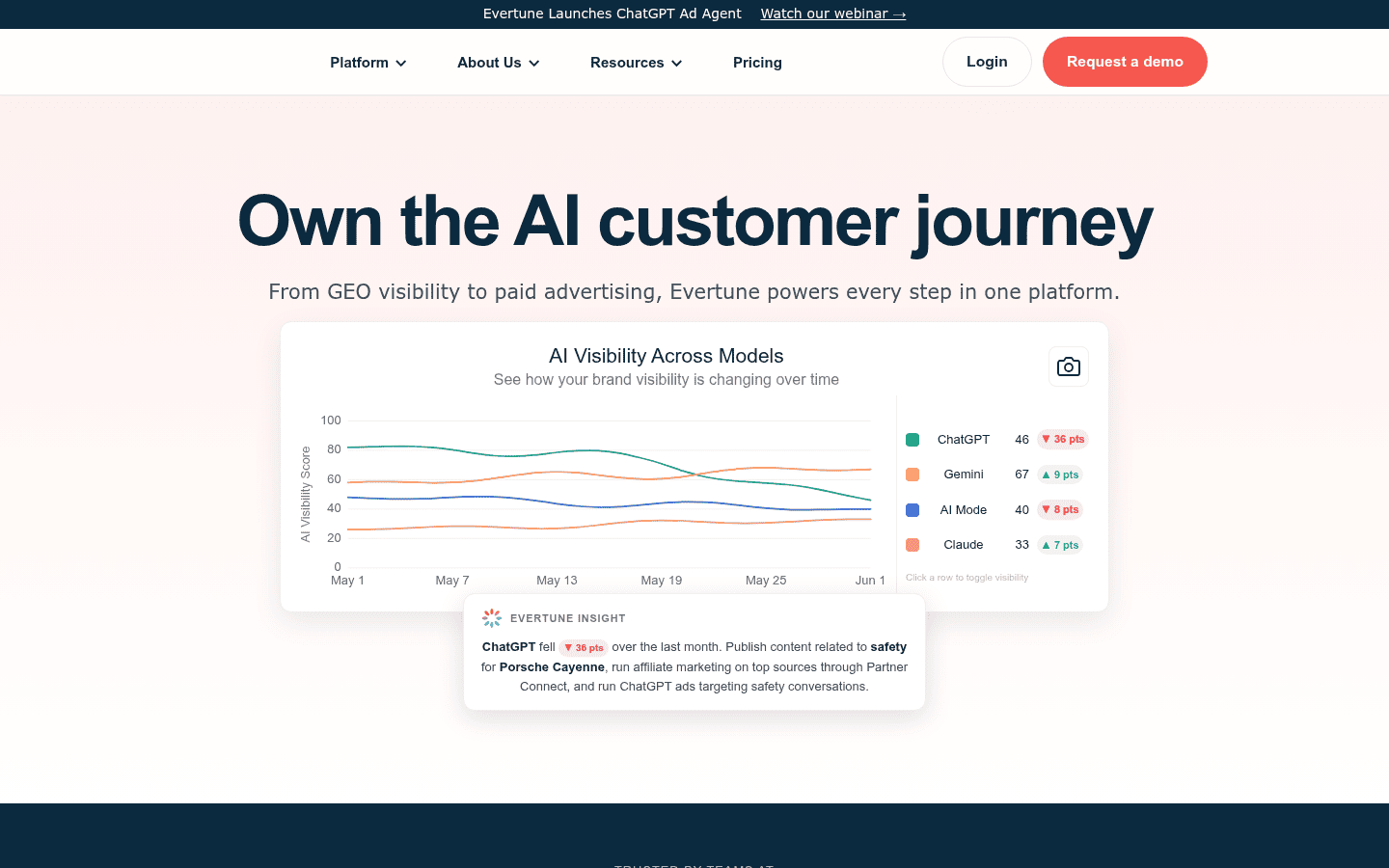
Evertune connects AI search brand discovery to paid AI media, using panel-built prompts.
Best for: Brand teams running paid media on large-sample perception data.
Standout Feature
Evertune’s Prompt Agent clusters questions from EverPanel, its panel of over 150 million user prompts, into topics.
Each prompt is sampled as many as 100 times per model across nine named engines, including ChatGPT, Claude, Gemini, AI Mode, Perplexity, and DeepSeek.
Pros
- Samples repeatedly to support more reliable analysis.
- Tracks languages and countries globally.
- Links findings to Content Studio and retargeting.
Cons
- Prompts start from Evertune’s panel, not yours.
- Evertune’s product pages do not clearly describe exports, API access, or BI connectors.
Pricing: Pro starts at $800 per month via demo. Enterprise pricing is custom.
What the CMO Sees
Large samples produce a brand score that can be evaluated against the question, “Was that a one-off result?” Ownership sits with brand and media teams more than SEO. I’d settle the reporting path during the demo, since that number needs to reach the same slide every quarter.
6. BrightEdge
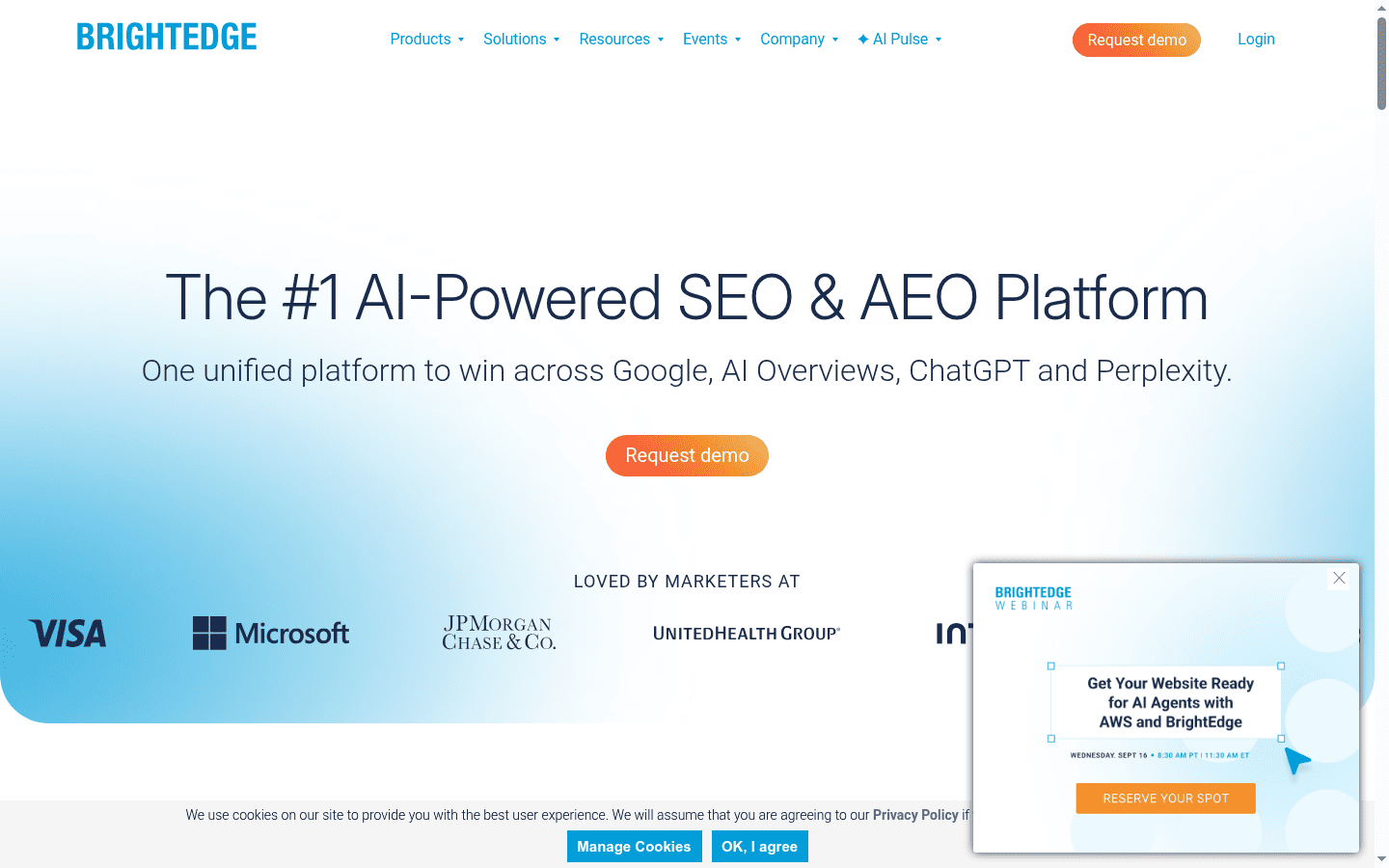
BrightEdge runs AI Catalyst as its AI search intelligence layer, alongside governed SEO data.
Best for: BrightEdge SEO customers wanting AI reporting under one governance structure.
Standout Feature
AI Catalyst tracks brand mentions and citations across ChatGPT, Perplexity, Google AI Overviews, Google AI Mode, and Gemini.
It builds prompts mapped to buyer-journey stages, tests whether answers change for a practitioner or decision-maker, and rates sentiment with supporting reasoning.
Pros
- Annotate dashboards with campaign launches.
- Export PNG charts for board presentations.
- Turn citation gaps into content briefs.
Cons
- No public pricing, so budgeting requires a sales conversation.
- Prompts are vendor-built around BrightEdge’s buyer-journey model.
Pricing: Custom; contact sales.
What the CMO Sees
For a team already using BrightEdge, AI Catalyst adds AEO reporting without introducing a completely new vendor. Annotated charts carry campaign context into the monthly review. The current BrightEdge contract holder can manage implementation, provided the vendor’s prompts are checked against the organization’s reporting definition.
7. Semrush AI Visibility Toolkit
Semrush’s toolkit adds prompts you track to a vendor prompt database.
Best for: Semrush SEO teams adding AI visibility monitoring.
Standout Feature
Semrush’s Prompt Tracking follows custom prompts daily across more than 220 countries and territories on supported engines, including ChatGPT, Google AI Mode, AI Overviews, and Gemini.
The standalone toolkit tracks 25 prompts. Semrush One plans increase that allowance to 50, 100, or 200 prompts.
Pros
- Schedule white-label email reports through an add-on.
- Export up to 1,000 rows per file.
- Add SSO and audit logs on Enterprise.
Cons
- Twenty-five toolkit prompts will not cover a large multi-market program.
- Semrush does not offer a standalone-toolkit free trial, according to the original vendor research.
Pricing: Toolkit costs $99 per month. Semrush One Starter is listed at $199 monthly or $165.17 per month when billed annually.
What the CMO Sees
Benchmarks Semrush describes as ready to present, delivered in a format the SEO team already sends to leadership. The SEO lead would own it. That is convenient, but it also creates a risk: AI visibility may be treated as another SEO ranking metric rather than a separate measurement of brand presence. Size the prompt quota against every market before purchasing.
8. Ahrefs Brand Radar
Ahrefs Brand Radar pairs a search-modeled AI visibility index with custom prompt tracking.
Best for: Index-based benchmarking of any brand’s AI answer share.
Standout Feature
The AI Visibility Index runs more than 475 million prompts, modeled from real searches in Ahrefs’ keyword database, through AI Overviews, AI Mode, ChatGPT, Perplexity, Gemini, and Copilot.
Custom Prompts adds Claude, with a daily, weekly, or monthly cadence selected for each platform.
Pros
- Benchmark competitors before writing prompts.
- Size categories using search-backed prompts.
- Track your buyers’ exact questions.
Cons
- Monthly retests across a 90-day window show trends rather than immediate changes.
- SSO and Looker Studio require higher Ahrefs plans.
Pricing: AI Visibility Index costs $199 per month. Custom prompts start at $50 per month.
What the CMO Sees
A category share figure for any competitor before the team has built its own prompt set. That makes it useful for an initial board presentation. The analyst refreshing the benchmark monthly owns the reporting process and needs to explain why a 90-day window may not reflect last week’s campaign launch.
How to Choose the Right AEO Tool for Your In-House Team
The best AEO platform is not necessarily the one tracking the most AI engines. It is the one that measures the right questions consistently and provides information your organization can use.
1. Confirm AI Platform Coverage
Not every AEO tool monitors the same AI systems. Some focus on ChatGPT and Google AI Overviews, while others include Gemini, Perplexity, Claude, and Copilot.
Choose platforms based on where your customers research products and services.
2. Understand How Prompts Are Selected
AEO platforms generally use custom prompts, vendor-generated datasets, or both.
Custom prompts provide greater control over business-specific questions. Larger prompt datasets can provide broader competitive context.
The important question is whether the monitored prompts represent meaningful customer research behavior.
3. Evaluate Reporting Consistency
Leadership reporting requires stable definitions.
Before choosing a tool, confirm whether it supports historical comparisons, consistent competitor sets, market-level reporting, data exports, and access to original AI responses.
Avoid changing measurement definitions during a reporting cycle without documenting the change.
4. Calculate the Full Cost
Advertised subscription prices may exclude additional prompts, users, markets, API access, or enterprise reporting.
Estimate the total cost using your actual monitoring requirements.
A business tracking one service category in one country will have different needs from an enterprise monitoring multiple brands internationally.
5. Decide Who Owns the Improvements
An AEO platform can identify visibility gaps. It cannot independently resolve every issue affecting brand representation.
Content teams may need to improve explanations and supporting evidence. Technical SEO specialists may need to address crawlability or indexing problems. Digital PR teams may need to strengthen relevant third-party coverage.
The most effective programs assign each recommendation to a responsible team.
What Should an AEO Report Include for Leadership?
An effective AEO report should answer three questions:
Where do we stand? What changed? What should we do next?
Leadership rarely needs hundreds of individual prompt results. Instead, organize reporting into three levels.
Level 1: Executive Overview
- AI visibility score
- Share of voice
- Brand mentions
- Competitive position
- Change from the previous period
Use consistent timeframes, markets, and competitor groups.
Level 2: Performance Analysis
Explain the changes behind the headline metrics.
For example, a brand’s AI visibility may decline because competitors appear more frequently in comparison prompts.
Alternatively, overall visibility may remain stable while citation frequency decreases.
These situations require different responses.
The dashboard should allow analysts to investigate the underlying answers rather than making assumptions from one score.
Level 3: Recommended Actions
Connect findings to specific business activities.
| Finding | Recommended Action | Responsible Team |
|---|---|---|
| Competitors dominate comparison prompts | Improve comparison and product content | Content |
| Brand information is inaccurate | Correct and standardize public information | Brand/Content |
| Important pages are inaccessible | Review technical SEO and indexing | Technical SEO |
| Competitors receive more third-party citations | Review relevant digital PR opportunities | PR |
| AI answers reference outdated information | Update important website resources | Content |
| AI traffic is not converting | Review landing pages and conversion tracking | CRO/Analytics |
This structure makes reporting useful beyond the marketing department. It also distinguishes measurement activities from optimization work.
For businesses that need support implementing those improvements, Asclique’s AI SEO Services connect search research, content optimization, and technical SEO with measurable business objectives.
Common Mistakes When Evaluating AEO Software
Choosing Tools Based Only on AI Engine Coverage
Supporting more AI platforms does not automatically produce better insights. The monitored engines must be relevant to the target audience.
Treating AI Visibility as Organic Traffic
AI visibility measures brand presence in generated answers. Organic traffic measures website visits. These metrics should be reported separately.
Tracking Too Few Prompts
A handful of questions rarely represents an entire market. Include informational, commercial, comparison, and decision-stage prompts relevant to your audience.
Comparing Scores Across Different Vendors
AI visibility scores are not standardized. Different platforms may use different prompt sets, scoring systems, and data collection methods.
A visibility score of 60 in one platform may not mean the same thing as 60 in another.
Ignoring Regional Differences
AI-generated answers may vary by geography, language, and platform configuration.
International businesses should avoid presenting results from one country as representative of every market.
Reporting Without Taking Action
Monitoring alone does not improve visibility. The findings should inform content updates, technical SEO improvements, and relevant digital PR activities.
Every significant recommendation should have a clear owner and review date.
Key Takeaways
- SE Visible is a strong option for teams prioritizing consistent AI visibility reporting.
- Profound and Conductor support enterprise programs connecting AI insights with content and SEO workflows.
- Scrunch AI is relevant for organizations managing AI agent experiences alongside monitoring.
- Evertune focuses on brand perception and large-scale prompt research.
- BrightEdge, Semrush, and Ahrefs provide AI visibility capabilities within established SEO ecosystems.
- AI share of voice and brand visibility are important leadership metrics, while referral traffic provides additional performance context.
- Consistent prompts and competitor sets make historical comparisons more meaningful.
- AEO tools measure performance, but marketing teams drive improvements.
FAQ’s
What Are the Best AEO Tools for 2027?
The best AEO tools to evaluate for 2027 include SE Visible, Profound, Conductor, Scrunch AI, Evertune, BrightEdge, Semrush AI Visibility Toolkit, and Ahrefs Brand Radar.
SE Visible is particularly relevant for AI visibility dashboards and executive reporting. Profound and Conductor support broader enterprise workflows, while Ahrefs and Semrush offer competitive research capabilities.
What Is an AEO Tool?
An AEO tool is software that measures how brands, products, services, and websites appear in AI-generated answers.
Depending on the platform, it can track brand mentions, citations, AI share of voice, sentiment, competitor visibility, and historical changes.
What Is the Difference Between AEO Tools and Traditional SEO Tools?
Traditional SEO tools primarily measure keyword rankings, backlinks, organic traffic, technical website health, and search performance.
AEO tools focus on how brands and websites appear in AI-generated answers.
They measure mentions, citations, share of voice, competitive visibility, and sometimes sentiment.
What Should an AI Brand Visibility Dashboard Include?
An effective AI brand visibility dashboard should include visibility score, share of voice, brand mentions, citations, competitor comparisons, and historical performance.
It should also allow users to investigate individual prompts and the original AI responses behind reported metrics.
Can AEO Tools Track ChatGPT Rankings?
AEO tools can track whether a brand appears in ChatGPT responses for selected prompts.
However, ChatGPT does not operate like a conventional search engine with one fixed ranking for every query.
Responses can vary depending on context, model behavior, location, and other factors.
How Do AEO Tools Measure AI Share of Voice?
AI share of voice measures a brand’s visibility relative to competitors within a defined set of AI-generated responses.
Some platforms calculate it using mention frequency. Others apply weighting based on answer position or additional factors.
Because methodologies differ, businesses should document the calculation used by their selected platform.
Are Free AEO Tools Accurate Enough for Business Reporting?
Free AEO tools and limited trials can help businesses understand basic AI visibility.
However, they may restrict prompt volume, historical data, geographic coverage, or exports.
For recurring executive reporting, businesses should prioritize consistent data collection, historical comparisons, and access to supporting responses.
How Much Do Answer Engine Optimization Tools Cost?
AEO software pricing varies considerably.
Entry-level monitoring can start at approximately $50 to $100 per month, depending on the platform and included features.
More advanced subscriptions may cost several hundred dollars monthly. Enterprise packages often require custom quotes.
Can AEO Tools Improve AI Search Rankings Automatically?
No. Monitoring tools primarily identify how a brand appears in AI-generated responses.
Some platforms also provide content recommendations or automated workflows, but these features do not guarantee improved visibility.
Actual optimization may require better content, technical SEO improvements, stronger brand information, and relevant third-party coverage.
Is SEO Dead Because of AI Search?
No. SEO remains an important foundation for website discovery and search visibility.
AEO extends traditional optimization by addressing how content and brands appear in generated answers.
Businesses should treat SEO and AEO as complementary activities rather than competing strategies.
How Often Should Businesses Monitor AEO Performance?
The appropriate reporting frequency depends on the organization’s size and rate of change.
A practical approach is weekly monitoring for marketing analysts, monthly performance reviews for marketing leadership, and quarterly strategic reporting for executive teams or boards.
What Is the Difference Between Brand Mentions and AI Citations?
A brand mention occurs when an AI platform names or discusses a company.
A citation occurs when the response references a source, often through a link.
These outcomes should be measured separately.
Can AEO Tools Measure Leads and Conversions From AI Search?
Some AEO platforms integrate with analytics or reporting systems that help connect AI visibility with website performance.
However, measuring the complete business impact of AI-generated answers remains challenging.
Businesses should distinguish directly attributable AI referral conversions from broader brand influence.
Which AEO Tool Is Best for Small Businesses?
Small businesses should prioritize affordability, ease of use, and relevant AI platform coverage.
SE Visible, Semrush AI Visibility Toolkit, and Ahrefs Brand Radar are reasonable options to compare.
The right choice depends on whether the business needs custom prompt monitoring, competitor benchmarking, or broader SEO capabilities.
Which AEO Tools Are Best for Enterprise Organizations?
Profound, Conductor, Scrunch AI, and BrightEdge are worth evaluating for enterprise requirements.
Enterprise buyers should also evaluate security, data access, API capabilities, user permissions, regional coverage, and vendor support.
What Is the Difference Between AEO and GEO?
Answer Engine Optimization focuses on making information useful and discoverable within direct answers, including AI-generated responses and certain traditional search answer features.
Generative Engine Optimization focuses more specifically on visibility within generative AI search experiences.
In practice, the two approaches overlap significantly.
How Can Businesses Increase Their Chances of Being Cited by AI Tools?
Businesses can improve their content’s usefulness by publishing accurate explanations, original research, clear product information, and well-supported answers to customer questions.
They should also maintain accessible websites, consistent brand information, and relevant internal links.
These improvements may support discovery and citation opportunities, but no optimization technique guarantees that an AI platform will cite a particular page.
Asclique’s How to Get Cited by ChatGPT Without Chasing Myths explains why businesses should prioritize verifiable improvements over unsupported optimization claims.
Should Businesses Track AI Visibility Separately From Organic Traffic?
Yes. AI visibility and organic traffic measure different outcomes.
AI visibility indicates whether a brand appears in monitored AI-generated responses. Organic traffic measures visits arriving through search channels.
Reporting these metrics separately helps businesses understand performance without overstating the impact of AI search.
How Can Marketing Teams Justify AEO Software Costs to Leadership?
Start by identifying the decisions the software will support.
For example, an AEO platform may help the organization identify competitor visibility gaps, inaccurate brand descriptions, missing citations, or underrepresented product categories.
A successful business case should explain what the tool measures, how frequently the data will be reviewed, who will act on the findings, and how progress will be evaluated.
Do Businesses Need Separate AEO and SEO Teams?
Not necessarily. Many organizations can manage AEO within an existing SEO or digital marketing department.
However, successful implementation often requires collaboration with content, analytics, technical SEO, brand, and PR teams.
What Is the Biggest Mistake Businesses Make When Investing in AEO Software?
The biggest mistake is purchasing an AI visibility platform without defining what success means.
Tracking hundreds of prompts has limited value if the questions do not reflect customer needs or if the organization cannot act on the findings.
Before investing, define the target audience, priority AI platforms, competitor set, reporting metrics, and responsible teams.
Final Thoughts: Which AEO Tool Should Your Team Choose?
The best answer engine optimization software is not necessarily the platform with the largest prompt database or the most AI integrations.
It is the platform that provides reliable information your organization can use.
For teams prioritizing executive reporting, SE Visible deserves consideration because of its focused visibility metrics, competitive analysis, and access to supporting AI responses.
Profound, Conductor, and Scrunch AI are relevant for organizations requiring more extensive enterprise workflows.
Semrush and Ahrefs offer practical options for teams that want AI visibility research alongside established SEO capabilities.
Evertune provides a different perspective through brand perception research, while BrightEdge supports organizations operating within its enterprise SEO ecosystem.
Our recommendation: Start with a defined set of commercially relevant prompts, establish a baseline, and test two or three platforms before committing to a long-term subscription.
Evaluate whether the results are consistent, understandable, and actionable.
Most importantly, make sure every significant visibility finding leads to a clear decision.
An AEO dashboard should do more than tell leadership where the brand appears. It should help the organization decide what to improve next.
Need Help With This?
Asclique can review your AI search visibility, identify content and citation gaps, and develop a prioritized plan connecting AEO insights with SEO, content, and analytics. The goal is a defensible roadmap based on your website and business objectives, not another dashboard without action.