
Quick Answer
Google Disavow Tool should be approached as a specialized link-management process, not a one-time SEO trick. Audit the backlink profile, investigate whether there is evidence of problematic links or a relevant manual action, review Google’s current documentation, prepare a precise disavow file when appropriate, and monitor the site after submission. Do not disavow links simply because a third-party tool labels them as toxic or because they are low quality.
Key Facts and What Is Verified
- FACT: Google spam policies prohibit link schemes intended to manipulate rankings.
- FACT: A backlink should be evaluated in context, including relevance, editorial reason, placement, destination and potential value.
- FACT: Not every brand mention includes a link, but mentions can still have communications and discovery value.
- FACT: Disavow is a specialized tool, not a routine cleanup step for every low-quality backlink.
- TOPIC-SPECIFIC NOTE: Use the disavow tool only when there is a strong reason to believe problematic links require it.
- TOPIC-SPECIFIC NOTE: Investigate manual actions, link acquisition history and suspicious patterns before taking cleanup actions.
Table of Contents
What Is Google Disavow Tool?
Google Disavow Tool is a specialized Google tool that allows site owners to ask Google to ignore specific backlinks when the site has a substantial number of spammy or artificial links pointing to it and those links may cause or be associated with a link-related issue. It is not a general backlink-cleanup tool and should not be treated as a routine step for every unfamiliar or low-quality link.
The important decision is whether disavowal is actually necessary. Teams should investigate the backlink source, acquisition history, link patterns and any relevant manual action before creating a file. Third-party backlink tools can help identify suspicious URLs or domains, but their toxicity scores are not themselves proof that Google considers a link harmful.
Why Google Disavow Tool Matters
The value of Google Disavow Tool comes from addressing a specific link-related risk rather than from submitting a file as an automatic ranking tactic. A careful process can help a site owner communicate which links they want Google to ignore when the situation meets the conditions for using the tool.
The business case should therefore be established before implementation. If a site has received a manual action related to unnatural links, the team should investigate the underlying link profile and take appropriate corrective action. If there is no evidence of a meaningful problem, routine disavowal may add unnecessary work without a clear business benefit.
Review Your Backlink ProfileIdentify suspicious link patterns, investigate their source and determine whether Google’s disavow process is actually appropriate for your situation. | Explore Link Building |
How Google Disavow Tool Works in Practice
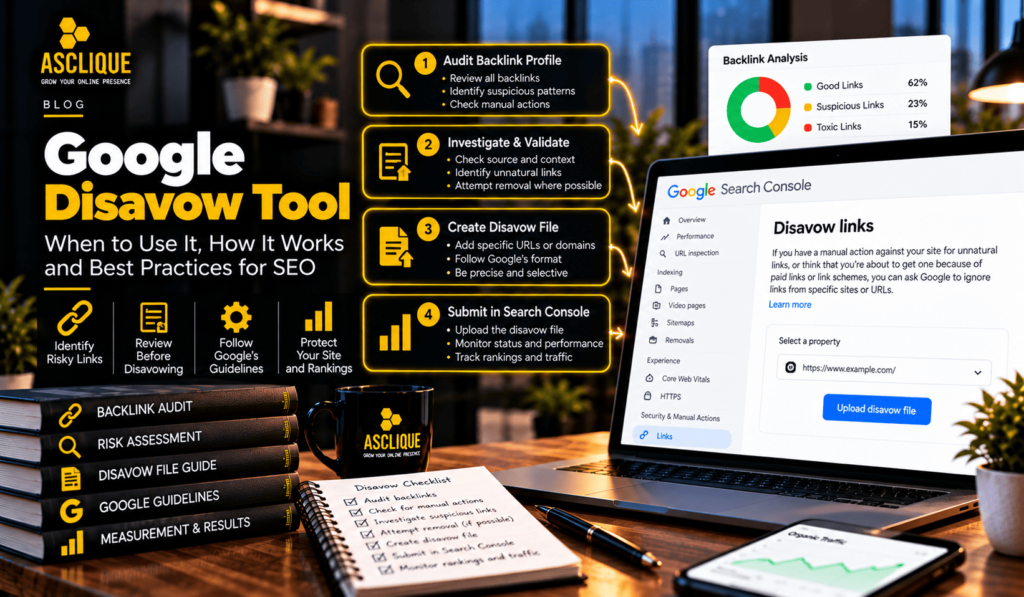
Audit the backlink profile
Collect backlink data from relevant sources and identify unusual domains, pages, anchor-text patterns and acquisition periods. Apply this specifically to Google Disavow Tool: when you should and should not use it by documenting the current state before making a decision.
Investigate suspicious links
Review the source, context, placement and reason each suspicious link exists. Look for patterns such as paid links, link networks, sitewide placements or other activity that may have been created primarily to manipulate rankings.
Check for manual actions
Review Google Search Console for relevant manual-action information and examine the site’s history. A manual action can materially change how the cleanup process should be handled.
Attempt appropriate cleanup where practical
When links were created through an identifiable relationship or controllable source, consider appropriate removal or cleanup efforts before relying on disavowal. Document the work and retain evidence of the process.
Prepare the disavow file carefully
If disavowal is appropriate, prepare the file according to Google’s current requirements. Use precise URLs or domains where justified and avoid adding legitimate links simply because a third-party tool considers them low quality.
Measure outcomes
Track relevant visibility, manual-action status, qualified traffic, conversions and other business outcomes after implementation. Do not assume that a ranking movement was caused by disavowal without considering other changes and external factors.
A Practical Asclique Workflow
- Audit: Collect relevant backlink URLs, domains, anchor text, acquisition dates, manual-action information and conversion data. Record the baseline before making changes.
- Diagnose: Separate symptoms from causes. A traffic decline, for example, can come from demand, ranking, indexation, tracking, seasonality, site changes or algorithmic changes rather than a single backlink issue.
- Prioritize: Prioritize links and patterns based on evidence, relevance and potential risk. Avoid spending resources on every low-quality backlink without a clear reason.
- Implement: Take the smallest coherent action that addresses the identified problem. Where disavowal is justified, prepare and submit the file according to Google’s current documentation.
- Validate: Check the file, syntax, domains and URLs before submission. Confirm that the live implementation and documented process match the intended action.
- Measure: Compare post-change results with the baseline and account for seasonality, algorithm changes, other releases and data limitations.
- Iterate: Keep what works, revise what does not and update the internal playbook with evidence from the site’s backlink history and search performance.
Weak Approach vs Better Approach
| Weak Approach | Better Approach | Why It Is Better |
|---|---|---|
| Copy a competitor page and change the wording | Research the same intent independently and build a stronger Asclique resource | Creates original value and reduces factual and copyright risk |
| Apply every checklist item | Diagnose the specific backlink problem first | Prevents unnecessary changes and makes results easier to interpret |
| Treat a third-party toxicity score as proof | Review the actual link, source, context and acquisition pattern | Reduces unnecessary disavowal and improves decision quality |
| Report rankings alone | Connect visibility to qualified traffic and conversions | Shows whether the work contributes to business outcomes |
| Publish and forget | Schedule review dates for changing claims and backlink conditions | Protects accuracy and long-term performance |
Common Mistakes to Avoid
- Treating Google Disavow Tool: when you should and should not use it as a guaranteed ranking factor or shortcut.
- Disavowing every backlink that a third-party SEO tool labels as toxic or low quality.
- Failing to investigate whether suspicious links were created intentionally or are simply irrelevant, old or low-value links.
- Ignoring Google Search Console manual-action information when investigating a potential link problem.
- Creating a disavow file without checking the current Google documentation and file requirements.
- Making a major sitewide change without a baseline, change log or validation plan.
- Confusing correlation with causation after rankings or traffic move.
- Optimizing for an SEO metric while ignoring the quality of traffic and conversions.
What Is Not Proven
There is no reason to present every industry theory about Google Disavow Tool: when you should and should not use it as established fact. Search systems are complex, platform behavior changes, and many public experiments are observational rather than controlled. Where evidence is incomplete, Asclique recommends labeling the statement as an observation, hypothesis or recommendation and describing how it could be tested on the site.
This distinction is particularly important for claims about link value, algorithm behavior, third-party toxicity scores, entity theories and AI-search visibility. A useful article can explain an industry hypothesis without pretending the platform has confirmed it.
How to Measure Success
| Measurement Layer | Examples | Use |
|---|---|---|
| Visibility | Impressions, relevant query coverage, rankings or presence in the target search surface | Use with the baseline and business objective; do not interpret in isolation. |
| Engagement | Qualified sessions, engaged sessions, useful navigation and interaction | Use with the baseline and business objective; do not interpret in isolation. |
| Technical health | Manual-action status, crawl behavior, indexation and relevant technical signals | Use with the baseline and business objective; do not interpret in isolation. |
| Conversion | Leads, calls, demos, purchases, signups or another defined business action | Use with the baseline and business objective; do not interpret in isolation. |
| Quality | Lead quality, revenue, assisted conversions, retention or downstream sales feedback | Use with the baseline and business objective; do not interpret in isolation. |
| Efficiency | Time and cost required to investigate, maintain and improve the backlink profile | Use with the baseline and business objective; do not interpret in isolation. |
Google Disavow Tool Checklist
- Define the primary link-related problem.
- Review the complete backlink profile and suspicious patterns.
- Check Google Search Console for relevant manual-action information.
- Review current first-party Google documentation.
- Record the baseline before making changes.
- Investigate suspicious links individually or by meaningful domain-level patterns.
- Attempt appropriate link removal or cleanup where practical.
- Prepare a precise disavow file only when disavowal is justified.
- Validate the file before submission.
- Measure qualified outcomes rather than vanity metrics.
FAQ’s
What is Google Disavow Tool?
Google Disavow Tool is a specialized tool that allows site owners to ask Google to ignore specific backlinks pointing to their site. It is intended for situations involving substantial spammy or artificial links where disavowal is appropriate, rather than routine cleanup of every low-quality backlink.
Is Google Disavow Tool still relevant in 2026?
Yes, but it should be used selectively and according to Google’s current documentation. Search teams should not assume that every suspicious or low-quality backlink requires disavowal.
How should a business start with Google Disavow Tool?
Start with a backlink audit. Document the current state, investigate suspicious patterns, check for relevant manual-action information, determine whether disavowal is justified and prepare the file carefully if needed.
What is the biggest mistake with Google Disavow Tool?
A major mistake is treating every low-quality backlink as harmful and automatically adding it to a disavow file. Third-party toxicity scores are useful for investigation, but they should not replace contextual review and evidence.
How do you measure Google Disavow Tool?
Use metrics that match the objective. Combine leading indicators such as search visibility and manual-action status with business outcomes such as qualified visits, leads, revenue, signups or other conversions. Avoid attributing every subsequent ranking change to the disavowal process.
Asclique Recommendation
Treat Google Disavow Tool: when you should and should not use it as a specialized part of a broader backlink-management system. Start with evidence, investigate suspicious link patterns, review Google’s current guidance and avoid disavowing links simply because they appear low quality in a third-party tool. When disavowal is justified, use a precise and documented process and measure the outcome against a defined business objective.
Need Help With This?
Asclique can audit your current Google Disavow Tool: when you should and should not use it setup, investigate suspicious backlink patterns, identify the highest-impact gaps, build a prioritized implementation plan and connect the work to SEO, content, analytics and AI-search measurement where relevant. The goal is a defensible roadmap based on your site and data, not a generic checklist.