That sentence now sits in the first vendor brief most buyers read: 94% of business buyers now use AI in their buying process. GenAI was also named their most meaningful information source, ahead of vendor websites and sales.
AI answers are brand copy, and AI visibility tools are how brand and marketing leaders read that copy before buyers do.
The usual comparison of AI brand visibility tools counts prompts and engine logos. A brand team needs the dated wording each engine uses, what the sentiment is about, and which sources shape it.
The description is the brand now, and it needs an owner.
My audits keep surfacing three problems that shape everything below.
Quick Answer: What Are the Best AI Visibility Tools for 2027?
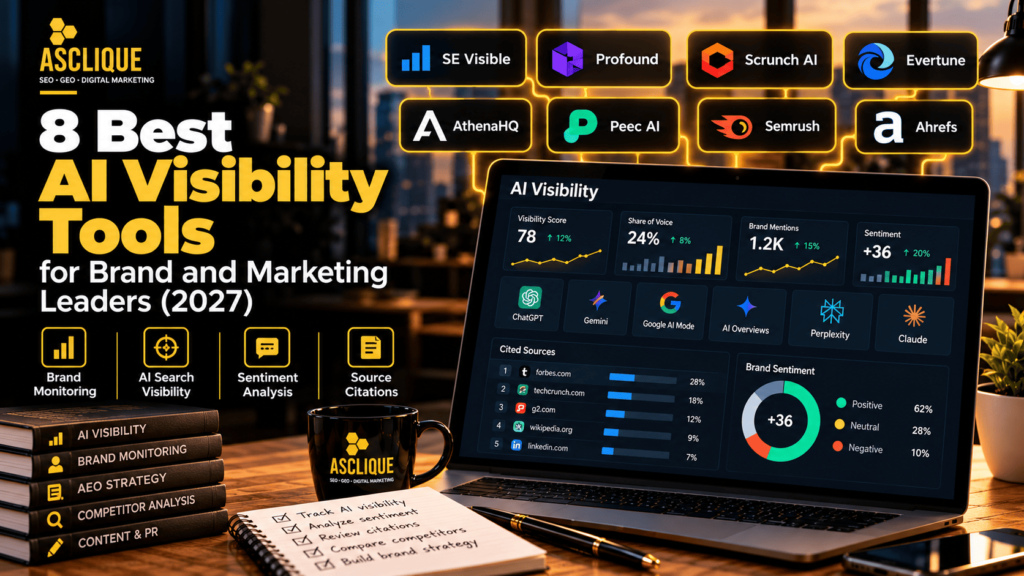
The best AI visibility tools for brand and marketing leaders include SE Visible, Profound, Scrunch AI, Evertune, AthenaHQ, Peec AI, Semrush AI Visibility Toolkit, and Ahrefs Brand Radar.
SE Visible is a strong choice for teams that need to monitor how AI platforms describe their brand. It tracks AI visibility, share of voice, sentiment, and cited sources while retaining the original responses behind reported metrics.
Profound and AthenaHQ support enterprise teams managing inaccurate brand claims. Scrunch AI focuses on monitoring and executive reporting, while Evertune provides attribute-based brand perception research.
Peec AI helps identify the sources influencing AI-generated descriptions. Semrush and Ahrefs offer AI visibility insights alongside established SEO capabilities.
For brand leaders, the most important consideration is not simply how many AI platforms a tool monitors. It is whether the platform preserves the exact wording, sentiment, sources, market, and date behind each result.
Key Facts and What Is Verified
- FACT: AI visibility tools monitor how brands appear in AI-generated answers across supported platforms.
- FACT: Brand mentions and source citations are different measurements.
- FACT: AI-generated responses can vary across prompts, platforms, locations, and reporting periods.
- FACT: Sentiment scores require context to explain which brand attributes or experiences influence the result.
- FACT: Source analysis can identify the domains and URLs referenced in AI-generated answers.
- FACT: AI visibility does not necessarily translate into direct website traffic.
- FACT: Consistent prompt sets and reporting periods make historical comparisons more meaningful.
- IMPORTANT: Vendor specifications, pricing, and research statistics reflect the original October 2026 research. Confirm them against current primary sources before publishing or purchasing.
Table of Contents
- Three Problems AI Visibility Tools Must Solve
- What Should AI Visibility Tools Show a Brand Team?
- AI Visibility Tools Compared
- The 8 Best AI Visibility Tools for Brand Teams
- How to Choose an AI Visibility Tool
- How to Measure AI Brand Visibility
- Common Mistakes to Avoid
- Key Takeaways
- Frequently Asked Questions
- Asclique Recommendation
- Need Help With AI Search Visibility?
Three Problems AI Visibility Tools Must Solve
Problem 1: The Description Is Out of Date, and Nobody Owns It
A stale description of your brand survives in AI answers because nobody owns it.
Even for professionally published news, 20% of AI assistant answers contained major accuracy issues, including hallucinated details and outdated information.
Treat the stale line as a brand defect with an owner, a cause, a fix, and a recheck date.
To recheck a stale line, AI visibility tracking must show how the machine describes us: the verbatim answer, engine, date, and market.
Problem 2: Sentiment Without a Subject
A sentiment score tells a brand team nothing until it names the subject: pricing perception, support, or category fit, each with a different owner.
That gap matters because half of people who see AI search answers say they trust them, while only a third regularly click through to the sources.
An AI answer reads as the final word, so its tone becomes the brand’s tone.
Your AI visibility tools should trace each score back to its response.
Problem 3: The Sources Behind the Description Stay Off-Screen
AI brand descriptions trace back to pages your buyers rarely open: review sites and comparison posts.
Review platforms were cited in 34.5% of AI Overviews, yet only 4.3% named a review platform in the answer text.
For AI search visibility, a platform must list cited domains and URLs per engine, and whether each cited page mentions the brand.
Corrections start there.
Understanding these sources is an important part of answer engine optimization. Asclique’s Answer Engine Optimization guide explains how businesses can connect AI search visibility with content quality and search fundamentals.
What Should AI Visibility Tools Show a Brand Team?
Stale descriptions, unexplained sentiment, and hidden sources share one fix: an AI visibility tool that keeps the evidence behind each number, so a brand team sees what each engine said and where the wording came from.
Check for five signals:
- Verbatim answers: Full, dated responses per engine.
- Traceable sentiment: Each reading opens into its response.
- Sources: Each engine’s cited domains and URLs.
- Coverage: Your buyers’ engines, with no per-engine trade-offs.
- Reporting out: Exports, connectors, an API, and executive reports for the quarterly brand-health read.
Because only 9.2% of AI Mode source URLs matched across three runs of the same query, one manual check is only an anecdote.
I scored each platform on these criteria using vendors’ product and pricing pages from October 2026.
For additional context on how AI systems reference websites, see Asclique’s AI Citation Tracking guide.
AI Visibility Tools Compared
Compared on engine coverage, answer evidence, sentiment, reporting, and starting price, these eight AI visibility tools split on one question:
Does the platform keep the wording behind its numbers?
That decides whether a brand team can recheck a description.
| Rank | Platform | Engines Covered | Answer Evidence | Sentiment | Reporting | Starting Price |
|---|---|---|---|---|---|---|
| 1 | SE Visible by SE Ranking | All plans: ChatGPT, Gemini, AI Mode, AI Overviews | Unedited response, engine, market, date | Net score, -100 to +100 | API, Looker Studio, CSV/XLSX | Free trial; plans on site |
| 2 | Profound | Trial 3, Enterprise up to 9 | Citation analytics, accuracy checks | Yes | Enterprise exports, API | Free trial; Enterprise custom |
| 3 | Scrunch AI | Core 4, Enterprise 9 | Citations and sources | Yes | Board reporting on Enterprise | $250/mo |
| 4 | Evertune | 11 models | Up to 100x sampling | Attribute scoring | Not stated | $800/mo |
| 5 | AthenaHQ | Free 5, Starter 11 | Claim review on Enterprise | Yes | CSV; BI on Enterprise | Free plan; $295/mo |
| 6 | Peec AI | 3 chosen, up to 13 Enterprise | Source classification | Attribute scoring | Looker Studio from Advanced | EUR 85/mo |
| 7 | Semrush AI Visibility Toolkit | 4 per report | Main narratives | Yes, weekly reports | CSV | $99/mo |
| 8 | Ahrefs Brand Radar | 6; Claude on custom prompts | Citations, cited pages | Not on Brand Radar | Within Ahrefs | $50/mo custom prompts |
The 8 Best AI Visibility Tools for Brand Teams, Ranked
The eight AI visibility platforms below each get a card: positioning, audience, standout feature, pros, cons, pricing, and brand read.
Each positioning line names the description problem its platform handles best: stale wording, sentiment without a subject, or off-screen sources.
1. SE Visible
An outdated product description in a ChatGPT answer is a brand problem long before anyone on the team notices it.
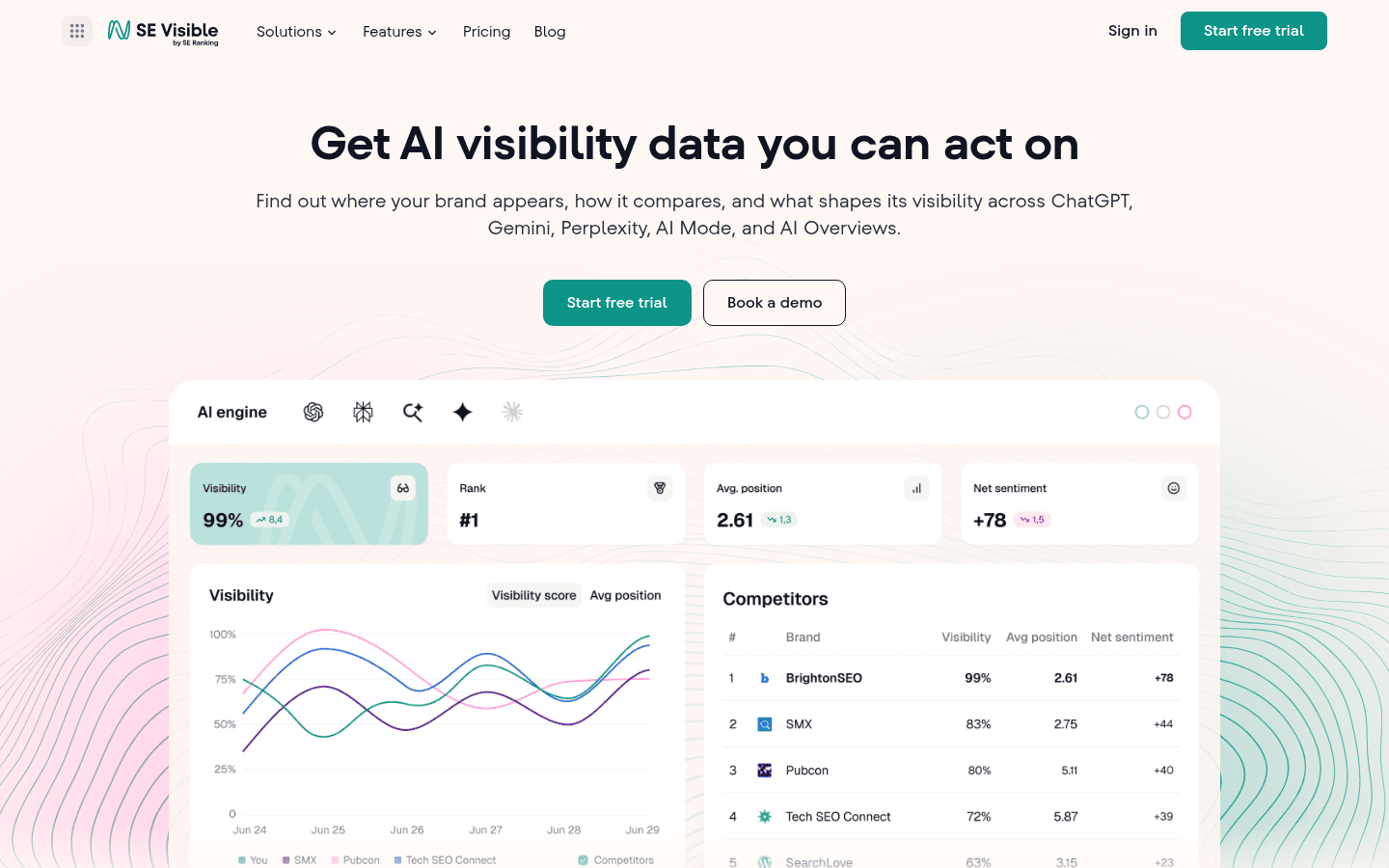
SE Visible by SE Ranking is an AI visibility platform that covers stale descriptions, sentiment without a subject, and the off-screen sources behind both.
Best for: In-house brand and marketing teams who own how the company is described across markets and report a brand-health read upward.
Standout Feature
SE Visible collects responses through a real browser session in each engine’s graphical interface and stores the unedited answer with its engine, market, and date.
Your visibility score, average position, share of voice, and net sentiment each open into the response behind them, so you read the wording, not just the number.
Pros
- Scores net sentiment on a -100 to +100 scale.
- Lists the most-cited domains and URLs per engine, with a filter for pages that mention the brand.
- Covers ChatGPT, Gemini, Google AI Mode, and Google AI Overviews on all plans, with no engine add-ons and no model tiering.
- Sets markets by country, city, or region, tracked daily by default at adjustable frequency.
Cons
- Scope stops at AI visibility. SEO work lives in SE Ranking.
- ChatGPT, Gemini, AI Mode, and AI Overviews today; the platform is still growing, with Claude support planned.
- In-app reports are still maturing, so fuller reporting goes through Looker Studio, the API, or exports.
Pricing: Plans are published on the SE Visible website with a free trial; all plans include API access.
The Brand Read
If you need the answer, its sentiment, and its source in one dated record, start here. See how it fits your audit on SE Visible’s page for brand specialists. SE Ranking covers the SEO side in Google and traditional search, so together the two platforms give a fuller picture of your brand.
2. Profound
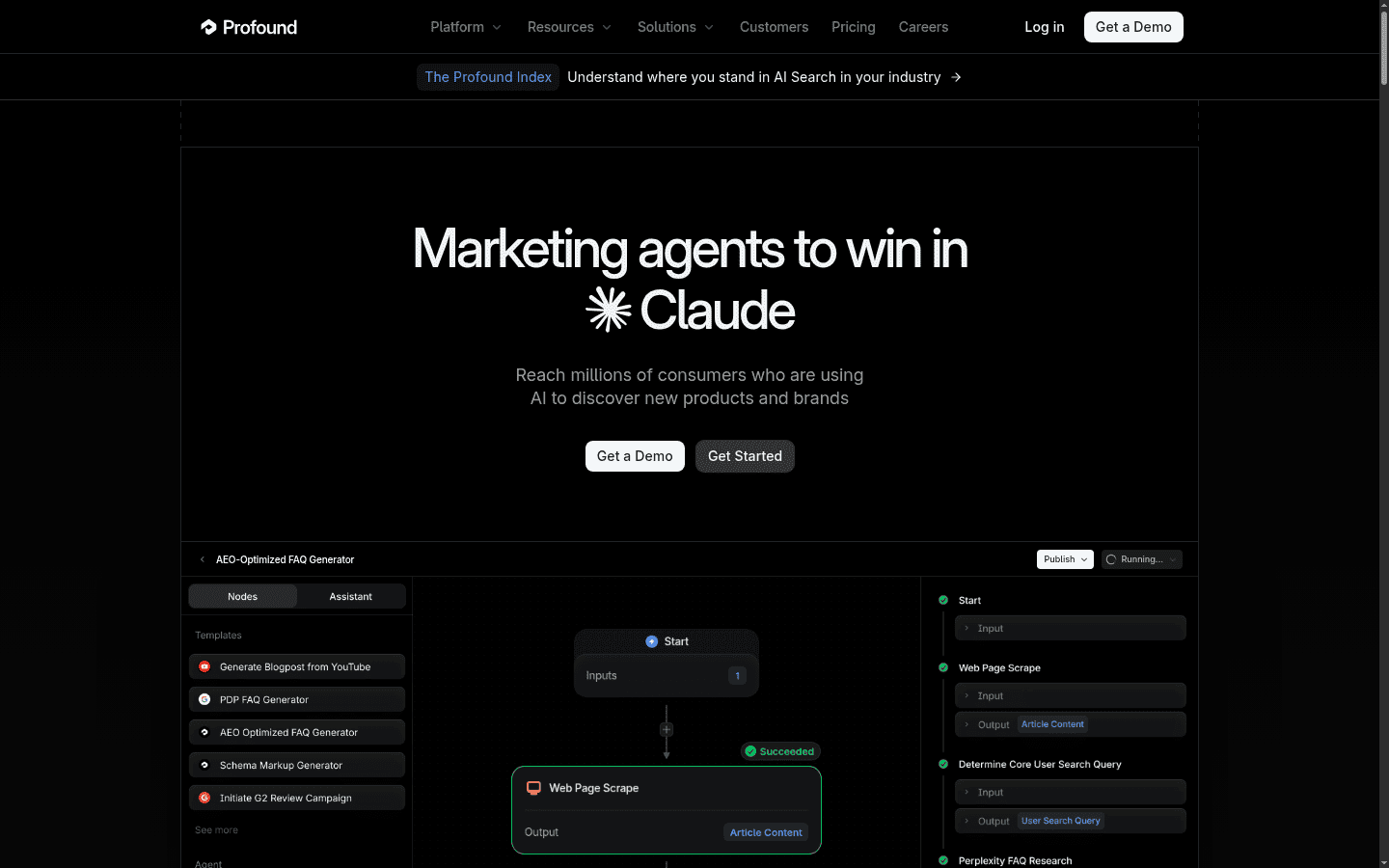
Profound handles stale descriptions at enterprise scale, with accuracy checks and sentiment across answer engines.
Best for: Fortune-500-scale brand and marketing organizations running AI search as an enterprise program with procurement and SSO requirements.
Standout Feature
Profound’s “verify the accuracy of AI claims” capability flags where engines spread misinformation about you, beside sentiment that names the narrative and its sources.
Enterprise extends it to up to nine engines, including Google AI Mode and Claude, with all-time history.
Pros
- Adds API and CSV/JSON exports.
- Supports SSO/SAML and SOC 2.
- Runs credit-based marketing agents.
Cons
- Trial tracks only ChatGPT, Gemini, and AI Overviews.
- Trial excludes prompt editing, history, exports, and API.
Pricing: Free seven-day trial; Enterprise by quote.
The Brand Read
Shortlist Profound if your brand team sits inside a global organization with procurement and security checklists. Profound’s accuracy checks target stale brand descriptions. Plan the pilot around Enterprise: the trial won’t show how Perplexity or AI Mode describe you.
3. Scrunch AI
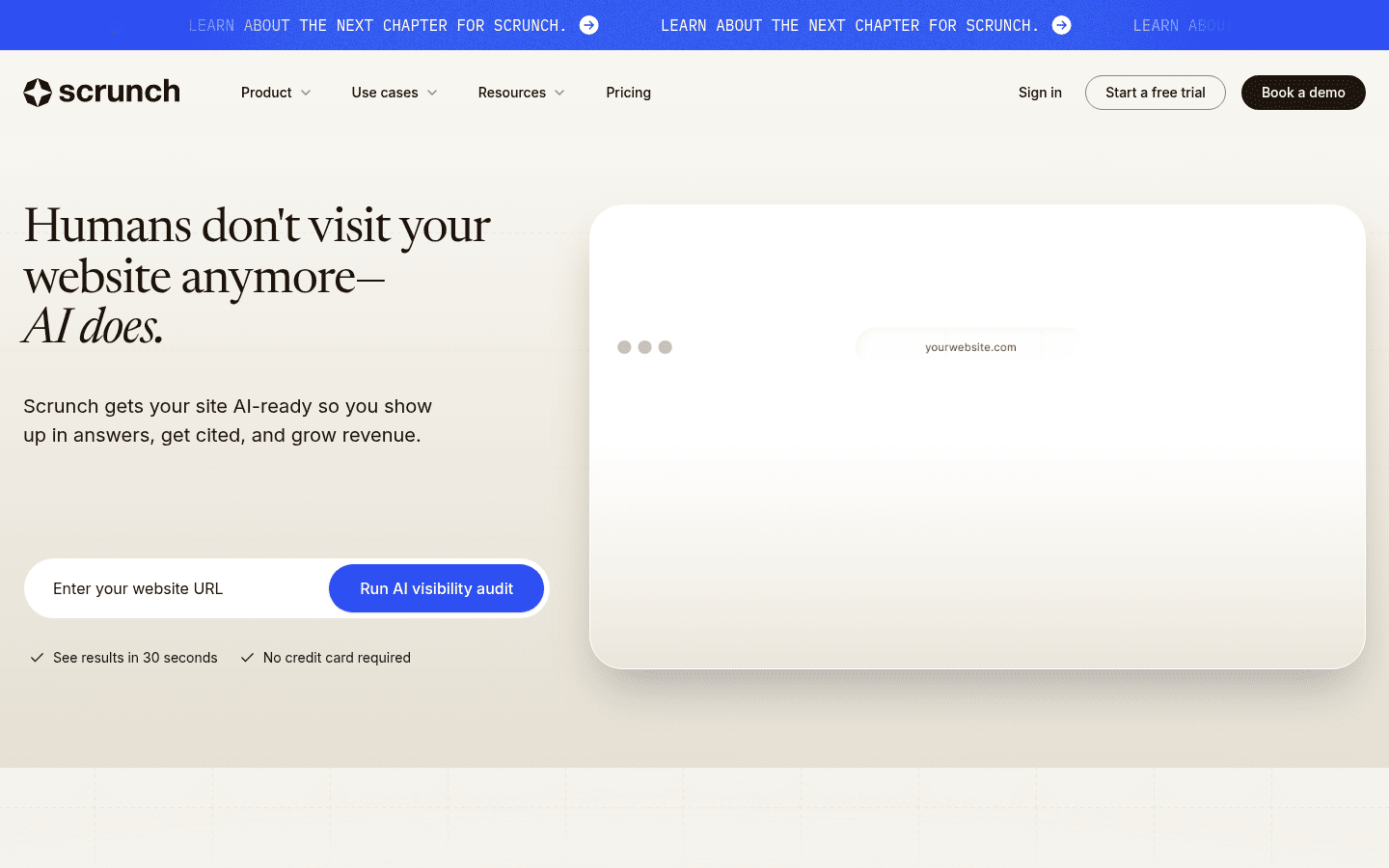
Scrunch AI addresses off-screen sources: both plans log the citations behind answers beside sentiment analysis.
Best for: Enterprise marketing teams that need board-level reporting on AI visibility.
Standout Feature
Scrunch’s Explorer, which the vendor calls “a fully composable BI layer,” sits on monitoring that tracks citations, sentiment, funnel stages, personas, and competitors.
On Enterprise, Exec/Board Reporting joins it, with coverage of nine LLMs, including Gemini and Google AI Mode.
Pros
- Segments monitoring by funnel stage.
- Analyzes AI agent traffic.
- Includes five user licenses.
Cons
- Core tracks four LLMs, without Gemini or AI Mode.
- Core allows one country, persona, and language.
- API, Looker Studio, and executive reporting are Enterprise-only.
Pricing: Core $250/month, seven-day free trial; Enterprise custom.
The Brand Read
Scrunch positions Core for evaluation, and for a brand team that’s fair: one country, no Gemini or AI Mode. I’d recommend it to enterprise teams that budget for Enterprise upfront, since board reporting is the main reason to choose it.
4. Evertune
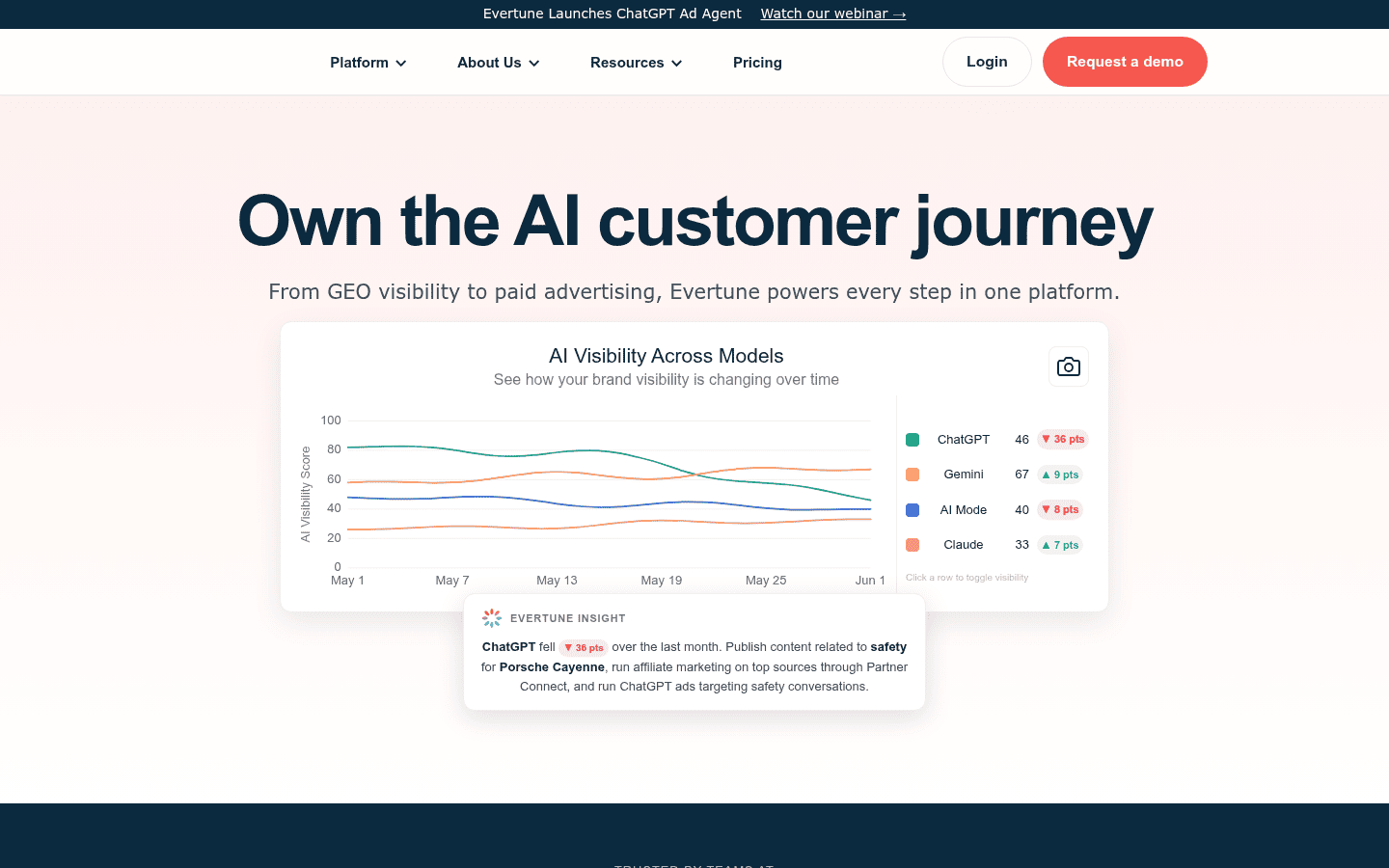
Evertune targets sentiment without a subject, scoring how models describe your brand attribute by attribute.
Best for: Brand strategy teams that want statistically sampled perception research by attribute.
Standout Feature
Evertune samples prompts up to 100 times per model, so a characterization counts only when it recurs.
Performance by Attribute scores your brand on qualities such as design, reliability, and safety against each competitor in your category.
Pros
- Tracks 100,000 prompts across 11 models.
- Draws on EverPanel’s 150 million user prompts.
- Sets cadence to daily, weekly, or monthly.
Cons
- Demo-led, with no trial stated.
- Sells ChatGPT ads and affiliate placements alongside monitoring.
- Bot analytics and SSO are Enterprise-only.
Pricing: Pro at $800/month.
The Brand Read
Evertune answers a question I used to buy from research agencies: which qualities do engines attach to us and each competitor? Use it for perception research by attribute, and pair each score with its source wording before naming an owner.
5. AthenaHQ
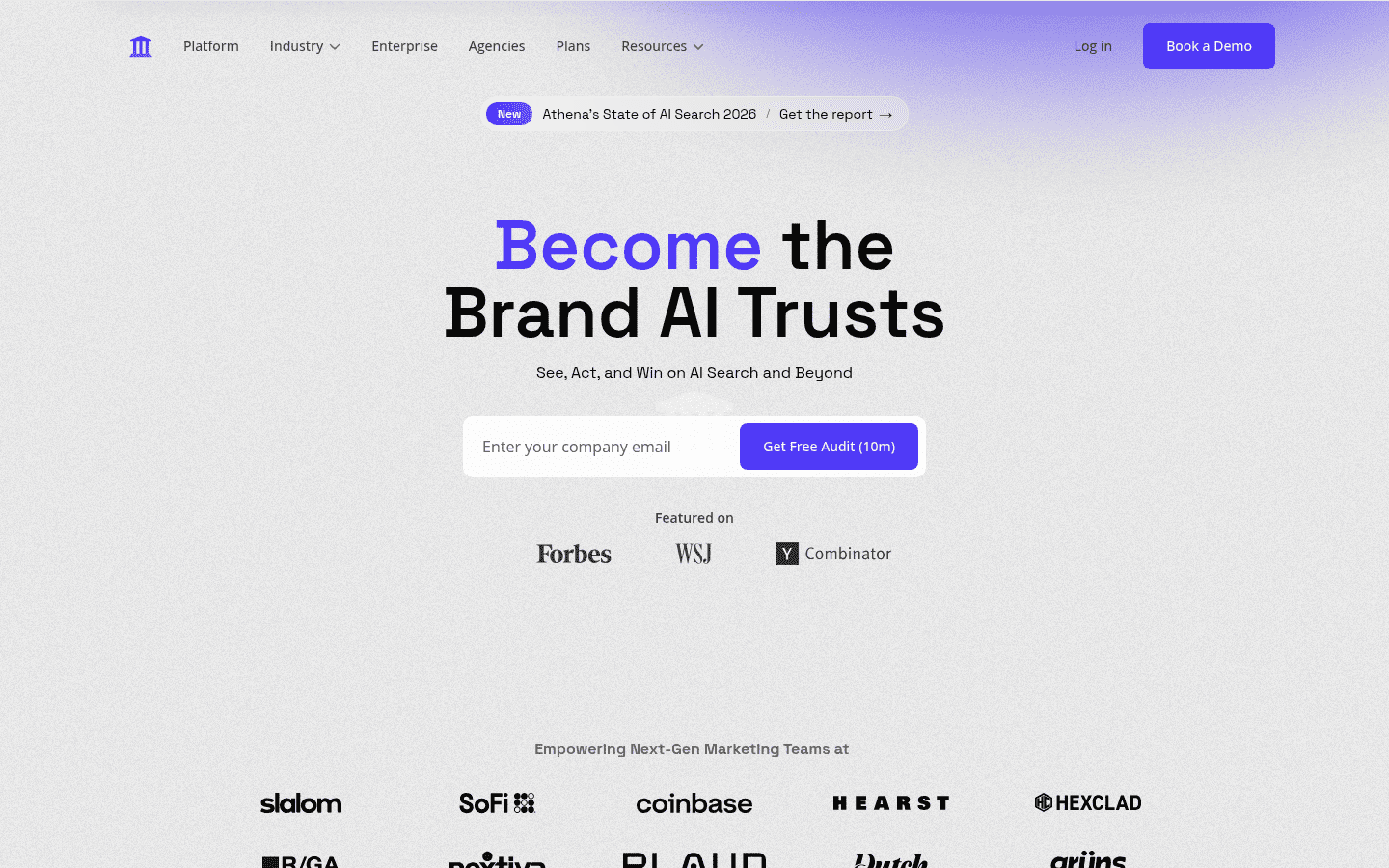
AthenaHQ targets the stale or wrong description, with claim review and discrepancy detection on Enterprise.
Best for: Marketing organizations that want brand-guideline enforcement and claim review tied to an action layer.
Standout Feature
Brand guidelines enforcement belongs to the action layer; Enterprise adds a Knowledge Base with claim review and Oracle discrepancy detection.
Findings feed a content optimization agent and on-page and off-page GEO actions, so the correction sits beside the read.
Pros
- Tracks 11 models on Starter.
- Pairs sentiment with guideline enforcement.
- Starts free with 300 credits.
Cons
- “1 credit = 1 AI response,” so daily multi-engine tracking is metered.
- Starter covers one region and language; API costs extra.
Pricing: Free Essential; Starter $295/month.
The Brand Read
AthenaHQ speaks the language of brand guidelines, which puts it on my governance shortlist. What a nine-market audit needs, claim review and multi-region coverage, sits on Enterprise. Price your daily prompt set in credits first: that’s the real cost.
6. Peec AI
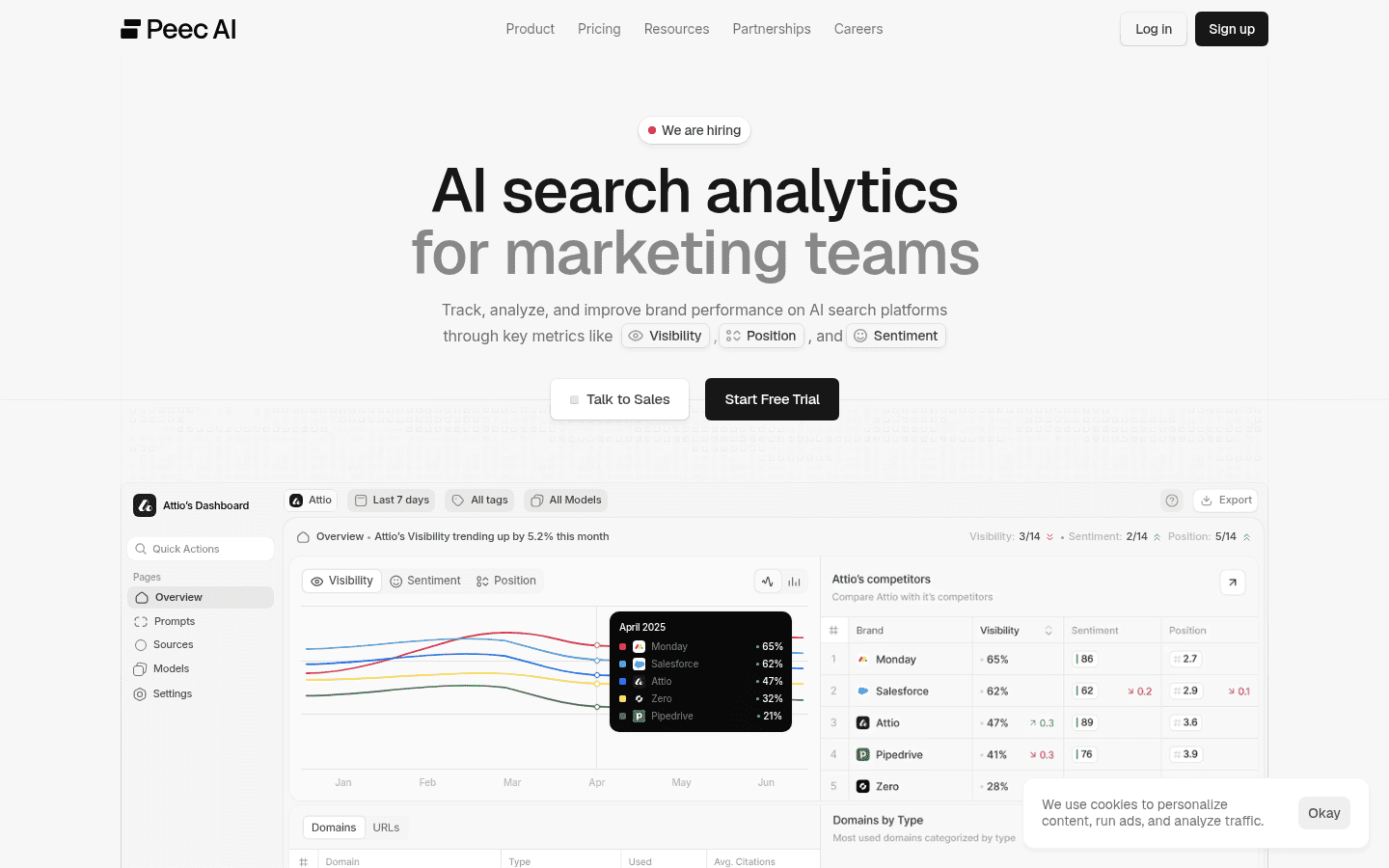
For off-screen sources, Peec AI is an AI visibility tracker that classifies the pages behind each answer by type.
Best for: Marketing teams that map which editorial, UGC, and competitor sources shape answers.
Standout Feature
Source analytics tags cited domains, subdomains, and URLs with types like competitor, editorial, reference, or UGC.
In a description audit, that turns “the wording came from somewhere” into a named page and type, which names the team that owns the fix.
Pros
- Tracks sentiment daily.
- Scores attributes and objections in Brand Perception.
- Fact-checks prompts against brand facts.
Cons
- Three models below Enterprise; extras are paid add-ons.
- API and SSO on Enterprise; Looker Studio from Advanced.
Pricing: EUR 85/205/425 per month; Enterprise custom.
The Brand Read
In my audits, stale descriptions usually came from someone else’s page, and Peec AI is built to name that page. Plan around the model cap: choose the three engines your buyers use, or budget add-ons before the audit spans several markets.
7. 
Semrush’s toolkit addresses sentiment without a subject, naming narratives, tone, and attributes behind each reading.
Best for: In-house teams already running SEO in Semrush who want AI brand narratives next to it.
Standout Feature
Brand Performance analyzes share of voice, sentiment, and the main narratives shaping your description across Google AI Mode, ChatGPT, Perplexity, and Gemini.
It assesses the tone and attributes engines attach to you, so you see which narrative pulled the reading down.
Pros
- Benchmarks visibility against auto-identified competitors.
- Tracks prompts daily across four engines.
- Sits beside your Semrush SEO data.
Cons
- Brand Performance reports update weekly.
- No free trial offered.
- Includes 25 prompts, licensed at $99 per user.
Pricing: $99/month; an additional 50 prompts costs $60/month.
The Brand Read
If your SEO lives in Semrush, this adds narrative reads without a new vendor review. Treat it as a weekly brand-health input, and size prompts early: 25 goes quickly once another market joins.
8. Ahrefs Brand Radar
Ahrefs Brand Radar maps off-screen sources at category scale: the domains and pages engines cite.
Best for: Brand and SEO teams benchmarking category share of voice across a large prompt index.
Standout Feature
The AI Visibility Index shows any brand’s visibility across 476 million prompts, each modeled from real searches, on AI Overviews, AI Mode, ChatGPT, Perplexity, Gemini, and Copilot.
Mentions, citations, AI share of voice, and estimated impressions make it a category benchmark.
Pros
- Benchmarks brands without setup.
- Tracks YouTube, Reddit, and TikTok sources.
- Adds Claude via Custom Prompts.
Cons
- Index re-tests monthly, with a 90-day window.
- Limited low-search-volume coverage.
- No sentiment metric listed; per-check overage.
Pricing: Custom Prompts from $50/month; Index from $199/month.
The Brand Read
Ahrefs Brand Radar shows how much of the category conversation is yours, a market-share study for AI answers. Use it to see where you stand, then read the answers to learn how engines describe you.
How to Choose an AI Visibility Tool for Your Brand
The best AI visibility platform is not necessarily the one with the largest prompt database or the most supported models.
For brand and marketing leaders, the decision should start with the problems the tool needs to solve.
1. Identify the Brand Problem First
Determine whether the primary issue is inaccurate descriptions, unexplained sentiment, missing citations, or weak competitive visibility.
Different platforms specialize in different parts of this process.
2. Confirm Access to Original AI Responses
A visibility score without the original answer is difficult to investigate.
Look for dated responses, platform identification, geographic context, and access to the wording behind each metric.
3. Evaluate Sentiment Context
Sentiment should explain what AI platforms say about the brand, not simply whether the overall tone is positive or negative.
Attribute-level analysis can help identify whether a negative reading concerns pricing, service quality, reliability, or another specific issue.
4. Review Citation and Source Analysis
Identify whether the platform lists cited domains, individual URLs, and source categories.
This information can help content and PR teams investigate where inaccurate or outdated descriptions may originate.
5. Check Reporting and Market Coverage
For organizations operating internationally, confirm support for the required countries, languages, and AI platforms.
Also evaluate exports, API access, Looker Studio integrations, and executive reporting capabilities.
6. Calculate the Actual Cost
Some vendors charge based on prompts, responses, markets, users, or monitored models.
A plan that appears affordable for one market may become expensive when expanded across multiple countries.
Estimate costs using your expected monitoring volume before committing to a subscription.
How to Measure AI Brand Visibility
AI visibility should be measured as a trend across consistent prompts, engines, and markets rather than through isolated manual checks.
A useful brand-health report connects visibility metrics with the actual descriptions and sources behind them.
| Measurement | What It Shows | Why It Matters |
|---|---|---|
| AI Visibility Score | How frequently a brand appears in monitored AI responses. | Provides a baseline for visibility trends. |
| Share of Voice | Brand presence compared with competitors. | Shows relative competitive performance. |
| Brand Mentions | How often AI platforms reference the company. | Measures brand presence in generated answers. |
| Sentiment | How positively or negatively AI platforms describe the brand. | Identifies potential reputation and positioning concerns. |
| Source Citations | Which domains and URLs appear as supporting sources. | Helps identify content and digital PR opportunities. |
| Historical Changes | How descriptions and visibility change over time. | Supports consistent executive reporting. |
These measurements should be reviewed alongside traditional SEO and analytics data.
For businesses developing a broader search strategy, Asclique’s AI SEO Services connect AI search visibility with content optimization, technical accessibility, and established search fundamentals.
Common Mistakes to Avoid When Tracking AI Visibility
Tracking Mentions Without Reading the Answers
A brand may appear frequently in AI-generated answers while being described inaccurately.
Visibility alone does not establish whether the brand’s positioning is represented correctly.
Treating Sentiment as a Complete Explanation
A positive or negative score does not explain which brand attribute influenced the result.
Review the underlying response before assigning corrective work.
Ignoring Third-Party Sources
AI-generated answers may cite comparison pages, reviews, editorial content, and other third-party sources.
Reviewing these sources can reveal outdated or incomplete information that requires attention.
Using One Manual Prompt as Evidence
AI responses can change between runs.
Use repeated observations across a consistent prompt set before drawing conclusions about performance.
Comparing Vendor Scores Directly
AI visibility scores are not standardized across platforms.
Different prompt datasets, scoring methods, and sampling frequencies can produce different results.
Purchasing Without Calculating Market Coverage
Multi-market tracking may require additional prompts, models, languages, or subscription tiers.
Confirm these requirements before evaluating total cost.
Reporting Without Assigning Ownership
Monitoring identifies potential problems. It does not automatically correct inaccurate brand descriptions or improve source quality.
Assign findings to the appropriate brand, content, SEO, or PR team.
Key Takeaways
- SE Visible is a strong choice for teams that need dated AI responses, sentiment, and citation evidence.
- Profound supports enterprise programs managing AI-generated claims and accuracy.
- Scrunch AI offers AI monitoring with executive reporting capabilities on Enterprise.
- Evertune focuses on attribute-based brand perception research.
- AthenaHQ connects brand guidelines and claim review with optimization workflows.
- Peec AI helps teams identify the types of sources influencing AI-generated descriptions.
- Semrush adds AI brand narratives to existing SEO workflows.
- Ahrefs Brand Radar supports category-level AI visibility and citation benchmarking.
- Original responses matter: Brand teams need to investigate the wording behind reported metrics.
- Consistent monitoring matters: One AI-generated response is not enough to establish a reliable trend.
FAQ’s
How Do AI Visibility Tools Work?
AI visibility tools run a fixed set of prompts across answer engines on a schedule, record each answer, and extract mentions, position, sentiment, and cited sources.
The more useful platforms keep the full response, so you can check a number against the words behind it.
How Do You Measure AI Search Visibility?
Measure AI search visibility with five readings: visibility score, share of voice, average position, net sentiment, and cited sources.
Read them as a trend over dated runs, per engine and per market.
A single snapshot proves little: the same prompt can return a different answer tomorrow.
Are AI Visibility Tools the Same as GEO or AEO Tools?
Partly. Generative engine optimization tools and AEO tools usually add an optimization or action layer on top of AI visibility tracking.
A brand team needs the evidence layer first: what each engine says about the brand and which sources it draws on.
Then it decides who acts.
What Are the Best AI Visibility Tools for 2027?
The leading tools to evaluate include SE Visible, Profound, Scrunch AI, Evertune, AthenaHQ, Peec AI, Semrush AI Visibility Toolkit, and Ahrefs Brand Radar.
The right choice depends on whether your priority is brand description accuracy, sentiment analysis, citation research, competitive benchmarking, or executive reporting.
What Is AI Brand Visibility?
AI brand visibility refers to how frequently and prominently a brand appears in AI-generated answers.
It can include brand mentions, recommendations, citations, competitive presence, and the language used to describe the company.
Visibility should be evaluated alongside the accuracy and context of those descriptions.
Can AI Visibility Tools Track ChatGPT Mentions?
Yes. Many AI visibility platforms monitor whether a brand appears in ChatGPT responses to selected prompts.
Some also store the complete response, track sentiment, and compare mentions with competitors.
Results can vary, so repeated monitoring is more useful than a single manual check.
What Is AI Share of Voice?
AI share of voice measures a brand’s presence relative to competitors across a defined set of AI-generated responses.
Depending on the platform, it may consider mention frequency, answer position, or other factors.
Because methodologies differ, compare trends within a consistent measurement system.
Can AI Visibility Tools Detect Incorrect Brand Information?
Some platforms provide claim review, accuracy checks, or access to the original responses used in their reporting.
These features can help teams identify outdated descriptions, inaccurate product information, or misleading brand claims.
However, human review is still important before determining whether a statement is incorrect.
Why Is Sentiment Analysis Important for AI Visibility?
Sentiment analysis helps teams understand how AI-generated answers describe a brand.
For example, an AI platform may consistently associate a company with affordability, reliability, premium pricing, or poor support.
Attribute-level sentiment is more actionable than a single positive or negative score because it identifies the subject of the description.
Can AI Visibility Tools Show Which Websites Influence AI Answers?
Many platforms provide citation and source analysis, showing the domains or URLs referenced in monitored AI responses.
Some also classify sources as editorial websites, review platforms, competitors, or user-generated content.
These reports help teams investigate potential influences on AI-generated descriptions, although a citation alone does not prove that a source caused a particular statement.
How Much Do AI Visibility Tools Cost?
Pricing depends on the vendor, number of prompts, monitored models, markets, reporting requirements, and subscription tier.
Some platforms offer entry-level plans below $100 per month, while more advanced solutions can cost several hundred dollars monthly.
Enterprise packages may require custom quotes.
Which AI Visibility Tool Is Best for Enterprise Brands?
Profound, Scrunch AI, AthenaHQ, and SE Visible are worth evaluating for different enterprise requirements.
Profound emphasizes enterprise-scale monitoring and accuracy checks. Scrunch AI supports executive reporting, while AthenaHQ provides brand-guideline workflows.
SE Visible is relevant when consistent response evidence and multi-market reporting are priorities.
How Often Should Brands Monitor AI Visibility?
Monitoring frequency depends on the business and the importance of AI search to its customer journey.
Daily or weekly collection can help analysts identify changes, while monthly reporting provides a more useful view for marketing leadership.
Quarterly reviews can connect visibility trends with broader brand strategy.
Can AI Visibility Tools Improve Brand Reputation?
AI visibility tools primarily measure how brands appear in AI-generated answers.
They can identify inaccurate descriptions, negative narratives, and relevant third-party sources.
Improving brand reputation requires additional work, including correcting public information, strengthening content, addressing customer concerns, and maintaining credible sources.
What Is the Difference Between AI Visibility and SEO Visibility?
SEO visibility generally measures how websites perform in traditional search results.
AI visibility focuses on how brands and sources appear in AI-generated responses.
A brand can receive prominent mentions in AI answers without ranking first for the equivalent traditional search query.
Both should be monitored as part of a connected search strategy.
Do AI Visibility Tools Measure AI Referral Traffic?
Some platforms connect with analytics tools or provide reporting that includes AI referral traffic.
However, referral traffic and AI visibility are separate metrics.
A user may discover a brand through an AI-generated answer without clicking a link immediately.
For this reason, traffic alone does not capture the complete picture of AI brand exposure.
How Can Brands Improve Their Chances of Being Cited by AI Search Engines?
Brands can improve the usefulness and accessibility of their information by publishing accurate content, maintaining clear product descriptions, supporting important claims, and keeping public brand information consistent.
Relevant editorial coverage and credible third-party references may also contribute to discovery.
These practices do not guarantee citations.
Asclique’s How to Get Cited by ChatGPT Without Chasing Myths explains why evidence-based improvements are more useful than unsupported AI optimization claims.
What Should a Monthly AI Brand Visibility Report Include?
A monthly report should include visibility trends, share of voice, brand mentions, sentiment changes, competitor comparisons, and important cited sources.
It should also highlight inaccurate or outdated descriptions and identify the teams responsible for reviewing them.
Leadership should be able to understand what changed and what action is recommended.
Are Free AI Visibility Tools Enough for Brand Monitoring?
Free plans can be useful for initial research and evaluating a platform’s interface.
However, they may limit prompt volume, AI platform coverage, markets, historical data, or reporting capabilities.
For ongoing brand monitoring, the selected plan should support consistent data collection and access to the underlying responses.
What Is the Biggest Mistake Brands Make With AI Visibility Tracking?
The biggest mistake is treating AI visibility as a dashboard metric without reviewing what AI platforms actually say.
A rising visibility score may look positive while the brand is being described inaccurately.
Teams should evaluate visibility, sentiment, citations, and the original responses together before deciding what needs improvement.
Asclique Recommendation
The best AI visibility tool is the one that makes brand descriptions measurable, traceable, and actionable.
For teams prioritizing dated AI responses, sentiment, and cited sources, SE Visible is a strong starting point.
Profound and AthenaHQ are relevant for organizations managing inaccurate brand claims and governance requirements.
Scrunch AI is worth evaluating for enterprise reporting, while Evertune supports deeper perception research.
Peec AI helps identify the sources behind AI-generated descriptions. Semrush and Ahrefs provide useful options for teams that want AI visibility alongside existing SEO workflows.
Our recommendation: Start with the questions your customers ask, identify the AI platforms they use, and establish a consistent monitoring baseline.
Review the original responses, not just the scores.
Then assign significant findings to the appropriate content, SEO, PR, or brand team.
AI visibility monitoring becomes valuable when it helps a business understand how it is represented and what needs to change.
Need Help With AI Search Visibility?
Asclique helps businesses evaluate their AI search presence, identify inaccurate brand descriptions, review citation opportunities, and develop practical optimization strategies. The goal is to connect AI visibility insights with useful content, technical SEO, and measurable business outcomes.