
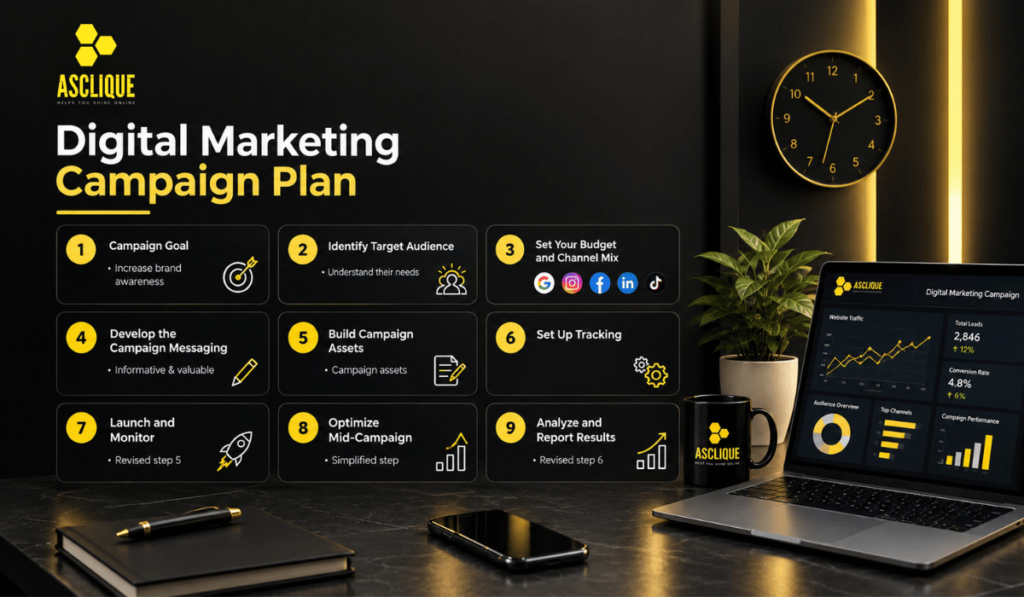
A digital marketing campaign is a coordinated set of online activities designed to achieve a specific business goal—generating leads, launching a product, building brand awareness, or driving sales over a defined period.
The difference between a campaign and scattered marketing activity is focus: a single goal, a defined timeframe, coordinated channels, and measurable outcomes. This guide walks through how to plan and execute a digital marketing campaign from the brief to the post-campaign analysis.
Step 1: Define the Campaign Goal
Every campaign needs one primary goal. Trying to achieve brand awareness and direct sales conversion simultaneously with the same budget and messaging typically weakens both.
Common campaign goals:
- Lead generation: Capturing contact information from potential clients or customers
- Product or service launch: Building awareness and initial sales for a new offering
- Brand awareness: Reaching a new audience segment that does not yet know the brand
- Sales conversion: Driving purchases or sign-ups from an existing audience
- Event promotion: Building attendance for a webinar, launch event, or in-person event
- Retargeting: Re-engaging people who have previously interacted with the brand
Define the goal in specific, measurable terms. “Increase brand awareness” is not a goal. “Reach 50,000 people in our target demographic in the US in October 2026” is a goal.
Step 2: Identify the Target Audience
Who are you trying to reach? The more precisely you define this, the better your messaging and channel selection will be.
Define your audience by:
- Demographics: Age, gender, location, income range, job title
- Psychographics: Values, interests, lifestyle, priorities
- Behavior: What platforms they use, what they search for, what content they engage with
- Stage in the funnel: Are they completely new to your brand? Have they visited your site before? Are they existing customers being upsold?
Different campaign goals require different audience definitions. A retargeting campaign speaks to people who already know you. An awareness campaign targets cold audiences with no prior brand contact.
Step 3: Set Your Budget and Channel Mix
Your budget determines which channels are viable and what scale is achievable. A $1,000 campaign budget limits your options differently than a $50,000 budget.
Channel options and their strengths:
| Channel | Best For | Minimum Effective Budget |
|---|---|---|
| Google Ads (Search) | High-intent lead generation | $1,500–$3,000/month |
| Meta Ads (Facebook/Instagram) | Awareness, retargeting, B2C | $500–$1,000/month |
| LinkedIn Ads | B2B lead generation | $3,000–$5,000/month |
| Email marketing | Existing audience conversion | Primarily time/tool cost |
| Content marketing + SEO | Long-term organic growth | Monthly production budget |
| YouTube/video ads | Awareness, product demonstration | $2,000–$5,000/month |
Allocate budget to channels that match the goal and audience. A B2B software launch campaign belongs on LinkedIn and Google, not primarily on TikTok. A consumer product targeting 18–35s warrants Instagram and TikTok investment.
Step 4: Develop the Campaign Messaging
Campaign messaging should be built around one central idea — what Ogilvy called “the big idea.” All assets, copy, and creative across channels should reflect the same core message, even as format changes.
Elements of campaign messaging:
Core message: What do you want people to understand or feel after encountering this campaign? (One sentence)
Key benefit: What does the audience gain? Speak to the benefit, not the feature.
Proof: Why should they believe you? Social proof, data, testimonials, case studies.
Call to action: What specific action do you want them to take? Be direct and specific.
Tailor tone and format to each channel. The same core message can be expressed as a 15-second pre-roll video on YouTube, a carousel on Instagram, and a long-form case study on LinkedIn — same idea, different presentation.
Step 5: Build Campaign Assets
Before launch, create all campaign materials:
- Ad creatives (images, videos, banner ads)
- Ad copy (headlines, descriptions, CTAs)
- Landing pages — campaigns should send traffic to dedicated landing pages, not generic homepages
- Email sequences (for campaigns using email)
- Organic social content calendar
- Supporting blog content or lead magnets if part of the content strategy
Landing pages deserve particular attention. A well-targeted ad sending traffic to a poor landing page wastes the campaign budget. The landing page should mirror the ad’s message, have a clear single CTA, and load quickly on mobile.
Step 6: Set Up Tracking
You cannot optimize a campaign you cannot measure. Before launch:
- Implement conversion tracking in Google Ads, Meta Ads, and any other paid platforms
- Set up Google Analytics 4 goals or events for the key conversion actions
- Install the Meta Pixel and any other platform pixels on your website
- Set up UTM parameters on all campaign URLs to track performance in GA4 by channel and campaign
- If using phone calls as a conversion, implement call tracking
Define your key performance indicators (KPIs) based on the campaign goal:
- Lead gen: cost per lead, lead volume, form completion rate
- Awareness: reach, frequency, brand search lift
- Sales: revenue, conversion rate, ROAS (return on ad spend)
Step 7: Launch and Monitor
Launch the campaign and check performance daily for the first 1–2 weeks. Early signals to watch:
- CTR (click-through rate): Is the ad resonating with the audience? Low CTR means the creative or targeting needs adjustment.
- Landing page conversion rate: Are people completing the desired action after clicking? Low conversion rate means the landing page or offer needs work.
- Cost per click (CPC): Is spend efficient? High CPC may indicate audience competition or poor quality score.
- Spend pacing: Is the budget deploying at the intended rate?
In the first week, resist making too many changes simultaneously — it makes cause-and-effect harder to assess. Make one change at a time and give it 3–5 days to generate meaningful data.
Step 8: Optimize Mid-Campaign
Once you have 1–2 weeks of data:
- Pause underperforming ad variations
- Increase budget or bids on ad sets that are converting well
- Test new ad creative variations
- Refine audience targeting based on which segments are performing
- Review landing page performance and test variations if conversion rate is low
Optimization is ongoing. Most campaigns improve meaningfully in weeks 3–6 as the algorithm learns and you refine based on real data.
Step 9: Analyze and Report Results
After the campaign ends (or monthly for ongoing campaigns), produce a structured report:
- What was the goal? Restate it clearly.
- What did we achieve? KPI results vs. targets.
- What worked? Channels, creatives, and audiences that outperformed.
- What did not work? What was underperforming and what was done about it.
- What should we do differently next time? Actionable takeaways for the next campaign.
Document these learnings. They make every subsequent campaign more effective.
Frequently Asked Questions
How long should a digital marketing campaign run?
Campaign length depends on the goal. Product launches often run 4–8 weeks. Lead generation campaigns run continuously with regular optimization. Brand awareness campaigns may run 8–12 weeks to achieve sufficient reach frequency.
How much should I budget for a digital marketing campaign?
For meaningful results across multiple channels, most small business campaigns require at least $3,000–$5,000/month. Specific channels (particularly LinkedIn) may require higher minimums.
What is the most important element of a campaign?
The offer and the audience. The best creative fails if the offer is unappealing to the audience or the audience targeting is wrong.
How do I know if a digital marketing campaign was successful?
Measure results against the KPIs defined before launch. A campaign is successful when it achieves or exceeds the defined goal at an acceptable cost. Compare cost per acquisition against the lifetime value of the customer gained.
Asclique plans and executes digital marketing campaigns across SEO, paid advertising, social media, and content marketing. If you need a campaign that ties together multiple channels under one coherent strategy, get in touch.