
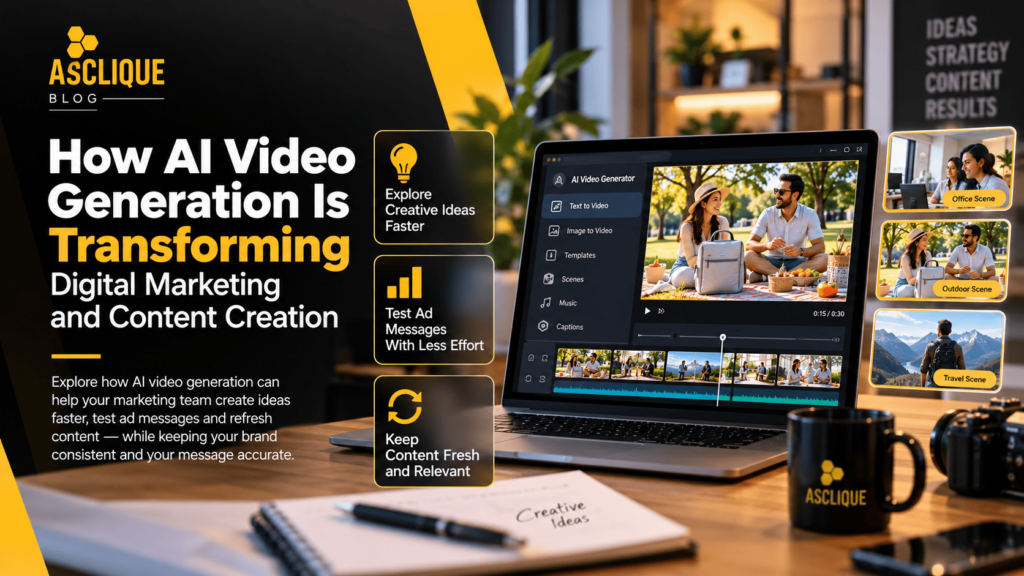
AI video generation is changing what marketing teams can put in front of a client before a shoot, how they develop alternative ad messages, and how they refresh a campaign after launch. These are three different jobs. A concept clip needs to communicate an idea; an ad experiment needs to answer a question; recurring content needs to keep a useful message current. Treating them separately makes it easier to decide where generation belongs and what still needs a camera, an editor or a client’s approval.
Quick Answer
AI video generation is transforming digital marketing by helping businesses explore creative concepts, develop advertising variations, and adapt recurring video content. It can make early creative decisions easier, support controlled advertising experiments, and help marketing teams refresh campaigns without filming every supporting scene. However, generated content still requires human editing, factual verification, brand consistency, and reliable performance measurement.
Key Facts
- AI video generation can support concept development before traditional video production begins.
- Generated scenes can help clients compare creative directions before approving a campaign.
- Advertising experiments require clear hypotheses and controlled comparisons.
- AI-generated product demonstrations should not be presented as verified evidence of product performance.
- Recurring campaigns can combine approved footage with newly generated supporting scenes.
- Branding, product details, captions, and promotional offers should remain editable.
- AI video performance should be evaluated using campaign-specific metrics rather than production volume alone.
- Human review remains essential for accuracy, compliance, and publication approval.
Official Reference Points:
Table of Contents
- What Is AI Video Generation?
- Where AI Video Generation Fits Into Marketing
- Concept Exploration: Make the Choice Visible
- Approve the Idea Before Polishing the Scene
- Ad Experiments: Give Each Variation a Question
- Separate the Message From Other Moving Parts
- Recurring Content: Change the Occasion Without Changing the Facts
- Build the Calendar Around Reasons to Watch
- AI Video Marketing Workflow: Step by Step
- Tools You Should Use
- Common Errors and How to Fix Them
- Weak Approach vs. Better Approach
- Common Mistakes to Avoid
- What Is Not Proven
- How to Measure Success
- AI Video Marketing Checklist
- Frequently Asked Questions
- Asclique Recommendation
- Related Asclique Resources
- Need Help With This?
What Is AI Video Generation?
AI video generation is the process of creating or modifying video content using artificial intelligence. Depending on the tool, marketers may provide written prompts, reference images, or existing footage to produce new visual material.
In digital marketing, these capabilities can support creative brainstorming, campaign presentations, advertising variations, and recurring content production.
However, generated video should be treated as a production resource rather than automatic evidence that a product, service, or marketing claim is accurate.
The most useful approach combines AI-assisted creation with human creative direction, verified information, and measurable campaign objectives.
Where AI Video Generation Fits Into Marketing

AI video generation can support different stages of the marketing process. The appropriate use depends on whether the team needs to communicate an idea, evaluate an advertising hypothesis, or maintain an existing campaign.
| Marketing Job | Useful Generated Material | What Establishes Success |
|---|---|---|
| Explore a concept | Mood, movement and a proposed setting | The client can choose a creative direction |
| Test an ad message | An alternative opening built around a hypothesis | A controlled campaign comparison |
| Adapt recurring content | Fresh supporting scenes around approved material | The message remains accurate and fits the occasion |
Changing the setting can suggest a different occasion. This generated concept illustration shows an imaginary product, not a product test.
Concept Exploration: Make the Choice Visible
A written brief can leave a client and an agency imagining different films. “Fresh and energetic” might mean a bright office lunch break to one person and a picnic outdoors to another. Short generated scenes can make that disagreement visible while the creative direction is still easy to change.
Consider a hypothetical campaign for a reusable lunch bag. Before producing the finished advertisement, the team could show two rough directions: a quiet workplace scene and a lively outdoor setting. The question for the client is which occasion best expresses the campaign’s message. It is too early to ask which clip will sell more bags.
This use is moving into advertising tools themselves. In its February 2026 industry outlook, Google described Veo 3 in Google Ads Asset Studio. That is evidence of generation becoming part of creative production, rather than proof that any generated advertisement will perform well.
Businesses exploring AI-assisted video campaigns should also consider how these assets support their broader content marketing strategy. Video concepts are most valuable when they communicate a relevant message and support a defined customer need.
Strengthen Your Video Marketing StrategyDevelop creative campaigns with clear messaging, audience research, and measurable business objectives. | Explore Content Marketing |
Approve the Idea Before Polishing the Scene
Give each concept a short description of its intended message and mark temporary elements clearly. Ask the client to respond to the setting, pace and emphasis. Otherwise, a discussion about the campaign can become a debate over a placeholder cup or a background colour.
A rough cut needs clips the editor can assemble. Animx’s AI Video Generator accepts a written prompt or an image as a starting point, according to its product page, and offers MP4 downloads. The page does not establish that a generated version of a particular product will preserve every detail, so inspect the output before presenting it as a faithful depiction.
A beautiful imagined bag cannot demonstrate the capacity or insulation of the bag being sold. Use verified product information and genuine footage for those claims. Label concept material in client presentations so approval of a mood does not quietly become approval of an unsupported demonstration.
Ad Experiments: Give Each Variation a Question
Once a direction is approved, generation can help produce alternatives without treating every alternative as a new campaign. The useful change is deliberate variation. More files in a folder do not, by themselves, tell a marketer anything about the audience.
Effective advertising experiments should connect creative decisions with measurable outcomes. A broader digital marketing strategy can help businesses coordinate content production, campaign distribution, audience targeting, and conversion measurement.
Separate the Message From Other Moving Parts
For the lunch-bag campaign, a possible question is whether an opening about organising a workday earns a different response from an opening about enjoying a lunch break. Keep the genuine product demonstration, offer and call to action the same. Change the opening message and its supporting scene. This tests an opening treatment as a whole; it does not isolate whether the wording or the imagery caused the difference.
If the team wants to study the wording alone, keep the scene unchanged too.
Google Ads’ Demand Gen experiment guidance recommends comparing campaigns that differ in one variable. Its video experiment guidance also recommends a hypothesis tied to the campaign goal and, for creative tests, consistent audiences, bids and ad formats. Those instructions concern specific experiment products, but they offer a sound planning discipline: decide what a comparison can tell you before producing its assets.
Choose the measure accordingly. For a sales campaign, completed purchases may matter more than clicks; for a lead campaign, the quality of enquiries may matter more than the cheapest form submission. Confirm that the relevant tracking works before launch. Keep the experiment’s settings and decision rule in the campaign record, rather than deciding what counts as success after seeing the results.
Generation does not remove uncertainty from a small or noisy result. If the available evidence is inconclusive, retain that conclusion. Repeatedly producing another visually impressive variation cannot compensate for an experiment that never had a clear question.
Recurring Content: Change the Occasion Without Changing the Facts
A campaign that runs beyond launch needs new contexts. The lunch bag might feature in a workplace post one week and a picnic post the next. Generated supporting scenes can help explore those settings while the approved product demonstration remains a separate, reusable part of the edit.
Keep the original product footage, logo artwork, offer wording and captions available as editable assets. Add exact text and branding during editing so that corrections do not depend on regenerating an entire scene. This also gives a reviewer a clear place to check a price, date or product name.
The boundary matters. A generic outdoor scene is atmosphere. A scene showing a bag surviving heavy rain implies something about the product. If that performance has not been established, choose another scene. A visual claim deserves the same scrutiny as a sentence in the advertisement.
Video content can also support organic discovery when it is published alongside useful, accessible information. Businesses can explore strategies for improving online visibility to understand how content, search visibility, and digital channels work together.
Build the Calendar Around Reasons to Watch
Give each proposed adaptation a reason to exist: a new occasion, a customer question or a different stage of the buying decision. A change of background alone may leave the audience with exactly the same message. Review the complete cut for its intended placement, including whether captions can be read and whether the offer is still current.
For an agency with an undecided client and a shoot approaching, concept exploration is the most useful starting point. Bring two clearly labelled rough directions to the next discussion, then leave with one approved message and a list of the product shots that still need to be filmed.
AI Video Marketing Workflow: Step by Step
Step 1: Define the Campaign Objective
Determine whether the video is intended to communicate a concept, test an advertising message, educate an audience, or support an existing campaign.
Document the intended audience, primary message, distribution channel, and expected outcome before generating content.
Step 2: Prepare the Creative Brief
Specify the setting, visual direction, intended message, brand requirements, and any elements that must remain accurate.
Separate creative suggestions from factual claims that require evidence.
Step 3: Generate Initial Concepts
Create a limited number of clearly differentiated concepts. Compare their ability to communicate the intended idea rather than producing variations without a decision framework.
Step 4: Review Accuracy and Brand Consistency
Inspect the generated scenes for incorrect product details, misleading demonstrations, visual inconsistencies, and unsupported claims.
Use genuine product footage or verified assets wherever factual representation matters.
Step 5: Edit and Prepare the Final Video
Combine approved scenes with editable captions, logos, offers, and calls to action.
Review the final video for the intended platform, including aspect ratio, caption readability, audio quality, and applicable advertising requirements.
Step 6: Publish and Measure Performance
Confirm that campaign tracking is working before publication.
Use relevant engagement, conversion, and lead-quality metrics to evaluate the campaign against its original objective.
Step 7: Document Findings and Improve
Record what was tested, which assets were used, what the available data showed, and what remains uncertain.
Use those findings to improve future creative decisions rather than assuming every new generated variation will perform better.
Tools You Should Use
AI Video Generation Tools
Use video generation software to explore scenes, visual concepts, and supporting creative material.
Review output quality, commercial usage terms, editing capabilities, and factual accuracy before using generated assets in published campaigns.
Video Editing Software
Use editing software to assemble approved footage, add captions, adjust pacing, and maintain consistent branding.
Keeping important assets editable makes corrections easier when offers, dates, or product information change.
Google Ads
Use the relevant campaign and experiment features to compare advertising approaches under documented conditions.
Define the hypothesis, target audience, and primary success metric before launching an experiment.
Google Analytics 4
Use GA4 to evaluate measurable website actions associated with campaign traffic.
Verify event configuration and attribution limitations before interpreting conversion data.
Content Calendar
Maintain a publishing calendar that records each video’s objective, target audience, approved message, publication date, and responsible team member.
A documented calendar helps prevent repetitive content and outdated promotional information.
SEO and Content Performance Tools
Video campaigns often support broader website content and search strategies.
Businesses can use search engine optimization services to improve the discoverability of relevant pages and connect educational content with customer search intent.
Common Errors and How to Fix Them
The following problems can reduce the usefulness of AI-generated marketing videos. Each requires a different corrective action.
| Error | Cause | Fix |
|---|---|---|
| Incorrect product appearance | Generated scenes do not preserve actual product details. | Use verified product footage or approved reference assets. |
| Unclear creative direction | The brief does not define the intended message. | Document the audience, objective, and concept before generation. |
| Inconsistent branding | Logos and text are generated instead of added during editing. | Use approved, editable brand assets. |
| Unreliable experiment results | Multiple campaign variables change simultaneously. | Use a documented hypothesis and controlled comparison. |
| Outdated promotional details | Offers and captions are embedded in generated footage. | Keep prices, dates, and offers editable. |
| Poor performance measurement | Tracking was not verified before launch. | Test analytics events and define success metrics in advance. |
Weak Approach vs. Better Approach
AI video generation becomes more useful when creative decisions are connected to clear marketing objectives and reliable evidence.
| Weak Approach | Better Approach |
|---|---|
| Generate videos without a creative brief | Define the message, audience, and purpose first. |
| Treat generated product scenes as evidence | Use genuine footage for verifiable product claims. |
| Produce many unrelated ad variations | Create alternatives around a specific hypothesis. |
| Regenerate videos to correct prices | Keep promotional text editable during post-production. |
| Measure only video views | Evaluate relevant engagement, conversions, and qualified leads. |
| Publish without human review | Verify factual accuracy, branding, and applicable policies. |
Common Mistakes to Avoid
1. Using AI-Generated Videos Without a Clear Objective
Producing videos simply because generation is available can create unnecessary content without improving campaign outcomes.
Start with a specific communication or marketing problem and determine whether generated material is appropriate.
2. Presenting Generated Product Demonstrations as Real Evidence
A generated scene may depict product capabilities that have never been tested.
Use genuine demonstrations and verified product information whenever visual claims affect purchasing decisions.
3. Changing Multiple Variables During Advertising Experiments
Changing the audience, offer, opening message, and visual treatment simultaneously makes it difficult to determine what influenced the result.
Document the hypothesis and keep unrelated conditions consistent wherever practical.
4. Ignoring Branding and Editing Requirements
Generated videos may contain inaccurate logos, distorted text, or inconsistent product details.
Use approved brand assets and review the complete video before publication.
5. Repeating Content Without Adding New Value
Changing the background of a video does not necessarily create a useful new message.
Each adaptation should address a different customer question, occasion, or stage of the buying process.
6. Assuming AI-Generated Videos Automatically Improve ROI
Faster production does not guarantee stronger campaign performance.
Evaluate the actual cost of producing approved assets alongside relevant business outcomes.
Improve Your Digital Marketing CampaignsIdentify opportunities to use AI-generated video content while maintaining consistent branding, accurate messaging, and meaningful campaign measurement. | Request a Marketing Audit |
What Is Not Proven
AI video generation can change how marketing assets are produced, but the available evidence does not establish that generated videos consistently outperform traditionally produced content.
Faster creative production does not automatically produce higher conversion rates, stronger brand awareness, or better advertising ROI.
A successful campaign experiment also does not prove that AI generation itself caused the improvement. The result may depend on the message, audience, offer, creative execution, or other campaign conditions.
Similarly, an attractive generated product scene does not establish that the actual product has the characteristics shown.
At Asclique, we recommend separating production efficiency, creative quality, campaign performance, and verified product claims when evaluating AI-generated video content.
How to Measure Success
AI video marketing should be evaluated against the specific purpose of each asset. A concept presentation, advertising experiment, and recurring social media video do not necessarily share the same success metrics.
Businesses can also explore how to generate leads through SEO to understand how educational content and digital visibility can contribute to measurable customer inquiries.
| Metric | Source | Use |
|---|---|---|
| Concept approval | Creative brief and client feedback | Evaluate whether the proposed direction communicates the intended message. |
| Production efficiency | Project management records | Compare time and resources required to produce approved assets. |
| Video engagement | Advertising and social platform reports | Assess how viewers interact with published videos. |
| Website conversions | GA4 and tested key events | Measure relevant actions associated with campaign visits. |
| Qualified leads | CRM and lead qualification records | Evaluate whether inquiries match the intended customer profile. |
| Campaign ROI | Campaign costs and attributable business outcomes | Assess financial performance where reliable attribution is available. |
AI Video Marketing Checklist
- Define the campaign objective and target audience.
- Identify whether the video is intended for concept exploration, advertising experiments, or recurring content.
- Prepare a documented creative brief.
- Identify the main message and intended customer action.
- Separate creative concepts from factual product claims.
- Choose suitable AI video generation tools.
- Review commercial usage rights and relevant platform requirements.
- Generate a limited number of purposeful creative alternatives.
- Verify product details and other factual representations.
- Use genuine footage when demonstrating actual product capabilities.
- Confirm that logos, captions, offers, and prices remain editable.
- Review the video for brand consistency.
- Check captions, audio, aspect ratio, and platform requirements.
- Document the hypothesis for advertising experiments.
- Verify conversion tracking before launching campaigns.
- Record campaign settings and the intended success metric.
- Save approved assets and project documentation.
- Measure relevant engagement, conversions, and qualified leads.
- Review findings before producing additional variations.
- Schedule updates when campaign information changes.
FAQ’s
What is AI video generation in digital marketing?
AI video generation in digital marketing refers to using artificial intelligence to create, modify, or enhance video content for advertising, social media, websites, and other marketing channels. Depending on the platform, these tools can generate video scenes from text descriptions, reference images, or existing footage.
Businesses can use AI-generated videos for several purposes, including visualizing campaign concepts, developing advertising variations, creating background scenes, and adapting existing content for different audiences.
For example, a marketing agency preparing a product campaign might generate two different visual concepts before scheduling a professional shoot. This allows the client to compare creative directions without investing in full production for each idea.
However, AI video generation is not a complete replacement for traditional production processes. Human involvement remains necessary for creative direction, script development, editing, brand consistency, and factual verification.
The most effective approach is to use AI video generation as part of a structured digital marketing strategy rather than relying on automated content creation alone.
How is AI video generation transforming content creation?
AI video generation is transforming content creation by changing how marketing teams develop ideas, produce supporting visual material, and adapt campaigns after publication.
Traditionally, visualizing multiple campaign concepts could require storyboards, stock footage, filming, or detailed animation. AI tools can help teams create preliminary video scenes from written descriptions or reference images, making it easier to communicate creative ideas during early planning.
Another important application is content adaptation. A business can use approved product footage alongside AI-generated supporting scenes to develop variations for different occasions, audiences, or marketing channels.
For example, a company promoting reusable lunch bags might create separate videos featuring workplace lunches, outdoor picnics, and travel situations while retaining the same verified product demonstration.
AI can also support advertising experiments by helping marketers develop alternative openings or creative treatments around a specific hypothesis.
Nevertheless, faster production does not automatically mean better content. Each video still needs a clear purpose, accurate messaging, appropriate editing, and human approval before publication.
Can AI-generated videos improve digital marketing ROI?
AI-generated videos can potentially improve digital marketing return on investment (ROI) by reducing some production requirements, supporting creative experimentation, and helping teams reuse approved marketing assets.
For example, generating preliminary concept scenes may reduce the resources required to present multiple creative directions to a client. Similarly, creating supporting visuals for recurring campaigns may reduce the need to organize additional filming sessions for every variation.
However, lower production costs do not automatically translate into higher marketing ROI.
A video that costs less to produce but generates fewer qualified leads or sales may deliver worse financial results than a more expensive traditional production.
Businesses should evaluate AI video marketing using relevant metrics such as:
- Total production and editing costs.
- Advertising expenditure.
- Website conversions and completed purchases.
- Qualified leads and customer acquisition costs.
- Attributable revenue, where reliable measurement is available.
- Time required to produce approved campaign assets.
For advertising experiments, marketers should establish a hypothesis and define success metrics before launching the campaign.
The objective is not simply to produce more videos at a lower cost. It is to create effective marketing content while managing resources responsibly.
Can AI video generation replace traditional video production?
AI video generation can replace or supplement certain production tasks, but it cannot reliably replace every aspect of traditional video production.
It is particularly useful for concept visualization, background scenes, creative experimentation, and situations where the content does not need to represent a real event or demonstrate an actual product capability.
For example, a marketing agency could generate an imaginary office environment to illustrate a campaign concept without organizing a physical shoot.
However, traditional video production remains important when businesses need authentic visual evidence.
Examples include customer testimonials, real product demonstrations, interviews with company representatives, manufacturing processes, property walkthroughs, and footage of actual business locations.
A generated video showing a product resisting water, supporting a particular weight, or performing a technical function should not be treated as proof that the real product can do those things.
Businesses should also consider intellectual property rights, consent, advertising requirements, and the commercial usage terms of their chosen AI tools.
A practical hybrid approach combines AI-generated supporting material with genuine footage, professional editing, and verified brand assets.
How can businesses use AI-generated videos for advertising experiments?
Businesses can use AI-generated videos to develop creative variations that test specific advertising hypotheses.
For example, an online retailer might want to understand whether an advertisement emphasizing convenience performs differently from one emphasizing lifestyle benefits.
The marketing team could develop two opening treatments while keeping the product demonstration, promotional offer, target audience, and call to action consistent.
This creates a more meaningful comparison than producing several unrelated advertisements.
A structured AI video advertising experiment should include five stages.
First, define the hypothesis. Identify the specific question the experiment should answer, such as whether a convenience-focused opening produces more qualified inquiries.
Second, select the variable. Determine whether the test will compare opening messages, visual treatments, calls to action, or another creative element.
Third, maintain consistent conditions. Keep unrelated campaign settings comparable wherever the advertising platform supports it.
Fourth, establish success metrics. Depending on the objective, these may include purchases, qualified leads, conversion rates, or other relevant outcomes.
Fifth, analyze the results. Review the available evidence and avoid declaring a winner when the results are inconclusive.
AI video generation makes it easier to create alternatives, but reliable advertising insights still depend on sound experiment design and accurate measurement.
What are the biggest risks of AI-generated marketing videos?
The biggest risks of AI-generated marketing videos involve factual accuracy, misleading representations, brand inconsistency, intellectual property concerns, and inadequate quality control.
One significant issue is inaccurate product visualization. AI-generated scenes may change product dimensions, colors, logos, packaging, or functional details.
These inaccuracies can mislead potential customers if the generated video is presented as an authentic demonstration.
Another concern is inconsistent branding. Generated text, logos, and visual elements may not match approved company guidelines.
Marketing teams should also evaluate whether generated content resembles copyrighted material, uses identifiable individuals without appropriate authorization, or conflicts with applicable advertising policies.
Other practical risks include unrealistic expectations about production savings, poor-quality visuals, and publishing large quantities of repetitive content without a clear marketing objective.
Businesses can reduce these risks by establishing an approval process that includes:
- Reviewing generated scenes for factual accuracy.
- Verifying product claims against reliable evidence.
- Using approved logos, fonts, and brand colors.
- Checking commercial usage rights and relevant policies.
- Keeping prices, offers, and promotional details editable.
- Obtaining appropriate approvals before publication.
- Reviewing the final video in its intended advertising or social media placement.
AI-generated content should meet the same standards of accuracy and responsibility as traditionally produced marketing material.
How can AI video generation support social media content?
AI video generation can support social media marketing by helping businesses develop visual concepts, create supporting scenes, and adapt approved messages for different platforms and audience interests.
For example, a company promoting a productivity application might use AI-generated office scenes to introduce common workplace challenges while using actual screen recordings to demonstrate the software.
This approach combines creative storytelling with accurate product information.
AI-generated supporting scenes may also help businesses develop content around seasonal occasions, customer questions, educational topics, and different stages of the buying journey.
However, effective social media content requires more than visual variation.
Each video should communicate a useful message, address a relevant audience need, and provide a clear reason for viewers to engage.
Businesses should also consider platform-specific requirements, including video dimensions, caption readability, audio quality, and content policies.
A structured content calendar can help marketing teams document the purpose of each video, identify reusable assets, and maintain consistency across campaigns.
Rather than publishing numerous nearly identical AI-generated clips, businesses should prioritize videos that educate customers, answer questions, explain products, or support meaningful engagement.
How should businesses measure AI video marketing performance?
Businesses should measure AI video marketing performance according to the purpose of each video and the marketing outcome it is intended to support.
There is no single metric that accurately evaluates every type of AI-generated video.
For concept exploration, success may involve obtaining client approval, communicating a creative direction clearly, or reducing unnecessary revisions before production.
For paid advertising, relevant metrics may include conversion rates, cost per qualified lead, completed purchases, and attributable revenue.
For organic social media content, marketers may evaluate relevant engagement, video retention, website visits, and meaningful customer actions.
Production efficiency should also be measured separately from campaign effectiveness.
For example, reducing the time required to create an approved video is a production improvement. It does not automatically establish that the video generated better business results.
A practical measurement framework should include:
Production metrics: Time spent generating, editing, reviewing, and approving the video, along with associated costs.
Engagement metrics: Relevant video views, watch time, retention, and audience interactions, interpreted according to each platform’s definitions.
Conversion metrics: Website inquiries, purchases, sign-ups, and other verified actions associated with the campaign.
Business metrics: Qualified leads, customer acquisition costs, and attributable revenue where reliable tracking is available.
Quality metrics: Factual accuracy, brand consistency, approval requirements, and the number of corrections needed before publication.
Tools such as Google Analytics 4, advertising platform reports, and customer relationship management systems can support this evaluation.
Before launching a campaign, businesses should confirm that tracking is configured correctly and establish a documented baseline.
The most useful performance assessment combines creative quality, production efficiency, reliable marketing data, and measurable business outcomes.
Asclique Recommendation
AI video generation should support a defined marketing objective rather than become a reason to produce more content.
For businesses beginning with AI-assisted video production, concept exploration is often a practical starting point. It allows teams to communicate creative directions before committing to a finished production.
Once a direction is approved, use generated variations selectively and evaluate advertising experiments against documented hypotheses.
For recurring campaigns, combine approved brand assets and genuine product footage with relevant supporting scenes. Keep factual information editable and verify the final content before publication.
Businesses interested in broader AI-assisted marketing can also review AI visibility tools to understand how AI-related measurement differs across marketing and search applications.
The most useful AI video strategy combines creative efficiency, factual accuracy, human judgment, and reliable performance measurement.
Related Asclique Resources
Explore Our Services
Recommended Asclique Articles
Need Help With AI Video Marketing?
Asclique helps businesses develop digital marketing strategies that connect content creation, audience engagement, and measurable campaign performance.
Whether your team is exploring AI-generated video concepts, planning advertising experiments, or creating recurring marketing content, a structured strategy can help identify the right opportunities.
We recommend starting with an assessment of your existing content, marketing objectives, production resources, and performance measurement setup.
Make AI Video Marketing Work for Your BusinessDiscuss a practical AI-assisted video strategy with clear creative direction, consistent branding, and measurable marketing objectives. | Talk to Asclique |