
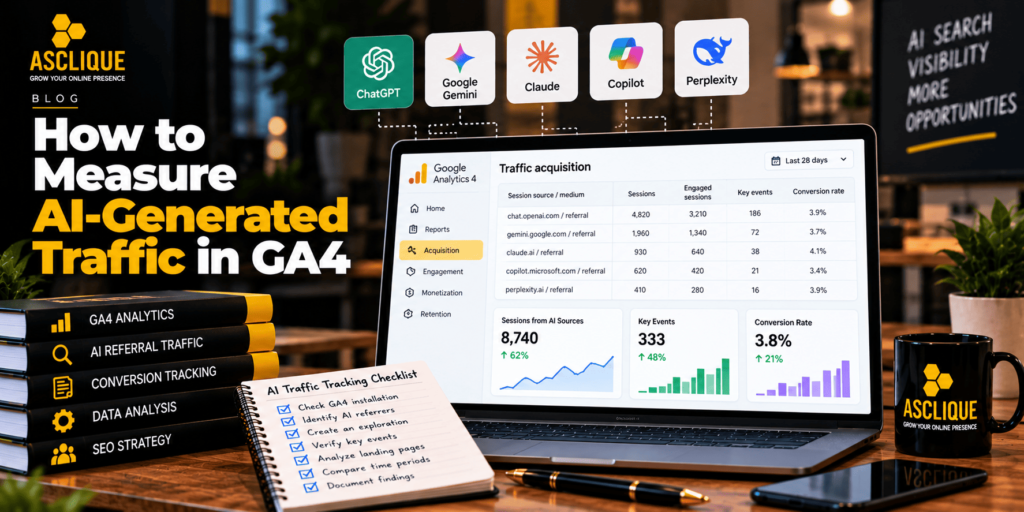
This article gives business owners, marketers, and in-house SEO teams a practical method, concrete checks, and an explanation of what the available evidence cannot establish.
Quick Answer
This guide shows how to examine source dimensions, build a focused exploration, test conversions, and explain attribution gaps to stakeholders.
Key Facts
- GA4 acquisition reports use available traffic-source information.
- Session source/medium and first user source/medium answer different attribution questions.
- A key event must be configured and tested before it can reliably support lead reporting.
- Not every AI-assisted visit retains a recognizable referrer.
- GA4 reporting does not count brand mentions inside third-party answers.
Verified reference points: Google Search Central; Google Analytics Help; Search Console URL Inspection.
Table of Contents
- What Is AI Referral Traffic in GA4?
- Why Measuring AI Referrals Matters
- How How to Measure AI-Generated Traffic in GA4 Works – Step by Step
- Tools You Should Use
- Common Errors and How to Fix Them
- Weak Approach vs Better Approach
- Common Mistakes to Avoid
- What Is Not Proven
- How to Measure Success
- Checklist
- Frequently Asked Questions
- Asclique Recommendation
- Need Help With This?
What Is AI Referral Traffic in GA4?
AI referral traffic is the subset of website visits for which available analytics information indicates a visit from an AI-powered service. The source might be a recognizable referrer, but not every interface or link passes the same information.
For example, an identifiable visit to a pricing page may appear under a particular session source. A visitor who copies the URL from an answer into a browser may instead appear as direct traffic. The second visit should not be reclassified without evidence.
The goal is to produce a transparent, repeatable view of identifiable sessions and subsequent actions, not to claim full measurement of off-site influence.
Why Measuring AI Referrals Matters
A growing referral source can reveal which landing pages answer customer questions effectively. If visitors arrive at technical articles and then request consultations, the team can investigate those journeys and improve the next step.
Without disciplined setup, a dashboard can exaggerate or understate the channel. Mixing first-user acquisition with session acquisition, for example, can make a returning visitor look like a new AI-sourced customer.
Accurate attribution helps businesses prioritize site improvements while acknowledging that many assisted journeys cannot be reconstructed from web analytics alone.
Strengthen Your Ai Referral Traffic FoundationReview the specific technical and content decisions that affect this topic, with documented evidence. | Explore SEO Services |
How How to Measure AI-Generated Traffic in GA4 Works – Step by Step
Step 1: Confirm GA4 is installed on the relevant domain and that page_view events are arriving
Confirm GA4 is installed on the relevant domain and that page_view events are arriving. Check consent settings and cross-domain configuration before drawing conclusions.
Step 2: Open Reports, Acquisition, Traffic acquisition
Open Reports, Acquisition, Traffic acquisition. Use session source/medium to inspect sources for the selected date range; avoid first-user dimensions when the question concerns current sessions.
Step 3: List identifiable AI service referrers that actually appear in your data
List identifiable AI service referrers that actually appear in your data. Keep the source list documented and update it when interfaces change; do not assume every possible hostname is stable.
Step 4: Create a GA4 Exploration or customized report using session source, landing page, sessions, and key events
Create a GA4 Exploration or customized report using session source, landing page, sessions, and key events. Save the filter logic and test whether it includes only the intended sources.
Step 5: Open the landing pages and review whether they answer the likely referral question
Open the landing pages and review whether they answer the likely referral question. Compare engagement and downstream events without interpreting a short session as automatically low quality.
Step 6: Verify lead events with DebugView or a controlled test
Verify lead events with DebugView or a controlled test. If the same form submission fires twice, repair event logic before calculating a conversion rate.
Step 7: Compare results over equivalent periods and annotate site releases, campaigns, and source-filter changes
Compare results over equivalent periods and annotate site releases, campaigns, and source-filter changes. Report identifiable referrals as a lower-bound observation, not total AI influence.
Tools You Should Use
GA4 Traffic acquisition
See identifiable session sources and associated session metrics.
Use this tool only for the information it actually provides. Preserve the original export, tested URL, or report settings so the result can be checked after a website or platform update.
GA4 Explorations
Build a reusable source-filtered report with landing pages and key events.
Use this tool only for the information it actually provides. Preserve the original export, tested URL, or report settings so the result can be checked after a website or platform update.
GA4 DebugView
Test whether form and lead events fire correctly during controlled visits.
Use this tool only for the information it actually provides. Preserve the original export, tested URL, or report settings so the result can be checked after a website or platform update.
Tag Manager Preview
Inspect triggers and prevent duplicate event firing.
Use this tool only for the information it actually provides. Preserve the original export, tested URL, or report settings so the result can be checked after a website or platform update.
CRM
Validate which recorded inquiries became qualified leads or customers.
Use this tool only for the information it actually provides. Preserve the original export, tested URL, or report settings so the result can be checked after a website or platform update.
Common Errors and How to Fix Them
The following issues have different causes and require different corrective actions. Diagnose the source before changing website content or analytics settings.
Weak Approach vs Better Approach
A better process makes its assumptions visible, preserves evidence, and connects the finding to a clear next action.
Common Mistakes to Avoid
Using: Using a source filter without checking actual values in the property. Identify the specific page, report, or decision affected before treating this as a priority.
Forgetting: Forgetting that consent and browser settings affect measurement. Identify the specific page, report, or decision affected before treating this as a priority.
Confusing: Confusing a referral session with a brand mention. Identify the specific page, report, or decision affected before treating this as a priority.
Comparing: Comparing periods with different event configurations. Identify the specific page, report, or decision affected before treating this as a priority.
Claiming: Claiming AI caused a conversion because it was one recorded touchpoint. Identify the specific page, report, or decision affected before treating this as a priority.
Review Your Ai Referral Traffic GapsGet a focused assessment of current implementation, measurement limits, and practical next steps. | Request an Audit |
What Is Not Proven
GA4 cannot establish the total number of users who saw your brand in AI answers. Attribution can be incomplete, and a reported source does not prove that an assistant recommendation caused the purchase.
At Asclique, we separate documented platform behavior from practitioner observations. Avoid treating an isolated test result as proof of a universal algorithm.
How to Measure Success
Define success in terms of reliable implementation, observable changes, and useful business outcomes. Keep each metric tied to its own source and denominator.
Checklist
- Document the specific business objective and owner.
- Identify the priority pages or customer questions.
- Check official documentation for relevant requirements.
- Verify source information and publication dates.
- Review technical access and indexing where applicable.
- Confirm that visible content supports each important claim.
- Record the testing method and its limitations.
- Check for duplicate or conflicting information.
- Test analytics events before using conversion totals.
- Save baseline evidence before making changes.
- Retest after implementation and record the result.
- Schedule a review after material site or platform changes.
FAQ’s
Can GA4 identify every ChatGPT visitor?
The answer depends on the scope of AI referral traffic and the source you are measuring. Begin with a clearly defined sample or URL set, then document the exact test conditions. Do not infer results for untested pages or platforms.
Which acquisition dimension should I use?
Not automatically. This guide shows how to examine source dimensions, build a focused exploration, test conversions, and explain attribution gaps to stakeholders. Record the underlying source and compare it with the visible page or original report before deciding what the result means.
Why are AI visits showing as direct?
Use the steps in this guide as a repeatable audit rather than a one-time configuration. Preserve the input, tool settings, date, and output. Recheck after significant changes because an earlier passing test does not verify the current implementation.
How do I build an AI referral exploration?
Treat the result as one piece of evidence, not a guarantee. Look for supporting information in the official documentation and in your own measured business outcomes. If the evidence is incomplete, state that limitation rather than filling it with an estimate.
Can I attribute sales to AI referrals?
Choose a metric that directly answers the business question and can be reproduced. Record the numerator, denominator, time window, and data source. Keep observations separate from verified website visits and customer inquiries.
Should I create a custom channel group?
Assign an owner and revisit the process after major content, technical, or tracking changes. For ongoing programs, a monthly review can reveal recurring problems. The right cadence depends on how frequently the underlying pages and data change.
Asclique Recommendation
Publish an auditable report with exact source filters, session metrics, tested key events, and a clear note about unknown referrers. That is more useful than an impressive but unverifiable AI traffic total.
Start with the highest-impact pages and a documented baseline. After making changes, retest the same conditions and record what improved, what remained uncertain, and which issue needs a separate investigation.
Need Help With This?
If your team needs help with AI referral traffic, Asclique can review the current setup, identify practical corrections, and establish an evidence-based reporting process. The scope should be agreed before changes are made, particularly where analytics or third-party data access is involved.
Make Ai Referral Traffic ActionableDiscuss a prioritized plan with measurable checks and clear ownership for the next implementation cycle. | Talk to Asclique |