
Quick Answer
Start with a real customer problem, map the decisions around it, and publish a coherent set of resources. Each page should have a distinct purpose and enough evidence to stand on its own. Connect relevant pages through descriptive internal links, maintain accurate information, and measure search visibility and business outcomes without assuming that AI citations are guaranteed.
Key Facts
- Google recommends helpful, people-first content rather than content made primarily to manipulate rankings.
- Internal links help users and crawlers discover related pages.
- Canonicalization helps Google identify preferred versions of duplicate or similar URLs.
- A sitemap can aid URL discovery but does not guarantee indexing.
- No published Google requirement says a fixed number of cluster pages guarantees AI citations.
- Each supporting article should address a distinct customer question or search intent.
- Content performance should be evaluated through relevant search visibility, engagement, and qualified business outcomes.
Official reference points:
Table of Contents
- What Is a Content Ecosystem?
- Why a Content Ecosystem Matters
- How to Build a Content Ecosystem for AI Search Visibility
- Tools You Should Use
- Common Errors and How to Fix Them
- Weak Approach vs. Better Approach
- Common Mistakes to Avoid
- What Is Not Proven
- How to Measure Success
- Content Ecosystem Checklist
- Frequently Asked Questions
- Asclique Recommendation
- Related Asclique Resources
- Need Help With This?
What Is a Content Ecosystem?
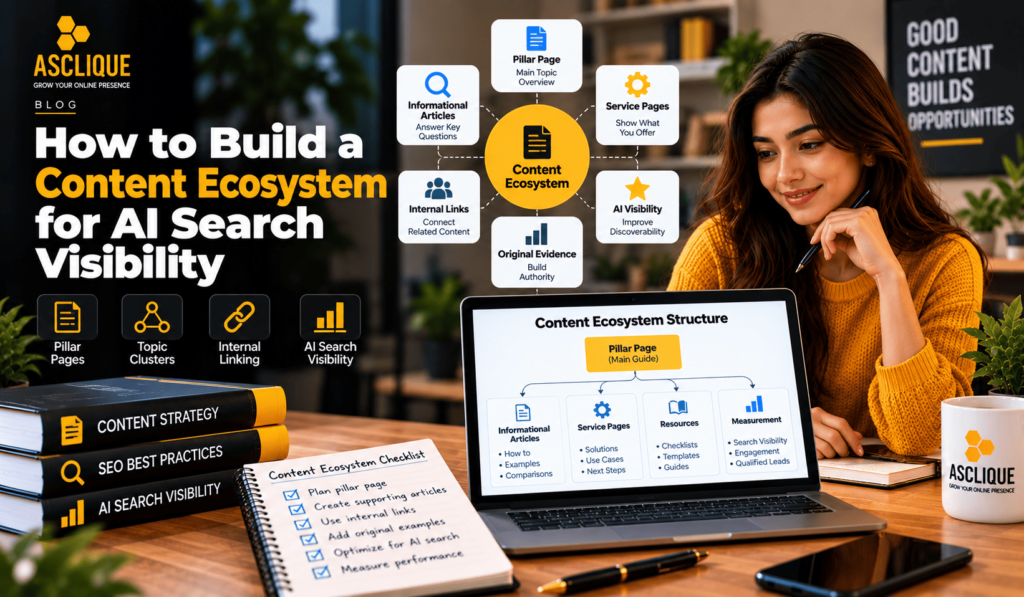
A content ecosystem is a planned group of pages, tools, examples, and service information that addresses one topic from several customer perspectives. A central guide explains the subject; supporting resources answer narrower questions; relevant service pages show what a business offers.
For a cleanroom construction company, the central guide might explain planning a controlled environment. Supporting pages could cover classification, HVAC requirements, validation, and modular construction tradeoffs. Each should answer a different decision.
The structure works only when links and content relationships are useful. Creating ten near-identical pages with swapped keywords adds little value to the reader.
A well-organized content ecosystem typically includes a central pillar page, supporting educational articles, relevant service pages, original examples, and contextual internal links.
Why a Content Ecosystem Matters
A single article rarely addresses every stage of a complex purchase. Buyers may begin with a definition, later compare options, and eventually need a scope checklist or quote request. Connected resources allow that journey without forcing every detail into one page.
Clear information architecture also helps editors spot gaps and outdated claims. If regulations change, the team can identify which technical guides require review instead of guessing where the information appears.
A connected content ecosystem also supports a broader approach to improving online visibility by making useful information accessible through search engines, internal navigation, and other discovery channels.
For AI systems, accessible and explicit pages may be easier to interpret, but visibility is not guaranteed. The defensible goal is strong information quality and discoverability, not an invented citation formula.
Building a connected content ecosystem is an important part of a broader SEO strategy. It helps organize relevant information, strengthen internal linking, and make important pages easier to discover.
Strengthen Your Content Ecosystem FoundationReview the specific technical and content decisions that affect this topic, with documented evidence. | Explore SEO Services |
How to Build a Content Ecosystem for AI Search Visibility: Step by Step
Step 1: Choose One Commercially Relevant Subject
Choose one commercially relevant subject and collect real sales, support, and search questions. Group questions by research, evaluation, and purchase intent.
For example, a business offering modular cleanroom construction could organize questions around cleanroom classifications, design requirements, construction methods, costs, and validation.
This approach helps ensure that the content ecosystem reflects genuine customer needs rather than arbitrary keyword variations.
Step 2: Audit Existing URLs and Map Search Intent
Audit existing URLs and map each page to one primary task. Mark duplicate articles, weak service pages, and outdated facts before proposing new content.
Review the existing pages to determine whether they address different questions or compete for the same search intent.
If multiple pages provide substantially similar information, consider consolidating them or giving each page a clearly differentiated purpose.
Step 3: Create a Comprehensive Pillar Guide
Write a pillar guide that defines the subject, introduces major decisions, and links to narrower resources.
Avoid making the pillar page a collection of teaser paragraphs. It should provide enough useful information to satisfy the reader’s main question.
Supporting pages can then explore specialized topics in greater depth.
Step 4: Develop Supporting Pages With Unique Value
Create supporting pages with unique examples, diagrams, source references, and decision criteria. An implementation checklist should not repeat the introductory guide.
Each supporting page should have a distinct purpose and provide information that is not already covered adequately elsewhere in the ecosystem.
A well-planned content marketing strategy helps ensure that each supporting article answers a distinct customer question while contributing to the overall content ecosystem.
Step 5: Connect Pages With Descriptive Internal Links
Connect related pages with descriptive anchor text that explains the destination.
Link to the service page only where a reader would reasonably want professional help.
For example, a guide explaining technical requirements may link to a detailed implementation checklist, while a comparison article may link to the relevant service page.
Avoid forcing links into unrelated paragraphs simply to increase the total number of internal links.
Step 6: Add Authorship, Sources, and Relevant Structured Data
Add authorship, update dates when meaningful, and references for technical claims.
Use structured data only where it accurately represents visible content.
For technical subjects, identify the relevant qualifications, standards, or authoritative sources that support important claims.
Do not add unsupported credentials or misleading publication dates.
Step 7: Measure Performance and Improve Existing Pages
Measure indexed coverage, internal link paths, engagement, and qualified inquiries.
Refresh weak pages before expanding the cluster further.
Review whether important supporting pages are discoverable, whether readers can navigate between related topics, and whether the ecosystem contributes to relevant business outcomes.
Tools You Should Use
Google Search Console
Find relevant queries and identify pages competing for the same intent.
Review search impressions, clicks, indexing status, and relevant URL performance.
Use this tool only for the information it actually provides. Preserve the original export, tested URL, or report settings so the result can be checked after a website or platform update.
Site Crawler
Inspect internal links, status codes, canonical tags, and orphan URLs.
A crawler can help identify important pages that are difficult to reach through internal navigation.
Preserve crawl settings and reports so findings can be checked after technical changes.
Google Analytics 4
Compare engagement and lead events across the content journey.
Use GA4 to evaluate how visitors interact with important pages and whether relevant actions are being recorded correctly.
Do not interpret website engagement as proof of AI-generated exposure.
Editorial Content Map
Assign a unique purpose, owner, evidence source, and update date to each URL.
A content map can also document target search intent, related pages, existing internal links, and opportunities for improvement.
Google Search Central
Check current guidance on helpful content, internal links, canonicalization, and indexing.
Use official documentation to distinguish established search requirements from unverified SEO claims.
AI Visibility Monitoring Tools
Businesses evaluating AI-powered discovery can also explore AI visibility tools to understand how different platforms track brand mentions, citations, and visibility across AI-generated responses.
These observations should be reported separately from verified website sessions and customer inquiries.
Common Errors and How to Fix Them
The following issues have different causes and require different corrective actions. Diagnose the source before changing website content or analytics settings.
| Error | Cause | Fix |
|---|---|---|
| Three pages target one question | Overlapping intent causes repetition. | Consolidate or differentiate page purposes. |
| Pillar has no links | Readers cannot navigate to supporting detail. | Add relevant descriptive contextual links. |
| Outdated facts across cluster | No maintenance owner is assigned. | Track sources and review dates by page. |
| Service page buried | Research content never connects to a next step. | Link when the user is ready for implementation help. |
| New pages not discovered | Internal links or indexing signals may be incomplete. | Check crawlability, sitemaps, and canonical tags. |
Weak Approach vs. Better Approach
A better process makes its assumptions visible, preserves evidence, and connects the finding to a clear next action.
| Weak Approach | Better Approach |
|---|---|
| Publish 30 keyword variants | Publish distinct resources tied to customer decisions. |
| Repeat one introduction everywhere | Give each page its own evidence and use case. |
| Link every paragraph to sales | Link contextually to genuinely relevant resources. |
| Treat indexing as guaranteed | Monitor discovery and index status by URL. |
| Measure post count | Measure useful coverage and qualified demand. |
Common Mistakes to Avoid
1. Building a Cluster Without Auditing Existing Content
Publishing new pages before reviewing existing content can create unnecessary duplication and overlapping search intent. Audit current URLs before expanding the ecosystem.
2. Treating Topical Authority as a Guaranteed Ranking Score
There is no universal Google score that guarantees rankings or AI citations after publishing a particular number of related articles.
Focus on useful coverage, clear organization, and reliable information instead.
3. Using Identical FAQs Across Multiple Pages
Repeated FAQ sections can make supporting articles less distinctive.
Each page should answer questions relevant to its specific topic and reader intent.
4. Using Vague Internal Link Anchor Text
Anchor text such as “click here” provides little context about the destination.
Use descriptive phrases that help readers understand what information they will find.
5. Leaving Technical Claims Without Sources
Technical information should be supported by appropriate references, particularly when it affects important business decisions.
Assign content owners and establish a review process for pages that require frequent updates.
Review Your Content Ecosystem GapsGet a focused assessment of current implementation, measurement limits, and practical next steps. | Request an Audit |
What Is Not Proven
There is no verified page-count threshold that makes an AI assistant cite a site. A cluster can improve usability and organization, but citation and ranking outcomes depend on many factors.
Similarly, internal linking alone does not guarantee inclusion in AI-generated answers.
Search engines and AI-powered discovery systems may use different retrieval and ranking processes. A content structure that supports traditional search does not establish a guaranteed result across every AI platform.
At Asclique, we separate documented platform behavior from practitioner observations. Avoid treating an isolated test result as proof of a universal algorithm.
How to Measure Success
Define success in terms of reliable implementation, observable changes, and useful business outcomes. Keep each metric tied to its own source and denominator.
Content ecosystems should support measurable business outcomes. Understanding how to generate leads from SEO can help businesses connect content performance with qualified inquiries and conversions.
| Metric | Source | Use |
|---|---|---|
| Content ecosystem coverage | Content map and page audit | Check whether priority customer questions have useful resources. |
| Verified issues closed | Issue tracker | Count fixes confirmed by a second test. |
| Relevant page discovery | Search Console | Inspect indexing and search visibility for important URLs. |
| Identifiable referral sessions | GA4 | Measure visits whose source can be observed. |
| Qualified leads | CRM and tested key events | Assess actual inquiry quality and downstream outcomes. |
Content Ecosystem Checklist
- Document the specific business objective and owner.
- Identify priority pages and customer questions.
- Audit existing content before creating new pages.
- Group questions by search intent and customer journey stage.
- Choose a central pillar topic.
- Assign a unique purpose to every supporting article.
- Check official documentation for relevant requirements.
- Verify source information and publication dates.
- Review technical access and indexing where applicable.
- Confirm that visible content supports each important claim.
- Add descriptive internal links between relevant resources.
- Connect service pages where professional help is relevant.
- Record testing methods and limitations.
- Check for duplicate or conflicting information.
- Test analytics events before using conversion totals.
- Save baseline evidence before making changes.
- Retest after implementation and record the result.
- Schedule a review after material site or platform changes.
FAQ’s
How many articles should a topic cluster contain?
There is no fixed number of articles required for a successful topic cluster. The appropriate size depends on the subject, customer questions, existing content, and the amount of useful information needed. Start with a comprehensive pillar page and add supporting articles only when they address distinct topics.
Does internal linking guarantee AI citations?
No. Internal linking helps readers and search crawlers discover related information, but it does not guarantee that an AI assistant will cite a particular website. AI citations depend on factors beyond internal link structure.
Should service pages sit inside the cluster?
Yes, relevant service pages can be connected to a content cluster when they provide a logical next step for the reader. Educational articles should answer informational questions, while service pages should clearly explain the solutions a business offers.
How do I prevent keyword cannibalization?
Audit existing pages and assign a distinct search intent to each URL. If multiple articles target the same question with substantially similar information, consider consolidating them or differentiating their purpose, examples, and audience.
When should I consolidate articles?
Consider consolidation when several articles cover nearly identical topics, provide overlapping answers, or fail to offer distinct value. Review their search performance, backlinks, internal links, and user intent before deciding which URL to retain.
How do I measure cluster performance?
Measure performance using relevant search impressions, clicks, indexing status, internal link coverage, engagement, and qualified leads. Compare results against a documented baseline and review whether the content ecosystem helps visitors complete meaningful actions.
Can a content ecosystem improve AI search visibility?
A well-organized content ecosystem can improve the clarity, accessibility, and completeness of website information. These qualities may support discoverability, but they do not guarantee visibility or citations in AI-generated responses.
What is the difference between a pillar page and a supporting article?
A pillar page provides a broad overview of a central subject, while supporting articles explore specific questions or subtopics in greater detail. Contextual internal links connect these resources into a useful information structure.
How often should a content ecosystem be updated?
Review content when important facts, services, regulations, or technologies change. A regular editorial review schedule can help identify outdated information and opportunities to improve existing resources.
Should every article link to the main pillar page?
Supporting articles should link to the pillar page when the connection is useful and relevant. However, links should reflect the reader’s needs rather than follow a rigid rule requiring identical navigation on every page.
Asclique Recommendation
Prioritize completeness of customer decisions over volume. A smaller set of accurate, internally connected pages can be more useful than dozens of shallow keyword variations.
Integrating content planning with digital marketing services can help businesses connect organic visibility, audience engagement, and lead generation.
Start with the highest-impact pages and a documented baseline. After making changes, retest the same conditions and record what improved, what remained uncertain, and which issue needs a separate investigation.
For AI search visibility, focus on clear information architecture, accurate content, meaningful internal links, and measurable business outcomes rather than unsupported ranking formulas.
Related Asclique Resources
Explore Our Services
Recommended Asclique Articles
Need Help With This?
If your team needs help building a content ecosystem, Asclique can review the current setup, identify practical corrections, and establish an evidence-based content and reporting process.
The scope should be agreed upon before changes are made, particularly where analytics or third-party data access is involved.
Make Your Content Ecosystem ActionableDiscuss a prioritized content strategy with measurable checks, clear ownership, and practical implementation steps. | Talk to Asclique |